What Is a Chargeback Ratio and Why Does It Matter?
- October 8, 2026
- Soham Guchait
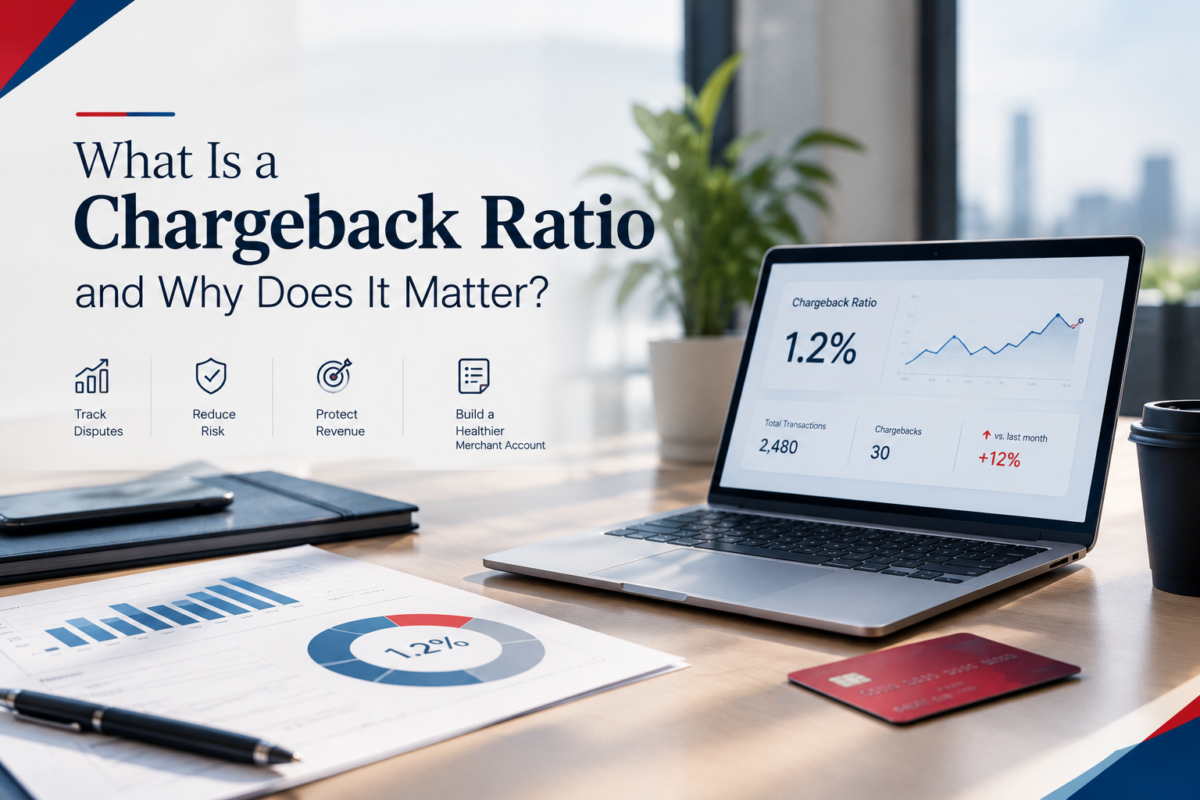
A business can receive a few chargebacks without having a serious payment problem. But when disputes start increasing compared with the number of transactions a merchant processes, payment providers may pay closer attention.
This is where the chargeback ratio comes in.
A chargeback ratio measures the level of chargebacks a merchant receives in relation to its sales or transactions during a particular period. It gives payment providers and merchants a way to see whether disputes are occasional or becoming a pattern.
Understanding the ratio is important because chargebacks can affect more than individual transactions. A consistently high level of disputes may lead to additional monitoring, higher costs, or problems with maintaining a merchant account, depending on the applicable rules and processing arrangement.
How Is a Chargeback Ratio Calculated?
At its simplest, a chargeback ratio compares the number of chargebacks with the number of transactions. For example, suppose a merchant processes 2,000 transactions in a month and receives 20 chargebacks. The basic calculation would be:
20 chargebacks ÷ 2,000 transactions × 100 = 1%
So the merchant’s chargeback ratio would be 1% under that calculation.
However, merchants should not assume that every provider calculates the ratio in exactly the same way. Card networks, processors, acquiring banks, and other payment arrangements can use different measurement methods, time periods, and definitions.
Some programs may also count transactions or chargebacks based on specific processing dates rather than simply looking at everything that happened during the same calendar month. That makes it important to understand the specific calculation used for a merchant’s payment setup.
Why Does the Chargeback Ratio Matter?
The ratio matters because the number of disputes needs to be viewed in context.
Ten chargebacks may sound significant. But ten chargebacks from 100,000 transactions represent a very different situation from ten chargebacks out of 500 transactions. A ratio provides that context.
It can also help a merchant identify a problem before the financial impact becomes much larger. A rising ratio may indicate issues with billing descriptions, fulfillment, customer service, fraud controls, or recurring payments.
These issues are closely connected to why customers file chargebacks. A merchant that understands the reason behind its disputes can address the underlying problem instead of simply responding to individual cases.
A High Ratio Can Attract Attention
Payment providers have an interest in merchants maintaining reasonable levels of dispute activity because excessive chargebacks can create financial and operational risk.
A merchant with consistently elevated dispute activity may face closer monitoring or other consequences under its payment agreement or applicable network program.
The exact thresholds and consequences vary. They can also change over time and differ by card network, region, merchant category, and processing arrangement. So it is risky to rely on a single number as a universal definition of a “safe” chargeback ratio. Instead, merchants should know which rules apply to their particular processing setup.
Chargeback Ratio vs. Number of Chargebacks
Looking only at the number of chargebacks can give a misleading picture. Consider two businesses:
- Business A: 25 chargebacks from 50,000 transactions
- Business B: 10 chargebacks from 500 transactions
Business A has more chargebacks in absolute terms. But Business B has a much higher proportion of disputed transactions. This is why merchants should monitor both the number of disputes and the percentage they represent.
The same principle applies when considering how much a chargeback costs a business. A merchant may focus on the dollar value of individual disputes while overlooking the fact that frequent disputes can create a separate business risk.
What Can Cause a Chargeback Ratio to Increase?
A rising ratio can have many causes. Sometimes the problem is fraud. Sometimes it has nothing to do with fraudulent activity. Common contributors include:
- Customers not recognizing the billing name on their card statement
- Products arriving late or not arriving
- Recurring subscriptions continuing after customers expected them to stop
- Customers receiving something different from what they expected
- Unauthorized transaction claims
- Poor customer-service response
- Duplicate charges
- Confusing refund or cancellation processes
For example, an online subscription business might see a sudden increase in disputes after changing its billing terms without making the new information clear to customers. The transactions may all be legitimate, but customers may still contact their banks instead of the merchant.
How Can Merchants Keep the Ratio Under Control?
The best approach is to look for patterns rather than treating every chargeback as an isolated event. A merchant should review the reason codes, transaction details, customer complaints, product information, and timing of disputes. This can reveal whether most chargebacks come from one particular product, payment method, subscription plan, or customer experience problem.
The same process can support broader chargeback prevention efforts. For example, if many disputes are caused by customers not recognizing a billing descriptor, improving statement information may reduce future disputes.
Merchants should also make sure their transaction and customer records are easy to retrieve. If a dispute occurs, having clear evidence can make the response process much easier. Understanding what happens when a customer files a chargeback is useful here because the merchant needs to know what information may be relevant when reviewing and responding to a dispute.
Chargeback Ratio and Merchant Account Risk
Chargeback activity can become particularly important when a merchant’s ratio remains elevated over time. A payment provider or acquiring institution may review the merchant’s business more closely. Depending on the circumstances, this could affect the terms under which the merchant processes payments.
This does not mean that one sudden chargeback automatically puts a merchant account at risk. Payment decisions generally depend on the broader situation, including dispute levels, transaction volume, business type, processing history, and the applicable rules. For this reason, merchants should treat the ratio as an early warning indicator rather than a simple pass-or-fail number.
What Should Merchants Track?
A useful chargeback monitoring process should look at more than the overall percentage. Merchants can track:
- Total chargebacks
- Chargeback ratio
- Transaction volume
- Chargeback reasons
- Disputed transaction value
- Products or services linked to frequent disputes
- Whether disputes are increasing or decreasing over time
It can also help to separate legitimate fraud from other causes. A business may discover that most of its disputes are not fraudulent transactions at all but customer confusion, fulfillment problems, or billing issues.
The Bottom Line
A chargeback ratio puts dispute activity into perspective. It shows how frequently chargebacks occur compared with the merchant’s transaction volume and can reveal problems that individual dispute counts may hide.
There is no single ratio that applies equally to every merchant or payment arrangement. The relevant calculation, monitoring period, thresholds, and consequences depend on the applicable card-network and processing rules.
For merchants, the practical goal is not simply to chase a particular percentage. It is to understand why disputes are happening, identify rising trends early, and reduce preventable chargebacks before they become a larger payment-processing problem. That makes the chargeback ratio useful not just as a number, but as a measure of the overall health of a merchant’s payment operations.

Categories
- ACH Payments (10)
- adult payment processing (11)
- AI (9)
- Altcoins (10)
- Banking (10)
- Bitcoin (133)
- Bitcoin ETF (11)
- Bitcoin Price (30)
- Blockchain (50)
- Brokering World Hunger Away (16)
- Business (17)
- card payment processing (10)
- CBD (11)
- CBDC (11)
- Chargeback (8)
- coaching business (11)
- COVID-19 (3)
- Crypto ATMs (1)
- Crypto Banking (17)
- Crypto Bill (1)
- Crypto business owner platform (31)
- Crypto Investment (3)
- Crypto Markets (5)
- Crypto Payment (35)
- Crypto Payment Processor (4)
- Crypto Prices (1)
- Crypto Trading (92)
- Cryptocurrency (402)
- Cryptocurrency Exchange (108)
- Data Visualization (2)
- dating platforms (11)
- debt collection payment processing (10)
- Decentralized Finance (7)
- DeFi Payment (9)
- DEX (3)
- Digital Currency (23)
- dropshipping payment processing (12)
- Ethereum (2)
- FAQ (7)
- file sharing payment processing (11)
- Finance (25)
- Financial Equality (4)
- Financial Freedom (8)
- Forex (35)
- hemp (1)
- ICO (2)
- Investment (11)
- IPTV (11)
- Merchant Account (10)
- Mining (3)
- News (66)
- NFTs (2)
- online gambling (11)
- P2P (1)
- Paybito (139)
- PayBitoPro (693)
- PayBitoPro Coin Listing (6)
- PayBitoPro Exchange (2)
- Payment Gateway (40)
- peptide (10)
- Post COVID Digital Transformation (1)
- Press Release (130)
- Privacy & Security (3)
- Real Estate (1)
- Stablecoin (5)
- Technology (15)
- Travel (11)
- Uncategorized (9)
- US Presidential Election (2)
- Utility Coin (1)
- Web3 business (4)
- Web3 Wallets (2)
- White Label Crypto Exchange (8)