Organizing the World’s Value – Why the Future of the Digital Economy Needs an Operating System?
- July 9, 2026
- Soham Guchait
The Digital Economy’s Missing Layer
The digital economy has transformed how the world creates value.
Entrepreneurs launch businesses, developers build applications, merchants sell products, investors fund innovation, creators grow communities, and customers exchange billions of dollars through digital platforms. More value is created today than at any point in human history.
Yet while the creation of value has accelerated, the systems responsible for managing it have become increasingly fragmented.
A business may launch its website on one platform, sell products through another, accept payments through a third, deposit revenue into a bank, invest idle capital elsewhere, raise funds on a separate platform, manage digital assets in another application, and engage customers through multiple social networks. Developers spend countless hours integrating these disconnected systems, while businesses struggle to move information — and value — between them.
Each platform solves an individual problem. Very few understand the complete journey of value.
But value was never meant to exist in isolation.
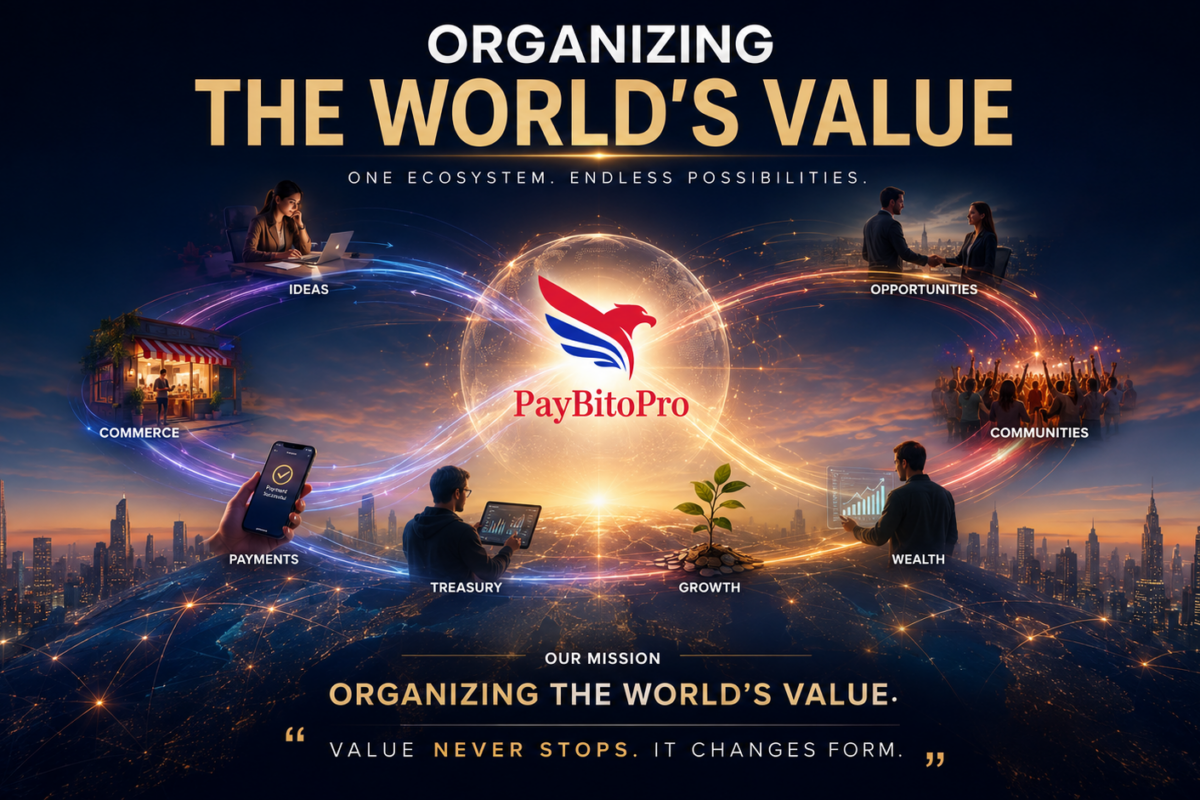
A payment is not the end of a transaction; it is the beginning of treasury. Treasury creates opportunities to earn yield or finance growth. Growth requires capital. Capital becomes assets. Assets generate wealth. Wealth strengthens communities. Communities create commerce. Commerce generates new payments. Every stage feeds the next.
Value is constantly moving, transforming, and compounding.
The future of the digital economy will not be defined by individual financial products. It will be defined by platforms that understand how value flows across its entire lifecycle.
This is the philosophy behind PayBito.
Our mission is simple:
Organizing the World’s Value.
To us, this means building the infrastructure that connects stages of economic activities — from launching a business and accepting payments to managing treasury, earning yield, accessing capital, investing in assets, building communities, enabling commerce, and empowering developers and AI to create entirely new economic experiences.
Rather than forcing businesses to assemble dozens of disconnected tools, PayBito brings these capabilities together within one programmable ecosystem where value never becomes trapped. It continues to move, evolve, and create new opportunities.
Because the future of the digital economy is not about managing transactions.
It is about organizing value.
Value Never Stops. It Changes Form.
Most people think of value as a destination.
A customer completes a purchase.
A merchant receives a payment.
An investor acquires an asset.
A loan is approved.
A trade is settled.
The transaction is complete.
But in reality, nothing has ended. Value has simply changed form.
A dollar received by a business immediately creates new possibilities. It can remain idle, earn yield, finance operations, repay debt, purchase inventory, fund expansion, or become the foundation for the next investment. Assets can generate income, appreciate in value, be tokenized to unlock liquidity, or become collateral for future growth. Communities create trust, trust creates commerce, commerce generates revenue, and that revenue fuels the next stage of innovation.
The digital economy is not a collection of isolated transactions. It is a continuous cycle of transformation.
An entrepreneur starts with an idea.
The idea becomes a business.
The business creates products and services.
Customers discover those products through communities and digital channels.
Commerce generates payments.
Payments become treasury.
Treasury becomes working capital.
Working capital earns yield or funds expansion.
Growing businesses raise additional capital through lending or tokenization.
Capital is invested into assets.
Assets generate wealth.
Wealth strengthens communities.
Communities create new commerce.
The cycle begins again.
Every stage creates value.
Every stage depends on the one before it.
Every stage becomes the foundation for the next.
Yet today’s digital infrastructure forces businesses to manage each stage independently. Payments, banking, lending, investing, tokenization, community engagement, commerce, and software development exist on separate platforms, connected only through manual processes and fragmented integrations.
The result is an economy where value constantly moves — but the systems supporting it remain disconnected.
The future belongs to platforms that understand value not as individual transactions, but as a continuous lifecycle.
Because value never stops.
It simply changes form.
The Problem: The World’s Value Is Fragmented
If value naturally flows from one stage to the next, why do businesses struggle to capture its full potential?
Because the infrastructure supporting the digital economy was never designed to manage the complete lifecycle of value.
Instead, it evolved as a collection of specialized products, each solving a single problem exceptionally well, but rarely communicating with the others.
A business may launch an online store on one platform, process payments through another, deposit funds into a bank, move surplus cash into an investment account, apply for financing from a lender, raise capital through an entirely different marketplace, engage customers on multiple social networks, and manage digital assets through separate wallets and exchanges.
Each platform creates its own data, its own identity, manages its own balances, and requires its own integrations. The business becomes the bridge between systems that were never designed to work together.
As value moves from commerce to payments, from payments to treasury, from treasury to investment, and from investment back into growth, it repeatedly crosses technological and organizational boundaries. Transitions introduce friction.
Revenue sits idle while businesses search for investment opportunities. Customer relationships remain disconnected from financial activity. Communities generate engagement but cannot seamlessly create commerce. Capital raising requires businesses to leave the platforms where they already operate.
Developers spend months building integrations instead of creating innovation.
AI systems can analyze information but cannot reliably execute financial workflows across fragmented infrastructure.
The problem is no longer a lack of digital tools.
The problem is that tools manage only a fragment of the economic journey.
Imagine if the Internet required a different browser for each website.
Or if email providers could communicate only with users on the same platform.
That is how much of today’s digital economy still operates.
Businesses are forced to move value between disconnected systems instead of allowing value to flow naturally through a connected ecosystem.
The next generation of financial infrastructure will not be built by adding yet another payment gateway, another commerce platform, or another financial application. It will be built by connecting stages of the value lifecycle into one programmable system where payments become treasury, treasury becomes capital, capital becomes investment, investment creates wealth, and wealth continually generates new opportunities.
The future of the digital economy depends not on creating more platforms. It depends on connecting value itself.
The PayBito Platform: Organizing the Lifecycle
If value is constantly transforming, the infrastructure supporting it must do more than process individual transactions.
It must understand how value moves.
Traditional financial platforms are built around products. One platform processes payments. Another manages the treasury. A third provides lending. Others handle investing, commerce, community engagement, or digital assets.
Each performs its own function efficiently. None of them understand the complete lifecycle of value.
PayBito was built on a different philosophy.
Instead of optimizing individual financial services, PayBito organizes how value moves across the digital economy. The platform is designed around a simple principle:
Every stage of value should naturally become the beginning of the next.
When a merchant receives a payment, that value should not stop at settlement. It should immediately become part of the business’s treasury, where it can remain available for operations, earn interest, or support future growth.
As the business expands, working capital should flow seamlessly into financing opportunities. Businesses should be able to access loans, raise capital through compliant real-world asset tokenization, or unlock liquidity from assets they already own — all without leaving the ecosystem where their value already exists.
As wealth accumulates, businesses and individuals should be able to actively manage diversified portfolios, trade digital assets, participate in new investment opportunities, and continuously optimize how capital is deployed.
Growth is not driven by financial services alone. Businesses grow because customers become communities.
Through BitoCircle, relationships evolve beyond individual transactions. Businesses engage directly with customers, creators build audiences, merchants launch stores, communities recommend products, and people exchange value socially. Commerce becomes a natural extension of trusted relationships rather than a separate destination.
Throughout this journey, value moves through a unified transactional layer, allowing businesses and individuals to transact seamlessly across the ecosystem instead of transferring value between disconnected financial platforms.
The platform itself remains open.
All major capabilities — payments, commerce, treasury, lending, tokenization, trading, identity, community, settlement, and business operations — are exposed through programmable APIs with native Model Context Protocol (MCP) support. Developers can build entirely new financial applications on top of PayBito, while AI systems can discover, understand, and execute platform capabilities without custom integrations.
Payments
Assets
Customers
Communities
Businesses
Applications
AI agents
They all become participants in the same economic ecosystem.
It is not a collection of financial products connected through integrations.
It is a programmable economic infrastructure where value is continuously created, exchanged, invested, expanded, and reinvested without leaving the platform.
Because organizing the world’s value is not about connecting software.
It is about connecting stages of the economic journey.
The Unified Transaction Layer: BitoDollar
Economies depend on a common medium through which value can move efficiently.
In the physical world, currencies enable commerce between individuals, businesses, and institutions. In the digital economy, where payments, commerce, investments, communities, and programmable applications increasingly interact with one another, the need for a unified transaction layer becomes even more important.
Without a common transactional framework, value becomes fragmented as it moves between different systems. Businesses reconcile multiple payment methods, applications maintain separate balances, and developers spend significant effort translating value from one platform to another.
BitoDollars provide the unified transaction layer that connects economic activity across the PayBito ecosystem.
Rather than viewing a payment, transfer, purchase, reward, or settlement as an isolated event, BitoDollars allow value to remain within a continuous economic flow. Whether a customer purchases a product, a merchant receives payment, a business rewards its community, a creator earns revenue, or an application settles transactions between participants, movement of value becomes part of the same connected infrastructure.
This creates a simpler and more efficient digital economy.
A merchant can accept payments and immediately use the same value to pay suppliers, compensate partners, reward customers, or invest in new opportunities.
A business can launch a social commerce campaign through BitoCircle, receive payments, distribute incentives, and reinvest revenue without constantly moving funds between disconnected platforms.
Developers building on PayBito can design applications around a single transactional model instead of supporting multiple proprietary systems, allowing innovation to focus on creating new experiences rather than managing financial complexity.
As AI agents become active participants in the economy, a unified transaction layer becomes even more valuable. Intelligent applications can execute payments, settle transactions, allocate capital, and coordinate financial workflows using a consistent economic model instead of navigating fragmented financial infrastructure.
The importance of BitoDollars is therefore not simply that they facilitate transactions.
Their significance lies in enabling value to move seamlessly across stages of the digital economy.
Communities Create Economic Value
Economies are built on relationships.
People buy from businesses they trust. Investors fund entrepreneurs they believe in. Communities recommend products they value. Developers contribute to platforms they want to see succeed.
Long before a payment is made or an investment is completed, value begins with trust.
Yet in today’s digital economy, communities and commerce often exist in separate worlds. Businesses build audiences on one platform, sell products on another, process payments somewhere else, and manage customer relationships through entirely different systems. Disconnected platforms weaken the relationship between engagement and economic activity.
PayBito approaches communities differently.
BitoCircle is not designed as another social network. It is designed as an economic network where people, businesses, creators, developers, and investors participate in the same ecosystem.
Conversations naturally lead to commerce. Communities discover products. Businesses launch stores. Creators recommend services. Customers purchase directly within the community.
People send and receive value as easily as they exchange ideas. Interactions have the potential to become economic activity. For businesses, this fundamentally changes how growth occurs.
Instead of treating marketing, commerce, payments, and customer engagement as independent functions, they become part of one continuous experience.
Within the PayBito ecosystem, BitoCircle transforms communities from communication platforms into engines of economic growth, ensuring that relationships do not end with conversations but continue through commerce, collaboration, and shared prosperity.
Because in the digital economy, communities do far more than connect people.
They create value.
Developers, MCP & AI: Making the Economy Programmable
All major technological shifts have been accelerated by developers. The Internet expanded because developers built websites and applications. Cloud computing transformed software because developers could build without managing infrastructure. Mobile platforms created entirely new industries because developers extended the capabilities of smartphones through applications.
The next transformation will be driven by developers — and increasingly by AI.
But unlike previous generations of software, the future is not simply about building applications. It is about building economic systems.
Payment workflow, merchant experience, lending platform, investment strategy, marketplace, escrow service, and digital business ultimately depends on programmable financial infrastructure. The easier that infrastructure is to build upon, the faster innovation accelerates.
PayBito was designed with this principle from the beginning.
Major capabilities within the platform are exposed through programmable APIs.
Payments.
Commerce.
Treasury.
Interest-earning accounts.
Business lending.
Tokenization.
Trading.
Asset management.
Identity.
Escrow.
Community.
Settlement.
These are not isolated services on PayBito. They are programmable economic building blocks that developers can combine to create entirely new products, industries, and business models.
The introduction of the Model Context Protocol (MCP) extends this vision even further. Traditionally, APIs were designed to be consumed by software engineers writing custom code. MCP makes those capabilities discoverable and executable by intelligent systems.
Large language models and AI agents can understand what the platform is capable of, determine which economic actions are required, and execute them through a standardized interface.
On PayBito, an AI agent can launch a
Merchant account.
Create products.
Generate a storefront.
Accept payments.
Manage treasury.
Earn yield on idle balances.
Apply for financing.
Tokenize real-world assets.
Manage an investment portfolio.
Launch a community.
Execute commerce.
All by orchestrating the programmable capabilities of the PayBito platform.
This fundamentally changes the role of software. Applications are no longer limited to the features originally designed by the platform itself. Developers become architects of entirely new economic experiences.
AI becomes an active participant in the economy rather than simply an observer.
Innovation no longer depends solely on what PayBito builds. It expands through developers, entrepreneurs, businesses, and AI systems that extends the platform in ways never imagined by its original creators.
This is how economic infrastructure evolves into an ecosystem. Not by adding more products. But by enabling others to create new forms of value on top of a shared foundation.
When economic capabilities become programmable, innovation is no longer constrained by software. The digital economy itself becomes programmable.
The Operating System for the Digital Economy
Every generation builds the infrastructure that defines the next era of human progress.
Roads connected cities.
Electricity powered industry.
The Internet connected information.
Cloud computing made software universally accessible.
Artificial intelligence is transforming how decisions are made.
The next generation of infrastructure will organize how value moves.
The digital economy can no longer depend on disconnected financial products that solve individual problems while remaining isolated from one another. Businesses should not have to assemble dozens of platforms simply to launch a company, accept payments, manage treasury, access capital, build communities, invest in assets, and create new opportunities.
The future belongs to connected economic systems. An operating system where businesses create value, individuals grow wealth, communities generate opportunity, developers build new industries, and AI participates as a first-class economic actor.
Because the future of the digital economy will not be defined by the number of financial products we create. It will be defined by how seamlessly value moves between them. By connecting stages of its lifecycle, so that value can continuously create more value.
It is the foundation upon which the next generation of businesses, developers, communities, and intelligent systems will build the digital economy.
Organizing the World’s Value.
The Operating System for the Digital Economy.

Categories
- AI (9)
- Altcoins (10)
- Banking (11)
- Bitcoin (134)
- Bitcoin ETF (11)
- Bitcoin Price (30)
- Blockchain (50)
- Brokering World Hunger Away (16)
- Business (13)
- CBDC (11)
- COVID-19 (3)
- Crypto ATMs (1)
- Crypto Banking (18)
- Crypto Bill (1)
- Crypto business owner platform (31)
- Crypto Investment (3)
- Crypto Markets (5)
- Crypto Payment (37)
- Crypto Payment Processor (4)
- Crypto Prices (1)
- Crypto Trading (92)
- Cryptocurrency (402)
- Cryptocurrency Exchange (108)
- Data Visualization (2)
- Decentralized Finance (7)
- DeFi Payment (9)
- DEX (3)
- Digital Currency (23)
- Ethereum (2)
- FAQ (7)
- Finance (29)
- Financial Equality (4)
- Financial Freedom (8)
- Forex (25)
- ICO (2)
- Investment (11)
- Mining (3)
- News (66)
- NFTs (2)
- P2P (1)
- PayBitoPro (698)
- PayBitoPro Coin Listing (6)
- PayBitoPro Exchange (2)
- Payment Gateway (22)
- Post COVID Digital Transformation (1)
- Press Release (130)
- Privacy & Security (3)
- Real Estate (1)
- Stablecoin (6)
- Technology (16)
- Uncategorized (3)
- US Presidential Election (2)
- Utility Coin (1)
- Web3 business (4)
- Web3 Wallets (2)
- White Label Crypto Exchange (8)
Recent Posts
- Organizing the World’s Value – Why the Future of the Digital Economy Needs an Operating System?
- Why Chargebacks Are a Major Threat to Forex Brokers?
- From Dream Vacation to Abandoned Cart: The Payment Mistakes That Drive Travelers Away in 2026
- The Gamer’s Regret: Why Video Game Studios Are Labeled “High-Risk”
- Why Businesses Get Labeled “High-Risk” – And Why Most Merchants Don’t Understand the Payment Industry’s Hidden Risk Model