The Gamer’s Regret: Why Video Game Studios Are Labeled “High-Risk”
- June 17, 2026
- Soham Guchait
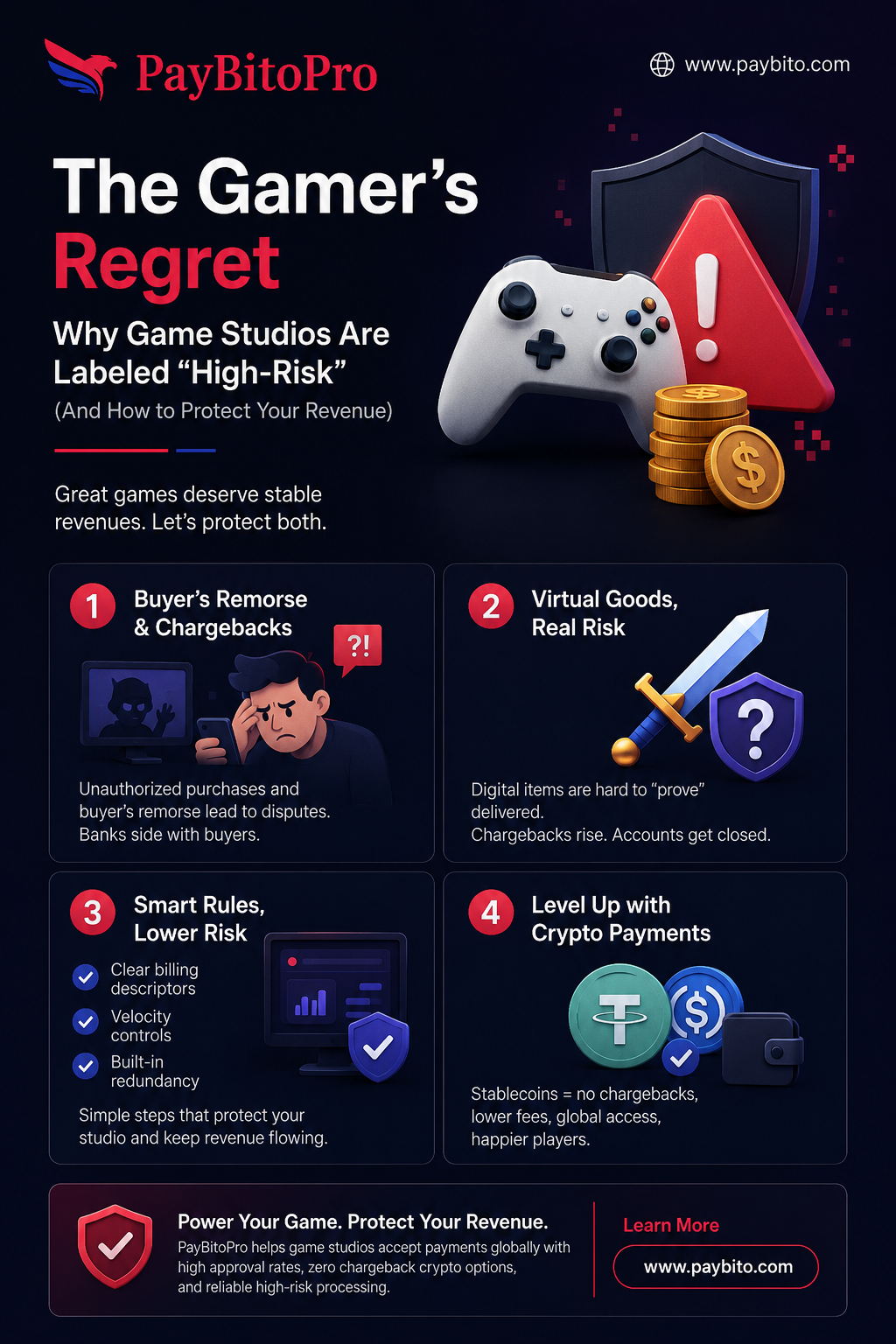
The global gaming industry is an absolute powerhouse, outpacing the film and music industries combined. Yet, behind the scenes of every successful indie title, multiplayer ecosystem, or casual mobile game lies a frustrating reality that players never see. Game developers spend months or years pouring their hearts into building immersive worlds, only to discover that traditional banks treat their businesses like financial hazards.
When a game studio tries to set up standard credit card processing, they are frequently met with outright rejections, exorbitant processing fees, or unexpected cash holds that can paralyze daily operations.
To traditional financial institutions, video game companies are categorized as a high-risk business. This post tears down the structural reasons why banks treat gaming merchants with such deep suspicion, and provides practical, everyday steps studios can take to protect their hard-earned cash flow.
1. “Buyer’s Remorse” and the Multi-Million Dollar Parent Trap
The primary reason banks keep gaming companies on a short leash comes down to consumer behavior – specifically, the high frequency of disputed transactions. In the gaming and gaming payment processing world, two unique phenomena drive up a studio’s chargeback exposure far beyond the averages seen in standard retail.
The first is what industry insiders call the “Parent Trap.” A child gains access to a parent’s smartphone or console account and makes a repetitive, unauthorized in-game purchase—buying cosmetic packs or loading up on premium in-game currency to unlock new characters. When the parent reviews their bank statement at the end of the month, they don’t see a fun family activity; they see hundreds of dollars in mysterious charges. Instead of reaching out to the game studio’s support desk for a refund, they call their credit card issuer and report the transactions as fraudulent.
The second issue is pure buyer’s remorse masquerading as “Friendly Fraud.” A player purchases Downloadable Content (DLC) or structural game upgrades, plays with them for a weekend, realizes they don’t actually like the mechanics, or simply loses a high-stakes match. Instead of accepting the loss, the player files a dispute with their bank, claiming they never authorized the purchase or that their account was hacked. Because traditional credit card companies often favor the cardholder during disputes, excessive chargebacks can place merchants into monitoring programs that may lead to higher processing fees, account restrictions, or even account termination. Learn more about how chargeback monitoring programs impact merchants through the Visa Merchant Chargeback Monitoring Programs. As a result, game studios not only lose the revenue from the original sale but may also incur chargeback penalty fees, which typically range from $15 to $50 per dispute.
2. The Virtual Goods Dilemma: Selling Items That Don’t “Exist”
Traditional banking infrastructure was built in an era of brick-and-mortar storefronts and physical shipping containers. When a dispute occurs in a traditional e-commerce business, the merchant can easily defend themselves by presenting a FedEx tracking number, a signed delivery slip, or a physical customs declaration form to prove the item safely reached the buyer.
In online gaming payment processing, you are selling virtual goods – digital swords, character skins, map unlocks, or ongoing game subscriptions.
When a consumer claims they never received a digital item, presenting internal server database logs to a traditional bank analyst rarely works. Old-school payment networks struggle to verify digital item fulfillment to their strict regulatory satisfaction. Because it is notoriously difficult to “prove” the delivery of a pixel to a legacy bank, banks default to issuing a chargeback against the studio. When these unresolvable disputes cross a strict 1% threshold of total monthly transaction volume, mainstream processors will abruptly close the merchant account, forcing developers to scramble to find specialist high-risk merchant account providers just to keep their store active.
3. Turning Off the Fraud Faucet: Simple Rules for Game Devs
While you cannot entirely eliminate player behavior, you can structurally redesign your store workflows to minimize fraud and keep traditional gaming payment processing networks happy.
The “Clear Statement” Fix
Most game studios operate under a corporate parent entity or an obscure holding company LLC. If a parent buys a battle pass for their kid in a game called “Galaxy Legends,” but the line item on their credit card statement reads “Alpha-Beta Holdings LLC,” they will flag it as fraud instantly. Always ensure your merchant billing descriptor matches the exact, highly recognizable name of the game or the specific game storefront the player interacts with.
Implement Velocity and Friction Gates
Fraudsters love automated scripts that rapidly test stolen credit cards on microtransactions. Protect your payment flow by setting strict velocity triggers: if an account attempts to purchase in-game currency three times within a five-minute window, trigger a temporary freeze or force a mandatory multi-factor authentication (SMS or email verification) gate before letting the transaction clear.
Build Redundancy into Your Infrastructure
Relying on a single payment processor is an existential risk for any studio. If your sole provider decides to suddenly alter its industry risk policy or temporarily freezes your funds during a high-traffic game launch, your incoming revenue drops to zero instantly. True operational safety requires utilizing a stable high-risk payment processing platform capable of managing rolling volume limits, handling fluctuating high-risk transaction traffic, and offering backup routing paths to keep your checkout lane online 100% of the time.
4. Leveling Up with Alternative Payments (Web3 and Digital Cash)
To truly defeat the chargeback problem, modern game studios are increasingly stepping outside the boundaries of traditional credit card networks. The most effective way to eliminate payment disputes is to offer a parallel checkout option that lacks a “chargeback button” entirely: digital wallets and stablecoin processing.
By integrating stablecoins (like USDT or USDC) as an optional payment method at checkout, studios can leverage push-based payment mechanics. Unlike a credit card transaction – where a processor pulls money from a customer’s account and leaves the door open for a clawback later – a cryptocurrency transaction requires the player to explicitly authorize and push the funds directly from their digital wallet to the studio.
The Immutability Advantage
Once a crypto transaction is confirmed on the blockchain, it is mathematically permanent and completely irreversible. There is no middleman or bank that can retroactively force a refund or hit your studio with a penalty fee.
Offering digital cash lanes completely rebalances the relationship between the player and the developer. If a player experiences a legitimate issue with an in-game purchase, they must contact your studio’s customer support desk directly to negotiate a resolution, rather than using an automated bank dispute as a weapon.
Transitioning your monetization architecture to a specialized gaming payment processing infrastructure allows you to safely blend traditional card lanes with these zero-chargeback alternative payment methods. This hybrid approach insulates your cash flow from predatory holds, gives international players without local credit cards a frictionless way to participate in your virtual economy, and frees up your development team to focus entirely on what they do best: building incredible gaming experiences.

Categories
- AI (9)
- Altcoins (10)
- Banking (11)
- Bitcoin (134)
- Bitcoin ETF (11)
- Bitcoin Price (30)
- Blockchain (50)
- Brokering World Hunger Away (16)
- Business (13)
- CBDC (11)
- COVID-19 (3)
- Crypto ATMs (1)
- Crypto Banking (18)
- Crypto Bill (1)
- Crypto business owner platform (31)
- Crypto Investment (3)
- Crypto Markets (5)
- Crypto Payment (37)
- Crypto Payment Processor (4)
- Crypto Prices (1)
- Crypto Trading (92)
- Cryptocurrency (402)
- Cryptocurrency Exchange (108)
- Data Visualization (2)
- Decentralized Finance (7)
- DeFi Payment (9)
- DEX (3)
- Digital Currency (23)
- Ethereum (2)
- FAQ (7)
- Finance (29)
- Financial Equality (4)
- Financial Freedom (8)
- Forex (25)
- ICO (2)
- Investment (11)
- Mining (3)
- News (66)
- NFTs (2)
- P2P (1)
- PayBitoPro (697)
- PayBitoPro Coin Listing (6)
- PayBitoPro Exchange (2)
- Payment Gateway (22)
- Post COVID Digital Transformation (1)
- Press Release (130)
- Privacy & Security (3)
- Real Estate (1)
- Stablecoin (6)
- Technology (16)
- Uncategorized (3)
- US Presidential Election (2)
- Utility Coin (1)
- Web3 business (4)
- Web3 Wallets (2)
- White Label Crypto Exchange (8)
Recent Posts
- Why Chargebacks Are a Major Threat to Forex Brokers?
- From Dream Vacation to Abandoned Cart: The Payment Mistakes That Drive Travelers Away in 2026
- The Gamer’s Regret: Why Video Game Studios Are Labeled “High-Risk”
- Why Businesses Get Labeled “High-Risk” – And Why Most Merchants Don’t Understand the Payment Industry’s Hidden Risk Model
- The High-Risk Merchant Survival Map: Navigating Payment Challenges in a Complex Digital Economy