What Are ACH Payments? A Complete Guide to ACH Transfers
- August 19, 2026
- Soham Guchait
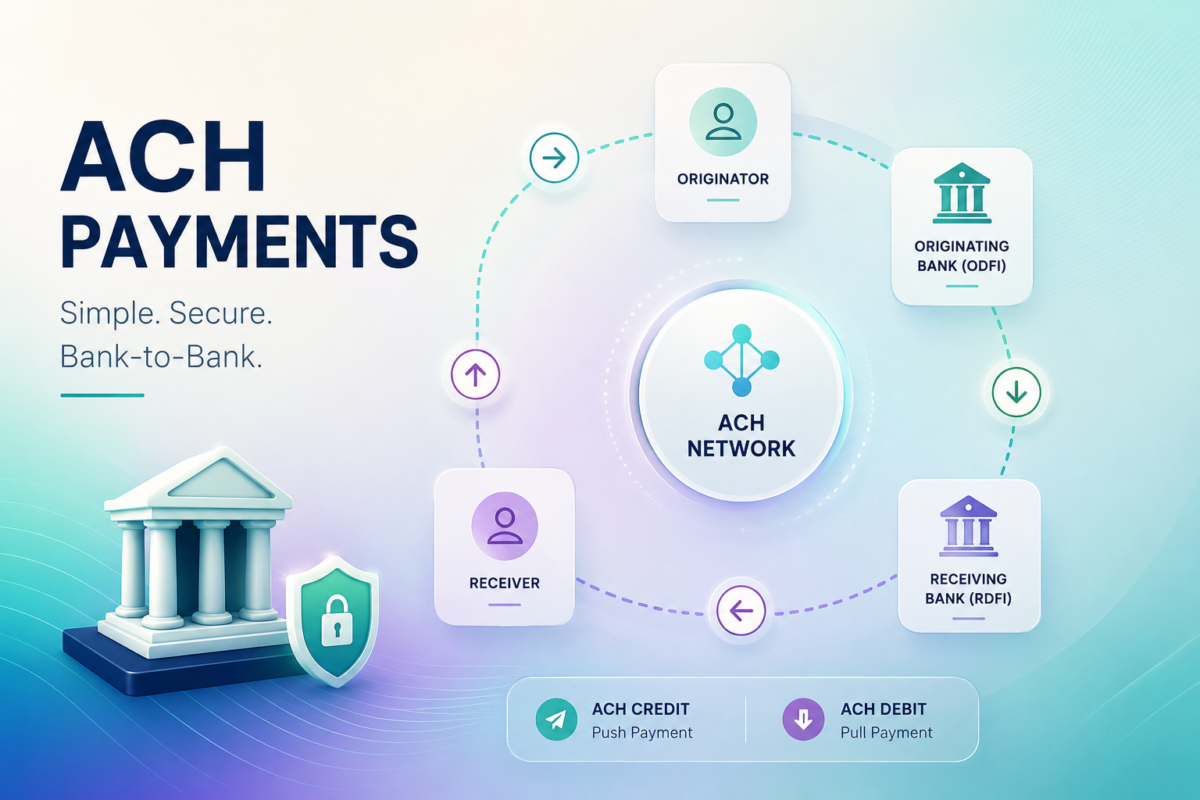
If you have ever seen “ACH payment” on a bank statement, payroll record, bill, or payment form, you may have wondered what it means. ACH payments are electronic bank-to-bank payments processed through the Automated Clearing House (ACH) network in the United States. They allow money to move between bank accounts without using a card network.
ACH is commonly used for payroll, recurring subscriptions, utility bills, insurance payments, B2B invoices, and other account-to-account transactions. For businesses, understanding how ACH works can help with payment decisions, cash-flow planning, reconciliation, and customer payment options.
But ACH is more than simply “sending money from one bank account to another.” It operates through a defined network involving financial institutions, payment instructions, processing windows, authorization requirements, and rules for handling transactions that cannot be completed.
What Are ACH Payments?
ACH payments are electronic transactions that move money between bank accounts through the Automated Clearing House network. Unlike card payments, ACH transactions generally do not use card networks. Instead, payment instructions are exchanged through the ACH system between participating financial institutions.
There are two basic types:
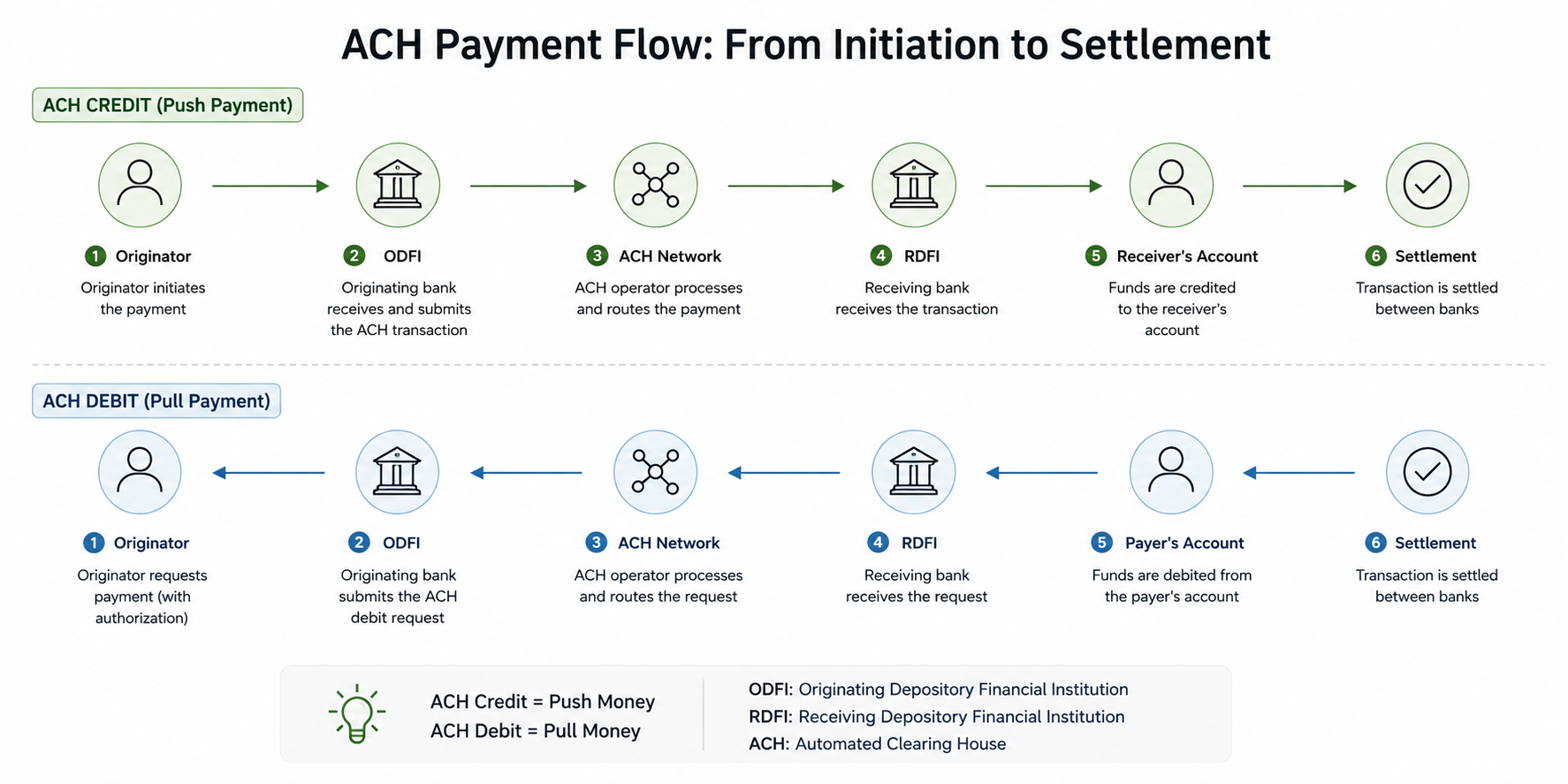
- ACH credit: Money is pushed into another bank account.
- ACH debit: Money is pulled from a bank account after appropriate authorization.
For example, an employer sending an employee’s wages to their checking account may use an ACH credit. A customer authorizing a utility company to collect a monthly bill from their bank account may use an ACH debit.
The distinction between these two transaction types becomes important when understanding how ACH payments are initiated and processed.
How Does the ACH Network Work?
Several participants can be involved in an ACH transaction.
- Originator: The person or business initiating the payment.
- Originating Depository Financial Institution (ODFI): The financial institution that submits the ACH transaction into the network on behalf of the originator.
- ACH Operator: A central processing intermediary that routes ACH transactions between participating financial institutions.
- Receiving Depository Financial Institution (RDFI): The financial institution receiving the transaction for the recipient.
- Receiver: The person or business whose account is ultimately credited or debited.
From the customer’s perspective, an ACH payment can seem straightforward: Money leaves one account and reaches another. Behind that simple result, however, payment information has to move through the appropriate financial institutions and ACH processing infrastructure. Understanding what happens between the payment request and the final account entry provides a clearer picture of why ACH payments have specific processing and settlement steps.
ACH Credit vs. ACH Debit
The easiest way to distinguish ACH credits from ACH debits is to think about the direction of the payment.
ACH Credit
An ACH credit pushes money into an account. A business might use an ACH credit to:
- Pay employees
- Pay a supplier
- Send a vendor payment
- Make certain tax payments
- Distribute funds to another account
For example, when an employer deposits an employee’s wages electronically, the employer initiates the payment and the employee’s bank account receives the funds.
ACH Debit
An ACH debit pulls money from an account after the required authorization has been obtained. Common examples include:
- Utility payments
- Mortgage payments
- Insurance premiums
- Loan payments
- Subscription charges
- Customer invoice collections
Imagine a SaaS company collecting a hypothetical $200 monthly subscription. If its customer authorizes recurring bank-account payments, the company could use ACH debit to collect the payment rather than requiring the customer to initiate each transaction manually.
A simple rule is:
ACH Credit = Push Money. ACH Debit = Pull Money.
The distinction can affect authorization, payment workflows, and how businesses manage recurring collections.
Where Are ACH Payments Commonly Used?
ACH is particularly useful for payments where direct movement between bank accounts makes sense.
Payroll
Businesses can use ACH credits to deposit employee wages electronically. This avoids requiring employees to receive a physical check for every pay period.
Recurring Payments
Subscription companies, service providers, insurers, and other businesses may use authorized ACH debits for recurring payments.
B2B Payments
ACH can also support business invoices and vendor payments. A company may send an ACH credit to a supplier after an invoice has been approved.
Bills and Scheduled Payments
Consumers and businesses may encounter ACH when paying utilities, loans, insurance premiums, memberships, and other recurring obligations.
The fact that ACH is suitable for one use case does not automatically make it the right choice for another. Payment value, customer preferences, timing requirements, authorization, and operational processes all matter.
How Long Do ACH Payments Take?
There is no single processing time that applies to every ACH transaction. Timing can depend on:
- When the transaction is submitted?
- Processing windows
- Banking days
- Holidays
- Transaction type
- The receiving financial institution
- Whether the transaction qualifies for Same Day ACH?
Same Day ACH provides a way for eligible transactions to be processed and settled on the same business day under applicable processing windows and rules. It does not mean that every ACH transaction is immediate.
For businesses, this makes it important to consider submission cutoffs and settlement schedules when planning around incoming or outgoing payments. These variables are why how long an ACH payment takes cannot always be answered with one fixed number.
What Are the Benefits of ACH Payments?
ACH can offer several advantages for certain businesses and payment situations.
Bank-Account-Based Payments
ACH allows businesses to accept or send payments directly through bank accounts rather than relying on card credentials.
Recurring Payment Support
Businesses with recurring billing models may find ACH useful for scheduled collections, provided the necessary authorization and operational processes are in place.
Potential Cost Advantages
ACH pricing varies by provider, business model, transaction volume, and pricing structure. For some businesses, bank-account payments may offer cost advantages compared with other payment methods. However, there is no universal ACH price. Businesses should consider per-transaction fees, monthly charges, return fees, and other applicable costs when evaluating the economics.
B2B Payment Use Cases
ACH can be practical for invoices, vendor payments, and other business transactions where direct bank-account movement is appropriate.
What Are the Limitations of ACH?
ACH is not automatically better than cards, wires, or other payment methods.
One consideration is timing. Businesses with transactions that require immediate payment confirmation may need to evaluate whether ACH fits their requirements.
Authorization is another consideration, particularly for ACH debits and recurring payments. Businesses need appropriate processes for obtaining and maintaining authorization.
ACH transactions can also be returned. A transaction might fail because of insufficient funds, incorrect account information, or another condition covered by the applicable ACH rules. A returned ACH payment can have several different causes, and what a business should do next depends on the reason for the return.
Finally, ACH requires attention to reconciliation. Finance teams need to match payments with customers, invoices, vendors, payroll records, or other accounting information.
Are ACH Payments Safe?
ACH payments use established banking infrastructure and network rules, but no electronic payment method is completely risk-free. Businesses handling ACH payments should pay attention to:
- Verifying bank-account information
- Collecting valid payment authorization
- Limiting access to sensitive banking information
- Monitoring unusual transactions
- Maintaining accurate payment records
- Reconciling transactions regularly
- Establishing procedures for returned transactions
Bank-account payment security also requires controls against unauthorized activity. Strong authorization, account verification, transaction monitoring, and other operational controls can help reduce ACH fraud risk.
ACH Payments vs. Credit Cards
Credit cards and ACH both allow businesses to accept electronic payments, but they operate through different infrastructures. ACH uses bank accounts and the ACH network. Credit card payments use card accounts and card payment networks. The better option depends on factors such as:
- Transaction size
- Customer preferences
- Payment frequency
- Processing costs
- Settlement requirements
- Fraud considerations
- Recurring-payment needs
- Checkout experience
For example, a recurring B2B payment may have different requirements from a low-value consumer purchase where speed and convenience are the primary considerations. Businesses therefore should compare payment methods based on their actual use cases rather than assuming one method is universally superior.
Frequently Asked Questions
Is an ACH payment the same as a bank transfer?
Not necessarily. ACH is a specific electronic payment network and processing system in the United States. “Bank transfer” is a broader term that can refer to different methods of moving money between accounts.
Is ACH a debit or a credit?
It can be either. An ACH credit pushes money into an account, while an ACH debit pulls money from an account after appropriate authorization.
Can businesses accept ACH payments?
Yes. Businesses can offer ACH as a payment method when they have an appropriate process for collecting payment information, obtaining authorization where required, and submitting transactions under applicable rules.
Are ACH payments instant?
No. ACH timing depends on factors such as transaction type, submission timing, processing windows, banking days, and whether Same Day ACH applies.
Can an ACH payment be returned?
Yes. ACH transactions can be returned for various reasons, including insufficient funds, incorrect account information, and other conditions recognized under ACH rules.
Conclusion
ACH payments provide a structured way to move money electronically between bank accounts in the United States. They support everyday business activities such as payroll, recurring subscriptions, customer collections, vendor payments, and bills.
For businesses, understanding ACH means looking beyond the basic idea of transferring money. The differences between ACH credit and debit, authorization requirements, processing and settlement timing, returns, reconciliation, and fraud controls all affect how the payment method works in practice.
ACH can be a useful payment option, but its suitability depends on the business model, transaction requirements, customer expectations, cost structure, and desired payment experience.

Categories
- ACH Payments (10)
- adult payment processing (11)
- AI (9)
- Altcoins (10)
- Banking (10)
- Bitcoin (133)
- Bitcoin ETF (11)
- Bitcoin Price (30)
- Blockchain (50)
- Brokering World Hunger Away (16)
- Business (17)
- card payment processing (10)
- CBD (11)
- CBDC (11)
- Chargeback (8)
- coaching business (11)
- COVID-19 (3)
- Crypto ATMs (1)
- Crypto Banking (17)
- Crypto Bill (1)
- Crypto business owner platform (31)
- Crypto Investment (3)
- Crypto Markets (5)
- Crypto Payment (35)
- Crypto Payment Processor (4)
- Crypto Prices (1)
- Crypto Trading (92)
- Cryptocurrency (402)
- Cryptocurrency Exchange (108)
- Data Visualization (2)
- dating platforms (11)
- debt collection payment processing (10)
- Decentralized Finance (7)
- DeFi Payment (9)
- DEX (3)
- Digital Currency (23)
- dropshipping payment processing (12)
- Ethereum (2)
- FAQ (7)
- file sharing payment processing (11)
- Finance (25)
- Financial Equality (4)
- Financial Freedom (8)
- Forex (35)
- hemp (1)
- ICO (2)
- Investment (11)
- IPTV (11)
- Merchant Account (10)
- Mining (3)
- News (66)
- NFTs (2)
- online gambling (11)
- P2P (1)
- Paybito (147)
- PayBitoPro (693)
- PayBitoPro Coin Listing (6)
- PayBitoPro Exchange (2)
- Payment Gateway (48)
- peptide (10)
- Post COVID Digital Transformation (1)
- Press Release (130)
- Privacy & Security (3)
- Real Estate (1)
- Stablecoin (5)
- Technology (15)
- Travel (11)
- Uncategorized (10)
- US Presidential Election (2)
- Utility Coin (1)
- Web3 business (4)
- Web3 Wallets (2)
- White Label Crypto Exchange (8)
Recent Posts
- Payment Gateway vs. Payment Orchestration: What’s the Difference?
- What Is Smart Payment Routing? Strategies to Optimize Payment Performance
- How to Improve Payment Approval Rates for High-Risk Businesses?
- Why Are Online Payments Failing? Common Causes and How to Fix Them
- How to Use Multiple Payment Processors to Reduce Business Disruptions?