ACH vs Wire Transfer: Which Payment Method Is Better for Businesses?
- August 19, 2026
- Soham Guchait
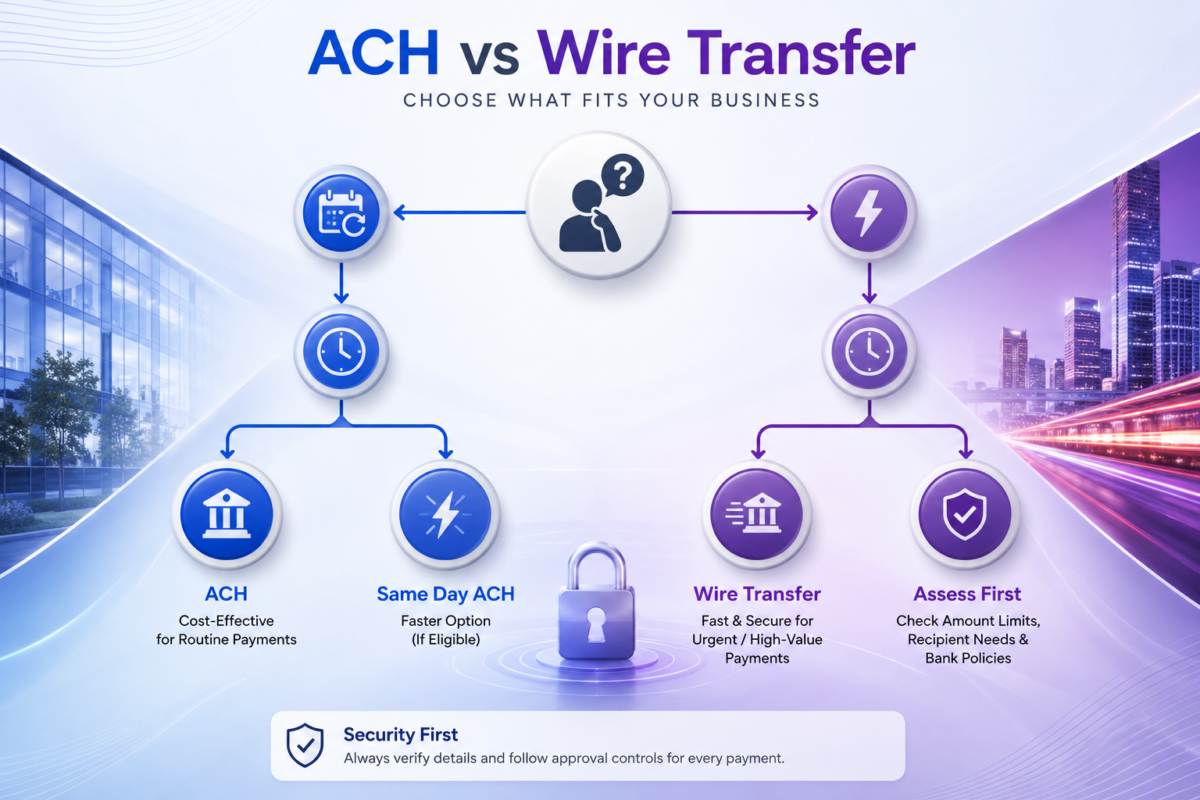
When a business needs to move a large amount of money, the choice often comes down to two familiar options: ACH vs Wire Transfer.
Both can move money electronically between bank accounts, but they are designed for different situations. ACH payments are often useful for routine business payments, recurring transactions, and domestic transfers where cost matters. Wire transfers are generally better suited to situations where speed, finality, or high-value transfers are more important.
The right choice depends on the amount being sent, how quickly the recipient needs the money, whether the payment is recurring, and how much the business is willing to pay for the transfer.
ACH vs Wire Transfer: What Is the Difference?
The simplest distinction is this:
ACH transfers are generally designed for efficient, lower-cost electronic payments that may be processed in batches or through established ACH processing windows. Wire transfers are designed for direct bank-to-bank movement of funds, typically with faster processing and higher fees.
For example, a company paying a supplier $5,000 every month may find ACH practical. A company closing a real-estate transaction may need a wire because the recipient requires a large payment to arrive quickly. The choice is therefore less about which payment method is “better” and more about which one fits the transaction.
ACH vs Wire Transfer: Speed
Speed is one of the biggest differences between ACH and wire transfers. ACH timing depends on factors such as:
- When the payment is submitted?
- Processing windows
- Banking days and holidays
- Transaction type
- Receiving institution
- Whether the transaction qualifies for Same Day ACH?
Wire transfers are generally used when the sender needs funds moved quickly, subject to the bank’s processing schedule and the type of wire involved.
Example
Imagine a business needs to pay a supplier $20,000.
If the supplier is willing to wait for normal ACH processing, ACH may be sufficient. But, if the supplier requires the funds urgently to complete a time-sensitive transaction, a wire may be more appropriate.
Which Is Cheaper: ACH or Wire Transfer?
ACH is often considered the more economical option for routine electronic payments, while wire transfers commonly carry higher fees. However, businesses should compare the actual pricing available to them rather than assuming a fixed cost. ACH pricing can vary according to:
- Provider
- Transaction volume
- Pricing model
- Per-transaction charges
- Monthly fees
- Return-related charges
Wire fees can also vary by financial institution and transaction type.
Hypothetical example
Suppose a business makes 100 routine supplier payments every month.
If each payment is eligible for an ACH transaction under the business’s pricing arrangement, ACH may be more economical than sending 100 individual wires. On the other hand, if the business needs to send one urgent, high-value payment, paying a higher wire fee may be justified by the speed and payment requirements.
The important question is not simply “Which has the lower fee?” but “What does the business need this payment to accomplish?”
ACH vs Wire Transfer for Large Payments
A large payment does not automatically mean a wire transfer is required. Businesses should consider:
- The amount being transferred
- Any applicable transaction limits
- Recipient requirements
- Required delivery time
- Bank policies
- Security procedures
- Whether the payment is recurring or one-time?
For example, a company making a recurring $15,000 monthly payment to a trusted domestic supplier may use ACH if the arrangement and applicable requirements allow it. A one-time $500,000 payment associated with a time-sensitive business transaction may be handled differently, with a wire potentially being more appropriate. The amount matters, but urgency and transaction purpose matter too.
ACH vs Wire Transfer: Recurring Payments
ACH generally fits recurring payment relationships particularly well. Consider a company that pays:
- Employees
- Contractors
- Suppliers
- Subscription vendors
- Service providers
on a regular schedule.
ACH can provide a practical mechanism for scheduled bank-account payments without requiring the business to initiate a wire for every transaction. Wire transfers are usually less attractive for high-volume recurring payments when the additional cost and manual effort do not provide a meaningful benefit. For businesses collecting recurring payments from customers, ACH debit may also be relevant.
Are Wire Transfers Safer Than ACH?
Neither payment method should be treated as automatically safe. Both involve financial institutions and electronic payment instructions, so businesses need appropriate controls around authentication, authorization, account information, and transaction approval.
The consequences of an incorrect payment can also be significant. A business sending money to the wrong account should not assume that the transaction can simply be undone. For that reason, businesses should consider controls such as:
- Verifying new beneficiary or bank-account details
- Using multi-factor authentication
- Separating payment preparation from approval
- Reviewing unusual payment amounts
- Restricting access to payment systems
- Confirming high-value payment instructions through an independent channel
Example:
An employee receives an email appearing to come from a supplier requesting that future payments be sent to a different bank account. Rather than changing the account immediately, the employee independently contacts the supplier using previously verified contact information.
This simple control can help prevent fraudulent payment redirection. Businesses using ACH should also understand the specific risks associated with bank-account payments.
ACH vs Wire Transfer: Reversibility and Payment Errors
One of the most important considerations is what happens when something goes wrong. ACH transactions can be returned under applicable ACH rules for specific reasons. A payment problem does not necessarily mean fraud occurred.
Wire transfers, particularly completed wires, can be difficult to recover once funds have reached the recipient’s bank. Recovery depends on the circumstances and the cooperation of the financial institutions involved. That makes pre-payment verification extremely important for both methods.
Before sending a high-value payment, businesses should confirm:
- Recipient identity
- Bank-account information
- Payment amount
- Payment purpose
- Approval from the appropriate person
A few minutes of verification can be far less costly than dealing with a misdirected payment afterward.
When Should a Business Use ACH?
ACH may be a good fit when the business needs a practical method for routine bank-account payments. Typical situations include:
- Payroll
- Recurring supplier payments
- B2B invoices
- Subscription payments
- Contractor payments
- Regular domestic business transactions
ACH can be particularly useful when payment cost matters and the recipient does not require immediate delivery.
When Should a Business Use a Wire Transfer?
A wire may be more appropriate when speed, transaction requirements, or the nature of the payment justify the additional cost. Examples can include:
- Time-sensitive business transactions
- Certain real-estate transactions
- Large one-time payments
- Situations where the recipient specifically requires a wire
- Payments where rapid bank-to-bank transfer is important
The exact requirements vary by bank and transaction type, so businesses should confirm the applicable rules before initiating a high-value wire.
ACH vs Wire Transfer: Quick Comparison
|
Factor |
ACH |
Wire Transfer |
|
Typical cost |
Often lower |
Often higher |
|
Processing |
Processing windows apply |
Generally faster |
|
Recurring payments |
Well suited |
Usually less practical |
|
Routine business payments |
Well suited |
Often unnecessary |
|
Urgent transfers |
May not be ideal |
Often better suited |
|
High-value transactions |
Can be suitable depending on requirements |
Commonly used in some high-value situations |
|
Payment recovery |
Depends on transaction circumstances |
Recovery can be difficult after completion |
This table is a general comparison, not a guarantee of how every bank or transaction will be handled.
How Should a Business Choose Between ACH and Wire?
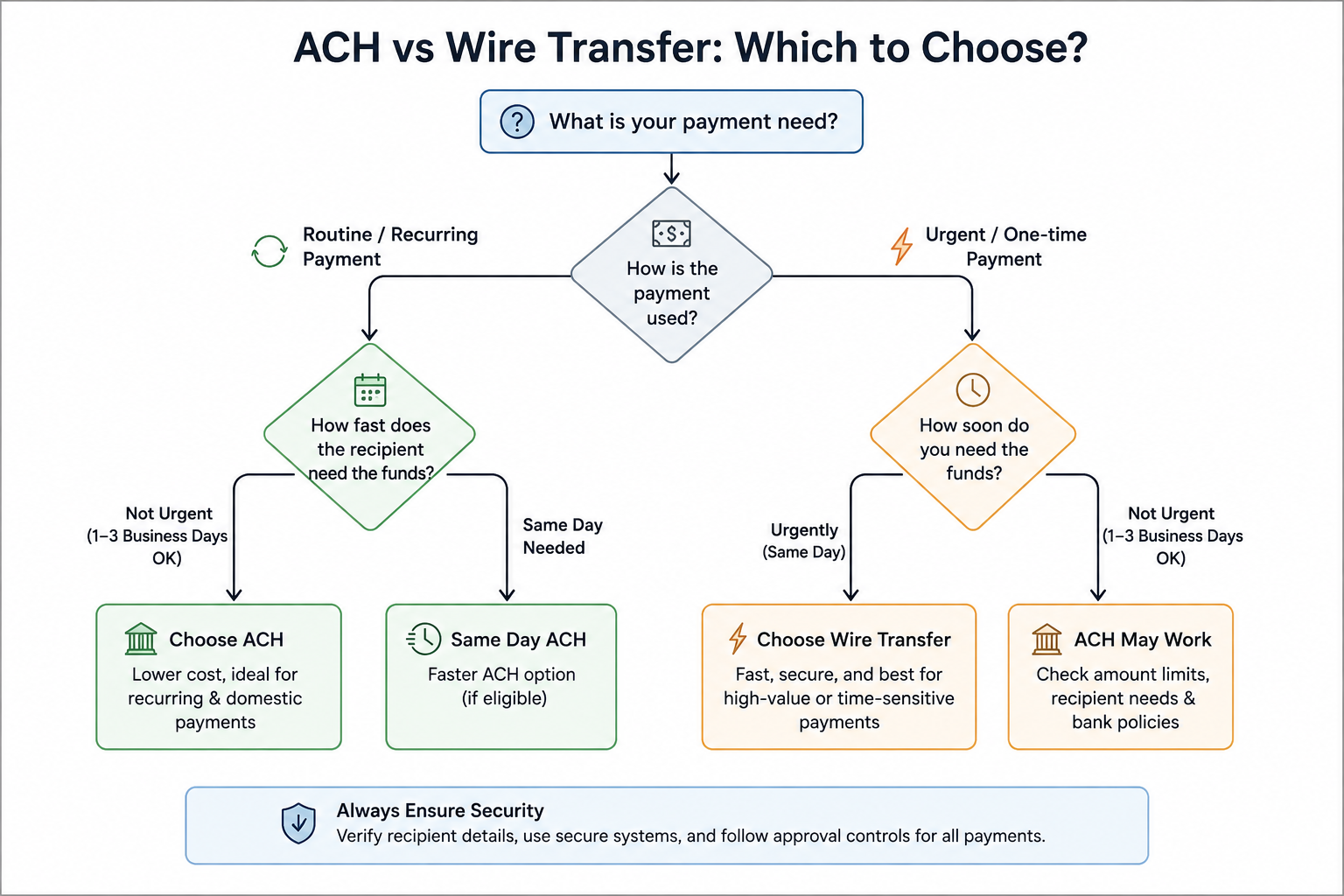
Instead of creating a single rule for every payment, businesses can evaluate each transaction using five questions:
- How quickly must the recipient receive the funds?
If timing is critical, investigate whether a wire is more appropriate. - Is the payment recurring?
Routine recurring payments often fit ACH better. - How much does the transfer cost?
Compare the actual fees applicable to your business. - What does the recipient require?
A supplier or transaction partner may specify an acceptable payment method. - What security controls are needed?
High-value transactions deserve additional verification regardless of the payment rail.
Frequently Asked Questions
Is ACH cheaper than a wire transfer?
ACH is often less expensive for routine electronic payments, but actual costs depend on the provider, financial institution, pricing structure, and transaction type.
Is a wire transfer faster than ACH?
A wire transfer is generally used when faster movement of funds is required. ACH timing depends on processing schedules and other transaction factors, including eligibility for Same Day ACH.
Can businesses use ACH for large payments?
Potentially, yes. Whether ACH is appropriate depends on the transaction requirements, applicable limits, bank policies, and recipient expectations. A large payment does not automatically require a wire.
Which is better for business payments: ACH or wire?
ACH is often practical for routine and recurring payments, while wires can be more suitable for urgent or certain high-value transactions. The better option depends on the specific payment.
Is a wire transfer safer than ACH?
Neither is inherently risk-free. Strong authentication, account verification, payment approvals, and monitoring are important regardless of which payment method a business uses.
Conclusion
The choice between ACH vs wire transfer comes down to the needs of the individual payment. ACH can be well suited to routine, recurring, and cost-sensitive transactions, while wire transfers can make more sense when speed or specific transaction requirements take priority.
Businesses should consider more than transfer fees. Processing time, payment purpose, recipient requirements, security controls, and the consequences of an incorrect payment all matter.
For most businesses, the practical answer is not to choose one method exclusively. Using ACH for appropriate routine payments while reserving wires for situations that genuinely require them can create a more sensible payment strategy.

Categories
- ACH Payments (10)
- adult payment processing (11)
- AI (9)
- Altcoins (10)
- Banking (10)
- Bitcoin (133)
- Bitcoin ETF (11)
- Bitcoin Price (30)
- Blockchain (50)
- Brokering World Hunger Away (16)
- Business (17)
- card payment processing (10)
- CBD (11)
- CBDC (11)
- Chargeback (8)
- coaching business (11)
- COVID-19 (3)
- Crypto ATMs (1)
- Crypto Banking (17)
- Crypto Bill (1)
- Crypto business owner platform (31)
- Crypto Investment (3)
- Crypto Markets (5)
- Crypto Payment (35)
- Crypto Payment Processor (4)
- Crypto Prices (1)
- Crypto Trading (92)
- Cryptocurrency (402)
- Cryptocurrency Exchange (108)
- Data Visualization (2)
- dating platforms (11)
- debt collection payment processing (10)
- Decentralized Finance (7)
- DeFi Payment (9)
- DEX (3)
- Digital Currency (23)
- dropshipping payment processing (12)
- Ethereum (2)
- FAQ (7)
- file sharing payment processing (11)
- Finance (25)
- Financial Equality (4)
- Financial Freedom (8)
- Forex (35)
- hemp (1)
- ICO (2)
- Investment (11)
- IPTV (11)
- Merchant Account (10)
- Mining (3)
- News (66)
- NFTs (2)
- online gambling (11)
- P2P (1)
- Paybito (147)
- PayBitoPro (693)
- PayBitoPro Coin Listing (6)
- PayBitoPro Exchange (2)
- Payment Gateway (48)
- peptide (10)
- Post COVID Digital Transformation (1)
- Press Release (130)
- Privacy & Security (3)
- Real Estate (1)
- Stablecoin (5)
- Technology (15)
- Travel (11)
- Uncategorized (10)
- US Presidential Election (2)
- Utility Coin (1)
- Web3 business (4)
- Web3 Wallets (2)
- White Label Crypto Exchange (8)
Recent Posts
- Payment Gateway vs. Payment Orchestration: What’s the Difference?
- What Is Smart Payment Routing? Strategies to Optimize Payment Performance
- How to Improve Payment Approval Rates for High-Risk Businesses?
- Why Are Online Payments Failing? Common Causes and How to Fix Them
- How to Use Multiple Payment Processors to Reduce Business Disruptions?