ACH Fraud Prevention: How Businesses Can Secure Bank Account Payments?
- August 19, 2026
- Soham Guchait
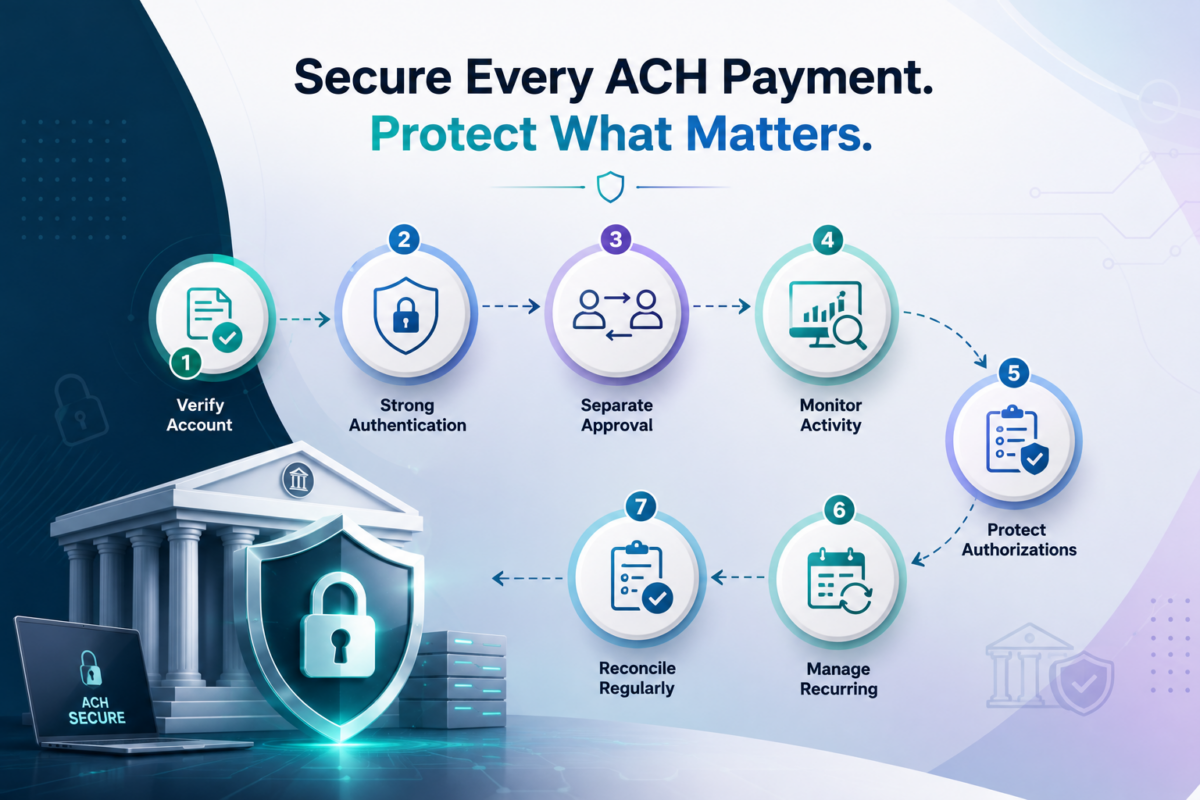
ACH payments can be a practical way for businesses to collect invoices, subscriptions, memberships, and other recurring payments directly from bank accounts. But because ACH transactions rely on bank-account information and electronic authorization, businesses need controls to reduce the risk of unauthorized payments and account information being misused.
ACH fraud prevention is not about eliminating every possible risk. It is about making unauthorized transactions harder to initiate, detecting suspicious activity quickly, and having clear procedures when something goes wrong.
For a business accepting ACH payments, effective protection usually involves several layers: Customer verification, authorization controls, account security, transaction monitoring, and regular reconciliation.
What Is ACH Fraud?
ACH fraud occurs when an ACH transaction is unauthorized, deceptive, or initiated using compromised payment information. For example, a fraudster could obtain a customer’s bank-account details and attempt to initiate an unauthorized debit. In another scenario, criminals could compromise a business’s systems or employee credentials and attempt to send unauthorized ACH credits.
Fraud does not always involve sophisticated hacking. Weak internal controls, stolen credentials, manipulated payment instructions, or insufficient verification can also create opportunities for fraud. Common warning signs include:
- Unexpected changes to bank-account information
- Unusual payment amounts
- Transactions involving unfamiliar accounts
- Multiple failed or suspicious transactions
- Requests to bypass normal payment procedures
- Unexpected changes in recurring payment instructions
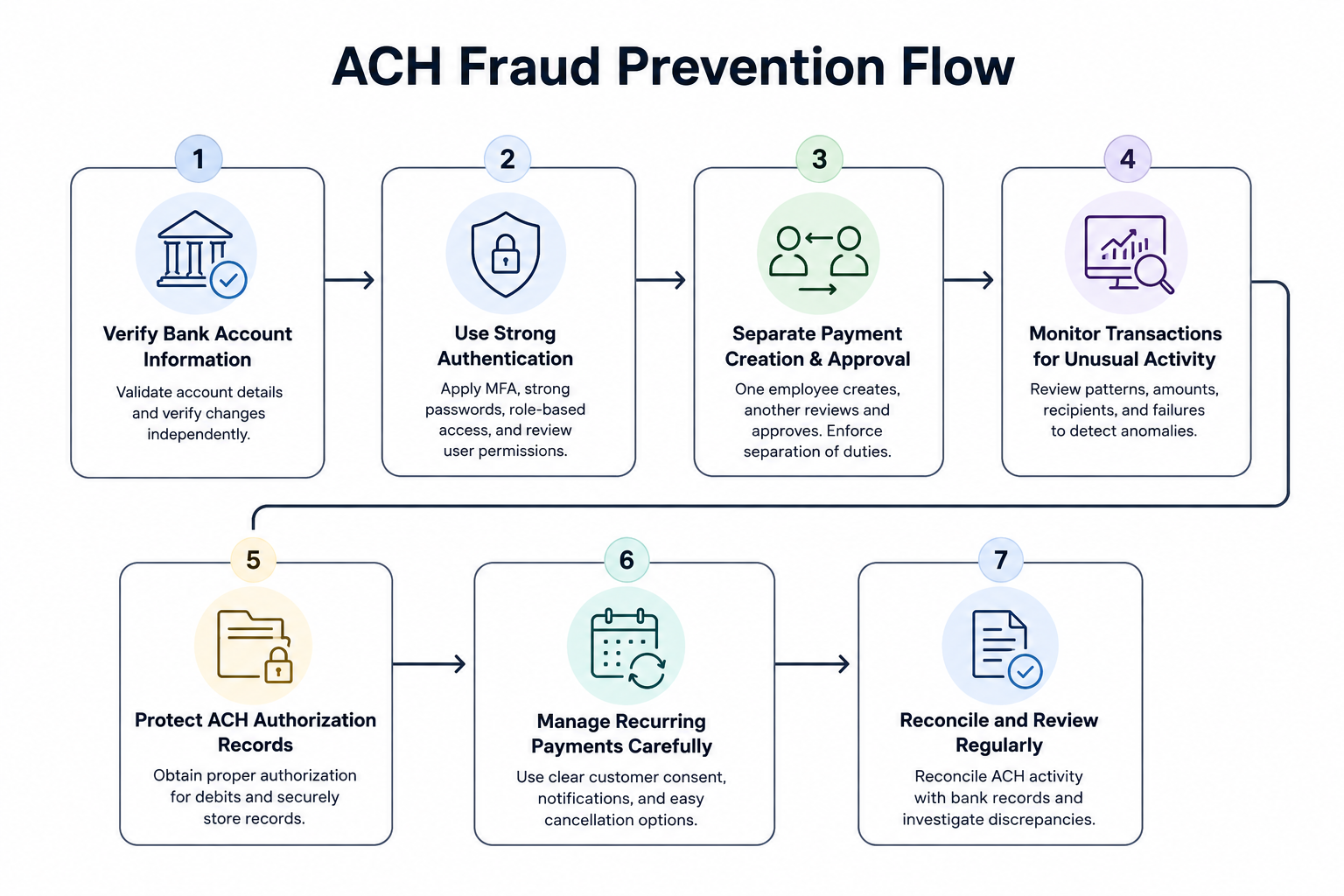
How Can Businesses Prevent ACH Fraud?
The strongest approach is to use multiple controls rather than relying on one security measure.
1. Verify Bank Account Information
Bank-account information should be treated as sensitive financial data. Before initiating payments, businesses should establish procedures for verifying account details, particularly when a customer, supplier, or employee requests a change.
Example:
A supplier emails a business requesting that future payments be sent to a new bank account. Instead of immediately changing the payment details, the finance team independently verifies the request using an established contact method. This extra step can help identify fraudulent payment-change requests.
2. Use Strong Authentication
Employees who can create, approve, or modify ACH transactions should have appropriately protected accounts. Businesses should consider controls such as:
- Multi-factor authentication
- Strong, unique passwords
- Role-based access
- Restricted administrative privileges
- Regular review of user access
Not every employee needs permission to create or approve payments. Limiting access reduces the number of accounts that could be exploited.
Separate Payment Creation and Approval
One useful internal control is to avoid giving a single employee complete control over a high-value payment process.
For example, one employee could prepare an ACH payment while another authorized employee reviews and approves it. This creates a basic separation of duties. It can be particularly valuable for:
- Large vendor payments
- Payroll files
- Changes to beneficiary information
- Unusual transactions
- High-value customer refunds
The exact approval structure should reflect the size and risk profile of the business.
Monitor ACH Transactions for Unusual Activity
Fraud prevention does not end when an ACH transaction is submitted. Businesses should monitor transactions for activity that does not match normal patterns. A finance team might investigate:
- A payment substantially larger than usual
- An unusual increase in transaction volume
- Payments to newly added accounts
- Repeated failed transactions
- Unexpected changes in recurring payment activity
- Transactions outside normal business procedures
Example:
A company normally sends 20 supplier payments each Friday. One week, a payment file contains several new recipients and unusually large amounts. That deviation should trigger additional review before the transactions are released.
Monitoring is more effective when businesses understand what “normal” activity looks like.
Protect ACH Authorization Records
For ACH debits, authorization is especially important.
A business collecting payments from a customer’s bank account needs appropriate authorization before initiating the debit. The business should also maintain records that demonstrate how and when the customer authorized the payment arrangement.
Depending on the payment arrangement, authorization requirements can differ. Businesses should therefore establish procedures appropriate to their transaction type and applicable ACH rules. Keeping accurate records can also make it easier to investigate disputes or unauthorized transactions.
Be Careful With Recurring ACH Payments
Recurring payments can create additional operational considerations because transactions may occur automatically according to an established schedule.
Suppose a customer authorizes a $150 monthly subscription payment. If the business later changes the amount or payment arrangement, it should follow the applicable authorization requirements rather than assuming the original authorization covers every possible change. Businesses should maintain clear records of:
- Customer authorization
- Payment amount or authorization terms
- Payment frequency
- Account information
- Changes to the arrangement
- Cancellation requests
Clear records reduce confusion and make payment activity easier to investigate.
Reconcile Bank Transactions Regularly
Reconciliation is one of the simplest ways to identify transactions that should not have occurred. A business should compare its internal payment records with actual bank activity on a regular basis. This can reveal:
- Unauthorized transactions
- Duplicate payments
- Unexpected returns
- Missing payments
- Incorrect payment amounts
- Transactions that were recorded incorrectly
For example, if the accounting system shows ten outgoing ACH payments but the bank account shows eleven, the discrepancy deserves investigation. Reconciliation is not only an accounting task. It can also function as a fraud-detection control.
What Should a Business Do If It Suspects ACH Fraud?
Speed matters when suspicious activity is discovered. A business should follow its established incident-response procedures and contact the appropriate financial institution or payment provider promptly. Useful immediate steps may include:
- Identify the suspicious transaction.
- Preserve relevant payment and authorization records.
- Review who initiated or approved the transaction.
- Secure potentially compromised employee accounts.
- Contact the relevant financial institution promptly.
- Investigate whether other transactions may be affected.
- Document the incident and corrective actions.
Businesses should not assume that one suspicious transaction is isolated until the surrounding activity has been reviewed.
ACH Fraud Prevention for Small Businesses
Small businesses may not have dedicated fraud departments, but they can still establish effective basic controls. A practical starting point is:
- Require multi-factor authentication for payment-related accounts.
- Restrict ACH access to employees who need it.
- Use separate preparation and approval responsibilities where practical.
- Verify bank-account changes independently.
- Review unusual transactions before release.
- Reconcile bank activity regularly.
- Keep authorization records organized.
- Train employees to recognize payment-related social engineering.
The goal is not to create an unnecessarily complicated process. It is to make high-risk actions require appropriate verification.
ACH Fraud vs ACH Returns
Fraud and ACH returns are related to payment problems but are not the same thing.
An ACH return is a transaction that is sent back through the ACH system for a defined reason. For example, an account may have insufficient funds or account information may be incorrect.
Fraud involves unauthorized or deceptive activity. A returned transaction therefore does not automatically mean fraud occurred. This distinction matters because the appropriate response depends on the reason for the transaction’s failure. For businesses learning how ACH payments move through the system, provides useful background on the transaction process.
Does ACH Fraud Prevention Eliminate Risk?
No security control can guarantee that fraud will never occur. Effective ACH fraud prevention is about reducing exposure and improving detection. Businesses should periodically review whether:
- Payment permissions are still appropriate
- Former employees still have system access
- Bank-account changes are being verified
- Authorization records are complete
- Unusual transactions are being reviewed
- Reconciliation is happening consistently
- Employees understand current fraud risks
Security procedures that were appropriate when a business had ten employees may need to change as transaction volume and staff access grow.
Frequently Asked Questions
What is the most common way ACH fraud happens?
ACH fraud can occur through several methods, including compromised account information, unauthorized debits, stolen credentials, fraudulent payment instructions, and manipulation of internal payment processes. Businesses should therefore use multiple security controls.
Can ACH payments be reversed if fraud occurs?
The appropriate response depends on the transaction and circumstances. Businesses should contact the relevant financial institution promptly when unauthorized activity is suspected rather than assuming recovery is automatic.
How can small businesses prevent ACH fraud?
Small businesses can start with strong authentication, restricted payment access, independent verification of account changes, transaction monitoring, regular reconciliation, and employee training.
Is ACH safer than credit cards?
Neither payment method is automatically risk-free. ACH and card payments have different transaction structures, authorization processes, and fraud risks. Security depends heavily on the controls surrounding the payment system.
Conclusion
ACH fraud prevention works best as a process rather than a single security feature. Businesses should protect payment credentials, verify account changes, control who can initiate and approve transactions, monitor unusual activity, maintain authorization records, and reconcile bank activity regularly.
The most important principle is simple: Do not treat an ACH transaction as trustworthy merely because it was processed electronically. Build verification into the steps where financial information changes, payments are created, and transactions are approved.
For businesses using ACH at scale, these controls can become part of everyday payment operations rather than an emergency response after fraud has already occurred.

Categories
- ACH Payments (10)
- adult payment processing (11)
- AI (9)
- Altcoins (10)
- Banking (10)
- Bitcoin (133)
- Bitcoin ETF (11)
- Bitcoin Price (30)
- Blockchain (50)
- Brokering World Hunger Away (16)
- Business (17)
- card payment processing (10)
- CBD (11)
- CBDC (11)
- Chargeback (8)
- coaching business (11)
- COVID-19 (3)
- Crypto ATMs (1)
- Crypto Banking (17)
- Crypto Bill (1)
- Crypto business owner platform (31)
- Crypto Investment (3)
- Crypto Markets (5)
- Crypto Payment (35)
- Crypto Payment Processor (4)
- Crypto Prices (1)
- Crypto Trading (92)
- Cryptocurrency (402)
- Cryptocurrency Exchange (108)
- Data Visualization (2)
- dating platforms (11)
- debt collection payment processing (10)
- Decentralized Finance (7)
- DeFi Payment (9)
- DEX (3)
- Digital Currency (23)
- dropshipping payment processing (12)
- Ethereum (2)
- FAQ (7)
- file sharing payment processing (11)
- Finance (25)
- Financial Equality (4)
- Financial Freedom (8)
- Forex (35)
- hemp (1)
- ICO (2)
- Investment (11)
- IPTV (11)
- Merchant Account (10)
- Mining (3)
- News (66)
- NFTs (2)
- online gambling (11)
- P2P (1)
- Paybito (147)
- PayBitoPro (693)
- PayBitoPro Coin Listing (6)
- PayBitoPro Exchange (2)
- Payment Gateway (48)
- peptide (10)
- Post COVID Digital Transformation (1)
- Press Release (130)
- Privacy & Security (3)
- Real Estate (1)
- Stablecoin (5)
- Technology (15)
- Travel (11)
- Uncategorized (10)
- US Presidential Election (2)
- Utility Coin (1)
- Web3 business (4)
- Web3 Wallets (2)
- White Label Crypto Exchange (8)
Recent Posts
- Payment Gateway vs. Payment Orchestration: What’s the Difference?
- What Is Smart Payment Routing? Strategies to Optimize Payment Performance
- How to Improve Payment Approval Rates for High-Risk Businesses?
- Why Are Online Payments Failing? Common Causes and How to Fix Them
- How to Use Multiple Payment Processors to Reduce Business Disruptions?