How Long Do ACH Payments Take? Processing Times, Settlement, and Same Day ACH
- August 19, 2026
- Soham Guchait
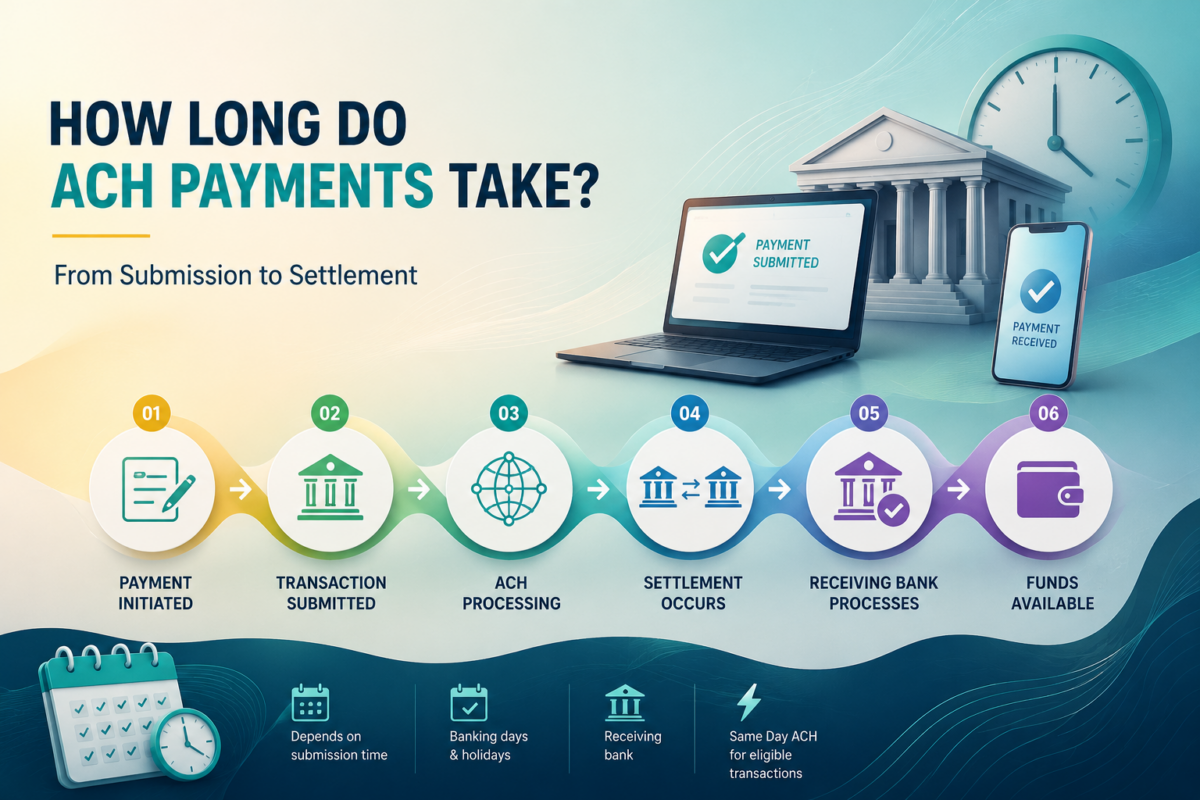
One of the first questions businesses ask after adding ACH as a payment option is simple: How long do ACH payments take?
The answer is not always a fixed number of hours or business days. ACH processing time depends on when the transaction is submitted, the type of payment, processing schedules, banking days, the receiving financial institution, and whether the transaction qualifies for Same Day ACH.
For businesses, this distinction matters. The date a payment is initiated is not necessarily the same date the funds become available. A company collecting invoices, running payroll, or charging recurring subscriptions needs to understand the difference between submission, processing, and settlement.
How Long Does an ACH Payment Take?
ACH payments can take anywhere from the same business day to longer, depending on the transaction and processing circumstances. Traditional ACH processing is not inherently instant, while eligible transactions can use Same Day ACH for faster processing and settlement.
There is therefore no universal “ACH takes X days” rule that applies to every transaction. The timing can depend on:
- When the payment is submitted?
- The applicable ACH processing window
- Whether it is an ACH credit or debit?
- Banking days and holidays
- The receiving financial institution
- Whether Same Day ACH applies?
- Whether the transaction encounters a return or other exception?
ACH timing is only one part of the decision for businesses evaluating bank-account payments. Its pricing can also vary based on transaction volume, the payment provider, and the pricing structure, so businesses should consider both processing time and cost when choosing an ACH payment arrangement. For businesses, it is more useful to think about ACH timing as a processing cycle rather than a guaranteed number of days.
What Happens Between ACH Submission and Settlement?
An ACH payment passes through several stages before the recipient can use the funds.
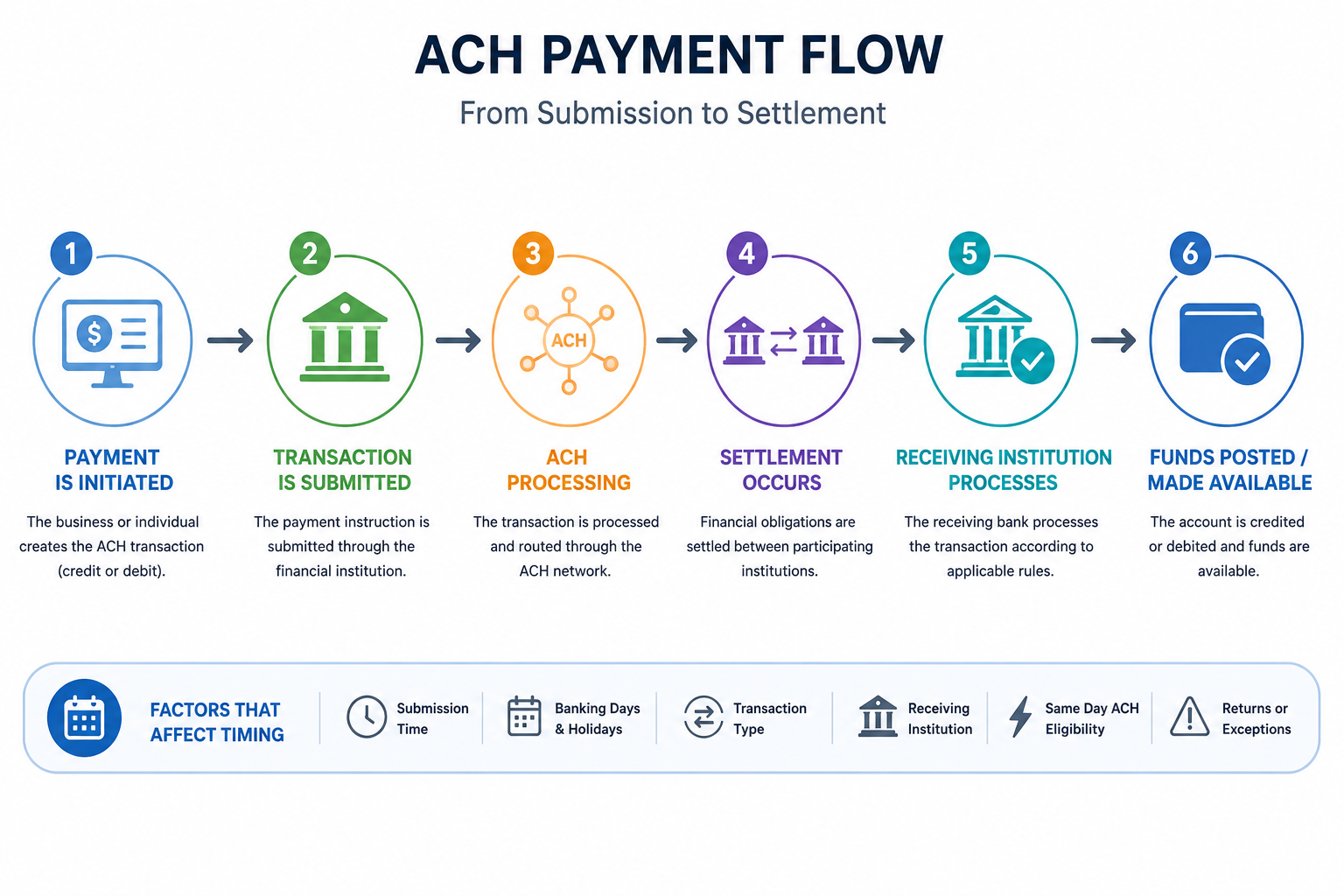
A simplified sequence is:
Payment initiated → Transaction submitted → ACH processing → Receiving institution → Settlement → Funds posted or made available
These stages are connected, but they are not identical.
1. Payment Is Initiated
The business or individual creates the ACH transaction. For example, a company may initiate an ACH credit to pay a supplier, while a subscription business may initiate an authorized ACH debit to collect a customer’s monthly payment.
2. Transaction Is Submitted
The payment instruction is submitted through the appropriate financial institution and ACH processing infrastructure. The time at which this happens can affect which processing window the transaction enters.
3. ACH Processing Takes Place
The transaction is processed and routed through the ACH system toward the receiving financial institution. This is one reason ACH should not be viewed as an instant bank-to-bank transfer.
4. Settlement Occurs
It refers to the process through which the financial obligations created by ACH transactions are settled between participating institutions.
Settlement timing is important because a payment being initiated does not necessarily mean the recipient has immediate access to final funds.
5. The Receiving Account Is Credited or Debited
The receiving financial institution processes the transaction and the appropriate account is credited or debited according to the applicable schedule and rules.
For businesses, this final stage is particularly important when determining when an invoice can be treated as paid or when funds can be incorporated into cash-flow planning.
Why Don’t All ACH Payments Take the Same Amount of Time?
Several variables can change the processing timeline.
Submission Time
ACH transactions are processed according to established schedules and processing windows. A transaction submitted at one point in the day may be handled differently from one submitted after a relevant cutoff.
Businesses should therefore avoid assuming that submitting a payment late in the day produces the same result as submitting it earlier.
Banking Days
ACH processing is tied to applicable banking and business-day schedules. Weekends and holidays can affect when transactions move through the system.
For example, a payment initiated immediately before a bank holiday may follow a different timeline from an otherwise identical payment submitted on a normal business day.
Transaction Type
ACH credits and ACH debits can have different processing circumstances.
A business sending payroll, for example, may plan its payment schedule differently from a company collecting a recurring customer debit.
Receiving Institution
The receiving financial institution also plays a role in when a transaction is posted or funds are made available.
This is particularly relevant when a business gives customers a specific expectation about when a payment will appear in an account.
What Is Same Day ACH?
Same Day ACH is a service that allows eligible ACH transactions to be processed and settled on the same business day, subject to applicable rules and processing windows.
It is important to understand what the term does – and does not – mean.
Same Day ACH does not mean:
- Every ACH transaction is automatically instant
- Every transaction is eligible
- Funds are available immediately after payment initiation
- Weekends and holidays are treated like normal business days
Instead, it provides eligible transactions with additional opportunities for faster processing and settlement within the ACH system. This can be useful for businesses where payment timing matters.
For example, imagine a supplier needs to receive a business payment on the same business day to release an order. If the transaction qualifies for Same Day ACH and is submitted within the applicable processing requirements, the faster service may be useful. Businesses should still verify the applicable rules and timing with their financial institution or ACH service provider rather than promising customers a specific availability time.
Same Day ACH vs. Standard ACH
The practical difference can be summarized like this:
| Factor | Standard ACH | Same Day ACH |
| Processing speed | Depends on applicable ACH schedule | Designed for same-business-day processing |
| Eligibility | Subject to transaction rules | Subject to eligibility requirements |
| Processing windows | Applicable standard schedules | Specific same-day processing windows |
| Availability | Depends on settlement and receiving institution | Same-day settlement for eligible transactions |
| Best suited for | Routine payments | Transactions where faster processing matters |
Same Day ACH can reduce waiting time, but it does not turn ACH into a real-time payment rail.
Example: How ACH Timing Works for a Business?
Consider a hypothetical online business collecting a $500 invoice through ACH debit. The customer authorizes the payment on Monday.
The business submits the transaction according to its ACH processing schedule. If the payment enters an applicable processing window, it moves through the ACH system toward the customer’s financial institution. The payment may then be processed and settled according to the applicable schedule.
If the transaction qualifies for Same Day ACH and is submitted within the relevant requirements, the timing may be faster.
But if the transaction is submitted after an applicable processing window—or encounters a banking holiday – the expected timing can change. This is why businesses should distinguish between “payment submitted” and “funds available”.
When Does an ACH Payment Become Available?
There is no single availability time that applies to every ACH payment. The timing can depend on:
- The ACH processing schedule
- Settlement timing
- The receiving financial institution’s procedures
- Transaction type
- Banking days
- Same Day ACH eligibility
- Any applicable exceptions or returns
A business should therefore avoid telling customers that an ACH payment will always be available at a specific hour unless that timing is supported by its actual payment arrangement.
This is especially important for businesses shipping physical goods or providing services immediately after payment.
How Long Do ACH Credits Take?
ACH credit timing depends on the same broad factors that affect other ACH transactions.
For example, a business sending a vendor payment may initiate an ACH credit according to its payment schedule. The transaction then goes through ACH processing and settlement before the receiving institution posts the funds.
Payroll is another common example. Employers generally plan payroll submissions ahead of the desired employee payment date because processing and settlement must occur within the applicable schedule. The important point is that an ACH credit should be scheduled around the desired settlement date rather than simply the date the payment instruction is created.
How Long Do ACH Debits Take?
ACH debits can also vary in timing.
Consider a hypothetical $75 monthly subscription debit. The customer may authorize the recurring payment well before the scheduled collection date. On the billing date, the business initiates the debit, which then enters the applicable ACH processing cycle. The customer’s account may not reflect the transaction at exactly the same moment the business submits it.
This distinction is important for subscription companies because billing systems, customer notifications, accounting records, and access controls should account for the actual payment process.
How Can Businesses Make ACH Timing More Predictable?
Businesses cannot control every factor affecting ACH processing, but they can improve planning. Useful practices include:
- Schedule transactions with processing windows in mind.
- Account for weekends and banking holidays.
- Understand the settlement schedule associated with your ACH arrangement.
- Avoid promising customers instant payment confirmation unless supported by the payment method.
- Monitor submitted, settled, and returned transactions separately.
- Consider Same Day ACH when faster processing genuinely benefits the business.
- Build reconciliation processes around settlement rather than payment initiation alone.
For businesses accepting ACH, understanding the complete transaction process can also make timing easier to manage.
Frequently Asked Questions
Are ACH payments instant?
No. Standard ACH payments are not inherently instant. Eligible transactions can use Same Day ACH, but processing and availability still depend on applicable requirements and schedules.
Can an ACH payment arrive the same day?
Do weekends affect ACH processing?
ACH processing follows applicable business-day schedules, so weekends and holidays can affect transaction timing.
Does ACH processing time depend on the bank?
The receiving financial institution may determine when it posts a transaction or makes funds available, while ACH processing follows established network schedules and rules.
Is Same Day ACH the same as an instant payment?
No. Same Day ACH provides faster ACH processing and settlement for eligible transactions. It is not the same thing as a real-time payment system.
Conclusion
So, how long do ACH payments take? There is no single timeline that applies to every transaction. Processing can depend on submission timing, ACH processing windows, transaction type, banking days, receiving institutions, and whether Same Day ACH is available.
For businesses, the most useful approach is to plan around the full payment lifecycle: initiation, processing, settlement, account posting, and potential returns.
Standard ACH works well for routine payments, while Same Day ACH helps businesses process eligible transactions faster. In either case, businesses should base customer expectations and cash-flow planning on the actual processing arrangement rather than relying on a generic number of business days.

Categories
- ACH Payments (10)
- adult payment processing (11)
- AI (9)
- Altcoins (10)
- Banking (10)
- Bitcoin (133)
- Bitcoin ETF (11)
- Bitcoin Price (30)
- Blockchain (50)
- Brokering World Hunger Away (16)
- Business (17)
- card payment processing (10)
- CBD (11)
- CBDC (11)
- Chargeback (8)
- coaching business (11)
- COVID-19 (3)
- Crypto ATMs (1)
- Crypto Banking (17)
- Crypto Bill (1)
- Crypto business owner platform (31)
- Crypto Investment (3)
- Crypto Markets (5)
- Crypto Payment (35)
- Crypto Payment Processor (4)
- Crypto Prices (1)
- Crypto Trading (92)
- Cryptocurrency (402)
- Cryptocurrency Exchange (108)
- Data Visualization (2)
- dating platforms (11)
- debt collection payment processing (10)
- Decentralized Finance (7)
- DeFi Payment (9)
- DEX (3)
- Digital Currency (23)
- dropshipping payment processing (12)
- Ethereum (2)
- FAQ (7)
- file sharing payment processing (11)
- Finance (25)
- Financial Equality (4)
- Financial Freedom (8)
- Forex (35)
- hemp (1)
- ICO (2)
- Investment (11)
- IPTV (11)
- Merchant Account (10)
- Mining (3)
- News (66)
- NFTs (2)
- online gambling (11)
- P2P (1)
- Paybito (147)
- PayBitoPro (693)
- PayBitoPro Coin Listing (6)
- PayBitoPro Exchange (2)
- Payment Gateway (48)
- peptide (10)
- Post COVID Digital Transformation (1)
- Press Release (130)
- Privacy & Security (3)
- Real Estate (1)
- Stablecoin (5)
- Technology (15)
- Travel (11)
- Uncategorized (10)
- US Presidential Election (2)
- Utility Coin (1)
- Web3 business (4)
- Web3 Wallets (2)
- White Label Crypto Exchange (8)
Recent Posts
- Payment Gateway vs. Payment Orchestration: What’s the Difference?
- What Is Smart Payment Routing? Strategies to Optimize Payment Performance
- How to Improve Payment Approval Rates for High-Risk Businesses?
- Why Are Online Payments Failing? Common Causes and How to Fix Them
- How to Use Multiple Payment Processors to Reduce Business Disruptions?