ACH Credit vs ACH Debit: What’s the Difference? With Real Examples
- August 19, 2026
- Soham Guchait
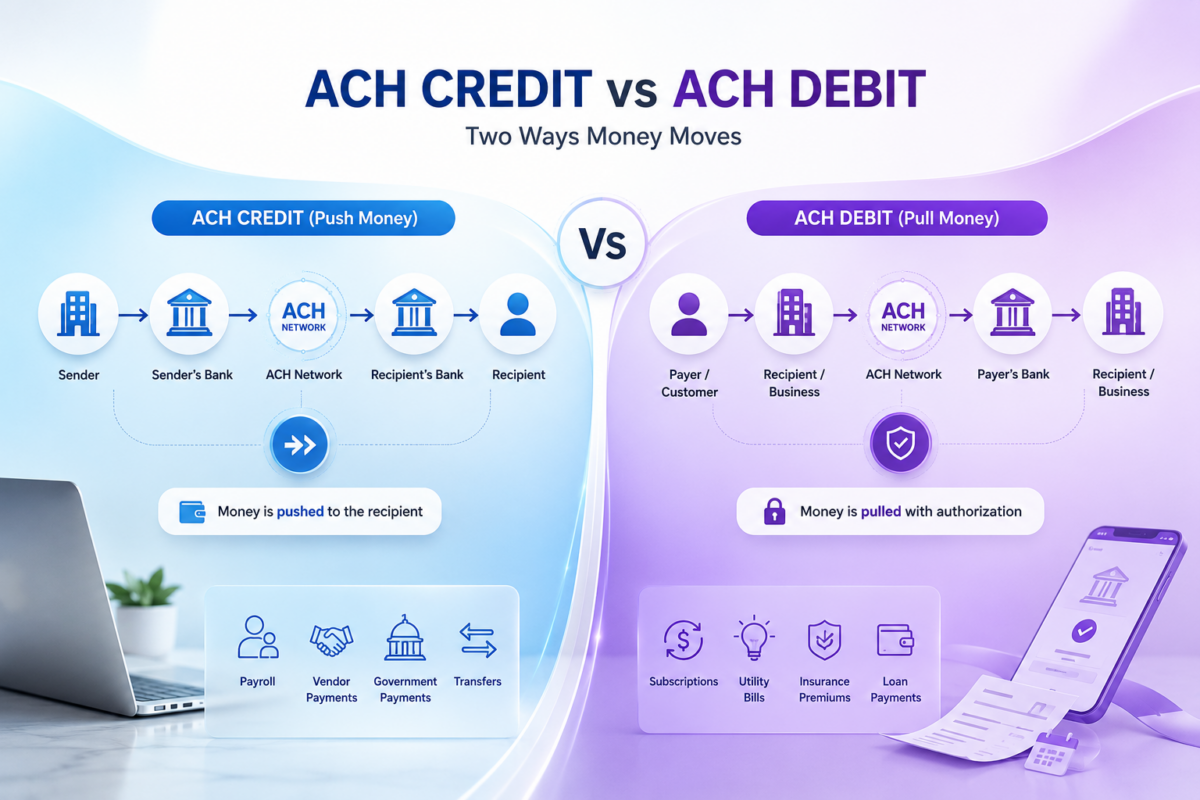
When you receive money through an ACH transfer, the transaction can work in one of two basic directions: Money can be pushed into an account, or it can be pulled from an account.
That distinction is the key to understanding ACH credit vs ACH debit.
An ACH credit generally means the sender instructs their bank to send money to another bank account. An ACH debit works in the opposite direction: the recipient of the payment is authorized to request money from the payer’s account.
The difference sounds simple, but it affects how businesses collect payments, pay employees, manage subscriptions, and handle customer authorization. This guide explains both methods with practical examples without getting unnecessarily technical.
ACH Credit vs ACH Debit: What’s the Difference?
The simplest way to remember the difference is:
- ACH credit = Push money
- ACH debit = Pull money
For larger or time-sensitive payments, businesses may also compare ACH credits with a wire transfer, which uses a different payment network and processing structure.
With an ACH credit, the party sending the payment initiates the transaction.
With an ACH debit, the party receiving the payment initiates a request to withdraw funds from the payer’s account, based on an authorization.
For example, when an employer sends payroll directly into an employee’s bank account, that is generally an ACH credit. When a customer authorizes a utility company to automatically withdraw their monthly bill from their bank account, that is generally an ACH debit. These two transaction types use the same ACH network but serve different purposes.
How Does an ACH Credit Work?
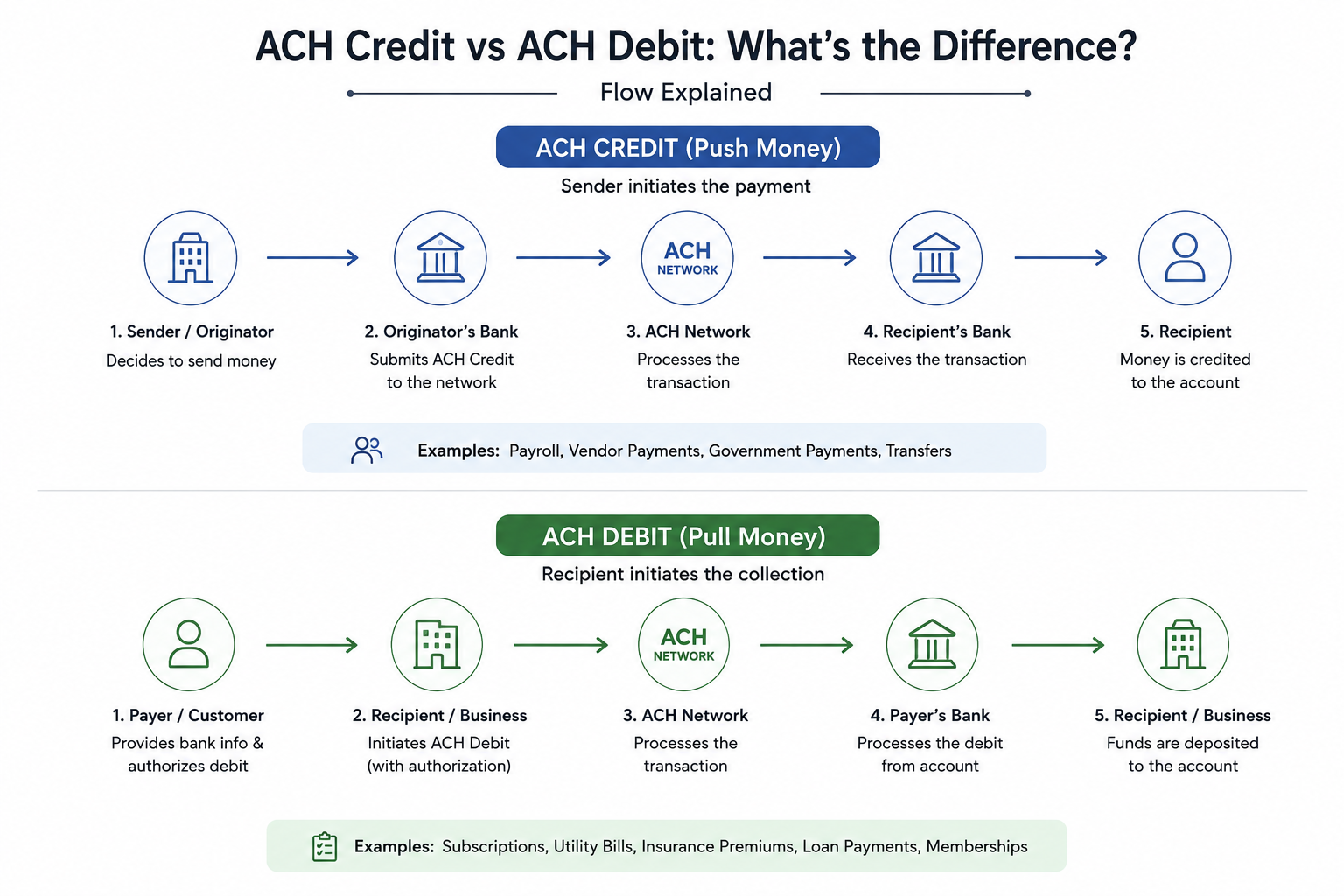
An ACH credit starts with the person or business that wants to send money. The originator provides payment instructions through its financial institution or payment service. The transaction is submitted into the ACH network and ultimately reaches the recipient’s bank account. A common example is payroll.
Example:
A company needs to pay an employee $3,000.
- The company initiates the payroll payment.
- The payment instruction is submitted as an ACH credit.
- The employee’s bank receives the transaction.
- The $3,000 is credited to the employee’s account.
The employee does not have to initiate the individual payment. ACH credits are commonly used for:
- Payroll and direct deposit
- Business-to-business payments
- Vendor payments
- Tax payments
- Government payments
- Transfers into bank accounts
The important point is that the sender controls the initiation of the payment.
How Does an ACH Debit Work?
An ACH debit reverses the basic direction of control. Instead of the payer initiating each transaction, the business or organization receiving payment can initiate the debit after obtaining the required authorization.
Example: Imagine a customer signs up for a $100 monthly software subscription and authorizes recurring bank-account payments. Each month, the software company can initiate an ACH debit for the authorized payment. The basic sequence is:
- The customer provides bank-account information.
- The customer authorizes the business to debit the account.
- The business initiates the ACH debit.
- The customer’s financial institution processes the transaction.
- Funds are transferred to the business.
This model can be useful when payments repeat on a predictable schedule. ACH debits are commonly used for:
- Subscription payments
- Utility bills
- Insurance premiums
- Mortgage and loan payments
- Memberships
- Recurring business invoices
- Customer collections
The critical difference is authorization. A business should not simply withdraw funds from a customer’s account without the appropriate authorization and procedures.
ACH Credit vs ACH Debit With a Simple Example
Consider a business that pays a contractor $2,000 every month. There are two possible arrangements.
Scenario 1: ACH Credit
The business initiates a $2,000 payment to the contractor every month.
Business → Contractor
The business is pushing the funds.
Scenario 2: ACH Debit
Suppose the contractor is providing a recurring service and has properly authorized the business’s payment arrangement through a different billing structure. The party authorized to collect the payment initiates the debit.
Payer’s account → Recipient
The recipient is pulling the funds based on authorization.
The money ultimately moves between bank accounts in both cases. What changes is who initiates the transaction and under what authorization.
ACH Credit vs ACH Debit for Businesses
The better option depends on what the business is trying to accomplish.
ACH credit may make more sense when:
- You are paying employees.
- You are paying suppliers or contractors.
- You are sending money to a specific recipient.
- Your business controls when each payment is initiated.
- You are making one-time or scheduled outgoing payments.
ACH debit may make more sense when:
- You regularly collect customer payments.
- Customers have authorized recurring withdrawals.
- You bill subscriptions or memberships.
- Payment amounts or schedules can be managed through an established billing arrangement.
- You want customers to pay directly from their bank accounts.
For a business that wants to collect ACH payments from customers, the actual acceptance process involves more than simply obtaining a bank account number.
ACH Credit vs ACH Debit: Which Is Better for Recurring Payments?
Neither is automatically better. The appropriate method depends on who needs to control the payment initiation.
Suppose a company pays a supplier $10,000 every month. The company may prefer ACH credits because its finance team initiates the outgoing payments.
Now consider a gym collecting a recurring $50 membership fee. An ACH debit may be more convenient because members can authorize the gym to collect the recurring payment.
This distinction can be summarized as:
|
Situation |
Likely ACH method |
|
Employer paying an employee |
ACH credit |
|
Company paying a supplier |
ACH credit |
|
Government sending a payment |
ACH credit |
|
Utility collecting a monthly bill |
ACH debit |
|
Subscription company collecting recurring fees |
ACH debit |
|
Membership business collecting dues |
ACH debit |
These are typical examples rather than mandatory rules. Specific transaction arrangements can vary.
What Happens If an ACH Debit Fails?
An ACH debit does not guarantee that the payment will successfully settle.
A transaction can be returned for various reasons, including insufficient funds or incorrect account information.
For example, if a subscription company attempts to collect a $200 payment but the customer’s account cannot cover it, the transaction may be returned. The business then needs to determine what happened and decide whether to contact the customer, retry the payment when permitted, or use another collection method. Understanding ACH return codes is particularly useful when managing failed bank-account payments.
Are ACH Credits and Debits Processed Differently?
Both use the ACH network, but their roles within a transaction differ.
The financial institutions involved also have specific responsibilities. An ODFI, or Originating Depository Financial Institution, is the financial institution that submits an ACH transaction on behalf of the originating party.
The receiving financial institution is known as the RDFI, or Receiving Depository Financial Institution. For most business owners, however, the practical distinction matters more than memorizing the terminology:
ACH credit: “I want to send this money.”
ACH debit: “I have authorization to collect this money.”
Processing and settlement timing can vary depending on submission schedules, banking days, transaction type, and other factors.
ACH Credit vs ACH Debit: Which Is More Secure?
Neither method should be treated as automatically risk-free. ACH debits require particular attention to authorization because they allow a business or organization to initiate withdrawals from a customer’s account. Businesses should have appropriate controls around:
- Customer authorization
- Bank-account information
- Access to payment systems
- Transaction monitoring
- Reconciliation
- Returned payments
- Fraud Prevention
- Unusual payment activity
Businesses collecting bank-account payments should also understand the risks associated with unauthorized transactions and account information being compromised.
Does ACH Credit or ACH Debit Cost More?
There is no universal answer. The cost can depend on the provider, transaction volume, pricing model, and additional services or fees. A business should evaluate the complete cost structure rather than assuming that one transaction type is always cheaper.
For example, a company collecting thousands of recurring payments may evaluate per-transaction costs alongside return handling, reconciliation, and operational requirements.
Frequently Asked Questions
Is ACH credit the same as direct deposit?
Direct deposit is a common use of ACH credit. For example, an employer can use ACH credit to deposit wages directly into an employee’s bank account.
Is ACH debit a payment?
Yes. An ACH debit is an electronic bank-account transaction initiated by the party receiving funds, based on appropriate authorization from the account holder.
Can an ACH payment be both credit and debit?
From the perspective of a single transaction, it is classified as either an ACH credit or ACH debit. The terms describe the direction of the entry from the relevant account perspective.
Which is better for businesses, ACH credit or ACH debit?
It depends on the payment relationship. Businesses making payments commonly use ACH credits, while businesses collecting recurring payments may use ACH debits.
Conclusion
The difference between ACH credit vs ACH debit becomes much easier to understand when you focus on who initiates the movement of money. ACH credit generally pushes funds from the sender to the recipient, while ACH debit allows an authorized recipient to pull funds from the payer’s account.
For businesses, that distinction affects payroll, supplier payments, subscriptions, invoices, and recurring collections. The right approach depends on the payment relationship, authorization requirements, customer expectations, and operational needs – not simply on which transaction type sounds more convenient.

Categories
- ACH Payments (10)
- adult payment processing (11)
- AI (9)
- Altcoins (10)
- Banking (10)
- Bitcoin (133)
- Bitcoin ETF (11)
- Bitcoin Price (30)
- Blockchain (50)
- Brokering World Hunger Away (16)
- Business (17)
- card payment processing (10)
- CBD (11)
- CBDC (11)
- Chargeback (8)
- coaching business (11)
- COVID-19 (3)
- Crypto ATMs (1)
- Crypto Banking (17)
- Crypto Bill (1)
- Crypto business owner platform (31)
- Crypto Investment (3)
- Crypto Markets (5)
- Crypto Payment (35)
- Crypto Payment Processor (4)
- Crypto Prices (1)
- Crypto Trading (92)
- Cryptocurrency (402)
- Cryptocurrency Exchange (108)
- Data Visualization (2)
- dating platforms (11)
- debt collection payment processing (10)
- Decentralized Finance (7)
- DeFi Payment (9)
- DEX (3)
- Digital Currency (23)
- dropshipping payment processing (12)
- Ethereum (2)
- FAQ (7)
- file sharing payment processing (11)
- Finance (25)
- Financial Equality (4)
- Financial Freedom (8)
- Forex (35)
- hemp (1)
- ICO (2)
- Investment (11)
- IPTV (11)
- Merchant Account (10)
- Mining (3)
- News (66)
- NFTs (2)
- online gambling (11)
- P2P (1)
- Paybito (147)
- PayBitoPro (693)
- PayBitoPro Coin Listing (6)
- PayBitoPro Exchange (2)
- Payment Gateway (48)
- peptide (10)
- Post COVID Digital Transformation (1)
- Press Release (130)
- Privacy & Security (3)
- Real Estate (1)
- Stablecoin (5)
- Technology (15)
- Travel (11)
- Uncategorized (10)
- US Presidential Election (2)
- Utility Coin (1)
- Web3 business (4)
- Web3 Wallets (2)
- White Label Crypto Exchange (8)
Recent Posts
- Payment Gateway vs. Payment Orchestration: What’s the Difference?
- What Is Smart Payment Routing? Strategies to Optimize Payment Performance
- How to Improve Payment Approval Rates for High-Risk Businesses?
- Why Are Online Payments Failing? Common Causes and How to Fix Them
- How to Use Multiple Payment Processors to Reduce Business Disruptions?