Payment Cascading Explained: How to Recover Failed Transactions
- October 9, 2026
- Soham Guchait
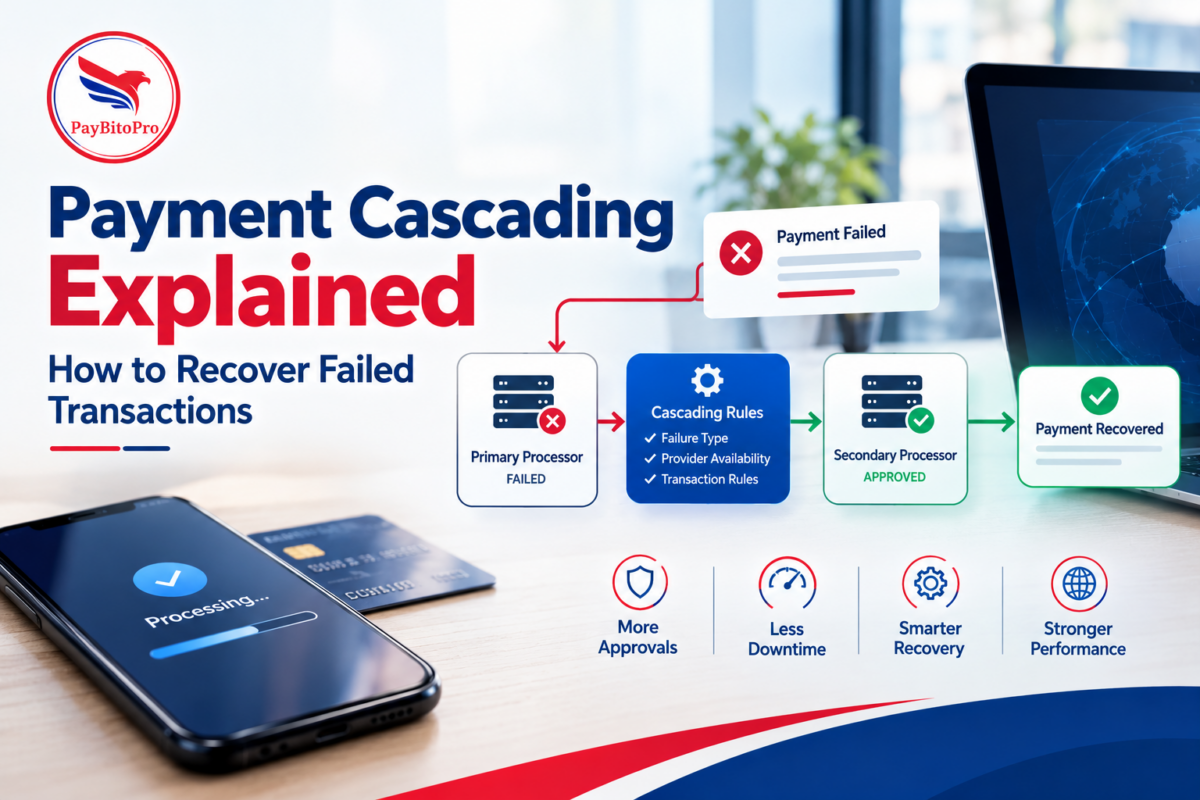
A failed payment does not always mean a customer lacks the money or has decided not to buy. Sometimes, the payment processor is temporarily unavailable. A bank may decline a transaction because of a risk rule, or a technical issue may interrupt the payment before it is completed.
For online businesses, especially those operating in high-risk industries, these failures can quickly add up. One way to reduce the impact is payment cascading, a process that allows eligible failed transactions to be retried through another payment processor under predefined rules.
It can help merchants recover payments that would otherwise be lost. But it needs to be configured carefully. Retrying every failed transaction without understanding why it failed can create more problems than it solves.
What Is Payment Cascading?
Payment cascading is a payment recovery method in which a failed transaction is automatically sent to another payment processor or acquiring route, provided the failure reason and applicable rules allow another attempt.
Imagine an online subscription business processing a customer’s renewal. Its primary processor cannot complete the payment because of a temporary technical issue. Instead of immediately asking the customer to try again, the system routes the eligible transaction to a secondary processor.
If that processor approves the payment, the transaction succeeds without requiring the customer to restart the checkout process. This is the basic idea behind cascading: Give an eligible transaction another viable path to approval.
It is closely related to payment routing strategies for high-risk merchants, but the two concepts are not identical. Routing determines where a payment should go in the first place. Cascading responds when an initial attempt fails and another attempt may be appropriate.
How Does Payment Cascading Work?
The process usually follows a few steps.
- A customer initiates a payment – The transaction is submitted to the merchant’s primary processor or selected payment route.
- The first attempt fails – The system receives a decline response, timeout, or other error from the processor.
- The failure is assessed – The system checks whether the transaction is eligible for another attempt. A temporary technical error may justify trying a different route, while a hard decline may not.
- The transaction is redirected – If the rules allow it, the payment is submitted to another suitable processor or acquiring connection.
- The result is recorded – The system tracks whether the second attempt succeeded, failed, or requires further action.
The exact workflow depends on the merchant’s payment setup. Some systems support sophisticated rules based on response codes, payment method, geography, currency, or processor availability. Others offer only basic retry options. The important part is deciding when to retry, not simply retrying more often.
Which Failed Payments Should Be Cascaded?
Not every failed payment should be sent to another processor. The reason for the failure matters. A temporary network interruption or processor outage may leave room for a successful second attempt. A transaction declined because of insufficient funds, an expired card, or a bank’s risk decision may need a different response.
For example, routing a transaction to another processor could help if the first processor is experiencing a technical problem. It will not necessarily overcome a cardholder’s insufficient balance. And attempting to bypass a legitimate issuer decline can create compliance, fraud, and customer-experience issues. Merchants should build rules around failure categories rather than treating every unsuccessful transaction the same way. Common situations to consider include:
- Temporary technical failures: A timeout or connection problem may justify a controlled retry, after checking the transaction’s status.
- Processor or acquirer outages: A backup route may help keep eligible payments moving when the primary connection is unavailable.
- Soft declines: Some issuer responses may permit another attempt, but the response code and applicable network rules should determine the next step.
- Hard declines: These generally require customer action or another appropriate resolution rather than repeated submissions.
Payment response codes are not always interpreted consistently across systems, so merchants should confirm how their processor classifies each failure.
Why Payment Cascading Matters for High-Risk Businesses
Businesses in industries such as online gaming, digital subscriptions, travel, and certain digital services may face more complex payment acceptance conditions. Processor availability, acquiring-bank policies, fraud controls, and regional restrictions can all affect transaction outcomes.
A single processing connection can become a bottleneck. If it experiences an outage or performs poorly for a particular transaction type, the merchant may lose payments that could potentially have succeeded through a suitable alternative.
Cascading adds another recovery path. When combined with broader payment processing optimization for high-risk merchants, it can help businesses identify avoidable failures and make better use of their available processing connections.
Still, more processors do not automatically mean more approvals. Each provider has its own underwriting requirements, supported markets, risk appetite, and transaction rules. Merchants need legitimate, compatible alternatives – not just a longer list of processor accounts.
Payment Cascading vs. Payment Routing vs. Orchestration
These terms are connected, but they describe different parts of payment management.
- Payment routing selects the processor or acquiring path for an incoming transaction based on defined rules or performance data.
- Payment cascading provides a recovery path when an initial attempt fails and the transaction is eligible for another attempt.
- Payment orchestration coordinates multiple payment providers, connections, and related workflows through a broader management layer.
In practice, these capabilities can work together. A routing system chooses the first processor, cascading handles certain eligible failures, and an orchestration platform can coordinate the wider workflow across providers. The specific capabilities depend on the platform and configuration.
This distinction becomes particularly useful when comparing [payment orchestration and its role in managing payment services or evaluating the difference between a payment gateway and payment orchestration.
Best Practices for Implementing Payment Cascading
A cascading setup should improve payment recovery without creating duplicate charges, unnecessary retries, or avoidable risk. Start with a small set of clear rules, then expand them based on observed results.
- Classify failures correctly – Separate technical errors, soft declines, hard declines, and suspected fraud instead of applying one retry rule to everything.
- Set retry limits – Avoid endless attempts. Follow processor requirements, card-network rules, and applicable regulations.
- Prevent duplicate processing – Use appropriate transaction-status checks and idempotency controls so a timeout does not lead to the same payment being charged twice.
- Choose compatible backup processors – Confirm that the alternative supports the payment method, currency, region, and merchant category.
- Monitor recovery performance – Track successful cascades, additional processing costs, duplicate-payment incidents, and customer complaints.
These practices also support efforts to improve payment approval rates in high-risk industries. Approval rate should be measured alongside costs and risk outcomes, not treated as the only measure of success.
How to Measure Whether Cascading Is Working
The simplest metric is the recovery rate: the share of eligible failed transactions that succeed after a subsequent attempt. But this number alone can be misleading.
Merchants should also examine the cost of recovered payments, the reasons for initial failures, the performance of each processor, and the rate of disputes or duplicate charges. Segmenting results by region, payment method, and decline category can reveal where cascading actually helps.
For instance, if a backup processor consistently recovers transactions affected by a primary processor’s technical issues, the arrangement may be valuable. If it repeatedly receives hard declines and adds processing costs without improving outcomes, the rules need to change. This is where smart payment routing strategies can complement cascading by using transaction and performance data to make more informed routing decisions.
Final Thoughts
Payment cascading gives merchants a practical way to recover certain failed transactions without making customers start over. Its value comes from applying the right recovery action to the right failure – not from sending every declined payment through another processor.
For high-risk businesses, the best results come from combining sensible retry rules, reliable backup connections, clear transaction tracking, and ongoing performance reviews. When those pieces work together, cascading becomes a controlled recovery strategy rather than a costly game of trial and error.

Categories
- ACH Payments (10)
- adult payment processing (11)
- AI (9)
- Altcoins (10)
- Banking (10)
- Bitcoin (133)
- Bitcoin ETF (11)
- Bitcoin Price (30)
- Blockchain (50)
- Brokering World Hunger Away (16)
- Business (17)
- card payment processing (10)
- CBD (11)
- CBDC (11)
- Chargeback (8)
- coaching business (11)
- COVID-19 (3)
- Crypto ATMs (1)
- Crypto Banking (17)
- Crypto Bill (1)
- Crypto business owner platform (31)
- Crypto Investment (3)
- Crypto Markets (5)
- Crypto Payment (35)
- Crypto Payment Processor (4)
- Crypto Prices (1)
- Crypto Trading (92)
- Cryptocurrency (402)
- Cryptocurrency Exchange (108)
- Data Visualization (2)
- dating platforms (11)
- debt collection payment processing (10)
- Decentralized Finance (7)
- DeFi Payment (9)
- DEX (3)
- Digital Currency (23)
- dropshipping payment processing (12)
- Ethereum (2)
- FAQ (7)
- file sharing payment processing (11)
- Finance (25)
- Financial Equality (4)
- Financial Freedom (8)
- Forex (35)
- hemp (1)
- ICO (2)
- Investment (11)
- IPTV (11)
- Merchant Account (10)
- Mining (3)
- News (66)
- NFTs (2)
- online gambling (11)
- P2P (1)
- Paybito (147)
- PayBitoPro (693)
- PayBitoPro Coin Listing (6)
- PayBitoPro Exchange (2)
- Payment Gateway (48)
- peptide (10)
- Post COVID Digital Transformation (1)
- Press Release (130)
- Privacy & Security (3)
- Real Estate (1)
- Stablecoin (5)
- Technology (15)
- Travel (11)
- Uncategorized (10)
- US Presidential Election (2)
- Utility Coin (1)
- Web3 business (4)
- Web3 Wallets (2)
- White Label Crypto Exchange (8)
Recent Posts
- Payment Gateway vs. Payment Orchestration: What’s the Difference?
- What Is Smart Payment Routing? Strategies to Optimize Payment Performance
- How to Improve Payment Approval Rates for High-Risk Businesses?
- Why Are Online Payments Failing? Common Causes and How to Fix Them
- How to Use Multiple Payment Processors to Reduce Business Disruptions?