Why Are Online Payments Failing? Common Causes and How to Fix Them
- October 9, 2026
- Soham Guchait
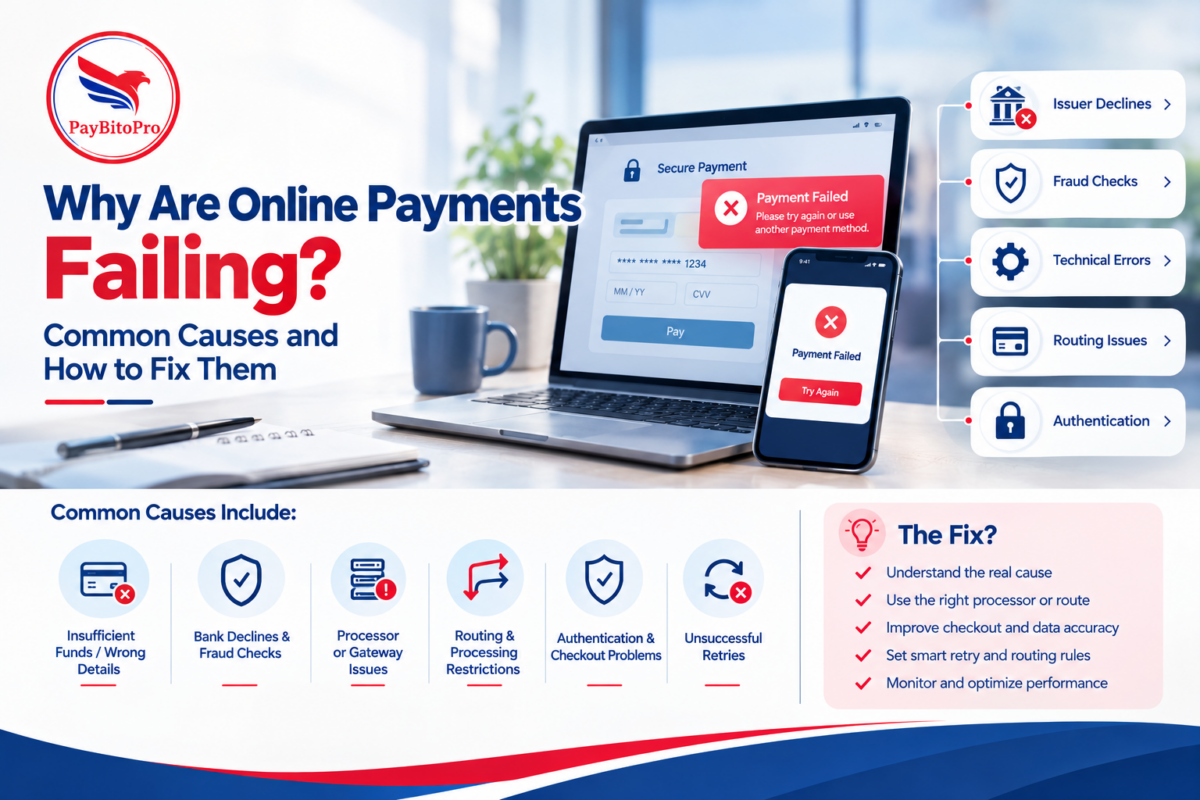
A customer reaches the checkout, enters their payment details, and clicks Pay. Then the transaction fails. Sometimes the customer tries again and succeeds. Other times, they leave without completing the purchase. For the business, the result is the same: A potentially valid sale is lost, and the reason may not be immediately obvious.
Online payments can fail for several reasons, including issuer declines, incorrect card details, fraud checks, technical errors, and processor outages. For high-risk businesses, the problem can be more complicated because payment providers may apply stricter risk controls or support only certain business categories and markets.
The first step toward fixing failed payments is understanding why they happen. Once the cause is clear, merchants can choose a solution instead of repeatedly retrying transactions and hoping for a different result.
Why Do Online Payments Fail?
A failed payment does not always mean a customer cannot afford the purchase. The transaction may be rejected by the issuing bank, interrupted by a technical problem, or blocked because a payment rule has not been satisfied. Here are some of the most common causes.
1. Insufficient Funds or Incorrect Card Details
Sometimes the explanation is straightforward. A customer may have insufficient available funds, enter an incorrect card number, use an expired card, or provide an incorrect security code.
How to fix it: Display a clear, helpful error message that tells the customer what to check without exposing sensitive payment information. Where appropriate, allow them to update their details or choose another payment method.
For recurring payments, expired cards and outdated billing details can cause repeated failures. A process for updating stored payment information can help reduce preventable declines.
2. Bank Declines and Fraud Checks
The card issuer ultimately decides whether to authorize many card transactions. It may decline a payment because of suspected fraud, unusual spending activity, geographic restrictions, or other account-specific rules. High-risk merchants may encounter additional scrutiny, depending on their industry, transaction patterns, and the policies of their acquiring partners.
How to fix it: Review decline codes and transaction patterns to distinguish issuer decisions from technical failures. Use appropriate fraud screening and authentication tools, and give customers a safe way to contact their bank or try another legitimate payment method when necessary.
Repeatedly sending the same declined transaction through different processors will not reliably overcome an issuer’s decision.
3. Payment Gateway or Processor Problems
A payment can fail even when the customer’s card details are valid. A gateway may experience an outage, a processor connection may time out, or a technical issue may interrupt communication between payment systems.
If a business relies on one processing connection, an issue with that connection can affect a large number of transactions at once. This is one reason using multiple payment processors to reduce business disruptions can be valuable. A compatible backup provider may help process eligible transactions when the primary connection becomes unavailable.
Merchants can also use payment routing strategies for high-risk businesses to direct transactions toward suitable providers based on configured rules and availability.
4. Payment Routing and Processing Restrictions
Not every processor supports every merchant, currency, payment method, or country. A transaction may fail because it is sent through a provider that cannot handle that particular combination. For high-risk businesses, processor compatibility matters even more. A provider may support the merchant’s business category but impose restrictions on certain products, markets, or transaction types.
How to fix it: Confirm that each processor supports the relevant transaction and that the merchant account is approved for the activity being processed. Review routing rules when failures repeatedly occur within a particular region or payment method.
A broader payment processing optimization strategy can help businesses assess these issues alongside processing costs, provider reliability, and approval performance.
5. Authentication and Checkout Issues
Some transactions require additional authentication, such as a 3-D Secure challenge. Payments can fail when authentication is not completed, a customer abandons the challenge, or a technical issue interrupts the checkout flow.
Checkout design can also contribute to failures. Confusing error messages, slow page loads, or problems on mobile devices may prevent customers from completing payment even when the processing infrastructure is working correctly.
How to fix it: Test the entire checkout journey across devices and browsers. Make authentication steps understandable, handle interruptions gracefully, and ensure customers can recover from errors without entering all their information again.
6. Why Retrying a Failed Payment Does Not Always Work?
Retrying can help when a failure is temporary, but it is not the right response to every decline. For example, a short-lived connection issue may justify another attempt. An expired card, suspected fraud, or a hard issuer decline usually requires a different action.
Payment cascading can help recover eligible failures by sending a transaction through another suitable processor when the initial attempt fails. The rules should account for the failure reason and confirm the transaction’s status before another attempt is made. This is how payment cascading can recover failed transactions without treating every unsuccessful payment as if it had the same cause.
Uncontrolled retries can increase costs, create unnecessary declines, and potentially cause duplicate charges if the original transaction actually succeeded despite a timeout.
How to Diagnose and Reduce Payment Failures?
Merchants should look beyond the total number of declined transactions. The useful question is whether failures share a pattern. Start with these practical checks:
- Group failures by reason: Separate issuer declines, technical errors, authentication failures, and processor restrictions.
- Compare provider performance: Check whether one processor has unusually high failure rates for a particular market or payment method.
- Review the checkout experience: Test payment flows on mobile and desktop, including authentication and error recovery.
- Monitor retries and recovery: Measure how often eligible retries succeed, while watching for duplicate charges and unnecessary processing costs.
A payment orchestration platform may help centralize provider connections, routing rules, and transaction reporting. Businesses evaluating that approach can explore how payment orchestration coordinates payment services. The aim is to make failures easier to identify and respond to, rather than adding more payment tools without understanding the underlying problem.
How Failed Payments Affect Approval Rates?
Payment approval rate measures the proportion of submitted transactions that receive approval, although the exact calculation can vary by reporting system. A lower rate may point to technical problems, unsuitable routing, issuer declines, fraud controls, or a mix of these factors.
Improving the rate requires identifying which failures are avoidable. Better processor selection may help with compatibility issues, while clearer checkout flows can reduce customer errors. Technical monitoring can reveal outages, and carefully configured routing or cascading may recover some eligible transactions.
These measures support strategies for improving payment approval rates in high-risk industries. The objective is not to force every transaction through. It is to help legitimate payments succeed while maintaining appropriate fraud controls and compliance.
Final Thoughts
Online payment failures have many causes, and each requires a different response. Incorrect card details call for better customer guidance. Issuer declines need careful handling. Technical outages may require backup processing, while routing and orchestration can help businesses manage complex payment environments.
For high-risk merchants, the most effective approach is to track failure reasons, check processor compatibility, test checkout flows, and use retries only when they make sense.
Do not treat every failed payment as the same problem. Understand what went wrong first, then fix the part of the payment journey responsible for it. That is how businesses reduce avoidable failures without creating new risks in the process.

Categories
- ACH Payments (10)
- adult payment processing (11)
- AI (9)
- Altcoins (10)
- Banking (10)
- Bitcoin (133)
- Bitcoin ETF (11)
- Bitcoin Price (30)
- Blockchain (50)
- Brokering World Hunger Away (16)
- Business (17)
- card payment processing (10)
- CBD (11)
- CBDC (11)
- Chargeback (8)
- coaching business (11)
- COVID-19 (3)
- Crypto ATMs (1)
- Crypto Banking (17)
- Crypto Bill (1)
- Crypto business owner platform (31)
- Crypto Investment (3)
- Crypto Markets (5)
- Crypto Payment (35)
- Crypto Payment Processor (4)
- Crypto Prices (1)
- Crypto Trading (92)
- Cryptocurrency (402)
- Cryptocurrency Exchange (108)
- Data Visualization (2)
- dating platforms (11)
- debt collection payment processing (10)
- Decentralized Finance (7)
- DeFi Payment (9)
- DEX (3)
- Digital Currency (23)
- dropshipping payment processing (12)
- Ethereum (2)
- FAQ (7)
- file sharing payment processing (11)
- Finance (25)
- Financial Equality (4)
- Financial Freedom (8)
- Forex (35)
- hemp (1)
- ICO (2)
- Investment (11)
- IPTV (11)
- Merchant Account (10)
- Mining (3)
- News (66)
- NFTs (2)
- online gambling (11)
- P2P (1)
- Paybito (147)
- PayBitoPro (693)
- PayBitoPro Coin Listing (6)
- PayBitoPro Exchange (2)
- Payment Gateway (48)
- peptide (10)
- Post COVID Digital Transformation (1)
- Press Release (130)
- Privacy & Security (3)
- Real Estate (1)
- Stablecoin (5)
- Technology (15)
- Travel (11)
- Uncategorized (10)
- US Presidential Election (2)
- Utility Coin (1)
- Web3 business (4)
- Web3 Wallets (2)
- White Label Crypto Exchange (8)
Recent Posts
- Payment Gateway vs. Payment Orchestration: What’s the Difference?
- What Is Smart Payment Routing? Strategies to Optimize Payment Performance
- How to Improve Payment Approval Rates for High-Risk Businesses?
- Why Are Online Payments Failing? Common Causes and How to Fix Them
- How to Use Multiple Payment Processors to Reduce Business Disruptions?