How to Use Multiple Payment Processors to Reduce Business Disruptions?
- October 9, 2026
- Soham Guchait
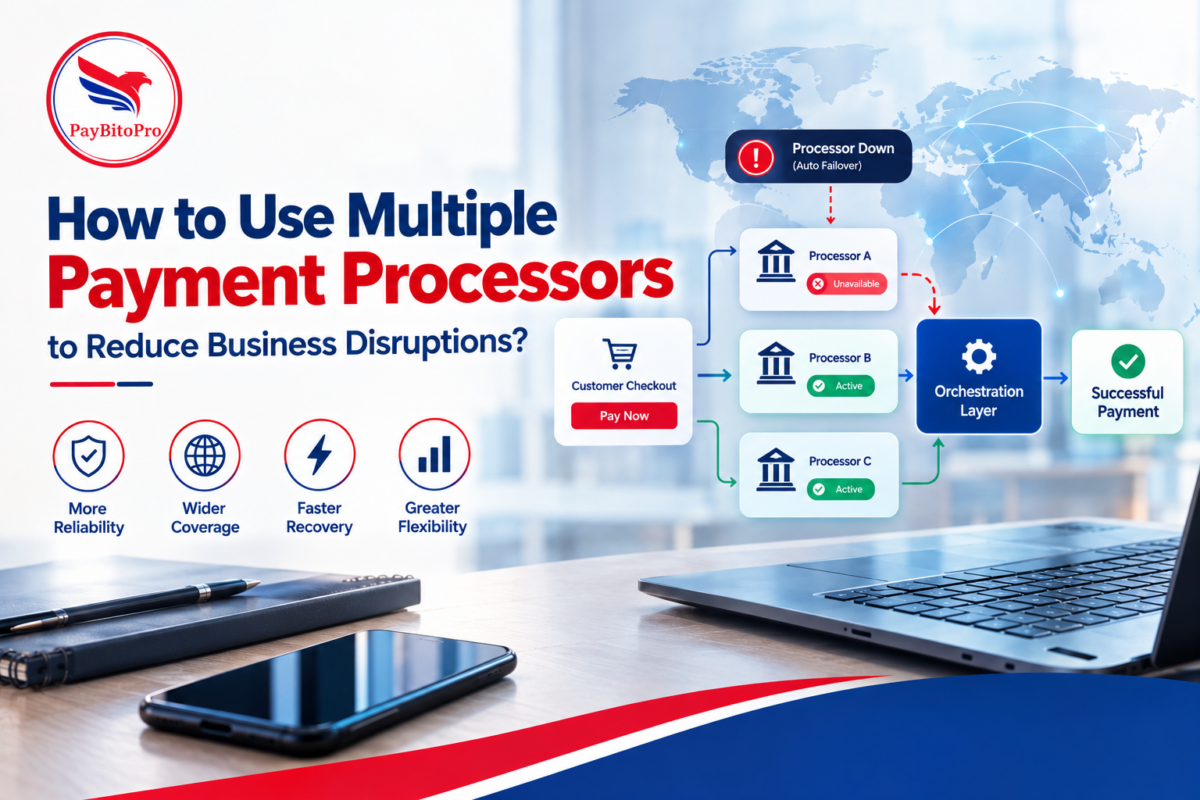
When a payment processor goes down, transactions can fail even when customers have valid cards and enough money to pay. For an online business, that can mean lost sales, interrupted subscriptions, frustrated customers, and a checkout experience that suddenly stops working.
Relying on one processor creates a potential single point of failure. Using multiple payment processors can reduce that dependency, giving a business alternative ways to process eligible transactions when one provider becomes unavailable or performs poorly. But adding processors alone will not solve the problem. The real value comes from choosing compatible providers, managing them effectively, and knowing when to switch between them.
Why Do Businesses Use Multiple Payment Processors?
A payment processor connects a business to the infrastructure needed to authorize and complete electronic payments. Each provider has its own technical setup, supported markets, risk policies, and acquiring relationships.
If a business depends entirely on one provider, an outage, account restriction, integration issue, or change in processing conditions can disrupt its ability to accept payments. Multiple processors create flexibility. If one connection experiences a technical problem, another may be able to handle eligible transactions, assuming it supports the payment method, region, currency, and merchant category.
This is especially relevant for high-risk businesses, which may face narrower processor availability and more demanding underwriting requirements. Building a resilient setup is one part of broader payment processing optimization for high-risk merchants.
How to Build a Multi-Processor Payment Setup?
The goal is not to connect as many providers as possible. It is to create a reliable arrangement in which each processor has a clear purpose.
1. Identify Your Business’s Processing Risks
Start by understanding where payment disruptions are most likely to occur. Review failed transactions, processor outages, authorization rates, geographic coverage, and any recurring integration problems.
For example, a subscription business may be particularly exposed when recurring billing runs in large batches. An international merchant may depend heavily on a provider that supports several important markets.
This assessment helps determine whether you need a backup processor for outages, better coverage in specific regions, or another provider with different acquiring capabilities.
2. Choose Compatible Backup Processors
A secondary processor is useful only if it can actually process the transactions you need to recover.
Before signing an agreement, confirm that each provider supports your industry, payment methods, currencies, target markets, and transaction types. High-risk merchants should also confirm underwriting approval and any restrictions that apply to their business model. Do not assume that a provider accepting your business today will support every product, market, or transaction type you introduce later.
3. Connect Providers Through a Suitable Integration
Businesses can integrate each processor separately or use a payment orchestration platform to manage several connections through a central layer. Direct integrations may provide greater control, but they can increase engineering and maintenance work. Orchestration can simplify provider management and reporting, depending on the platform’s capabilities.
For merchants comparing these approaches, understanding how payment orchestration coordinates multiple payment services can help clarify whether a centralized layer fits their technical and operational needs.
4. Establish Routing and Failover Rules
Once multiple processors are connected, the business needs rules that determine where transactions go.
A routing system might send transactions to a preferred provider based on geography, currency, payment method, or historical performance. If that provider becomes unavailable, a failover rule may direct eligible transactions to a backup connection.
These decisions should be based on actual provider capabilities and transaction conditions. The principles behind payment routing for high-risk businesses are useful here because a backup route must be selected deliberately, not simply chosen at random.
How Multiple Processors Reduce Business Disruptions?
A multi-processor setup can protect payment operations in several ways.
- Backup processing during outages: If the primary connection becomes unavailable, eligible transactions may be redirected to another functioning provider.
- Reduced dependence on one provider: A business has more flexibility when a processor changes its supported markets, technical requirements, or risk policies.
- Better regional coverage: Different processors may offer suitable acquiring capabilities for different countries or payment methods.
- More informed performance decisions: Comparing transaction outcomes across providers can help merchants identify where processing problems are concentrated.
These benefits are not automatic. If every processor relies on the same underlying infrastructure, or if the backup provider has the same limitation, switching may not help. Resilience depends on having genuinely usable alternatives.
What Happens When a Transaction Fails?
Not every failed payment should be sent to another processor. The reason for the failure matters.
A timeout or temporary technical error may justify a controlled recovery attempt, provided the system checks the transaction’s status first. A hard decline, suspected fraud, or other issuer decision may require a different response.
This is where payment cascading can complement a multi-processor setup. Rather than treating every failed transaction identically, payment cascading rules for recovering eligible failed transactions determine when another attempt is appropriate and which alternative route may be used.
Careful handling is essential. If the first processor times out after the payment has actually been authorized, blindly submitting the transaction again could create a duplicate charge. Transaction-status checks and idempotency controls help reduce that risk.
Common Mistakes to Avoid
A multi-processor setup can introduce new complexity if it is poorly managed. Watch for these common problems:
- Choosing providers based only on price: Lower processing fees do not necessarily compensate for poor compatibility, limited support, or weak backup coverage.
- Ignoring approval performance: A provider that works well for one region or payment method may perform differently elsewhere.
- Failing to test failover: A backup connection that has never been tested may fail when it is needed most.
- Retrying unsuitable transactions: Repeatedly submitting hard declines can waste resources and create compliance or risk concerns.
- Overlooking monitoring: Without alerts and centralized reporting, teams may not notice an outage until customers start complaining.
It is also worth reviewing strategies to improve payment approval rates for high-risk businesses. A second processor is useful only when it improves the merchant’s ability to handle eligible transactions reliably, without introducing unnecessary costs or risk.
How to Measure Multi-Processor Performance
Track more than whether the backup processor is online. Review the frequency and duration of outages, the number of eligible transactions successfully recovered, approval rates by provider, processing costs, and duplicate-payment incidents.
Compare results by market, payment method, and transaction type. This can reveal whether a particular processor is a strong backup for specific transactions or whether your routing rules need adjustment.
Over time, smart payment routing strategies can help businesses use performance data to make more informed decisions about which processor should receive a transaction first.
Final Thoughts
Using multiple payment processors can reduce dependence on a single provider and give online businesses more options when payment disruptions occur. For high-risk merchants, that flexibility can be particularly valuable when provider availability and processing requirements vary across markets.
The strongest setup combines compatible processors, tested failover rules, sensible transaction recovery, and ongoing monitoring. More connections are not the goal. Reliable alternatives are. When every processor has a clear role and the system knows when to use each one, a technical problem with one provider is less likely to become a business-wide payment disruption.

Categories
- ACH Payments (10)
- adult payment processing (11)
- AI (9)
- Altcoins (10)
- Banking (10)
- Bitcoin (133)
- Bitcoin ETF (11)
- Bitcoin Price (30)
- Blockchain (50)
- Brokering World Hunger Away (16)
- Business (17)
- card payment processing (10)
- CBD (11)
- CBDC (11)
- Chargeback (8)
- coaching business (11)
- COVID-19 (3)
- Crypto ATMs (1)
- Crypto Banking (17)
- Crypto Bill (1)
- Crypto business owner platform (31)
- Crypto Investment (3)
- Crypto Markets (5)
- Crypto Payment (35)
- Crypto Payment Processor (4)
- Crypto Prices (1)
- Crypto Trading (92)
- Cryptocurrency (402)
- Cryptocurrency Exchange (108)
- Data Visualization (2)
- dating platforms (11)
- debt collection payment processing (10)
- Decentralized Finance (7)
- DeFi Payment (9)
- DEX (3)
- Digital Currency (23)
- dropshipping payment processing (12)
- Ethereum (2)
- FAQ (7)
- file sharing payment processing (11)
- Finance (25)
- Financial Equality (4)
- Financial Freedom (8)
- Forex (35)
- hemp (1)
- ICO (2)
- Investment (11)
- IPTV (11)
- Merchant Account (10)
- Mining (3)
- News (66)
- NFTs (2)
- online gambling (11)
- P2P (1)
- Paybito (147)
- PayBitoPro (693)
- PayBitoPro Coin Listing (6)
- PayBitoPro Exchange (2)
- Payment Gateway (48)
- peptide (10)
- Post COVID Digital Transformation (1)
- Press Release (130)
- Privacy & Security (3)
- Real Estate (1)
- Stablecoin (5)
- Technology (15)
- Travel (11)
- Uncategorized (10)
- US Presidential Election (2)
- Utility Coin (1)
- Web3 business (4)
- Web3 Wallets (2)
- White Label Crypto Exchange (8)
Recent Posts
- Payment Gateway vs. Payment Orchestration: What’s the Difference?
- What Is Smart Payment Routing? Strategies to Optimize Payment Performance
- How to Improve Payment Approval Rates for High-Risk Businesses?
- Why Are Online Payments Failing? Common Causes and How to Fix Them
- How to Use Multiple Payment Processors to Reduce Business Disruptions?