What Is Smart Payment Routing? Strategies to Optimize Payment Performance
- October 9, 2026
- Soham Guchait
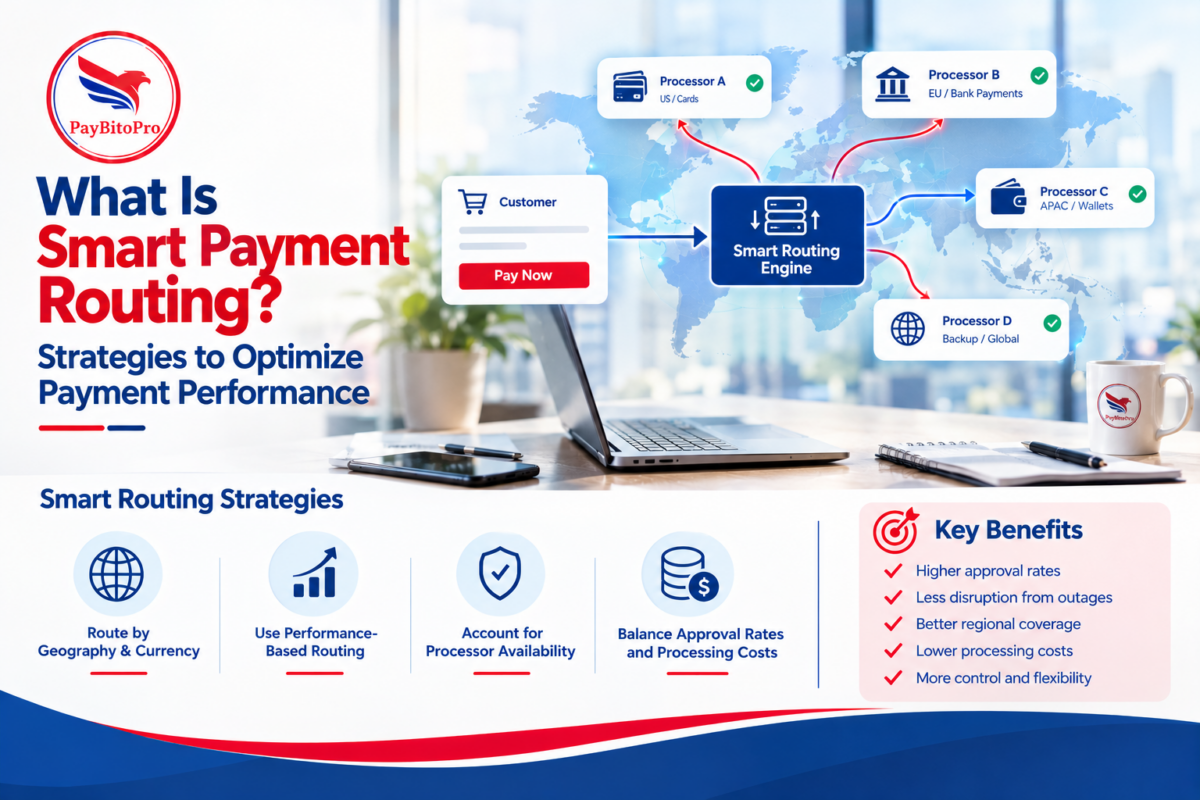
Sending every online payment through the same processor may seem simple, but it is not always the most effective approach. One provider might perform better in a particular region, another may support a specific payment method more reliably, and a third may offer a useful backup when technical problems occur.
Smart payment routing helps businesses choose a suitable processing path for each transaction using predefined rules, transaction details, and, where available, performance data.
For high-risk businesses, where processor compatibility and approval performance can vary considerably, this approach can improve control over payment operations. It also supports broader payment processing optimization for high-risk merchants.
What Is Smart Payment Routing?
Smart payment routing is a payment-management approach that directs transactions to suitable processors or acquiring connections based on selected criteria.
Basic routing may use fixed rules, such as sending transactions in a particular currency to a specific processor. More advanced systems can consider factors such as historical approval rates, provider availability, processing costs, and transaction characteristics. The goal is to choose a route that fits the transaction rather than treating every payment identically.
For example, an online business serving customers across several countries may use different processors for different markets. Smart routing can apply those preferences automatically, reducing the need for manual decisions and helping the business respond to changing processing conditions.
However, routing cannot guarantee approval. The issuing bank still makes authorization decisions, and a transaction may fail because of insufficient funds, suspected fraud, or other factors outside the merchant’s control.
How Does Smart Payment Routing Work?
Although implementations differ, the process generally follows four steps.
- Collect transaction details – The system identifies relevant information, such as currency, payment method, customer region, and transaction amount.
- Evaluate routing rules – It checks which connected processors can handle the transaction and which rules apply.
- Select a processing route – The system sends the transaction to a suitable provider based on the available information.
- Track the outcome – The merchant reviews approvals, declines, costs, and technical errors to understand whether the routing strategy is working.
Some systems use relatively simple rules, while others use historical performance data to guide decisions. The quality of the result depends on accurate information, suitable processor connections, and rules that reflect the business’s actual needs.
Smart Payment Routing Strategies That Work
There is no single routing strategy that suits every merchant. The right approach depends on where customers are located, which payment methods they use, and what the available processors can support.
1. Route Payments by Geography and Currency
Processors may perform differently across regions because of their acquiring relationships, supported currencies, and local payment capabilities.
A merchant can configure routing rules to send transactions to providers that support the relevant market and payment method. This is especially useful for businesses expanding internationally. The key is to confirm that the selected provider is approved to process the merchant’s business and transaction type in that region.
2. Use Performance-Based Routing
Performance-based routing considers historical results when selecting a processor. A business might compare approval rates by region, card type, or payment method and use those findings to refine its routing rules.
For example, if one processor consistently handles eligible transactions more successfully in a particular market, the merchant may prioritize that connection for similar payments. However, historical performance is not a guarantee of future results. Merchants should monitor changes regularly and avoid relying on small or unrepresentative samples.
3. Account for Processor Availability
A processor outage can interrupt payments even when customers have valid payment details. Routing rules that account for provider availability can help prevent transactions from being sent to a connection that is known to be unavailable.
This is particularly valuable when a business uses multiple payment processors to reduce dependence on a single provider.
A backup route must be genuinely compatible with the transaction. If the alternative processor does not support the payment method, market, or merchant category, switching providers will not solve the problem.
4. Balance Approval Rates and Processing Costs
The processor with the highest approval rate is not automatically the best choice for every transaction. Processing fees, currency-conversion costs, technical reliability, and fraud exposure all affect the overall result.
Merchants should evaluate routing decisions against their broader business objectives instead of optimizing one metric in isolation. For high-risk businesses, this also means ensuring that routing rules respect processor restrictions and applicable payment-network requirements.
How Smart Routing Works With Cascading and Orchestration
Smart routing is connected to two other payment-management concepts: cascading and orchestration.
Payment cascading addresses eligible failures after an initial transaction attempt. If a processor encounters a temporary technical problem, a cascading rule may allow the transaction to be retried through another suitable connection. As explained in payment cascading and failed-transaction recovery, retries must be controlled and based on the reason for failure.
Payment orchestration coordinates multiple payment providers and related workflows through a central platform. Depending on its capabilities, it may combine routing rules, provider connections, reporting, and cascading into one management layer. Businesses evaluating this model can explore how payment orchestration works for online businesses.
These capabilities can complement one another, but they are not interchangeable. Routing chooses a path, cascading manages certain recovery attempts, and orchestration coordinates the wider payment setup.
Common Smart Routing Mistakes to Avoid
Even a well-connected payment setup can underperform if its routing rules are poorly designed.
- Using outdated performance data: Processor performance can change, so review results regularly instead of relying on old assumptions.
- Retrying every declined transaction: Hard declines and suspected fraud require appropriate handling, not automatic resubmission through another provider.
- Ignoring transaction status: A timeout does not always mean a payment failed. Confirm the outcome before retrying to reduce the risk of duplicate charges.
Merchants should also investigate the underlying reasons for failed payments. Understanding common online payment failures and their causes helps ensure routing changes address genuine problems rather than masking them.
How to Measure Routing Performance?
Smart routing should be evaluated using more than the total number of approved transactions. Track approval rates by processor, market, and payment method. Also review processing costs, technical failures, eligible recovery rates, chargebacks, and duplicate-payment incidents.
These measures help reveal whether a routing rule improves the overall payment experience or simply shifts costs and risks elsewhere. They also support strategies to improve payment approval rates for high-risk businesses.
Final Thoughts
Smart payment routing gives online businesses a structured way to choose suitable processors for different transactions. When supported by reliable data and compatible provider connections, it can help merchants manage regional differences, respond to technical disruptions, and make more informed processing decisions.
For high-risk businesses, the objective is not to route every transaction toward the processor with the highest headline approval rate. It is to find a suitable, compliant, and cost-effective path for each payment – and keep reviewing the results as conditions change.

Categories
- ACH Payments (10)
- adult payment processing (11)
- AI (9)
- Altcoins (10)
- Banking (10)
- Bitcoin (133)
- Bitcoin ETF (11)
- Bitcoin Price (30)
- Blockchain (50)
- Brokering World Hunger Away (16)
- Business (17)
- card payment processing (10)
- CBD (11)
- CBDC (11)
- Chargeback (8)
- coaching business (11)
- COVID-19 (3)
- Crypto ATMs (1)
- Crypto Banking (17)
- Crypto Bill (1)
- Crypto business owner platform (31)
- Crypto Investment (3)
- Crypto Markets (5)
- Crypto Payment (35)
- Crypto Payment Processor (4)
- Crypto Prices (1)
- Crypto Trading (92)
- Cryptocurrency (402)
- Cryptocurrency Exchange (108)
- Data Visualization (2)
- dating platforms (11)
- debt collection payment processing (10)
- Decentralized Finance (7)
- DeFi Payment (9)
- DEX (3)
- Digital Currency (23)
- dropshipping payment processing (12)
- Ethereum (2)
- FAQ (7)
- file sharing payment processing (11)
- Finance (25)
- Financial Equality (4)
- Financial Freedom (8)
- Forex (35)
- hemp (1)
- ICO (2)
- Investment (11)
- IPTV (11)
- Merchant Account (10)
- Mining (3)
- News (66)
- NFTs (2)
- online gambling (11)
- P2P (1)
- Paybito (147)
- PayBitoPro (693)
- PayBitoPro Coin Listing (6)
- PayBitoPro Exchange (2)
- Payment Gateway (48)
- peptide (10)
- Post COVID Digital Transformation (1)
- Press Release (130)
- Privacy & Security (3)
- Real Estate (1)
- Stablecoin (5)
- Technology (15)
- Travel (11)
- Uncategorized (10)
- US Presidential Election (2)
- Utility Coin (1)
- Web3 business (4)
- Web3 Wallets (2)
- White Label Crypto Exchange (8)
Recent Posts
- Payment Gateway vs. Payment Orchestration: What’s the Difference?
- What Is Smart Payment Routing? Strategies to Optimize Payment Performance
- How to Improve Payment Approval Rates for High-Risk Businesses?
- Why Are Online Payments Failing? Common Causes and How to Fix Them
- How to Use Multiple Payment Processors to Reduce Business Disruptions?