What Is Payment Orchestration? A Complete Guide for Online Businesses
- October 9, 2026
- Soham Guchait
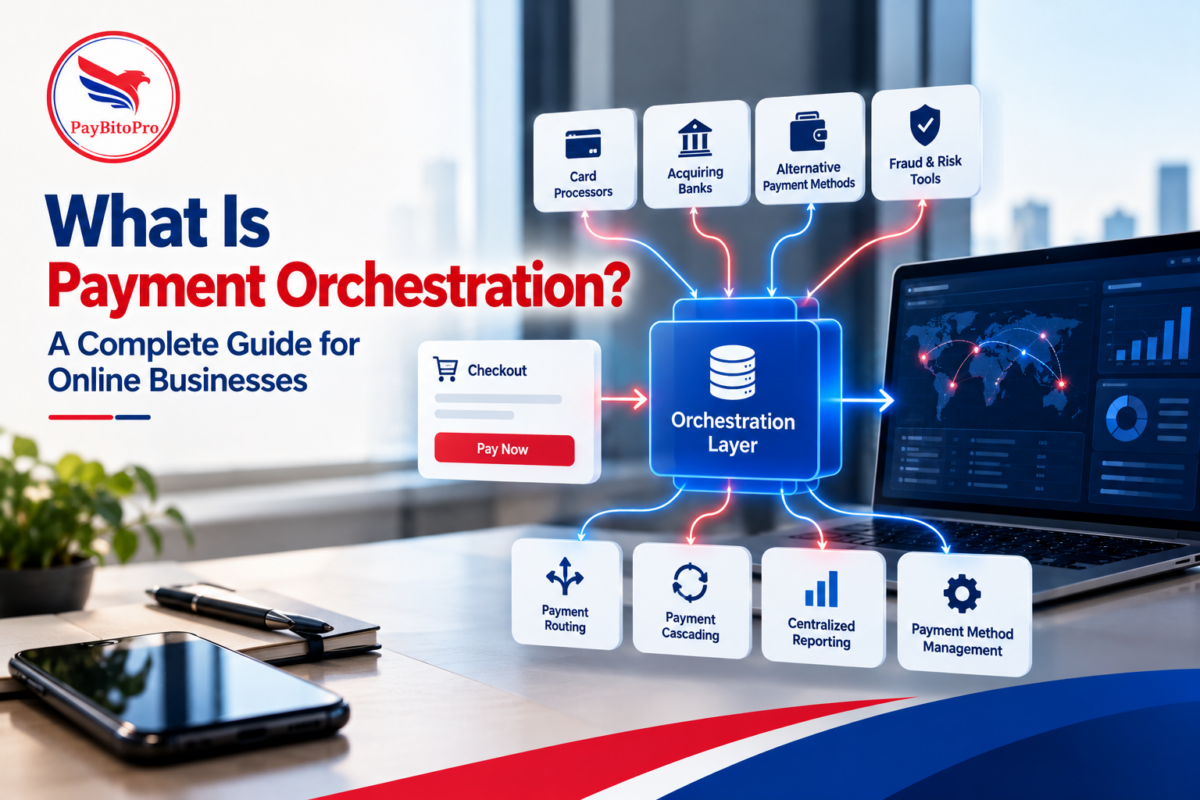
As an online business grows, payment processing often becomes more complicated than simply connecting a checkout page to a payment gateway. Different markets require different payment methods, processors perform differently across regions, and a technical issue with one provider can disrupt transactions across the business.
Managing all these connections separately can quickly become difficult. That is where payment orchestration comes in.
Payment orchestration helps businesses coordinate multiple payment providers, processing connections, and payment-related workflows through a unified system. For high-risk merchants, where processor availability, approval rates, and risk requirements can vary significantly, that coordination can make payment operations easier to manage.
What Is Payment Orchestration?
Payment orchestration is the process of managing and coordinating payment services through a central platform or integration layer. Depending on the solution, this may include payment gateways, processors, acquiring banks, fraud tools, alternative payment methods, and transaction-routing rules.
Instead of building and maintaining separate integrations for every provider, a business can use an orchestration layer to connect to multiple services and manage how transactions move between them.
For example, an online subscription business might accept payments from customers in several countries. One processor may work well for domestic card payments, while another may support a particular region or payment method more effectively. An orchestration platform can help direct transactions according to the merchant’s configured rules and available provider capabilities.
This approach supports broader payment processing optimization for high-risk merchants by making it easier to manage processing options, respond to failures, and evaluate payment performance across providers.
How Does Payment Orchestration Work?
The exact setup depends on the platform, but the general process follows a few steps.
- A customer initiates a payment – The transaction begins at checkout or through a recurring billing process.
- The orchestration layer evaluates the transaction – It applies configured rules based on factors such as payment method, currency, location, provider availability, or processing requirements.
- The transaction is sent to a suitable provider – The selected gateway, processor, or acquiring connection handles the payment attempt.
- The result is returned and recorded – The system collects the outcome and may pass relevant information to other connected services.
- Additional actions happen when appropriate – Depending on its capabilities, the platform may trigger an eligible retry, send a failed transaction through another route, or provide reporting that helps the merchant investigate the problem.
The main benefit is coordination. Instead of managing every provider as a separate operational island, the business can apply consistent rules across a connected payment environment.
Key Features of a Payment Orchestration Platform
Not every platform offers the same features. Some focus mainly on routing and connectivity, while others provide a wider set of payment-management tools. Common capabilities include:
- Multi-provider connectivity: Integrations with multiple gateways, processors, acquirers, or alternative payment methods.
- Payment routing: Rules that determine which provider receives a transaction based on defined business or performance criteria.
- Payment cascading: Configured recovery attempts through another suitable provider when an initial transaction fails for an eligible reason.
- Centralized reporting: A consolidated view of transaction outcomes, provider performance, and processing issues.
- Payment method management: Support for connecting and coordinating different payment options across markets.
- Fraud and risk integrations: Connections to tools that assess transactions, subject to the platform’s capabilities and the merchant’s configuration.
These features can work together, but orchestration does not automatically guarantee higher approval rates or prevent every failed transaction. Results depend on the quality of the integrations, the rules being applied, and the providers available to the merchant.
Why Does Payment Orchestration Matter for High-Risk Businesses?
High-risk businesses can face additional payment-processing challenges. Certain acquiring banks may not support their industry, some providers may impose geographic or transaction restrictions, and risk controls can affect how payments are evaluated.
Relying on a single processing connection may leave a business exposed to outages, changing provider requirements, or poor performance in a particular market. Orchestration can help merchants manage multiple compatible connections without treating each one as a completely separate system.
It also makes it easier to see where problems occur. If approval rates decline in one region or a provider begins returning more technical errors, centralized reporting may help the business identify the issue and adjust its setup. Of course, orchestration is not a workaround for underwriting rules. Merchants still need legitimate provider relationships, appropriate risk controls, and compliance with applicable requirements.
Payment Orchestration vs. Routing and Cascading
These concepts are related, but they solve different problems.
Payment routing determines where a transaction should go. Routing rules might consider provider availability, transaction currency, geography, or historical performance. Businesses exploring how payment routing works for high-risk merchants will find that routing is one of the core functions that orchestration platforms may coordinate.
Payment cascading focuses on recovering eligible failed transactions by attempting another suitable processing route. For example, when a provider experiences a temporary technical issue, a cascading rule may allow a retry through a backup connection. The recovery logic needs to distinguish between temporary errors and declines that should not be resubmitted.
Payment orchestration operates at a broader level. It can bring routing, cascading, provider integrations, and reporting together within one management layer.
This is also why orchestration should not be confused with a payment gateway. A gateway typically facilitates the secure transmission of payment information, while an orchestration platform coordinates services across a broader payment setup. The precise division of responsibilities varies by provider, which is important when assessing payment gateways versus payment orchestration.
How to Choose a Payment Orchestration Solution
Before choosing a platform, businesses should look beyond the number of integrations advertised. The important question is whether those connections support the business’s actual payment requirements. Start by checking:
- Provider compatibility: Does the platform connect to processors and acquirers that support your industry, regions, and payment methods?
- Routing and recovery controls: Can you configure rules for transaction routing and eligible retries without creating unnecessary duplicate attempts?
- Reporting quality: Can you compare provider performance, decline reasons, approval rates, and processing costs?
- Integration requirements: How much engineering work is needed to connect the platform to your checkout, billing system, and fraud tools?
- Compliance and security: Does the proposed setup support your security obligations and relevant payment-industry requirements?
A business should also understand the platform’s pricing and operational limitations. A unified interface is useful, but it will not solve problems caused by unsuitable processors or poorly designed payment rules.
How Payment Orchestration Can Improve Payment Performance
Orchestration gives businesses more control over how payment services work together. When configured properly, it can help reduce the burden of maintaining separate integrations, make provider changes easier to manage, and improve visibility into failed transactions.
Those insights can support a broader strategy for improving payment approval rates in high-risk industries. Merchants can investigate whether declines are tied to technical failures, issuer decisions, provider limitations, or other causes before deciding what to change.
It can also support smart payment routing strategies by making transaction and provider data easier to use when applying routing rules. However, better coordination is not the same as guaranteed payment success. Businesses still need suitable providers, accurate failure handling, sensible retry limits, and regular performance reviews.
Final Thoughts
Payment orchestration provides a central way to coordinate payment providers, routing decisions, eligible recovery attempts, and transaction reporting. For online businesses with multiple markets, payment methods, or processing relationships, it can simplify an increasingly complicated setup.
For high-risk merchants, its value lies in visibility and control: understanding where transactions go, identifying why they fail, and making informed changes without rebuilding the payment stack every time a provider or business requirement changes.
The best solution is not necessarily the one with the most features. It is the one that fits the merchant’s processing needs and helps manage payments more reliably, transparently, and efficiently.

Categories
- ACH Payments (10)
- adult payment processing (11)
- AI (9)
- Altcoins (10)
- Banking (10)
- Bitcoin (133)
- Bitcoin ETF (11)
- Bitcoin Price (30)
- Blockchain (50)
- Brokering World Hunger Away (16)
- Business (17)
- card payment processing (10)
- CBD (11)
- CBDC (11)
- Chargeback (8)
- coaching business (11)
- COVID-19 (3)
- Crypto ATMs (1)
- Crypto Banking (17)
- Crypto Bill (1)
- Crypto business owner platform (31)
- Crypto Investment (3)
- Crypto Markets (5)
- Crypto Payment (35)
- Crypto Payment Processor (4)
- Crypto Prices (1)
- Crypto Trading (92)
- Cryptocurrency (402)
- Cryptocurrency Exchange (108)
- Data Visualization (2)
- dating platforms (11)
- debt collection payment processing (10)
- Decentralized Finance (7)
- DeFi Payment (9)
- DEX (3)
- Digital Currency (23)
- dropshipping payment processing (12)
- Ethereum (2)
- FAQ (7)
- file sharing payment processing (11)
- Finance (25)
- Financial Equality (4)
- Financial Freedom (8)
- Forex (35)
- hemp (1)
- ICO (2)
- Investment (11)
- IPTV (11)
- Merchant Account (10)
- Mining (3)
- News (66)
- NFTs (2)
- online gambling (11)
- P2P (1)
- Paybito (147)
- PayBitoPro (693)
- PayBitoPro Coin Listing (6)
- PayBitoPro Exchange (2)
- Payment Gateway (48)
- peptide (10)
- Post COVID Digital Transformation (1)
- Press Release (130)
- Privacy & Security (3)
- Real Estate (1)
- Stablecoin (5)
- Technology (15)
- Travel (11)
- Uncategorized (10)
- US Presidential Election (2)
- Utility Coin (1)
- Web3 business (4)
- Web3 Wallets (2)
- White Label Crypto Exchange (8)
Recent Posts
- Payment Gateway vs. Payment Orchestration: What’s the Difference?
- What Is Smart Payment Routing? Strategies to Optimize Payment Performance
- How to Improve Payment Approval Rates for High-Risk Businesses?
- Why Are Online Payments Failing? Common Causes and How to Fix Them
- How to Use Multiple Payment Processors to Reduce Business Disruptions?