An Operating System for the Digital Economy: What It Means for Developers?
- July 31, 2026
- Soham Guchait
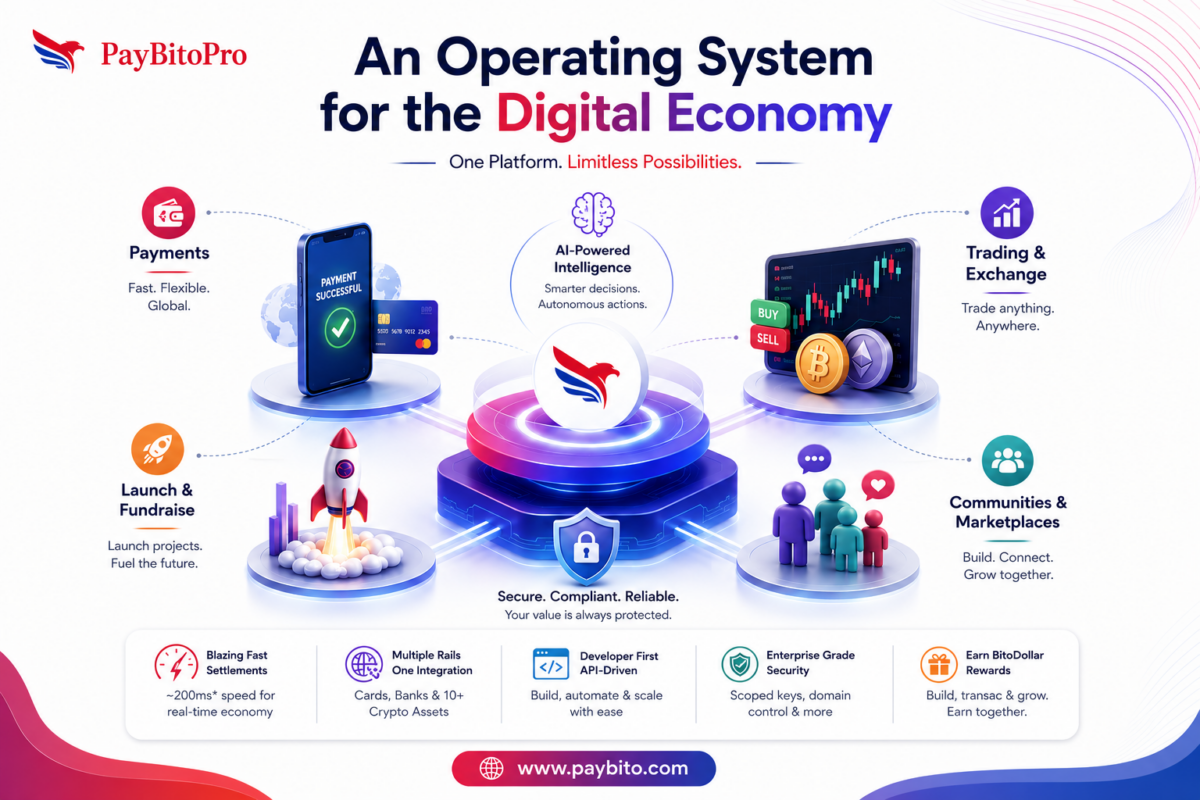
For more than three decades, building on the internet meant building on infrastructure designed for information — protocols that move data, browsers that render pages, and applications that present content.
Finance remained the last frontier. The movement of value stayed confined to banks, card networks, and financial infrastructure built for institutions rather than software. Banking digitized ledgers and records, but it never made value itself programmable.
PayBito is building that missing layer.
Not another app. Not another exchange. Not another payment button.
An operating layer for value itself.
What Is an Operating System for the Digital Economy?
An operating system doesn’t do any one thing especially well. It does something more important: it gives every application below it a common set of primitives (memory, storage, networking, permissions) so builders don’t have to reinvent them. The value of an OS compounds with every app built on it.
PayBito is built on a simple thesis: the digital economy needs an operating system for value, just as computing needed an operating system for computation.
It is called the Value Exchange System — a programmable operating layer where value can be created, moved, negotiated, invested, and exchanged autonomously across finance, commerce, and communities by AI agents and software.
Most payment platforms are designed to move money. Most exchanges are designed to match trades. PayBito brings together in a single programmable platform — and extends beyond them by enabling software to negotiate, execute, and settle the transactions that connect them.
Every operating system evolves in layers. PayBito’s Value Exchange System is being built around three capabilities that ultimately converge into one platform:
1. A connected digital economy that is programmable. Payments, settlement, custody, and exchange stop being separate tools you have to connect yourself. They become simple building blocks. A checkout, a broker account, a token launch, and a trading engine all work the same way, so your app can combine them easily, the same way you’d combine any other functions in your code.
2. AI agents assisting human actors. Before agents act alone, they act alongside people: pricing a trade, drafting a settlement, flagging risk, reconciling a ledger, negotiating terms. This collapses work that used to take a support team into a call a developer’s app makes on a user’s behalf.
3. AI agents acting autonomously as authorized by human actors. The furthest stage, and the one everything else is scaffolding for: agents that hold scoped authority to move value, execute trades, rebalance a treasury, or settle a marketplace payout without a human in the loop for every step, bounded by the permissions a person explicitly grants.
That progression (programmable rails, then assisted actions, then authorized autonomy) is the actual product roadmap. Every API Paybito ships is building toward agents being first-class actors in the economy, not just users clicking buttons faster.
Why Does This Matter to You as a Developer?
Every software platform succeeds because it gives developers primitives they don’t have to build themselves.
You don’t build your own database anymore — you use one. You don’t build your own authentication system — you integrate one. You don’t write your own cloud infrastructure — you deploy to one.
PayBito does the same thing for the movement of value.
Instead of stitching together payment processors, exchanges, wallets, settlement systems, identity providers, merchant onboarding, and compliance workflows, you build on a single programmable layer.
That changes what you spend your time building. Instead of integrating infrastructure, you build products.
Imagine building a marketplace where an AI agent negotiates a purchase, collects payment, converts between currencies, settles funds to multiple parties, and records every transaction — all through one platform. Or a trading application that combines payments, custody, and exchange without requiring half a dozen third-party integrations. Or a social commerce experience where buying, selling, rewarding, and investing are native capabilities rather than disconnected services.
The infrastructure already exists. Your application simply orchestrates it.
Every capability is exposed through a consistent developer surface: authentication, wallets, payments, checkout, settlement, exchanges, launches, merchant accounts, webhooks, and AI-ready APIs. Instead of building the financial plumbing yourself, you compose these primitives into entirely new products.
That’s the real advantage. PayBito doesn’t just give developers another API. It gives them a programmable financial operating layer, allowing them to focus on creating new experiences rather than rebuilding the infrastructure that powers them.
From Plugin to Platform
1. Build apps across every Paybito platform. The Payment Platform, Launch Platform, and Exchange Platform, Social commerce are all addressable through the same developer surface. Build a checkout experience, a token launch flow, or a trading interface, and plug it into infrastructure that’s already handling settlement, custody, and compliance underneath you.
2. Design an entirely new platform for your own clients. This is the step past integration: white-labeling the rails themselves. Spin up your own branded exchange and financial services platform, or your own branded payments platform, running on Paybito’s infrastructure but carrying your identity, your economics, and your configuration. You’re not a plugin on someone else’s product; you’re shipping your own.
3. Build the layer above the rails. Social commerce, community tools, messaging, feeds, marketplace integrations, and AI-powered experiences. Instead of adding payments as an afterthought, you build them in from the start. For example, an agent could negotiate a group deal in a community feed and settle it right there, because payments and commerce are part of the same system.
4. Build and sell apps through the Paybito App Store and Developer Portal. Beyond building your own platform, you can build individual apps and tools, like trading add-ons, integrations, and extensions, and publish them where existing Paybito merchants and traders can find and use them. You get built-in distribution instead of starting from zero users. Activity on your app also earns BitoDollar, Paybito’s shared rewards token, the same way any transaction on the platform does.
Why Building Early on PayBito Matters More?
Timing matters when you’re picking a platform to build on. Here are five practical reasons to look at Paybito now rather than later.
Early means greater visibility. PayBito’s community layer, BitoCircle, is still growing, and early builders benefit from a less crowded ecosystem. Apps launched today are more likely to be discovered, adopted, and shared while the platform is in its early stages. As the ecosystem expands and more applications compete for attention, earning that visibility naturally becomes more difficult.
You’re building on production infrastructure, not a beta. PayBito already powers payments for real businesses and supports live financial activity every day. Your application isn’t launching into an empty sandbox waiting for users — it’s connecting to an ecosystem with active merchants, traders, customers, and real transaction volume from day one.
You get a direct line to the team while the platform is still growing.
You get direct access to the team while the platform is still taking shape. Early developers don’t just build on PayBito — they help shape it. Your feedback can influence the APIs we prioritize, the capabilities we introduce, and the improvements we make. As the platform scales to thousands of developers, that level of collaboration naturally becomes much harder to maintain.
Early integrations get first pick of the App Store shelf.
As more developers publish applications to the PayBito App Store and Developer Portal, discovery naturally becomes more competitive. By publishing early, your app has the opportunity to establish visibility, build adoption, and become one of the first solutions merchants and traders encounter when exploring the ecosystem.
Build What’s Next
Everything described here is live today — the APIs, webhooks, App Store, white-label infrastructure, and BitoDollar. You’re not building against a roadmap; you’re building on production infrastructure.
Every major computing platform created outsized opportunities for the developers who built before everyone else. As software becomes capable of moving, negotiating, and exchanging value autonomously, the same opportunity is emerging again.
The operating system for the digital economy is still being built. This time, you have the opportunity to help build it.

Categories
- ACH Payments (10)
- adult payment processing (11)
- AI (9)
- Altcoins (10)
- Banking (10)
- Bitcoin (133)
- Bitcoin ETF (11)
- Bitcoin Price (30)
- Blockchain (50)
- Brokering World Hunger Away (16)
- Business (17)
- card payment processing (10)
- CBD (11)
- CBDC (11)
- Chargeback (8)
- coaching business (11)
- COVID-19 (3)
- Crypto ATMs (1)
- Crypto Banking (17)
- Crypto Bill (1)
- Crypto business owner platform (31)
- Crypto Investment (3)
- Crypto Markets (5)
- Crypto Payment (35)
- Crypto Payment Processor (4)
- Crypto Prices (1)
- Crypto Trading (92)
- Cryptocurrency (402)
- Cryptocurrency Exchange (108)
- Data Visualization (2)
- dating platforms (11)
- debt collection payment processing (10)
- Decentralized Finance (7)
- DeFi Payment (9)
- DEX (3)
- Digital Currency (23)
- dropshipping payment processing (12)
- Ethereum (2)
- FAQ (7)
- file sharing payment processing (11)
- Finance (25)
- Financial Equality (4)
- Financial Freedom (8)
- Forex (35)
- hemp (1)
- ICO (2)
- Investment (11)
- IPTV (11)
- Merchant Account (10)
- Mining (3)
- News (66)
- NFTs (2)
- online gambling (11)
- P2P (1)
- Paybito (147)
- PayBitoPro (693)
- PayBitoPro Coin Listing (6)
- PayBitoPro Exchange (2)
- Payment Gateway (48)
- peptide (10)
- Post COVID Digital Transformation (1)
- Press Release (130)
- Privacy & Security (3)
- Real Estate (1)
- Stablecoin (5)
- Technology (15)
- Travel (11)
- Uncategorized (10)
- US Presidential Election (2)
- Utility Coin (1)
- Web3 business (4)
- Web3 Wallets (2)
- White Label Crypto Exchange (8)
Recent Posts
- Payment Gateway vs. Payment Orchestration: What’s the Difference?
- What Is Smart Payment Routing? Strategies to Optimize Payment Performance
- How to Improve Payment Approval Rates for High-Risk Businesses?
- Why Are Online Payments Failing? Common Causes and How to Fix Them
- How to Use Multiple Payment Processors to Reduce Business Disruptions?