The Value Exchange System: The Birth of a New Business Category
- July 31, 2026
- Soham Guchait
Every few decades, a company stops competing on the old terms and quietly invents a new layer instead.
Before Amazon, retail was stores competing on price and shelf space. Amazon asked a different question: what if buying anything felt like one continuous motion instead of a hundred separate errands? That question became e-commerce infrastructure.
Before Uber, transportation was taxis and closed dispatch systems. Uber connected your intent to move directly to the nearest car, payment already handled underneath. That became on-demand mobility.
Before Airbnb, hospitality was hotels competing on rooms and amenities. Airbnb connected the need for a place to stay to millions of underused spaces already sitting there. That became the marketplace for space.
And before Google, search was a stack of directories behaving like phone books. Google understood intent — what you actually meant by three vague words — and matched it to the right answer. That became the operating layer of the internet itself.
Notice the pattern underneath all four. None built a better version of the old thing. Each found a fragmented industry and replaced the fragmentation with connection, so intent could flow straight into the outcome without a person standing in the middle translating.
Finance has never had that moment. It has better banks, better apps, better exchanges — a century of better, and still zero category. Payments live in one room, investing in another, trading in a third, and a human still walks between them, carrying the value by hand. That gap is where the next category lives.
Introducing the Value Exchange System (VES)
Call it a VES. It isn’t a payment gateway, and it isn’t an exchange, and it isn’t a wallet — it’s the layer underneath all three, built so that value can finally move the way information already does.
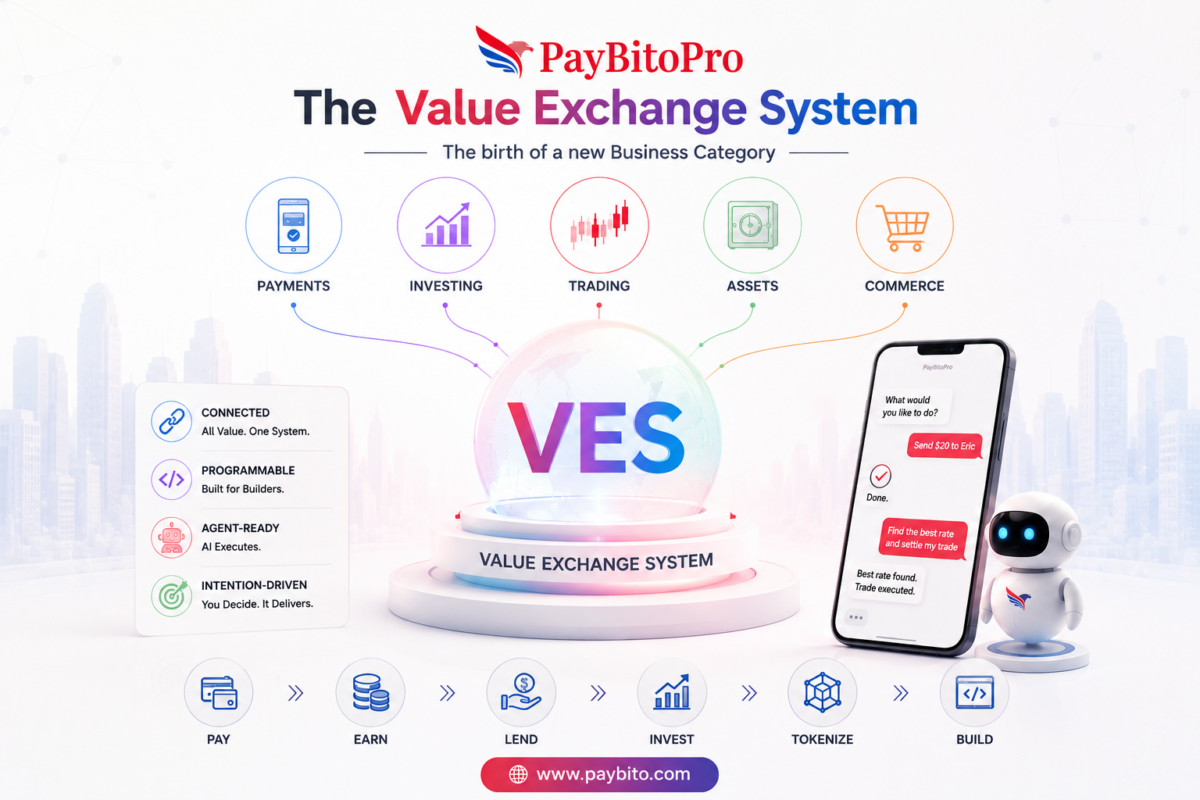
Picture it as four ideas stacked on top of each other, each one making the next possible. First, everything is connected — accepting a payment, holding it, and investing it aren’t three separate products stitched together with duct tape and APIs; they’re one continuous surface, so money never has to leave home to do something new with itself.
Second, that surface is programmable — not a fixed menu of features, but an operating layer that developers build on.
Build on not using old-style APIs but AI driven decision engines that can interpret their intent and execute commands for them automatically.
Third, because it’s programmable for AI, agents can act inside it — instead of a person tapping through six screens, an assistant sitting in a chat or a voice app can authenticate, decide, and execute on someone’s behalf. And fourth, once an agent is acting for you, the whole relationship flips from instruction to intention — you stop telling it every step and start telling it what you want, and it works out the steps itself. That’s the LLM of finance: a decision engine that turns a goal into an outcome the same way a language model turns a question into an answer.
This is a category, not a feature list, for the same reason Amazon and Google were categories: intent stopped needing translation. You never had to know which warehouse had your item or which driver was closest — the system just knew. Finance still makes you your own translator, deciding which app, which button, which rate is actually good. A VES removes that job from your hands, and quietly solves the two things everyone in finance has simply learned to live with — an app that pays but can’t invest, and the exhausting work of comparing five tabs just to move money well.
The Company Already Standing on This Layer
If a VES has to be connected, programmable, agent-ready, and intention-driven, the natural question is: who already has all four sitting on one foundation? That’s where PayBito comes in.
PayBito already runs multi-rail payments, merchant onboarding, settlement, exchange infrastructure, custody, asset management and a social commerce engine on a single stack.
From its first payment to a fully integrated ecosystem, a business can grow on one platform — enabling payments, earning yield, accessing lending, investing, tokenizing assets, engaging communities, powering commerce, and building intelligent applications through MCP-capable interfaces. The future simply widens this: every new rail, asset class, and region becomes one more node value that can pass through without a seam.
That connection is already programmable. PayBito exposes its financial infrastructure through MCP-capable interfaces that allow LLMs and AI agents to understand, discover, and execute platform capabilities. Built on top of end-to-end customer journey graphs, PayBito’s decision engine enables AI systems to reason through financial workflows, determine the optimal sequence of actions, and execute outcomes across payments, commerce, and financial services — just as a developer would build and orchestrate applications today.
And this is easiest to see in a small example. Want to send twenty dollars to a friend? Text a bot, “sign me in,” and it authenticates you. Say “send twenty dollars to Eric,” and it’s done — no app, no screens, just intention replacing instruction in its simplest form.
Now stretch that same idea further. Ask it to find the best rate on a trade and settle it for you. The agent isn’t just a courier — it’s a negotiator, pulling live rates across merchants and liquidity sources, weighing them, and only then executing, inside that same authenticated session. One request was a step to follow; the other was a goal to reason toward. That gap is the real boundary between a payment app and a Value Exchange System, and PayBito’s infrastructure already delivers both — an agent that compares and decides before it moves money, not as a demo, but as a standard capability.
That same instinct is already visible in how PayBito routes a single payment across cards, wallets, and crypto based on whichever path performs best, instead of forcing a person to choose manually every time. It’s intention over instruction, structurally built in — the platform deciding how, once you’ve decided what, as part of a reasoning layer that hears “get me the best deal” and plans the sequence of financial actions needed to deliver it.
PayBito won’t be alone in this territory forever. WeChat has quietly built something close to it, letting chat, payments, and developer-built mini-programs live inside one surface. Alibaba built the same connective tissue from commerce inward through Alipay. Even Airbnb and Booking.com show a lighter version of the same instinct — payouts, currency conversion, and multi-country settlement riding invisibly underneath a stay or a trip, not sold as finance at all. What’s missing across the board is an open version: a programmable, agent-ready layer any business, not just one ecosystem, can build on. That’s the door PayBito is standing in front of.
Why This Is PayBito’s Category to Define?
None of the companies this story opened invented the need underneath them — people always needed to shop, move, stay somewhere, find an answer. What they invented was the connected, intention-driven layer underneath a need that already existed, arriving right as the old way ran out of road.
That’s precisely where PayBito is standing now. It didn’t start as a chatbot with a payment feature bolted on. It started as the infrastructure itself — already touching every rail, rate, merchant, and asset a decision engine would need to reason over. And it was already built to operate across borders, currencies, and jurisdictions. The AI layer and the intention-driven engine aren’t a new company to build. They’re the next floor on a building whose foundation is already poured.
The Value Exchange System isn’t a feature PayBito is planning to add. It’s simply the name for what PayBito already is — and for what the rest of finance is about to become.

Categories
- ACH Payments (10)
- adult payment processing (11)
- AI (9)
- Altcoins (10)
- Banking (10)
- Bitcoin (133)
- Bitcoin ETF (11)
- Bitcoin Price (30)
- Blockchain (50)
- Brokering World Hunger Away (16)
- Business (17)
- card payment processing (10)
- CBD (11)
- CBDC (11)
- Chargeback (8)
- coaching business (11)
- COVID-19 (3)
- Crypto ATMs (1)
- Crypto Banking (17)
- Crypto Bill (1)
- Crypto business owner platform (31)
- Crypto Investment (3)
- Crypto Markets (5)
- Crypto Payment (35)
- Crypto Payment Processor (4)
- Crypto Prices (1)
- Crypto Trading (92)
- Cryptocurrency (402)
- Cryptocurrency Exchange (108)
- Data Visualization (2)
- dating platforms (11)
- debt collection payment processing (10)
- Decentralized Finance (7)
- DeFi Payment (9)
- DEX (3)
- Digital Currency (23)
- dropshipping payment processing (12)
- Ethereum (2)
- FAQ (7)
- file sharing payment processing (11)
- Finance (25)
- Financial Equality (4)
- Financial Freedom (8)
- Forex (35)
- hemp (1)
- ICO (2)
- Investment (11)
- IPTV (11)
- Merchant Account (10)
- Mining (3)
- News (66)
- NFTs (2)
- online gambling (11)
- P2P (1)
- Paybito (147)
- PayBitoPro (693)
- PayBitoPro Coin Listing (6)
- PayBitoPro Exchange (2)
- Payment Gateway (48)
- peptide (10)
- Post COVID Digital Transformation (1)
- Press Release (130)
- Privacy & Security (3)
- Real Estate (1)
- Stablecoin (5)
- Technology (15)
- Travel (11)
- Uncategorized (10)
- US Presidential Election (2)
- Utility Coin (1)
- Web3 business (4)
- Web3 Wallets (2)
- White Label Crypto Exchange (8)
Recent Posts
- Payment Gateway vs. Payment Orchestration: What’s the Difference?
- What Is Smart Payment Routing? Strategies to Optimize Payment Performance
- How to Improve Payment Approval Rates for High-Risk Businesses?
- Why Are Online Payments Failing? Common Causes and How to Fix Them
- How to Use Multiple Payment Processors to Reduce Business Disruptions?