Multi-Currency Payment Processing for Travel Businesses: Why It Matters and How It Works
- July 30, 2026
- Soham Guchait

The travel industry serves customers from around the world, making international bookings a normal part of business for many travel agencies, tour operators, online booking platforms, and vacation rental providers. As businesses expand into new markets, one challenge quickly becomes apparent—customers prefer to pay in their own currency.
Displaying prices and accepting payments in a customer’s local currency creates a more familiar and transparent checkout experience. It reduces uncertainty about exchange rates and helps customers understand exactly how much they are paying before confirming a booking.
Understanding multi-currency payment processing can help travel businesses improve customer experience, support international growth, and simplify cross-border transactions.
What Is Multi-Currency Payment Processing?
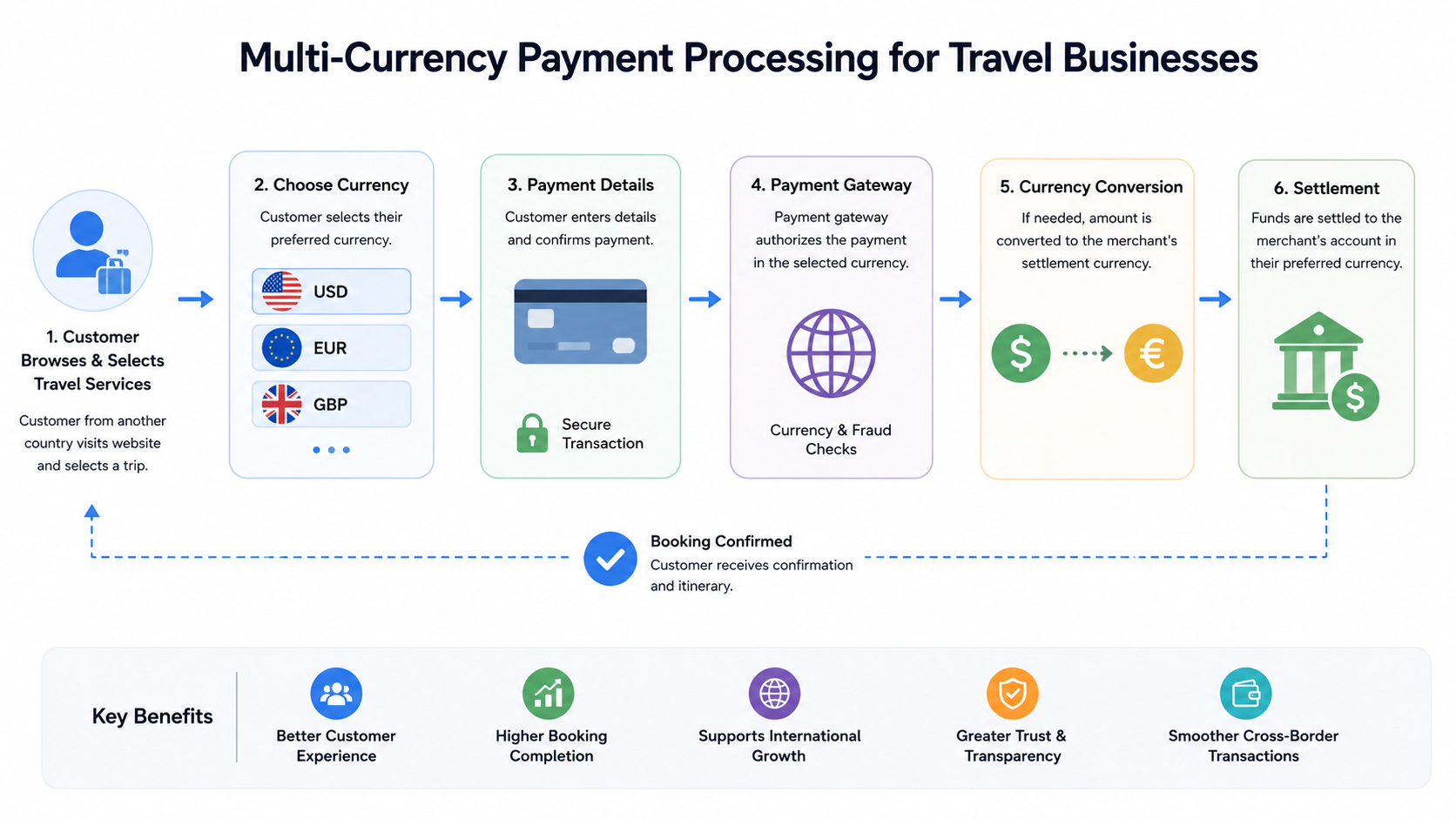
Multi-currency payment processing allows a business to accept payments in more than one currency. Instead of requiring every customer to pay in the merchant’s local currency, the payment system enables customers to complete transactions using a currency they recognize.
For example, a travel company based in Thailand may allow customers from the United Kingdom to pay in British pounds, while customers from Australia can complete the same booking in Australian dollars. Behind the scenes, the payment provider manages the currency conversion before the funds are settled according to the merchant’s account settings.
Although the process appears simple to the customer, multiple payment systems work together to authorize the transaction, convert currencies where required, and complete the payment securely.
If you’re unfamiliar with how these systems interact, understanding travel payment processing provides a useful foundation before exploring multi-currency capabilities.
Why Do Travel Businesses Need Multi-Currency Payments?
Travel businesses often market their services internationally, even if they operate from a single location.
Imagine a boutique travel company in Costa Rica promoting eco-tour packages online. Visitors from Canada, Germany, Japan, and the United States may all visit the website on the same day. If every price is displayed only in the local currency, many customers will need to calculate exchange rates themselves before deciding whether to continue.
Displaying familiar currencies helps remove this uncertainty and creates a more comfortable booking experience.
Businesses that accept international reservations also benefit from appearing more accessible to overseas customers, particularly when combined with payment methods that are commonly used in different regions.
Benefits Beyond Customer Convenience
While customer experience is one of the biggest advantages, multi-currency payment processing offers several operational benefits as well.
Travel businesses may experience:
- Higher booking completion rates by reducing payment friction.
- Greater pricing transparency for international customers.
- Improved customer confidence during checkout.
- Easier expansion into new international markets.
For example, a tour operator that begins advertising to customers across Europe may notice that more visitors complete their bookings after prices become available in euros instead of requiring manual currency conversion.
Small improvements like these can make a noticeable difference as international bookings increase.
Understanding Currency Conversion
Currency conversion is an important part of multi-currency payment processing.
When a customer pays in one currency and the business receives funds in another, the payment provider converts the transaction based on the applicable exchange rate and settlement process.
For example, a customer from Australia books a safari offered by a business in Kenya. The customer pays in Australian dollars, while the merchant ultimately receives the payment according to its settlement arrangement.
Businesses should remember that exchange rates can change regularly, meaning the converted amount may vary over time. Providing customers with clear pricing before payment helps reduce confusion and creates greater confidence during checkout.
Multi-Currency Payments and International Growth
Expanding into international markets requires more than translating a website or advertising overseas. Customers often expect businesses to offer payment experiences that feel familiar, including local currencies and preferred payment methods.
For example, an online travel agency that attracts bookings from several continents may initially accept only one currency. As international traffic increases, the business introduces multi-currency payment processing to better serve overseas customers.
The result is a booking experience that feels more localized without requiring the company to establish separate websites for every country.
Businesses planning global expansion should also understand international payment processing for travel businesses, as both capabilities work together to support cross-border transactions.
Common Considerations Before Offering Multiple Currencies
Introducing multi-currency payments requires thoughtful planning rather than simply adding additional currencies to a checkout page.
Businesses should evaluate factors such as:
- Where most international customers are located ?
- Which currencies customers expect to use ?
- Settlement preferences
- Currency conversion processes
- Payment provider capabilities
Selecting currencies based on customer demand is often more effective than trying to support every currency available.
Example: A Growing Tour Company
A guided tour company based in South Africa begins receiving bookings from travelers across Europe and North America.
Initially, all prices are displayed only in South African rand. While customers can still complete bookings, many leave the website before reaching checkout because they are unsure about the final cost after conversion.
The company introduces multi-currency payment processing, allowing customers to view prices in euros, British pounds, and US dollars. Although the tours remain the same, customers now have a clearer understanding of pricing, making the booking experience more straightforward and reducing uncertainty during payment.
Building a Better International Payment Experience
Multi-currency payment processing is only one part of creating an effective international payment strategy.
Travel businesses should also consider:
- Supporting payment methods preferred by international customers.
- Using a secure travel payment gateway to protect transactions.
- Monitoring payment performance across different regions.
- Reviewing customer feedback to identify payment barriers.
Combining these practices creates a smoother payment journey from booking to settlement while supporting long-term international growth.
Conclusion
As travel businesses attract customers from around the world, offering familiar and transparent payment experiences becomes increasingly important. Multi-currency payment processing helps businesses accept payments from international travelers while allowing customers to pay in currencies they recognize and understand.
When combined with secure payment processing, appropriate payment methods, and a well-planned international payment strategy, multi-currency capabilities can improve customer confidence, simplify cross-border bookings, and support sustainable business growth.

Categories
- ACH Payments (10)
- adult payment processing (11)
- AI (9)
- Altcoins (10)
- Banking (10)
- Bitcoin (133)
- Bitcoin ETF (11)
- Bitcoin Price (30)
- Blockchain (50)
- Brokering World Hunger Away (16)
- Business (17)
- card payment processing (10)
- CBD (11)
- CBDC (11)
- coaching business (11)
- COVID-19 (3)
- Crypto ATMs (1)
- Crypto Banking (17)
- Crypto Bill (1)
- Crypto business owner platform (31)
- Crypto Investment (3)
- Crypto Markets (5)
- Crypto Payment (35)
- Crypto Payment Processor (4)
- Crypto Prices (1)
- Crypto Trading (92)
- Cryptocurrency (402)
- Cryptocurrency Exchange (108)
- Data Visualization (2)
- dating platforms (11)
- debt collection payment processing (10)
- Decentralized Finance (7)
- DeFi Payment (9)
- DEX (3)
- Digital Currency (23)
- dropshipping payment processing (12)
- Ethereum (2)
- FAQ (7)
- file sharing payment processing (11)
- Finance (25)
- Financial Equality (4)
- Financial Freedom (8)
- Forex (35)
- hemp (1)
- ICO (2)
- Investment (11)
- IPTV (11)
- Merchant Account (10)
- Mining (3)
- News (66)
- NFTs (2)
- online gambling (11)
- P2P (1)
- Paybito (139)
- PayBitoPro (693)
- PayBitoPro Coin Listing (6)
- PayBitoPro Exchange (2)
- Payment Gateway (40)
- peptide (10)
- Post COVID Digital Transformation (1)
- Press Release (130)
- Privacy & Security (3)
- Real Estate (1)
- Stablecoin (5)
- Technology (15)
- Travel (11)
- Uncategorized (9)
- US Presidential Election (2)
- Utility Coin (1)
- Web3 business (4)
- Web3 Wallets (2)
- White Label Crypto Exchange (8)
Recent Posts
- ACH vs Wire Transfer: Which Payment Method Is Better for Businesses?
- ACH Fraud Prevention: How Businesses Can Secure Bank Account Payments?
- ACH Credit vs ACH Debit: What’s the Difference? With Real Examples
- ACH vs Credit Card: Which Payment Method Is Better for Businesses?
- How Long Do ACH Payments Take? Processing Times, Settlement, and Same Day ACH