Travel Payment Processing: A Complete Guide for Travel Businesses
- July 29, 2026
- Soham Guchait

The travel industry depends on reliable payment systems to complete bookings, collect customer payments, and manage transactions across different regions. From small travel agencies and tour operators to online booking platforms and vacation rental businesses, every travel company needs a secure way to accept payments.
However, travel payments are often more complicated than regular online purchases. Customers may book months before their trip, transaction values can be high, cancellations are common, and businesses often serve international customers.
Because of these factors, understanding travel payment processing is essential for building a stable payment operation and providing customers with a smooth booking experience.
What Is Travel Payment Processing?
Travel payment processing refers to the systems and processes that allow travel businesses to accept, verify, and complete customer payments.
It connects multiple parties involved in a transaction, including:
- Customer making the payment
- Travel business providing the service
- Payment gateway handling transaction details
- Payment processor managing authorization
- Banks approving and transferring funds
For example, when a customer books a $2,500 vacation package online, the payment system securely transfers the transaction details, checks whether the payment can be approved, and completes the transfer of funds to the travel business.
A complete payment process helps travel companies accept bookings while reducing payment failures, fraud risks, and customer frustration.
How Does Payment Processing Work for Travel Businesses?
Although customers experience payment as a simple checkout process, several steps happen behind the scenes.
1. Customer Makes a Payment
The process begins when a customer selects a travel service and completes checkout.
Travel businesses may accept payments through:
- Credit cards
- Debit cards
- Bank transfers
- Digital wallets
- Alternative payment methods
For example, a tour company may collect a deposit when a customer books a guided vacation and collect the remaining balance closer to the travel date.
2. Payment Gateway Transfers Transaction Information
A payment gateway securely collects payment details and sends transaction information between the customer, travel business, and financial institutions.
A suitable payment gateway for travel businesses helps companies provide:
- Secure checkout experiences
- Multiple payment options
- Fraud detection support
- Faster online booking payments
This is especially important because travel purchases often involve large payments and customers expect a reliable booking experience.
3. Payment Processor Authorizes the Transaction
The payment processor communicates with banks and payment networks to determine whether the transaction should be approved.
The approval process may consider:
- Available funds
- Customer payment details
- Fraud indicators
- Transaction history
- Risk factors
Once approved, the payment moves toward settlement.
4. Settlement Transfers Funds
After authorization, the funds are transferred to the travel business according to the agreed settlement schedule.
Settlement timing may depend on:
- Business location
- Payment method
- Transaction volume
- Risk assessment
- Banking arrangements
For travel businesses, understanding settlement is important because many companies receive payments long before delivering the actual service.
Why Are Travel Businesses Considered High Risk?
Many travel businesses are classified as high risk by payment processors because of the unique characteristics of the industry.
Being considered high risk does not mean a business is unreliable. It means payment providers evaluate travel companies more carefully because certain factors can increase the possibility of disputes, refunds, or financial losses.
Some common reasons include:
Advance Payments Before Service Delivery
Travel customers often pay before they receive the actual service.
For example, a customer may book a European holiday package six months in advance. During that time, travel plans can change due to personal circumstances, cancellations, or unexpected events.
Because money is collected before service delivery, payment providers may consider travel transactions higher risk.
High Transaction Values
Travel purchases are often larger than typical online transactions.
A single booking may include:
- Flights
- Hotels
- Transportation
- Activities
- Multiple travelers
Higher-value transactions can create greater financial impact if disputes or fraudulent payments occur.
Chargeback and Dispute Risks
Travel companies often deal with payment disputes related to:
- Cancellation disagreements
- Refund expectations
- Changes in travel plans
- Customers misunderstanding booking conditions
Because of this, payment providers may review how businesses handle refund policies, customer communication, and transaction records.
Businesses looking to reduce these issues should understand travel chargebacks and methods for preventing payment disputes.
Seasonal Revenue Patterns
Many travel businesses experience seasonal changes in demand. For example, a holiday tour company may process hundreds of bookings during peak vacation months but experience slower periods during the rest of the year.
Payment providers may evaluate these revenue patterns when reviewing business risk.
International Payment Complexity
Travel companies frequently serve customers from different countries.
Cross-border transactions may involve:
- Currency conversion
- Different payment preferences
- Foreign bank restrictions
- Additional verification requirements
Businesses expanding internationally need to understand international payment processing for travel businesses to create smoother payment experiences.
Common Payment Challenges Faced by Travel Businesses
Payment Declines
A declined payment can result in abandoned bookings and lost revenue.
Common reasons include:
- Incorrect customer information
- Bank restrictions
- Fraud protection systems
- International payment limitations
- Technical issues
For example, an international traveler may have sufficient funds but their bank may block a transaction because overseas payments are disabled.
Refund Management
Travel businesses regularly manage cancellations, rescheduling, and refunds.
A clear refund process should include:
- Transparent cancellation policies
- Timely communication
- Accurate payment records
- Simple refund procedures
Proper refund management helps reduce disputes and improves customer confidence.
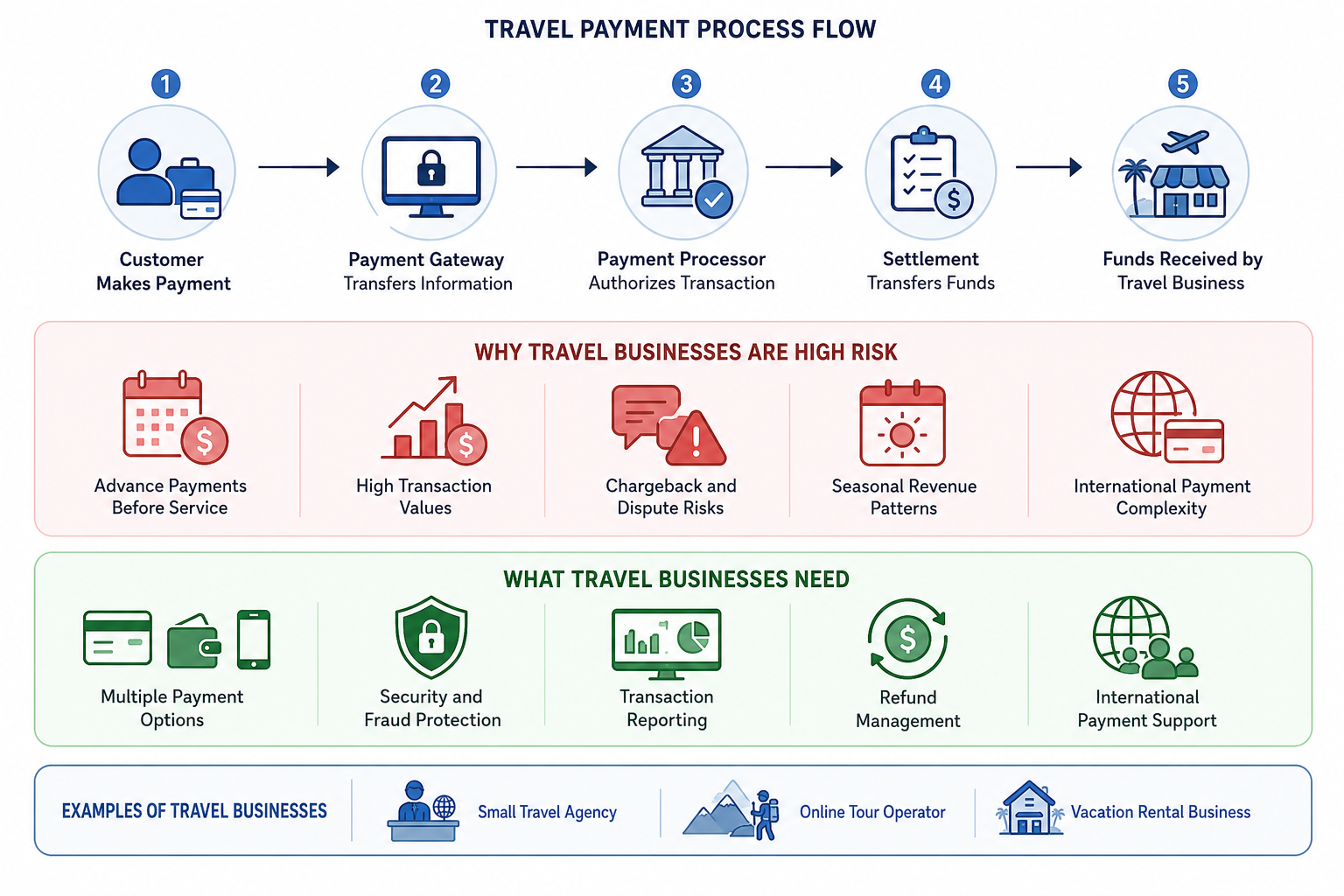
What Should Travel Businesses Look for in Payment Processing?
When choosing a payment approach, travel companies should consider their customer base, transaction volume, and future growth plans.
Important factors include:
Multiple Payment Options
Customers from different regions may prefer different payment methods.
Supporting multiple options can help businesses serve:
- International travelers
- Local customers
- Corporate clients
- Mobile users
Security and Fraud Protection
Travel businesses handle sensitive payment information and should prioritize secure transactions.
Important security features include:
- Encrypted payments
- Secure checkout pages
- Fraud monitoring
- Customer verification tools
Transaction Reporting
Clear payment reporting helps businesses understand their financial activity.
Useful reports include:
- Successful payments
- Failed transactions
- Refunds
- Settlements
- Disputes
Better visibility allows businesses to identify problems and improve payment performance.
Examples of Travel Payment Processing
Small Travel Agency
A boutique travel agency sells customized vacation packages. Customers pay a deposit during booking and complete the remaining payment before departure.
The business needs payment processing that supports deposits, future payments, and refund handling.
Online Tour Operator
An adventure travel company sells experiences to customers worldwide.
The company needs international payment support, secure checkout, and payment options suitable for different travelers.
Vacation Rental Business
A vacation rental provider accepts reservations months ahead of arrival.
The business needs reliable payment collection, clear records, and efficient cancellation management.
Conclusion
Travel payment processing is a critical part of operating a modern travel business. Unlike many industries, travel involves advance bookings, international customers, high-value transactions, and increased dispute considerations.
By understanding payment gateways, merchant accounts, high-risk classifications, security requirements, and common payment challenges, travel businesses can create stronger payment operations.
A reliable payment process helps businesses reduce transaction problems, improve customer trust, and build a better foundation for long-term growth.

Categories
- ACH Payments (10)
- adult payment processing (11)
- AI (9)
- Altcoins (10)
- Banking (10)
- Bitcoin (133)
- Bitcoin ETF (11)
- Bitcoin Price (30)
- Blockchain (50)
- Brokering World Hunger Away (16)
- Business (17)
- card payment processing (10)
- CBD (11)
- CBDC (11)
- Chargeback (8)
- coaching business (11)
- COVID-19 (3)
- Crypto ATMs (1)
- Crypto Banking (17)
- Crypto Bill (1)
- Crypto business owner platform (31)
- Crypto Investment (3)
- Crypto Markets (5)
- Crypto Payment (35)
- Crypto Payment Processor (4)
- Crypto Prices (1)
- Crypto Trading (92)
- Cryptocurrency (402)
- Cryptocurrency Exchange (108)
- Data Visualization (2)
- dating platforms (11)
- debt collection payment processing (10)
- Decentralized Finance (7)
- DeFi Payment (9)
- DEX (3)
- Digital Currency (23)
- dropshipping payment processing (12)
- Ethereum (2)
- FAQ (7)
- file sharing payment processing (11)
- Finance (25)
- Financial Equality (4)
- Financial Freedom (8)
- Forex (35)
- hemp (1)
- ICO (2)
- Investment (11)
- IPTV (11)
- Merchant Account (10)
- Mining (3)
- News (66)
- NFTs (2)
- online gambling (11)
- P2P (1)
- Paybito (147)
- PayBitoPro (693)
- PayBitoPro Coin Listing (6)
- PayBitoPro Exchange (2)
- Payment Gateway (48)
- peptide (10)
- Post COVID Digital Transformation (1)
- Press Release (130)
- Privacy & Security (3)
- Real Estate (1)
- Stablecoin (5)
- Technology (15)
- Travel (11)
- Uncategorized (10)
- US Presidential Election (2)
- Utility Coin (1)
- Web3 business (4)
- Web3 Wallets (2)
- White Label Crypto Exchange (8)
Recent Posts
- Payment Gateway vs. Payment Orchestration: What’s the Difference?
- What Is Smart Payment Routing? Strategies to Optimize Payment Performance
- How to Improve Payment Approval Rates for High-Risk Businesses?
- Why Are Online Payments Failing? Common Causes and How to Fix Them
- How to Use Multiple Payment Processors to Reduce Business Disruptions?