Best Payment Methods for Travel Businesses: Choosing the Right Payment Options for Your Customers
- July 30, 2026
- Soham Guchait
Every travel business wants to make booking as simple as possible, but the payment experience is often where customers decide whether to complete or abandon a purchase. A traveler who cannot pay using their preferred method may delay the booking or choose another provider that offers a more convenient checkout experience.
The best payment methods for travel businesses are not necessarily the ones with the most features – they are the ones that match customer preferences, support secure transactions, and work well with the business’s booking process. Whether you operate a travel agency, tour company, vacation rental business, or online booking platform, selecting the right payment options can improve customer satisfaction and increase successful bookings.
Why Payment Choice Matters More Than Ever?
Travel businesses serve a wide variety of customers. Some book weekend tours from their mobile phones, while others spend thousands of dollars on international holidays planned months in advance.
Because customer expectations vary, relying on a single payment option can limit sales opportunities. A payment method that works well for domestic customers may not be suitable for travelers booking from another country.
For example, a family reserving a luxury holiday package may prefer paying with a credit card because of purchase protection and reward programs. Meanwhile, a traveler making a last-minute excursion booking on a smartphone may choose a digital wallet simply because it is faster.
Understanding these differences helps businesses build a payment processer that supports more completed bookings.
Match Payment Methods to Your Business Model
There is no universal payment solution for every travel business. The right combination depends on the services you offer and the customers you serve.
A local tour operator may only need card payments and one or two digital wallets because most customers are domestic travelers making relatively small purchases.
An online travel agency serving international customers, however, may need to support additional payment methods, multiple currencies, and regional payment preferences to reduce friction during checkout.
Businesses that offer premium travel experiences or customized itineraries may also receive requests for bank transfers, particularly when customers are making high-value purchases. Instead of trying to offer every available payment option, businesses should focus on the methods their customers are most likely to use.
Understanding the Most Common Payment Methods
Although customer preferences continue to evolve, several payment methods remain popular across the travel industry.
Credit and debit cards continue to be the most widely accepted option because they are familiar, convenient, and suitable for everything from hotel reservations to guided tours.
Digital wallets have grown rapidly in recent years, particularly for mobile bookings. They allow customers to complete purchases quickly without manually entering card information, making them especially useful for last-minute reservations.
Bank transfers are commonly used for larger transactions, such as luxury travel packages, corporate travel arrangements, or customized itineraries where customers may prefer transferring funds directly from their bank account.
Many international travelers also expect businesses to support regional or local payment methods that are widely used in their home countries. Providing these familiar options can improve customer confidence and increase booking completion rates.
Consider Your International Customers
One of the biggest differences between the travel industry and many other sectors is the number of international transactions. Customers may be booking from different countries, using different currencies, and relying on payment methods that are not commonly used in your local market.
For example, a travel company based in Spain may receive bookings from customers in Canada, Australia, Germany, and Japan within the same week. If the payment process only supports a limited number of payment methods, some of those customers may encounter unnecessary difficulties during checkout.
Supporting international payments and familiar payment options creates a smoother experience for overseas travelers. Businesses planning to expand globally should also understand international payment processing for travel businesses and how multi-currency payment processing can improve the booking experience.
Security Is Just as Important as Convenience
Offering multiple payment methods should never come at the expense of security.
Customers trust travel businesses with sensitive payment information, particularly when making expensive bookings months before departure. A secure payment experience helps build confidence while reducing fraud risks.
Using a reliable travel payment gateway with encryption, fraud monitoring, and secure payment processing helps protect both customers and businesses throughout the transaction process.
Avoid Offering Too Many Payment Options
While flexibility is important, more payment methods do not always create a better checkout experience. A payment page overloaded with unnecessary choices can make decision-making more difficult and increase checkout complexity.
Instead, businesses should regularly review booking data to understand which payment methods customers actually use. As the business grows into new markets, additional payment options can be introduced based on customer demand rather than assumption.
A focused payment strategy is often more effective than trying to support every available payment method.
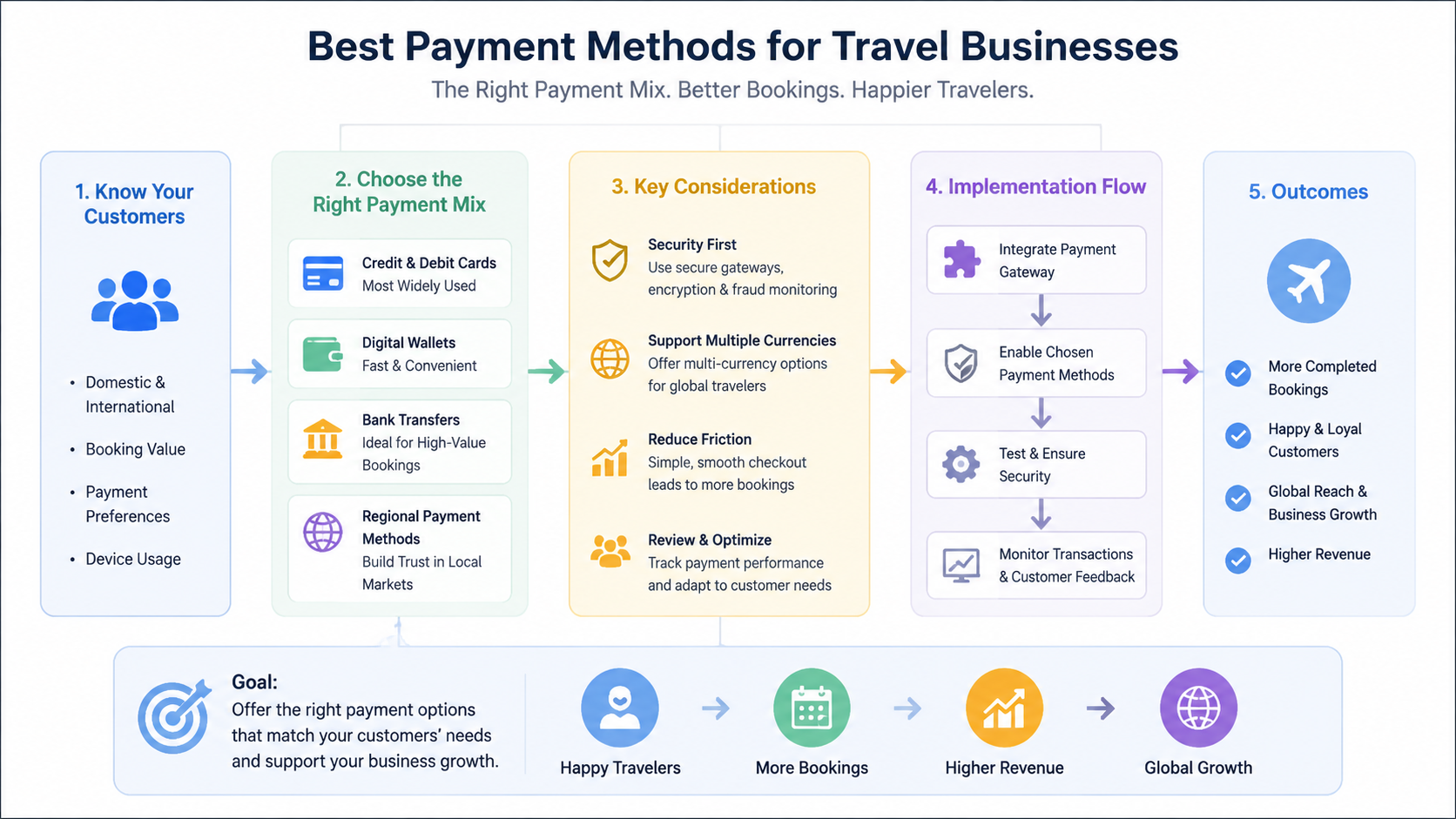
Example: Building the Right Payment Mix
Imagine a growing travel agency that initially serves customers within one country. At first, accepting credit and debit cards may be enough to meet customer expectations.
As the business begins selling international holiday packages, customer behavior changes. Overseas travelers start requesting digital wallets, while corporate clients prefer bank transfers for larger bookings.
Rather than replacing its existing payment setup, the agency gradually adds new payment methods based on actual customer demand. As the business continues to expand, it may also explore a white-label payment platform to provide a branded payment experience across its website and booking system while managing payments more efficiently. This gradual approach improves the booking experience without adding unnecessary complexity.
Conclusion
Choosing the best payment methods for travel businesses is about understanding your customers rather than simply offering the largest number of payment options. Card payments, digital wallets, bank transfers, and regional payment methods all serve different purposes depending on the type of travel services you provide and the markets you operate in.
By building a payment strategy around customer needs, security, and business goals, travel companies can create a smoother checkout experience, improve booking completion rates, and support future growth as they expand into new markets.

Categories
- ACH Payments (10)
- adult payment processing (11)
- AI (9)
- Altcoins (10)
- Banking (10)
- Bitcoin (133)
- Bitcoin ETF (11)
- Bitcoin Price (30)
- Blockchain (50)
- Brokering World Hunger Away (16)
- Business (17)
- card payment processing (10)
- CBD (11)
- CBDC (11)
- Chargeback (8)
- coaching business (11)
- COVID-19 (3)
- Crypto ATMs (1)
- Crypto Banking (17)
- Crypto Bill (1)
- Crypto business owner platform (31)
- Crypto Investment (3)
- Crypto Markets (5)
- Crypto Payment (35)
- Crypto Payment Processor (4)
- Crypto Prices (1)
- Crypto Trading (92)
- Cryptocurrency (402)
- Cryptocurrency Exchange (108)
- Data Visualization (2)
- dating platforms (11)
- debt collection payment processing (10)
- Decentralized Finance (7)
- DeFi Payment (9)
- DEX (3)
- Digital Currency (23)
- dropshipping payment processing (12)
- Ethereum (2)
- FAQ (7)
- file sharing payment processing (11)
- Finance (25)
- Financial Equality (4)
- Financial Freedom (8)
- Forex (35)
- hemp (1)
- ICO (2)
- Investment (11)
- IPTV (11)
- Merchant Account (10)
- Mining (3)
- News (66)
- NFTs (2)
- online gambling (11)
- P2P (1)
- Paybito (147)
- PayBitoPro (693)
- PayBitoPro Coin Listing (6)
- PayBitoPro Exchange (2)
- Payment Gateway (48)
- peptide (10)
- Post COVID Digital Transformation (1)
- Press Release (130)
- Privacy & Security (3)
- Real Estate (1)
- Stablecoin (5)
- Technology (15)
- Travel (11)
- Uncategorized (10)
- US Presidential Election (2)
- Utility Coin (1)
- Web3 business (4)
- Web3 Wallets (2)
- White Label Crypto Exchange (8)
Recent Posts
- Payment Gateway vs. Payment Orchestration: What’s the Difference?
- What Is Smart Payment Routing? Strategies to Optimize Payment Performance
- How to Improve Payment Approval Rates for High-Risk Businesses?
- Why Are Online Payments Failing? Common Causes and How to Fix Them
- How to Use Multiple Payment Processors to Reduce Business Disruptions?