How to Get Approved for an Adult Entertainment Merchant Account?
- August 4, 2026
- Soham Guchait
For many adult businesses, accepting payments is one of the most important steps toward building a sustainable online operation. Whether the business runs a subscription platform, creator membership website, digital-content marketplace, live-streaming service, or adult eCommerce store, reliable payment acceptance depends on having the right merchant account setup.
However, getting approved for an adult merchant account can be more involved than applying for standard payment processing. Payment providers typically conduct detailed reviews to understand the business model, transaction patterns, compliance practices, and potential risks before approving an account.
Preparation plays a major role in this process. Businesses that understand what providers evaluate and organize the required information in advance are more likely to experience a smoother approval process.
What Is an Adult Merchant Account?
An adult merchant account is a type of payment processing account designed for businesses operating in the adult industry. It allows companies to accept customer payments through supported payment methods while managing the additional risks associated with the industry.
Unlike a regular business account, an adult merchant account application usually involves more detailed underwriting. Payment providers want to understand exactly what the business offers, how customers make purchases, how recurring payments are handled, and what systems are in place to prevent disputes and fraud.
For example, a creator subscription platform applying for payment processing may need to explain how creators are onboarded, how customer subscriptions work, how payments are collected, and how disputes are handled. This information helps payment providers evaluate whether the business has proper operational controls in place.
Businesses new to payment processing should first understand the broader ecosystem by reviewing adult entertainment payment processing and how different payment components work together.
What Payment Providers Review During Approval?
Approval decisions are based on several factors. While requirements vary between providers, most underwriting teams review the business, ownership structure, website information, payment history, and risk management practices.
Some common areas reviewed include:
- Business registration and ownership information: Providers typically verify the legal entity, owners, and operational details of the company.
- Website and business model review: The website should clearly explain the products or services offered, pricing, customer journey, and payment terms.
- Customer policies: Refund policies, cancellation procedures, privacy policies, and terms of service help demonstrate how customer relationships are managed.
- Expected transaction activity: Providers may review expected monthly volume, average transaction size, customer locations, and payment frequency.
- Previous processing history: Existing businesses may be evaluated based on previous chargebacks, declines, or account issues.
For example, consider two businesses applying for the same type of payment account.
The first company has a clearly documented subscription model, transparent pricing, visible cancellation terms, and established customer support procedures.
The second company provides limited business information, unclear billing practices, and no explanation of how recurring charges work.
Even if both businesses operate legally, the first company presents a clearer risk profile because its payment processes are easier to understand and manage.
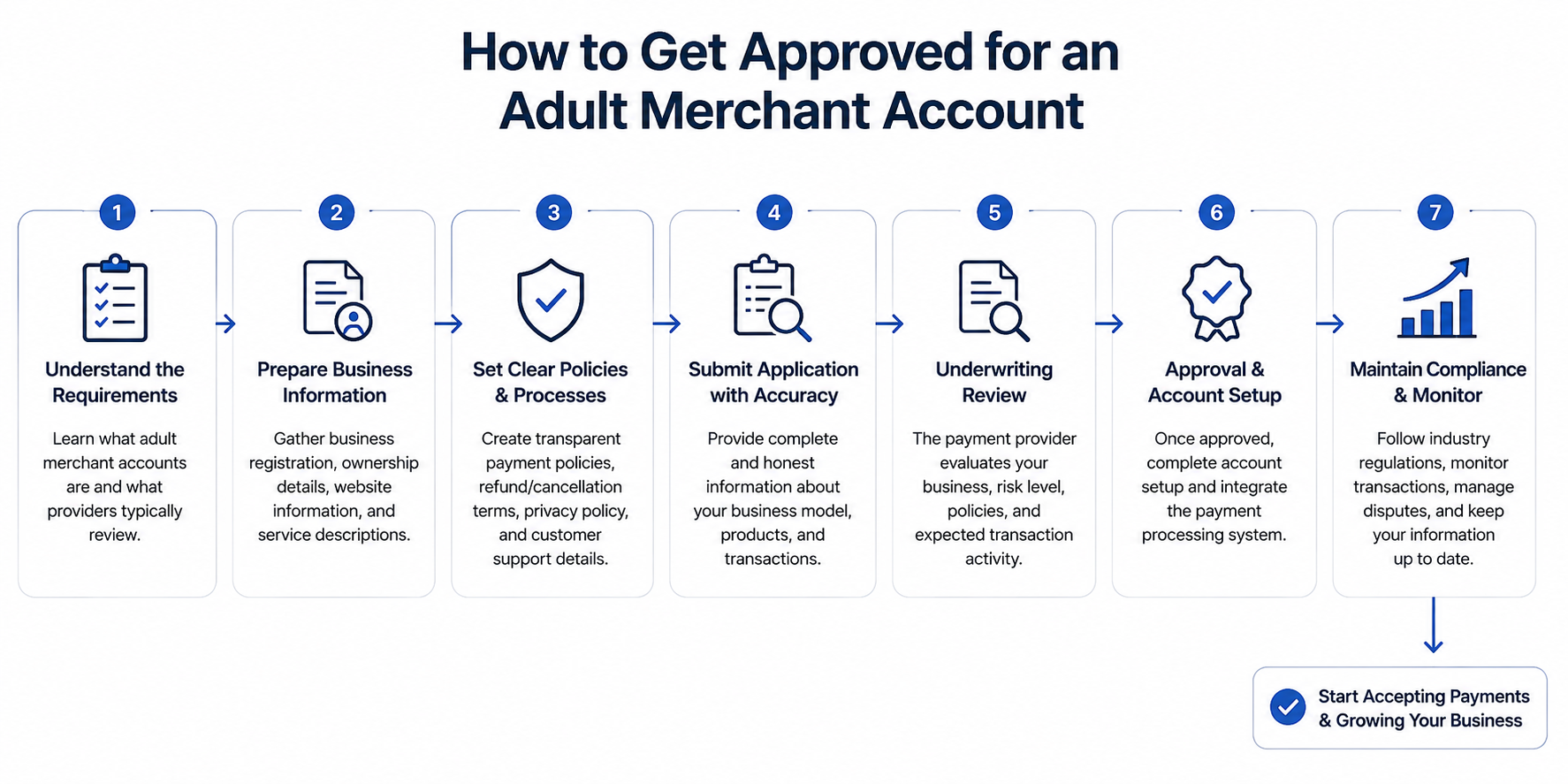
Preparing Your Business Before Applying
Many merchant account applications face delays because businesses apply before their operational details are ready. Preparing documentation and reviewing customer-facing information beforehand can make the process more efficient.
Before applying, businesses should review areas such as:
Clear Business Information
Payment providers need to understand what the company does. Descriptions should accurately explain the business model rather than using vague terms.
For example, a platform that provides paid creator memberships should clearly explain that customers purchase subscription access, how billing works, and what customers receive after payment.
Transparent Payment Policies
Payment-related policies should be easy for customers to find and understand.
Important areas include:
- Subscription renewal terms.
- Cancellation procedures.
- Refund conditions.
- Customer support contact information.
- Billing explanations.
Clear policies reduce confusion and can help prevent future disputes.
Compliance and Verification Processes
Payment providers may also review whether the business follows appropriate verification and monitoring procedures. This can include business verification, ownership verification, customer-related controls where required, and ongoing monitoring practices.
Understanding KYC and AML for adult entertainment payment processing can help businesses prepare for the verification requirements commonly associated with payment operations.
Common Reasons Adult Merchant Account Applications Are Rejected
A rejection does not always mean the business itself cannot process payments. In many cases, applications are declined because the provider does not have enough information to properly evaluate the business.
Common issues include:
- Incomplete application information.
- Unclear description of products or services.
- Missing website policies.
- Lack of transparency about the business model.
- Previous high chargeback activity.
- Unexpected transaction volume projections.
- Inconsistent information between the application and website.
For example, an adult membership platform may describe itself as a “digital community service” during the application process but operate a paid subscription model on its website. This mismatch can create concerns during underwriting because providers need accurate information to assess risk.
Honest and complete disclosure is one of the most important parts of building trust during the approval process.
Choosing the Right Payment Setup After Approval
Getting approved for an adult merchant account is only the first step. Businesses also need to ensure their payment infrastructure supports their specific needs.
A subscription platform may require recurring billing tools, while an adult eCommerce store may prioritize checkout flexibility and payment tracking. Choosing the right technology depends on the business model, customer expectations, and growth plans. Businesses evaluating their options should also understand how to choose a payment gateway for an adult entertainment business, as the gateway plays an important role in transaction security, customer experience, and payment reliability.
Conclusion
Getting approved for an adult merchant account requires preparation, transparency, and a clear understanding of how payment providers evaluate risk. The approval process is not only about submitting an application – it is about demonstrating that the business has reliable operations, clear customer policies, and responsible payment practices.
By preparing accurate business information, maintaining transparent policies, and understanding underwriting expectations, adult businesses can create a stronger foundation for accepting payments and managing future growth.

Categories
- ACH Payments (10)
- adult payment processing (11)
- AI (9)
- Altcoins (10)
- Banking (10)
- Bitcoin (133)
- Bitcoin ETF (11)
- Bitcoin Price (30)
- Blockchain (50)
- Brokering World Hunger Away (16)
- Business (17)
- card payment processing (10)
- CBD (11)
- CBDC (11)
- coaching business (11)
- COVID-19 (3)
- Crypto ATMs (1)
- Crypto Banking (17)
- Crypto Bill (1)
- Crypto business owner platform (31)
- Crypto Investment (3)
- Crypto Markets (5)
- Crypto Payment (35)
- Crypto Payment Processor (4)
- Crypto Prices (1)
- Crypto Trading (92)
- Cryptocurrency (402)
- Cryptocurrency Exchange (108)
- Data Visualization (2)
- dating platforms (11)
- debt collection payment processing (10)
- Decentralized Finance (7)
- DeFi Payment (9)
- DEX (3)
- Digital Currency (23)
- dropshipping payment processing (12)
- Ethereum (2)
- FAQ (7)
- file sharing payment processing (11)
- Finance (25)
- Financial Equality (4)
- Financial Freedom (8)
- Forex (35)
- hemp (1)
- ICO (2)
- Investment (11)
- IPTV (11)
- Merchant Account (10)
- Mining (3)
- News (66)
- NFTs (2)
- online gambling (11)
- P2P (1)
- Paybito (139)
- PayBitoPro (693)
- PayBitoPro Coin Listing (6)
- PayBitoPro Exchange (2)
- Payment Gateway (40)
- peptide (10)
- Post COVID Digital Transformation (1)
- Press Release (130)
- Privacy & Security (3)
- Real Estate (1)
- Stablecoin (5)
- Technology (15)
- Travel (11)
- Uncategorized (9)
- US Presidential Election (2)
- Utility Coin (1)
- Web3 business (4)
- Web3 Wallets (2)
- White Label Crypto Exchange (8)
Recent Posts
- ACH vs Wire Transfer: Which Payment Method Is Better for Businesses?
- ACH Fraud Prevention: How Businesses Can Secure Bank Account Payments?
- ACH Credit vs ACH Debit: What’s the Difference? With Real Examples
- ACH vs Credit Card: Which Payment Method Is Better for Businesses?
- How Long Do ACH Payments Take? Processing Times, Settlement, and Same Day ACH