KYC and AML for Adult Entertainment Payment Processing: Why They Matter and How They Work?
- August 4, 2026
- Soham Guchait
Launching an adult business involves more than creating a platform, attracting customers, and accepting payments. Before most payment providers allow an adult business to process transactions, they need to understand who they are working with, how the business operates, and whether appropriate safeguards are in place to prevent financial crime.
This is where KYC (Know Your Customer) and AML (Anti-Money Laundering) become important.
Many business owners assume KYC and AML are only relevant to banks or cryptocurrency companies. In reality, these processes are an essential part of payment processing for high-risk industries, including adult entertainment. They help payment providers verify businesses, monitor financial activity, reduce fraud, and comply with financial regulations.
Understanding why KYC and AML are required – and how they affect day-to-day payment operations – can help adult businesses prepare for payment processing, avoid unnecessary delays, and build stronger relationships with payment providers.
What Are KYC and AML?
Although they are often mentioned together, KYC and AML serve different purposes.
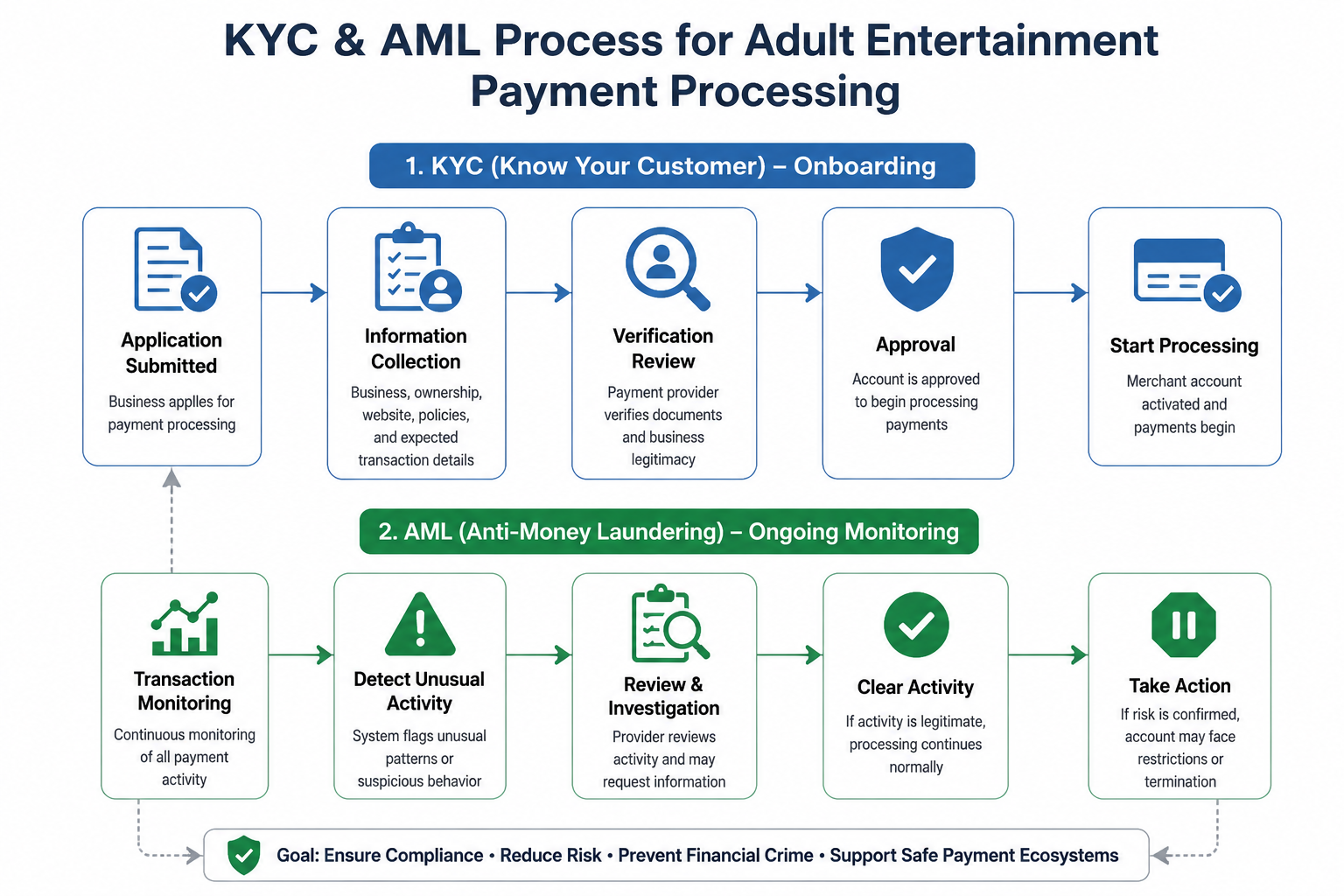
Know Your Customer (KYC) is the process of verifying the identity of a business and its owners before payment services are provided. Payment providers need to confirm that the business is legitimate, understand what products or services it offers, and identify the people responsible for operating it.
Anti-Money Laundering (AML) refers to the ongoing monitoring of financial activity to identify suspicious transactions that could involve money laundering, fraud, terrorist financing, or other illegal financial activities.
Think of KYC as the process of verifying who a business is, while AML focuses on monitoring how payments move through that business over time.
For example, if a company launches a creator subscription platform, the payment provider may first verify the company’s registration documents, ownership information, website policies, and business model. Once payment processing begins, AML systems continue monitoring transactions for unusual activity, such as unexpected payment volumes or suspicious transaction patterns. Businesses that are new to payment processing should first understand adult entertainment payment processing, as KYC and AML are only one part of the larger payment ecosystem.
Why Are KYC and AML Important for Adult Businesses?
Adult businesses often process digital transactions, recurring subscriptions, international payments, and high transaction volumes. These characteristics make verification and ongoing monitoring particularly important.
Payment providers are responsible for understanding the businesses they support. If they fail to identify suspicious activity or approve businesses without proper verification, they may expose themselves to financial, regulatory, and reputational risks. This does not mean adult businesses are inherently suspicious. Instead, providers apply stronger verification procedures because the industry is generally classified as higher risk.
For example, imagine two businesses applying for payment processing.
The first business clearly explains its subscription model, provides transparent pricing, publishes customer policies, and submits complete ownership documentation.
The second business provides incomplete company information, vague website descriptions, and inconsistent ownership records.
Even if both businesses are legitimate, the first application is much easier for an underwriter to evaluate because the payment provider has a clearer understanding of how the business operates.
What Information Is Usually Verified During KYC?
The exact requirements vary between providers, but most KYC reviews focus on verifying the legitimacy of the business and understanding its payment activities.
Common verification areas include:
- Business registration documents.
- Identity of owners, directors, or beneficial owners.
- Business address and contact information.
- Website content and services offered.
- Terms of service and privacy policy.
- Refund and cancellation policies.
- Expected transaction volume and average payment size.
- Geographic markets served.
- Previous payment processing history, where applicable.
For example, a membership platform that clearly explains how customers subscribe, cancel memberships, and request refunds presents a more transparent payment environment than one with incomplete or missing policies.
Businesses preparing for onboarding should also understand how to get approved for an adult merchant account, since many of the documents reviewed during underwriting are closely connected to KYC requirements.
How AML Monitoring Works After Approval?
Verification does not stop once a merchant account has been approved. Payment providers continue monitoring transactions to identify activity that differs significantly from the normal behavior of the business. This ongoing review helps detect situations that may require additional investigation.
Examples include:
- Sudden increases in transaction volume.
- Unusual payment activity from unexpected regions.
- Large numbers of declined transactions.
- Repeated use of different cards by the same customer.
- Payment activity that differs significantly from previous business patterns.
For example, imagine an adult subscription platform that normally processes 300 transactions per day. Following a viral marketing campaign, daily transactions suddenly increase to 6,000.
The increase may simply reflect rapid business growth, but payment providers may temporarily review the account to understand whether the activity is legitimate or potentially linked to fraud. This type of review is a normal part of AML monitoring and does not necessarily indicate that the business has done anything wrong.
KYC and AML for Creator Platforms and Marketplaces
Businesses that allow multiple creators or merchants to sell through a single platform often face additional verification requirements.
For example, a creator marketplace may onboard hundreds of independent creators who earn revenue through subscriptions or premium content.
Depending on the platform’s payment structure, verification may extend beyond the platform operator to include participating creators or sub-merchants.
This helps ensure that businesses understand who is receiving payments through the platform while reducing opportunities for fraudulent accounts or financial abuse. As platforms grow, maintaining accurate onboarding procedures becomes increasingly important for long-term payment stability.
Common Mistakes That Delay Verification
Many payment delays happen because businesses submit incomplete information rather than because they fail verification.
Some common issues include:
- Providing inconsistent business information.
- Using vague descriptions of products or services.
- Missing customer policies.
- Failing to disclose recurring billing models.
- Outdated ownership documentation.
- Incomplete responses to verification requests.
For example, if an application describes the business as a “digital media platform” while the website primarily sells subscription-based adult content, underwriters may request additional clarification before moving forward.
Being transparent from the beginning helps payment providers understand the business more quickly and reduces unnecessary back-and-forth communication.
KYC, AML, and Fraud Prevention
Although KYC and AML contribute to safer payment operations, they are not the same as fraud prevention.
KYC verifies businesses during onboarding.
AML monitors transaction activity over time.
Fraud prevention focuses on identifying unauthorized payments, stolen cards, account takeovers, and other criminal payment activity before losses occur.
Together, these processes create multiple layers of protection that help payment providers maintain secure payment systems. Businesses interested in reducing unauthorized transactions should also understand how to prevent payment fraud in adult entertainment businesses, as fraud controls complement verification and compliance processes.
Conclusion
KYC and AML are fundamental parts of payment processing for adult businesses. They help payment providers verify legitimate businesses, monitor financial activity, reduce risk, and comply with financial regulations while supporting safer payment ecosystems.
Although verification may seem time-consuming, it benefits both payment providers and merchants by creating greater transparency and reducing long-term operational risks. Businesses that maintain accurate records, provide clear information, and understand how KYC and AML work are generally better prepared for merchant onboarding, ongoing compliance reviews, and sustainable payment growth.

Categories
- ACH Payments (10)
- adult payment processing (11)
- AI (9)
- Altcoins (10)
- Banking (10)
- Bitcoin (133)
- Bitcoin ETF (11)
- Bitcoin Price (30)
- Blockchain (50)
- Brokering World Hunger Away (16)
- Business (17)
- card payment processing (10)
- CBD (11)
- CBDC (11)
- Chargeback (8)
- coaching business (11)
- COVID-19 (3)
- Crypto ATMs (1)
- Crypto Banking (17)
- Crypto Bill (1)
- Crypto business owner platform (31)
- Crypto Investment (3)
- Crypto Markets (5)
- Crypto Payment (35)
- Crypto Payment Processor (4)
- Crypto Prices (1)
- Crypto Trading (92)
- Cryptocurrency (402)
- Cryptocurrency Exchange (108)
- Data Visualization (2)
- dating platforms (11)
- debt collection payment processing (10)
- Decentralized Finance (7)
- DeFi Payment (9)
- DEX (3)
- Digital Currency (23)
- dropshipping payment processing (12)
- Ethereum (2)
- FAQ (7)
- file sharing payment processing (11)
- Finance (25)
- Financial Equality (4)
- Financial Freedom (8)
- Forex (35)
- hemp (1)
- ICO (2)
- Investment (11)
- IPTV (11)
- Merchant Account (10)
- Mining (3)
- News (66)
- NFTs (2)
- online gambling (11)
- P2P (1)
- Paybito (147)
- PayBitoPro (693)
- PayBitoPro Coin Listing (6)
- PayBitoPro Exchange (2)
- Payment Gateway (48)
- peptide (10)
- Post COVID Digital Transformation (1)
- Press Release (130)
- Privacy & Security (3)
- Real Estate (1)
- Stablecoin (5)
- Technology (15)
- Travel (11)
- Uncategorized (10)
- US Presidential Election (2)
- Utility Coin (1)
- Web3 business (4)
- Web3 Wallets (2)
- White Label Crypto Exchange (8)
Recent Posts
- Payment Gateway vs. Payment Orchestration: What’s the Difference?
- What Is Smart Payment Routing? Strategies to Optimize Payment Performance
- How to Improve Payment Approval Rates for High-Risk Businesses?
- Why Are Online Payments Failing? Common Causes and How to Fix Them
- How to Use Multiple Payment Processors to Reduce Business Disruptions?