Adult Entertainment Payment Processing: A Complete Guide for Adult Businesses
- August 4, 2026
- Soham Guchait
Launching an adult entertainment business today is easier than ever. Entrepreneurs can create subscription-based creator platforms, sell digital content, operate adult eCommerce stores, or build membership communities that serve customers worldwide. While attracting customers is often the first priority, many businesses quickly discover that accepting payments is one of the biggest operational challenges they will face.
Unlike many traditional online businesses, adult businesses operate in a high-risk industry from the perspective of banks and payment providers. This doesn’t mean the business is doing anything illegal or unethical. Instead, it reflects the higher financial and operational risks associated with recurring billing, digital products, customer disputes, fraud, and regulatory scrutiny.
Understanding how adult payment processing works can help business owners choose the right payment infrastructure, reduce unnecessary payment issues, and create a smoother experience for customers. This guide explains the fundamentals of payment processing, the key participants involved, and the challenges adult businesses should be prepared to manage as they grow.
What Is Adult Payment Processing?
Adult payment processing refers to the systems and financial services that allow adult businesses to securely accept payments from customers. Whether someone is purchasing premium digital content, subscribing to a creator membership, buying products from an adult eCommerce store, or purchasing credits on a live-streaming platform, every transaction passes through multiple financial systems before the payment reaches the business.
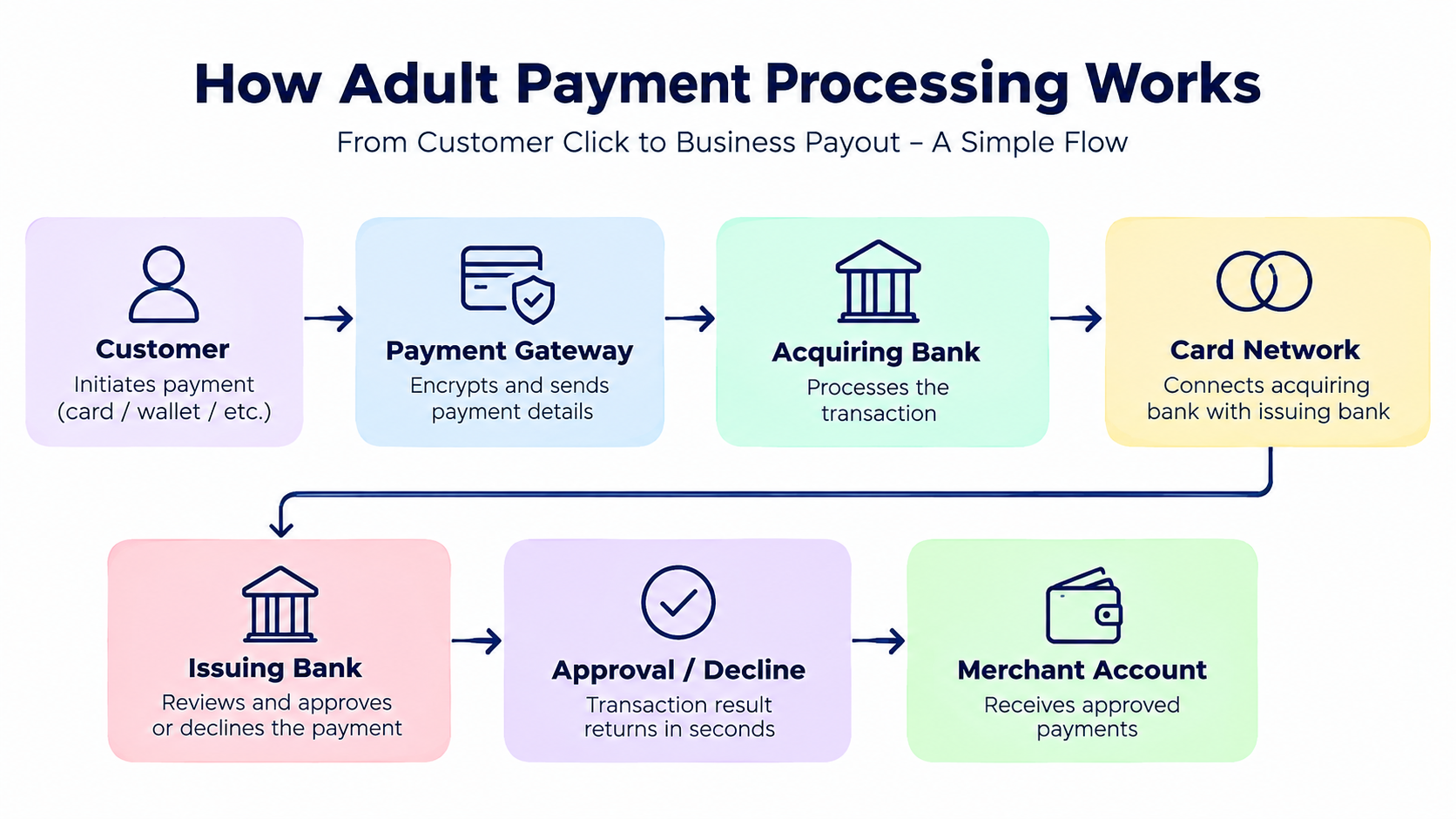
Although the payment experience may appear simple to the customer, several organizations work together behind the scenes. When a customer enters their payment details, the payment request travels through a payment gateway, reaches the acquiring bank, communicates with the customer’s card issuer, and finally returns an approval or decline within seconds.
For example, imagine a customer subscribing to a creator platform that charges a monthly membership fee. After entering their card details, the payment is verified, approved by the issuing bank, processed through the payment network, and deposited into the merchant’s account. If the payment is successful, the customer immediately gains access to premium content while the business receives confirmation that the transaction has been authorized.
This process happens thousands of times every day across subscription platforms, digital marketplaces, live-streaming services, and adult eCommerce websites.
Why Payment Processing Is Different for Adult Businesses?
Not every online business faces the same payment risks. Businesses selling physical products with clear shipping records often present fewer concerns than companies offering digital subscriptions or recurring services. Adult businesses frequently combine several factors that increase payment risk from a financial institution’s perspective.
Recurring subscriptions are one example. Customers sometimes forget that a membership renews automatically and later dispute the transaction after seeing it on their bank statement. In other situations, customers may not recognize the billing descriptor associated with the purchase and mistakenly report the payment as unauthorized.
Digital products also create unique challenges because there is no physical shipment proving delivery. Once premium content has been accessed, resolving disputes can become more complicated than with traditional retail purchases.
As businesses grow internationally, payment complexity increases further. Different countries have different banking policies, payment preferences, fraud risks, and regulatory expectations. A payment method that works well in one region may experience higher decline rates or limited availability elsewhere.
These factors contribute to why many providers classify adult businesses as high risk. If you’d like to understand the reasoning in greater detail, it’s worth exploring why adult entertainment businesses are considered high risk, as this classification influences nearly every payment-related decision a business will make.
The Main Participants in an Adult Payment Transaction
Every successful payment involves multiple organizations working together to authorize, process, and settle funds. Understanding each participant makes it easier to diagnose payment problems and choose the right payment infrastructure.
- Customer: Initiates the payment using a credit card, debit card, bank account, or another supported payment method.
- Payment Gateway: Securely encrypts payment information and transmits it for authorization.
- Merchant Account: Temporarily receives approved customer payments before settlement into the business’s bank account.
- Acquiring Bank: Processes transactions on behalf of the business and communicates with the payment networks.
- Card Network: Connects acquiring banks with issuing banks to authorize transactions.
- Issuing Bank: Reviews the transaction, checks available funds, applies fraud controls, and approves or declines the payment.
For example, if a customer purchases tokens on a live-streaming platform, the issuing bank may decline the transaction because it detects unusual spending behavior, even if the customer entered the correct card details. From the customer’s perspective, the payment simply “failed,” but the actual reason may involve fraud detection rules rather than a technical problem.
Understanding how these participants interact makes it easier to troubleshoot issues when payments do not go as planned.
Common Payment Challenges Adult Businesses Encounter
Payment processing is not simply about accepting money. It also involves managing operational risks that can affect revenue, customer satisfaction, and long-term business stability.
Some of the most common challenges include:
- Merchant account approval delays due to underwriting requirements.
- Higher payment decline rates caused by issuer restrictions or fraud screening.
- Recurring billing disputes from subscription renewals.
- Chargebacks resulting from unrecognized billing descriptors or customer confusion.
- Fraud attempts involving stolen cards, account takeover, or card testing.
- Compliance reviews and ongoing monitoring by payment providers.
- Supporting customers across different countries with varying payment preferences.
Consider a subscription-based membership website that experiences rapid growth after a successful marketing campaign. Daily transaction volume suddenly triples within a week. While this growth is positive, payment providers may temporarily review the account because the activity differs significantly from previous processing patterns. Preparing for situations like this helps businesses avoid unnecessary interruptions while continuing to scale.
Fortunately, these challenges are manageable with the right payment setup, transparent business practices, and an understanding of how payment providers assess risk. Many of these topics – including merchant account approval, payment gateways, chargeback prevention, fraud management, and recurring billing – deserve dedicated attention and are explored in greater depth throughout this content series.
Building a Reliable Payment Infrastructure
A reliable payment system is built on more than the ability to accept card payments. Adult businesses need payment infrastructure that supports their business model, scales with growth, and minimizes operational risks.
One of the first decisions is obtaining a suitable merchant account. Unlike a standard business bank account, a merchant account is specifically designed to receive customer card payments before they are settled into the business’s primary account. Because adult businesses operate in a higher-risk category, providers often review business information, website content, policies, ownership details, and expected transaction volumes before granting approval.
Preparing these documents in advance can make the underwriting process smoother. Businesses looking for a deeper explanation of this process should also understand how to get approved for an adult merchant account, including the information payment providers typically review.
The next important component is the payment gateway. While merchant accounts hold and settle funds, the gateway securely captures payment information and connects customers to the payment network. A fast, secure checkout experience can improve customer confidence while reducing abandoned purchases. As a business grows, choosing the right gateway becomes increasingly important for supporting subscriptions, international customers, and multiple payment methods.
Choosing Payment Methods That Fit Your Business Model
Different adult businesses serve customers in different ways, so there is rarely a single payment method that works for everyone.
A creator membership platform may rely heavily on recurring card payments, while an adult eCommerce store may benefit from offering additional payment options for one-time purchases. Businesses serving international customers may also need locally preferred payment methods to reduce failed transactions.
For example, a customer purchasing premium digital content may complete the payment immediately using a credit card, while another customer subscribing to a monthly membership expects future renewals to happen automatically without re-entering payment details. Understanding these differences helps businesses build a payment experience that matches customer expectations instead of forcing every purchase through the same checkout flow.
As your business expands, regularly reviewing payment performance, customer preferences, and approval rates can help identify opportunities to improve the checkout experience.
Managing Risk as the Business Grows
Growth brings more transactions, more customers, and greater operational complexity. It also increases the importance of managing payment-related risks before they affect revenue.
Successful adult businesses typically focus on several areas:
- Maintaining transparent billing descriptors so customers recognize transactions.
- Monitoring payment declines to identify recurring patterns.
- Responding quickly to customer support requests before disputes escalate.
- Reviewing fraud activity and unusual transaction behavior.
- Keeping website policies, refund procedures, and compliance information up to date.
Imagine a creator platform launching a successful promotional campaign that attracts thousands of new subscribers over a weekend. While the increase in revenue is welcome, the sudden spike in transaction volume may also attract more fraudulent payment attempts and increase the likelihood of customer inquiries about recurring billing. Businesses that monitor these trends early are generally better prepared to handle rapid growth without disrupting the customer experience.
If transaction failures become more frequent, understanding why adult entertainment payments get declined can help identify whether the cause is related to fraud controls, issuing banks, expired cards, or technical issues. Likewise, businesses experiencing increasing customer disputes should learn how to prevent chargebacks for adult entertainment businesses, since resolving disputes after they occur is often far more expensive than preventing them in the first place.
Conclusion
Payment processing is one of the foundations of a successful adult business. While accepting payments may seem straightforward on the surface, every transaction involves multiple financial institutions, security checks, compliance requirements, and risk assessments working together behind the scenes.
Businesses that understand how payment processing works are better equipped to choose suitable infrastructure, prepare for merchant account approval, support their customers, and respond to operational challenges as they grow. Rather than viewing payment processing as a technical requirement, it should be treated as an essential part of building a sustainable business.
As your payment operations mature, you’ll naturally encounter more specialized topics – from selecting the right payment gateway to reducing payment declines, preventing chargebacks, and managing recurring subscriptions. Developing a strong understanding of each of these areas will help create a more reliable payment experience for both your business and your customers.

Categories
- ACH Payments (10)
- adult payment processing (11)
- AI (9)
- Altcoins (10)
- Banking (10)
- Bitcoin (133)
- Bitcoin ETF (11)
- Bitcoin Price (30)
- Blockchain (50)
- Brokering World Hunger Away (16)
- Business (17)
- card payment processing (10)
- CBD (11)
- CBDC (11)
- Chargeback (8)
- coaching business (11)
- COVID-19 (3)
- Crypto ATMs (1)
- Crypto Banking (17)
- Crypto Bill (1)
- Crypto business owner platform (31)
- Crypto Investment (3)
- Crypto Markets (5)
- Crypto Payment (35)
- Crypto Payment Processor (4)
- Crypto Prices (1)
- Crypto Trading (92)
- Cryptocurrency (402)
- Cryptocurrency Exchange (108)
- Data Visualization (2)
- dating platforms (11)
- debt collection payment processing (10)
- Decentralized Finance (7)
- DeFi Payment (9)
- DEX (3)
- Digital Currency (23)
- dropshipping payment processing (12)
- Ethereum (2)
- FAQ (7)
- file sharing payment processing (11)
- Finance (25)
- Financial Equality (4)
- Financial Freedom (8)
- Forex (35)
- hemp (1)
- ICO (2)
- Investment (11)
- IPTV (11)
- Merchant Account (10)
- Mining (3)
- News (66)
- NFTs (2)
- online gambling (11)
- P2P (1)
- Paybito (147)
- PayBitoPro (693)
- PayBitoPro Coin Listing (6)
- PayBitoPro Exchange (2)
- Payment Gateway (48)
- peptide (10)
- Post COVID Digital Transformation (1)
- Press Release (130)
- Privacy & Security (3)
- Real Estate (1)
- Stablecoin (5)
- Technology (15)
- Travel (11)
- Uncategorized (10)
- US Presidential Election (2)
- Utility Coin (1)
- Web3 business (4)
- Web3 Wallets (2)
- White Label Crypto Exchange (8)
Recent Posts
- Payment Gateway vs. Payment Orchestration: What’s the Difference?
- What Is Smart Payment Routing? Strategies to Optimize Payment Performance
- How to Improve Payment Approval Rates for High-Risk Businesses?
- Why Are Online Payments Failing? Common Causes and How to Fix Them
- How to Use Multiple Payment Processors to Reduce Business Disruptions?