What Is a White Label Payment Platform for Adult Businesses? A Complete Guide
- August 4, 2026
- Soham Guchait
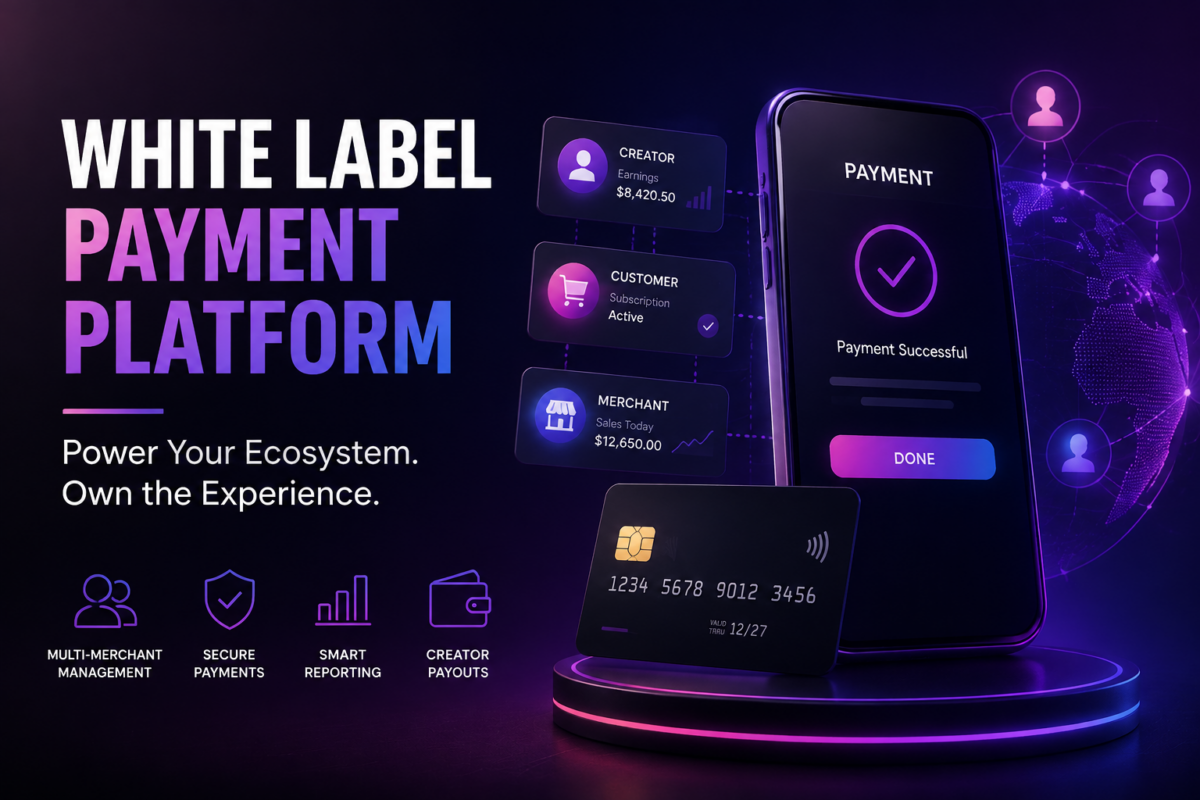
The adult entertainment industry has evolved far beyond traditional websites. Today, businesses operate creator platforms, subscription marketplaces, live-streaming services, digital content networks, affiliate ecosystems, and multi-vendor marketplaces that process thousands—or even millions—of transactions every month.
As these businesses grow, many discover that simply accepting online payments is no longer enough. They need greater control over branding, merchant onboarding, reporting, payment routing, and the overall customer payment experience. This is where a white label payment platform becomes relevant.
Unlike a standard payment gateway that only processes transactions, a white label payment platform allows businesses to offer a fully branded payment experience while managing multiple merchants, creators, vendors, or business units under one payment ecosystem.
If you’re building a scalable adult business, understanding how white label payment platforms work can help you determine whether your company needs one—or whether a traditional payment setup is sufficient.
What Is a White Label Payment Platform?
A white label payment platform is a payment processing solution that businesses can rebrand and offer as their own. Instead of customers or merchants interacting with a third-party payment interface, every part of the payment experience carries the business’s own branding.
For an adult business, this means customers can complete transactions, creators can receive payouts, merchants can manage payments, and administrators can monitor activity—all within a unified platform that appears to belong entirely to the business itself.
Think of it this way.
A standard payment gateway helps your business accept payments.
A white label payment platform helps your business provide payment services as part of its own ecosystem.
For example, imagine an adult creator marketplace where thousands of creators sell premium subscriptions.
Rather than each creator finding their own payment processor, the marketplace operates one centralized payment platform. Customers subscribe through a branded checkout, creators manage earnings from their own dashboard, and administrators oversee every transaction from a single system. This creates a much more seamless experience than connecting several unrelated payment tools.
Businesses unfamiliar with the payment ecosystem should first understand adult entertainment payment processing, since a white label platform builds upon the same payment infrastructure.
Who Needs a White Label Payment Platform?
Not every adult business requires a white label solution. A creator with a single subscription website usually needs only a merchant account and payment gateway. However, larger businesses often outgrow traditional payment setups.
White label platforms are commonly used by:
- Creator marketplaces with multiple content creators.
- Adult membership networks operating several websites.
- Live-streaming platforms with performer payouts.
- Adult affiliate and reseller networks.
- Digital content marketplaces.
- Multi-brand adult businesses operating several platforms.
- Businesses provide payment services to other merchants.
For example, imagine a company operating ten adult websites under different brands.
Instead of managing separate payment systems, customer records, reporting tools, and payment providers for each website, the business can centralize everything within one branded payment platform while allowing each brand to maintain its own identity. As transaction volume grows, this centralized approach becomes significantly easier to manage.
How Does a White Label Payment Platform Work?
Although every platform is different, most white label payment platforms combine several payment functions into one branded system.
These commonly include:
- Customer checkout.
- Merchant or creator onboarding.
- Payment processing.
- Subscription management.
- Reporting dashboards.
- Settlement management.
- Fraud monitoring.
- Compliance workflows.
- API integrations.
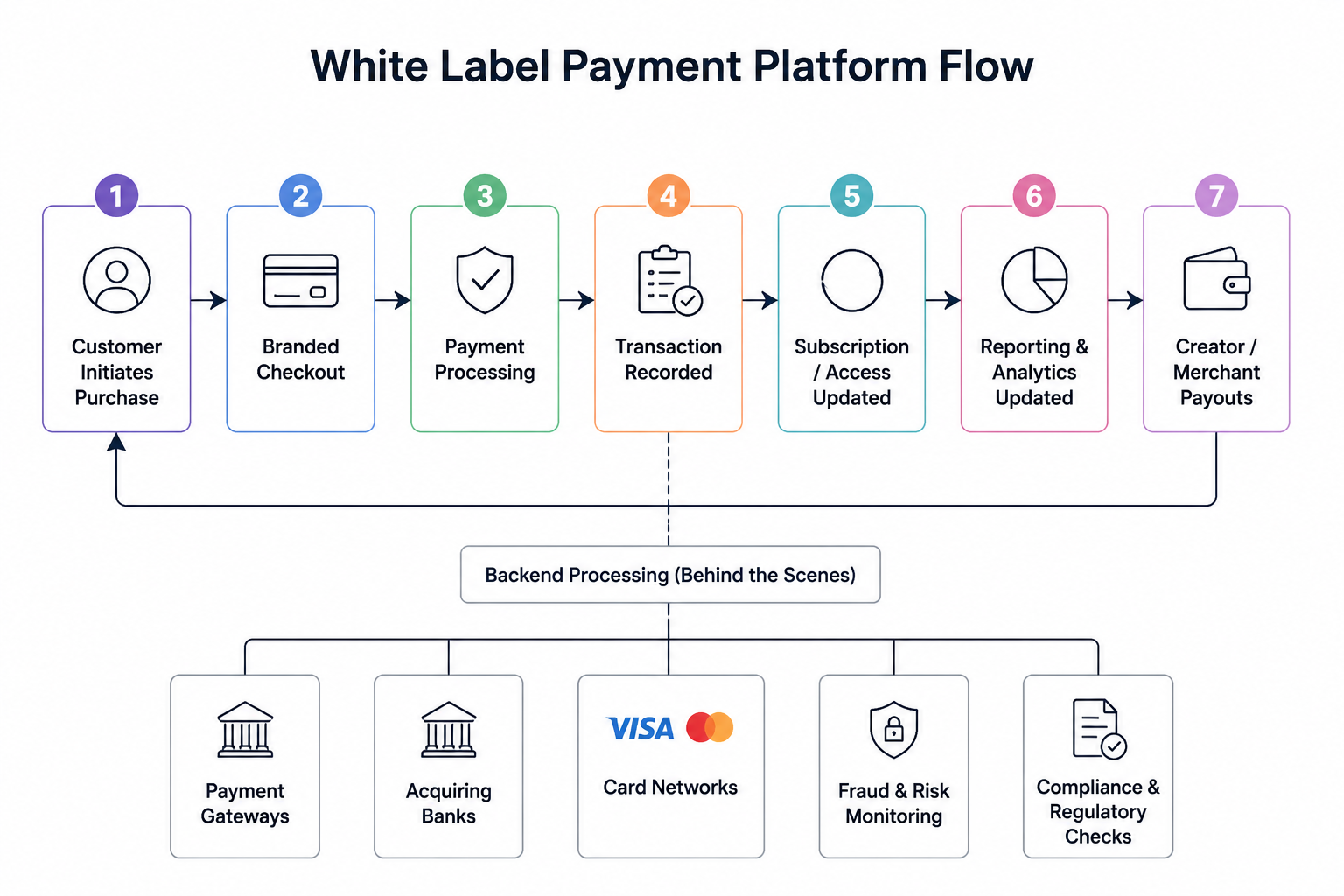
For example, when a customer purchases a premium creator subscription, the payment platform securely processes the transaction, records the payment, updates subscription status, tracks reporting information, and prepares future creator payouts – all without the customer leaving the business’s branded environment.
Behind the scenes, payment gateways, acquiring banks, and payment networks still perform the transaction processing. The white label platform simply manages and presents these services through one integrated interface.
Key Features Adult Businesses Should Look For
Not every white label payment platform offers the same capabilities. The right solution depends on the business model and long-term growth strategy.
Multi-Merchant and Creator Management
One of the biggest advantages is the ability to manage multiple businesses or creators within a single platform.
For example, a creator marketplace may onboard hundreds of creators, each with different earnings, reporting requirements, and subscription plans. Instead of creating separate payment systems for each creator, administrators manage everything through one platform while creators access their own dedicated dashboards.
Branded Customer Experience
Brand consistency plays an important role in customer trust.
With a white label platform, customers remain inside the business’s ecosystem throughout the payment journey rather than being redirected to unfamiliar third-party interfaces. For subscription-based adult businesses, this creates a smoother experience and reinforces brand recognition.
Reporting and Payment Insights
As transaction volume increases, businesses need more than simple payment confirmations. A modern white label platform should provide visibility into:
- Transaction history.
- Subscription performance.
- Revenue trends.
- Merchant activity.
- Creator earnings.
- Payment failures.
- Chargeback reporting.
For example, a marketplace administrator can identify which creators generate the highest subscription revenue, monitor payment approval rates, and review settlement reports from one dashboard.
Compliance, Security, and Fraud Management
Managing payments for multiple merchants or creators introduces additional operational responsibilities. A well-designed white label platform should support:
- Merchant verification.
- Creator onboarding.
- KYC procedures.
- AML monitoring.
- Fraud detection.
- Transaction monitoring.
- Role-based administrative access.
For example, before allowing a new creator to begin accepting payments, the platform may verify business information and identity as part of its onboarding process.
Likewise, unusual transaction patterns or suspected fraudulent activity can be monitored across the entire platform rather than on individual accounts. Businesses operating large payment ecosystems should also understand KYC and AML for adult entertainment payment processing and how to prevent payment fraud in adult entertainment businesses, since compliance and fraud prevention become increasingly important as payment volumes grow.
White Label Payment Platform vs. Payment Gateway
Many businesses confuse these two solutions, but they serve different purposes.
A payment gateway focuses on securely authorizing and transmitting customer payments.
A white label payment platform manages the broader payment ecosystem.
For example:
A creator selling premium content through one website usually needs a payment gateway.
A company operating a marketplace with thousands of creators, branded payment dashboards, subscription management, reporting tools, and creator payouts may benefit from a white label payment platform. The gateway processes the payment. The white label platform manages the business built around those payments.
When Should an Adult Entertainment Business Upgrade?
Many businesses begin with a traditional payment setup and later transition to a white label platform as operations become more complex.
Signs that it may be time to upgrade include:
- Managing multiple brands or websites.
- Supporting hundreds of creators or merchants.
- Requiring customized payment workflows.
- Needing centralized reporting.
- Managing subscription payments at scale.
- Offering payment services within your own ecosystem.
For example, an adult marketplace that initially served twenty creators may eventually expand to several thousand. Managing onboarding, reporting, payouts, and payment operations individually becomes increasingly inefficient without a centralized platform.
Conclusion
A white label payment platform is much more than a tool for accepting payments. It allows adult businesses to create their own branded payment ecosystem, manage multiple merchants or creators, streamline operations, and deliver a consistent customer experience without relying entirely on third-party interfaces.
For smaller businesses, a traditional merchant account and payment gateway are often enough. But as platforms expand, transaction volumes increase, and business models become more complex, a white label payment platform can provide the flexibility, scalability, and operational control needed to support long-term growth.
Understanding the difference between a standard payment solution and a white label platform helps businesses choose payment infrastructure that matches not only their current needs but also their future ambitions.

Categories
- ACH Payments (10)
- adult payment processing (11)
- AI (9)
- Altcoins (10)
- Banking (10)
- Bitcoin (133)
- Bitcoin ETF (11)
- Bitcoin Price (30)
- Blockchain (50)
- Brokering World Hunger Away (16)
- Business (17)
- card payment processing (10)
- CBD (11)
- CBDC (11)
- coaching business (11)
- COVID-19 (3)
- Crypto ATMs (1)
- Crypto Banking (17)
- Crypto Bill (1)
- Crypto business owner platform (31)
- Crypto Investment (3)
- Crypto Markets (5)
- Crypto Payment (35)
- Crypto Payment Processor (4)
- Crypto Prices (1)
- Crypto Trading (92)
- Cryptocurrency (402)
- Cryptocurrency Exchange (108)
- Data Visualization (2)
- dating platforms (11)
- debt collection payment processing (10)
- Decentralized Finance (7)
- DeFi Payment (9)
- DEX (3)
- Digital Currency (23)
- dropshipping payment processing (12)
- Ethereum (2)
- FAQ (7)
- file sharing payment processing (11)
- Finance (25)
- Financial Equality (4)
- Financial Freedom (8)
- Forex (35)
- hemp (1)
- ICO (2)
- Investment (11)
- IPTV (11)
- Merchant Account (10)
- Mining (3)
- News (66)
- NFTs (2)
- online gambling (11)
- P2P (1)
- Paybito (139)
- PayBitoPro (693)
- PayBitoPro Coin Listing (6)
- PayBitoPro Exchange (2)
- Payment Gateway (40)
- peptide (10)
- Post COVID Digital Transformation (1)
- Press Release (130)
- Privacy & Security (3)
- Real Estate (1)
- Stablecoin (5)
- Technology (15)
- Travel (11)
- Uncategorized (9)
- US Presidential Election (2)
- Utility Coin (1)
- Web3 business (4)
- Web3 Wallets (2)
- White Label Crypto Exchange (8)
Recent Posts
- ACH vs Wire Transfer: Which Payment Method Is Better for Businesses?
- ACH Fraud Prevention: How Businesses Can Secure Bank Account Payments?
- ACH Credit vs ACH Debit: What’s the Difference? With Real Examples
- ACH vs Credit Card: Which Payment Method Is Better for Businesses?
- How Long Do ACH Payments Take? Processing Times, Settlement, and Same Day ACH