KYC and AML Requirements for Dropshipping Businesses: What Online Sellers Need to Know
- August 7, 2026
- Soham Guchait
Starting a dropshipping business involves setting up an online store, finding suppliers, marketing products, and building a reliable payment system. However, before a business can process customer payments at scale, it must usually complete verification procedures designed to confirm its legitimacy and reduce financial risks.
This is where KYC and AML requirements for dropshipping businesses become important.
Many new ecommerce entrepreneurs are unfamiliar with why payment providers request business documents, verify identities, or review transaction activity. These processes are sometimes viewed as unnecessary obstacles, but they play an important role in protecting merchants, customers, and the broader payment ecosystem.
Understanding how KYC and AML processes work helps dropshipping businesses prepare better applications, avoid unnecessary delays, and build stronger payment operations from the beginning.
What Are KYC and AML in Payment Processing?
KYC stands for Know Your Customer. It refers to the process businesses and payment providers use to verify who they are working with. In the context of dropshipping businesses, KYC helps confirm that the merchant is a legitimate business, operated by identifiable individuals, selling permitted products, and providing accurate information.
AML stands for Anti-Money Laundering. These measures are designed to prevent financial systems from being used for illegal activities such as money laundering, fraud, or unauthorized transactions. Although AML requirements are often associated with banks and financial institutions, payment providers also follow similar principles because they handle digital transactions and financial flows.
Together, KYC and AML processes help create a safer environment where legitimate businesses can accept payments while reducing financial risks.
Why Payment Providers Require KYC for Dropshipping Businesses?
Payment providers need to understand the businesses they support before allowing them to process customer payments. Unlike traditional retail businesses with physical locations, dropshipping businesses often operate entirely online. This means payment providers rely on documentation, website information, and business verification to understand how the merchant operates.
A high-risk business like dropshipping may be reviewed based on factors such as:
- Business ownership and registration details.
- Products being sold.
- Supplier relationships.
- Website transparency.
- Expected transaction volume.
- Customer locations.
For example, two online stores may sell similar products, but one clearly displays business information, shipping policies, refund terms, and customer support details, while the other provides very little information. From a payment provider’s perspective, the first business demonstrates greater transparency and operational readiness.
Common KYC Documents Required for Dropshipping Businesses
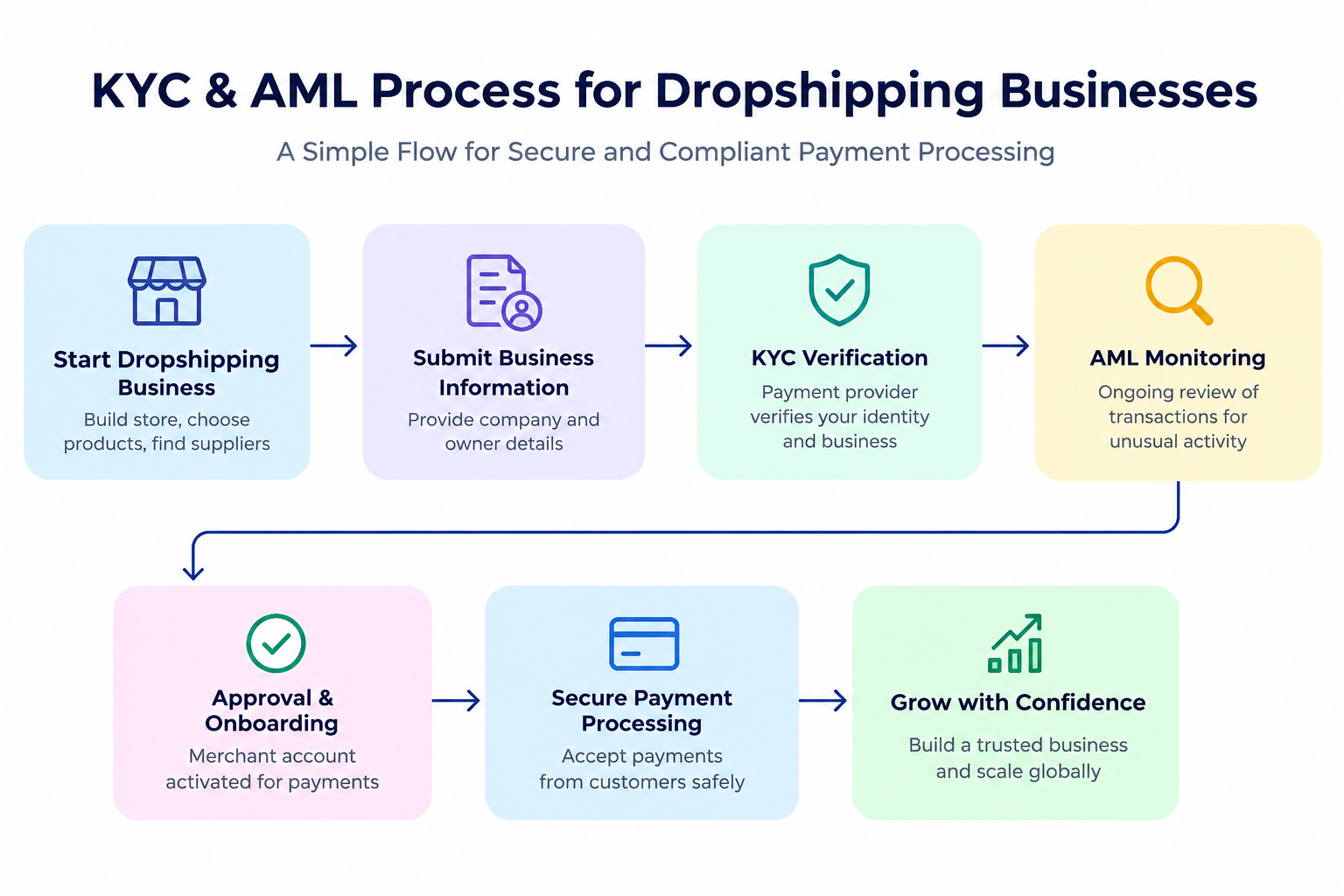
The exact documentation required depends on the payment provider, business location, and operating model. However, most businesses should be prepared to provide information that verifies their identity and operations. These verification requirements are also a key part of the merchant account approval process, where payment providers evaluate business legitimacy, documentation, website information, and operational readiness before enabling payment processing.
Common requirements may include:
- Business registration documents.
- Government-issued identification of business owners.
- Proof of business address.
- Business bank account information.
- Website details and product information.
- Supplier or fulfillment information.
A new dropshipping entrepreneur may not have years of processing history, but they can still demonstrate credibility through proper documentation and a professional online presence.
For example, a newly launched store selling fitness equipment can improve its approval chances by clearly showing product details, supplier information, delivery timelines, and customer service channels.
Why Website Transparency Matters During Verification?
For ecommerce businesses, the website is often one of the first things reviewed during the onboarding process. A payment provider needs to understand what customers see before making a purchase and whether the business provides enough information to support a reliable shopping experience.
Important website elements include:
- Clear product descriptions.
- Accurate pricing information.
- Shipping policies.
- Refund and return policies.
- Privacy policy and terms of service.
- Contact information.
A common issue among new dropshipping businesses is focusing heavily on advertising while overlooking basic customer trust elements.
For example, a store may successfully run social media campaigns and attract visitors, but if customers cannot find information about delivery times or returns, it creates uncertainty for both shoppers and payment providers.
How AML Monitoring Applies to Dropshipping Businesses?
AML processes are primarily focused on identifying unusual financial activity rather than reviewing normal ecommerce transactions. For most legitimate dropshipping businesses, AML monitoring happens in the background as payment providers analyze transaction behavior.
Examples of activity that may require additional review include:
- Sudden unusual increases in transaction volume.
- Transactions inconsistent with normal business activity.
- Suspicious payment patterns.
- High levels of refunds or disputes.
For instance, a small dropshipping store that normally processes a few hundred dollars per week suddenly begins processing tens of thousands of dollars in international transactions within a few days. This change may require additional verification to confirm that the activity matches genuine business growth. The purpose of monitoring is not to prevent growth but to ensure that payment activity remains consistent with the merchant’s business profile.
How KYC and AML Help Protect Dropshipping Merchants?
Although verification requirements may seem time-consuming, they provide important benefits for legitimate businesses. Strong compliance processes help reduce exposure to fraudulent merchants, unauthorized transactions, and financial risks that could negatively impact the payment ecosystem.
For dropshipping businesses, proper verification can help create:
- More stable payment operations.
- Greater trust with payment providers.
- Better protection against fraudulent activity.
- Easier expansion into new markets.
A transparent business is easier to evaluate, which can lead to smoother onboarding and fewer issues as transaction volumes increase.
Common KYC Mistakes Made by New Dropshipping Businesses
Many payment onboarding delays happen because merchants are not prepared rather than because their business model is unsuitable.
Some common mistakes include:
Inconsistent Business Information
The information submitted during onboarding should match the information displayed on the website and business documents. Differences in business names, addresses, or ownership details can create unnecessary verification delays.
Lack of Product Transparency
Payment providers need to understand what products are being sold. A website with limited descriptions, unclear pricing, or missing policies makes it difficult to evaluate the business.
Poor Documentation Preparation
Submitting incomplete documents or unclear copies can slow down the approval process. Preparing accurate documentation before applying helps create a smoother experience.
Preparing Your Dropshipping Business for KYC Approval
A strong KYC process begins before submitting any application. Dropshipping businesses should focus on building operational transparency from the start. This includes maintaining accurate business records, creating a professional website, clearly explaining fulfillment processes, and keeping supplier information organized.
For example, a merchant selling beauty products through a dropshipping model should be able to explain where products come from, how orders are fulfilled, how customers receive support, and how refunds are handled.
These details demonstrate that the business is prepared to manage customer transactions responsibly.
Compliance Becomes More Important as Businesses Scale
A small dropshipping store may begin with local customers and limited transaction volume. However, as the business expands internationally, payment operations become more complex.
Higher transaction volumes, more customer locations, and additional payment methods require stronger monitoring and documentation. Businesses that establish proper compliance practices early are better prepared for future growth.
KYC and AML should not be viewed only as requirements for approval. They are part of building a trustworthy ecommerce operation capable of handling larger payment volumes.
Final Thoughts
KYC and AML requirements for dropshipping businesses are an important part of modern payment processing. These processes help payment providers verify legitimate merchants, reduce financial risks, and maintain secure transaction environments.
For dropshipping entrepreneurs, understanding these requirements makes the payment onboarding process easier and helps build stronger foundations for growth.
By maintaining accurate business information, providing transparent customer policies, organizing documentation, and operating responsibly, businesses can create more reliable payment systems while preparing themselves for long-term ecommerce success.

Categories
- ACH Payments (10)
- adult payment processing (11)
- AI (9)
- Altcoins (10)
- Banking (10)
- Bitcoin (133)
- Bitcoin ETF (11)
- Bitcoin Price (30)
- Blockchain (50)
- Brokering World Hunger Away (16)
- Business (17)
- card payment processing (10)
- CBD (11)
- CBDC (11)
- Chargeback (8)
- coaching business (11)
- COVID-19 (3)
- Crypto ATMs (1)
- Crypto Banking (17)
- Crypto Bill (1)
- Crypto business owner platform (31)
- Crypto Investment (3)
- Crypto Markets (5)
- Crypto Payment (35)
- Crypto Payment Processor (4)
- Crypto Prices (1)
- Crypto Trading (92)
- Cryptocurrency (402)
- Cryptocurrency Exchange (108)
- Data Visualization (2)
- dating platforms (11)
- debt collection payment processing (10)
- Decentralized Finance (7)
- DeFi Payment (9)
- DEX (3)
- Digital Currency (23)
- dropshipping payment processing (12)
- Ethereum (2)
- FAQ (7)
- file sharing payment processing (11)
- Finance (25)
- Financial Equality (4)
- Financial Freedom (8)
- Forex (35)
- hemp (1)
- ICO (2)
- Investment (11)
- IPTV (11)
- Merchant Account (10)
- Mining (3)
- News (66)
- NFTs (2)
- online gambling (11)
- P2P (1)
- Paybito (147)
- PayBitoPro (693)
- PayBitoPro Coin Listing (6)
- PayBitoPro Exchange (2)
- Payment Gateway (48)
- peptide (10)
- Post COVID Digital Transformation (1)
- Press Release (130)
- Privacy & Security (3)
- Real Estate (1)
- Stablecoin (5)
- Technology (15)
- Travel (11)
- Uncategorized (10)
- US Presidential Election (2)
- Utility Coin (1)
- Web3 business (4)
- Web3 Wallets (2)
- White Label Crypto Exchange (8)
Recent Posts
- Payment Gateway vs. Payment Orchestration: What’s the Difference?
- What Is Smart Payment Routing? Strategies to Optimize Payment Performance
- How to Improve Payment Approval Rates for High-Risk Businesses?
- Why Are Online Payments Failing? Common Causes and How to Fix Them
- How to Use Multiple Payment Processors to Reduce Business Disruptions?