Merchant Account for Dropshipping Businesses: Requirements, Approval Process, and Common Challenges
- August 6, 2026
- Soham Guchait
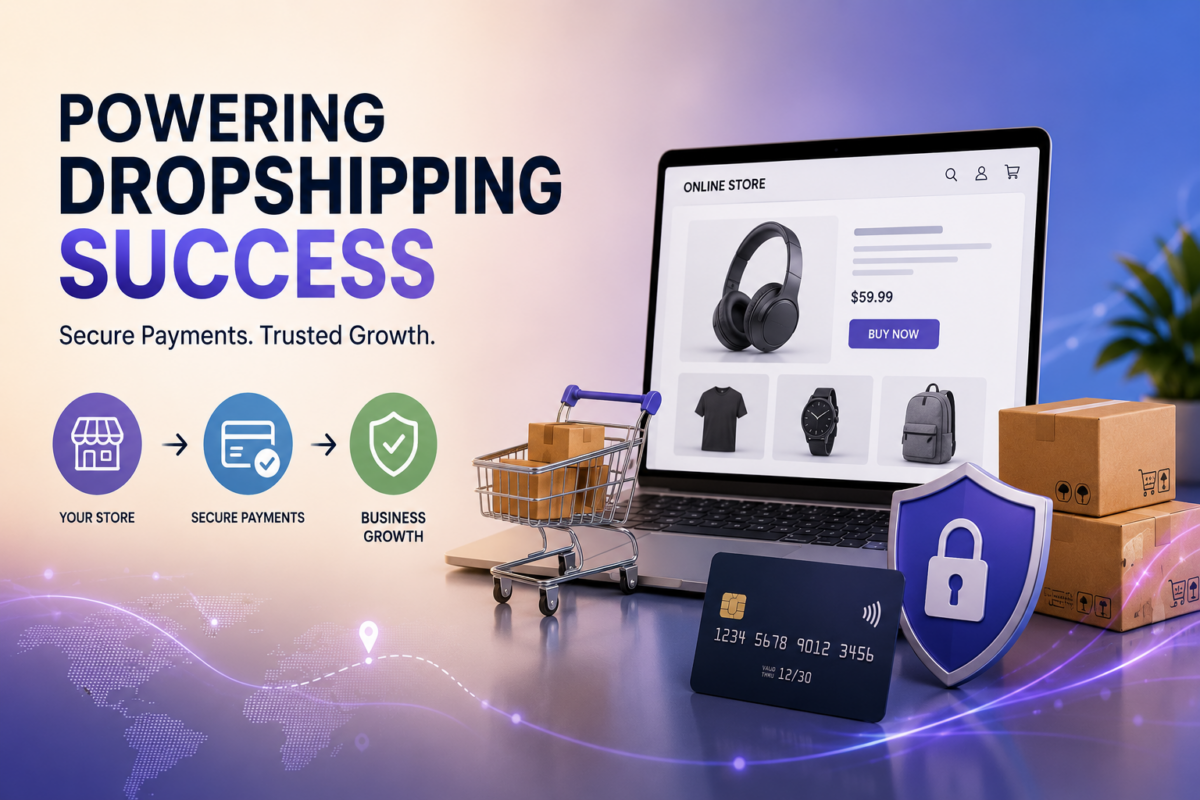
Starting a dropshipping business involves more than building an online store and finding reliable suppliers. Before customers can complete purchases, the business needs a way to securely accept card payments and receive funds. This is where a merchant account becomes essential.
Many new ecommerce entrepreneurs assume that opening a merchant account is a simple registration process. In reality, payment providers carefully evaluate every business before approving payment processing. For dropshipping businesses, this review is often more detailed because providers assess operational risks such as fulfillment timelines, refund rates, supplier relationships, and customer satisfaction.
Understanding how a merchant account for dropshipping businesses works – and what payment providers look for during the approval process – can significantly improve your chances of getting approved while helping you build a more reliable payment infrastructure.
What Is a Merchant Account?
A merchant account is a specialized business account that allows online merchants to accept electronic payments from customers. Unlike a standard business bank account, it temporarily holds approved transaction funds before they are transferred according to the agreed settlement schedule.
Every time a customer completes a purchase, the transaction moves through several stages before the money reaches the business. The merchant account acts as an intermediary during this process, allowing payment providers to verify, monitor, and settle transactions securely.
For example, imagine a customer purchasing a kitchen appliance from a dropshipping store. The payment is approved within seconds, allowing the order to move forward. However, the funds do not immediately appear in the merchant’s bank account. Instead, they pass through the merchant account before settlement, ensuring the transaction has been properly authorized and processed.
Understanding this distinction helps business owners see why merchant accounts play a much larger role than simply collecting payments.
Why Payment Providers Review Dropshipping Businesses Carefully?
Payment providers are responsible for managing financial risk for every merchant they onboard. Their objective is not to reject businesses but to understand how they operate and whether they can process payments responsibly.
Dropshipping businesses often receive additional scrutiny because the merchant does not directly control inventory or product fulfillment. Customer satisfaction depends heavily on suppliers, shipping partners, and delivery timelines.
Several operational factors influence the review process:
- Products may be fulfilled by third-party suppliers located in different countries.
- Delivery times can vary significantly depending on supplier availability.
- Refunds and customer disputes may increase if expectations are not clearly communicated.
- Businesses experiencing rapid sales growth may require additional monitoring.
These considerations do not automatically classify every dropshipping business as high risk. Instead, they help payment providers determine whether the business has appropriate systems in place to manage customer expectations and payment-related risks.
What Payment Providers Evaluate During Merchant Account Approval?
Merchant account approval involves reviewing both the business itself and how it plans to process payments.
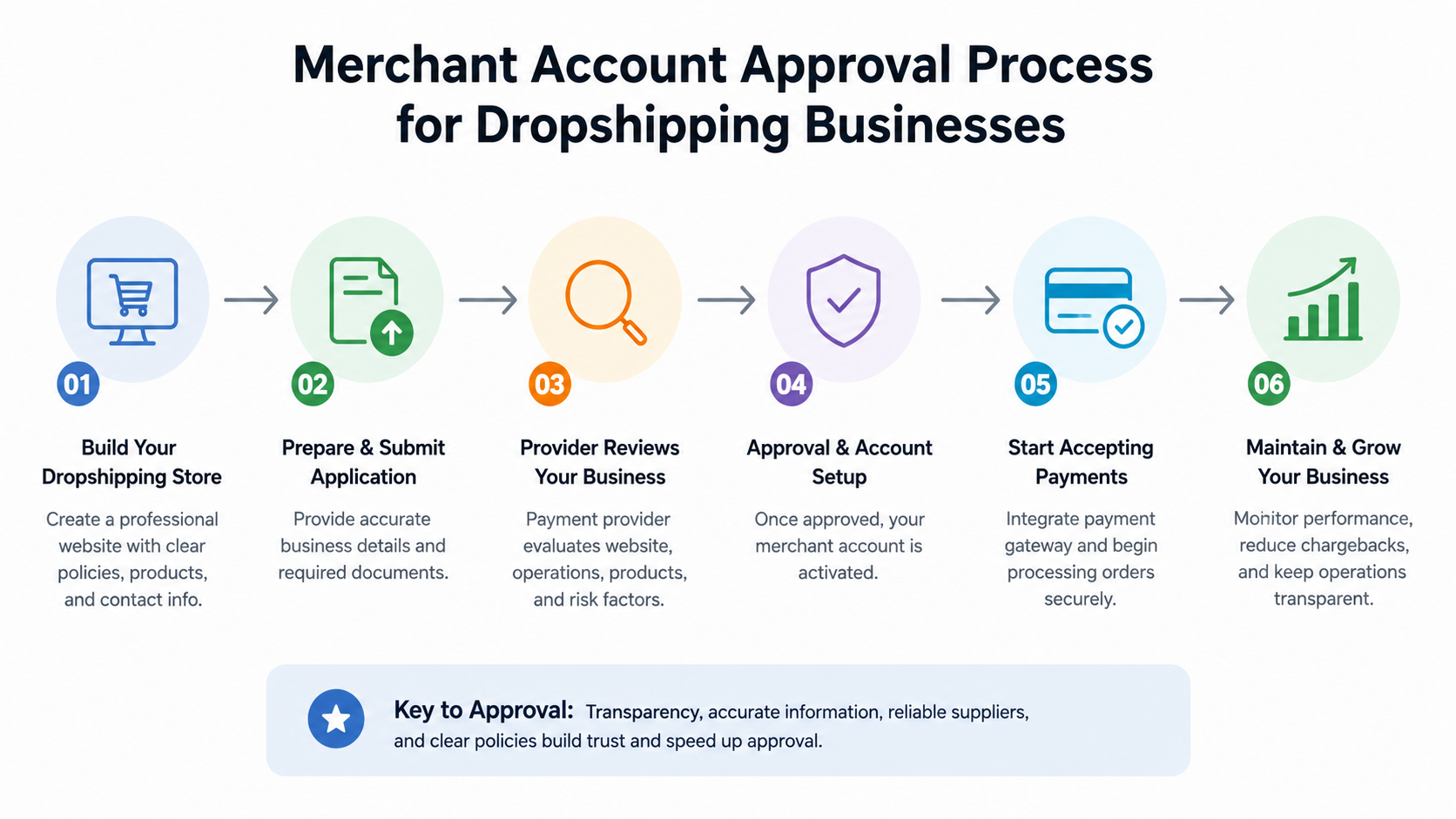
One of the first areas examined is the business website. A professional website demonstrates transparency and helps payment providers understand exactly what customers are purchasing.
A typical review includes product pages, pricing information, shipping policies, refund policies, contact details, privacy notices, and terms of service.
For example, a website selling premium fitness accessories should clearly explain product specifications, estimated delivery times, return procedures, and customer support channels. Missing or incomplete information can create uncertainty for both customers and payment providers.
The business itself is also evaluated. Payment providers usually verify legal registration details, ownership information, operating location, and business activities to ensure the merchant is genuine and compliant with applicable regulations.
Documents Commonly Required for Merchant Account Applications
Although requirements vary between providers and jurisdictions, most applications request documentation that verifies the legitimacy of the business. Commonly requested documents include:
- Business registration certificates.
- Government-issued identification for business owners.
- Business bank account information.
- Company address verification.
- Product and supplier information.
- Website URL and business description.
- Processing history (if previously accepting payments).
A new dropshipping business may not have processing history, which is generally not a problem. In these cases, payment providers place greater emphasis on website quality, business transparency, and operational readiness.
Providing accurate documentation during the initial application often speeds up the approval process and reduces requests for additional information.
Common Reasons Merchant Account Applications Are Delayed or Rejected
Many merchant account applications encounter delays not because the business model is unsuitable, but because important details are missing or inconsistent.
One common issue is a website that appears incomplete. Missing product descriptions, unavailable contact information, or unclear refund policies make it difficult for payment providers to evaluate how customers will interact with the business.
Another frequent issue involves unrealistic shipping promises. For example, advertising “next-day delivery” while sourcing products from overseas suppliers creates a mismatch between customer expectations and actual fulfillment capabilities.
Applications may also require additional review when product sourcing information is unclear or when merchants cannot explain how customer orders will be fulfilled.
Businesses should also ensure that all information submitted during the application matches the details displayed on their website. Differences in business names, addresses, or contact information often lead to unnecessary verification requests.
How to Improve Merchant Account Approval Chances?
Preparing your business before submitting an application can significantly improve the approval experience. Instead of focusing only on documentation, merchants should demonstrate that their business is designed to provide a reliable customer experience.
Helpful preparation includes:
- Publishing complete shipping and return policies.
- Providing accurate product descriptions.
- Displaying clear contact information.
- Being transparent about fulfillment timelines.
- Working with reputable suppliers.
- Maintaining consistent business information across all documents and website pages.
Consider a new dropshipping business selling home décor products. Rather than advertising unrealistically fast delivery, the business clearly states estimated shipping times, explains its return process, and provides order tracking updates. This level of transparency helps build trust with both customers and payment providers.
Merchant Accounts Are Only One Part of the Payment Ecosystem
Receiving merchant account approval is an important milestone, but it represents only one component of a complete payment system. Merchants must also select an appropriate payment gateway, support customer-preferred payment methods, monitor transactions for fraud, and prepare for challenges such as payment declines and chargebacks.
As businesses expand internationally, additional considerations such as multiple currencies, cross-border payments, and regulatory compliance become increasingly important. Understanding how these components work together allows merchants to build payment systems that are more reliable and easier to scale over time.
Building Long-Term Trust with Payment Providers
Merchant account approval should be viewed as the beginning of an ongoing relationship rather than a one-time application.
Payment providers continue monitoring account activity to ensure transactions remain consistent with the merchant’s business profile. Sudden spikes in sales, unusually high refund rates, or increased chargebacks may trigger additional reviews.
Businesses that maintain transparent operations, communicate clearly with customers, and monitor payment performance are generally better positioned to establish long-term processing stability.
For growing dropshipping businesses, this means regularly reviewing payment data, improving customer communication, and adapting operational processes as transaction volumes increase.
For businesses operating multiple dropshipping stores or building ecommerce platforms for multiple sellers, a white label payment platform for dropshipping businesses can provide a more structured way to manage payment operations as transaction volumes increase.
Final Thoughts
A merchant account is the foundation that enables dropshipping businesses to accept customer payments securely and operate with confidence. Understanding how payment providers evaluate applications helps merchants prepare stronger businesses before submitting an application.
Rather than viewing the approval process as an obstacle, entrepreneurs should see it as an opportunity to build trust through transparency, accurate documentation, and a customer-focused business model.
As your business grows, merchant account management becomes closely connected with payment gateways, fraud prevention, chargeback reduction, international payment processing, and compliance. Developing each of these areas creates a stronger payment infrastructure that supports sustainable growth and improves the overall customer payment experience.
Categories
- ACH Payments (10)
- adult payment processing (11)
- AI (9)
- Altcoins (10)
- Banking (10)
- Bitcoin (133)
- Bitcoin ETF (11)
- Bitcoin Price (30)
- Blockchain (50)
- Brokering World Hunger Away (16)
- Business (17)
- card payment processing (10)
- CBD (11)
- CBDC (11)
- Chargeback (8)
- coaching business (11)
- COVID-19 (3)
- Crypto ATMs (1)
- Crypto Banking (17)
- Crypto Bill (1)
- Crypto business owner platform (31)
- Crypto Investment (3)
- Crypto Markets (5)
- Crypto Payment (35)
- Crypto Payment Processor (4)
- Crypto Prices (1)
- Crypto Trading (92)
- Cryptocurrency (402)
- Cryptocurrency Exchange (108)
- Data Visualization (2)
- dating platforms (11)
- debt collection payment processing (10)
- Decentralized Finance (7)
- DeFi Payment (9)
- DEX (3)
- Digital Currency (23)
- dropshipping payment processing (12)
- Ethereum (2)
- FAQ (7)
- file sharing payment processing (11)
- Finance (25)
- Financial Equality (4)
- Financial Freedom (8)
- Forex (35)
- hemp (1)
- ICO (2)
- Investment (11)
- IPTV (11)
- Merchant Account (10)
- Mining (3)
- News (66)
- NFTs (2)
- online gambling (11)
- P2P (1)
- Paybito (147)
- PayBitoPro (693)
- PayBitoPro Coin Listing (6)
- PayBitoPro Exchange (2)
- Payment Gateway (48)
- peptide (10)
- Post COVID Digital Transformation (1)
- Press Release (130)
- Privacy & Security (3)
- Real Estate (1)
- Stablecoin (5)
- Technology (15)
- Travel (11)
- Uncategorized (10)
- US Presidential Election (2)
- Utility Coin (1)
- Web3 business (4)
- Web3 Wallets (2)
- White Label Crypto Exchange (8)
Recent Posts
- Payment Gateway vs. Payment Orchestration: What’s the Difference?
- What Is Smart Payment Routing? Strategies to Optimize Payment Performance
- How to Improve Payment Approval Rates for High-Risk Businesses?
- Why Are Online Payments Failing? Common Causes and How to Fix Them
- How to Use Multiple Payment Processors to Reduce Business Disruptions?