Why Is IPTV Businesses Considered High Risk for Payment Processing?
- August 11, 2026
- Soham Guchait
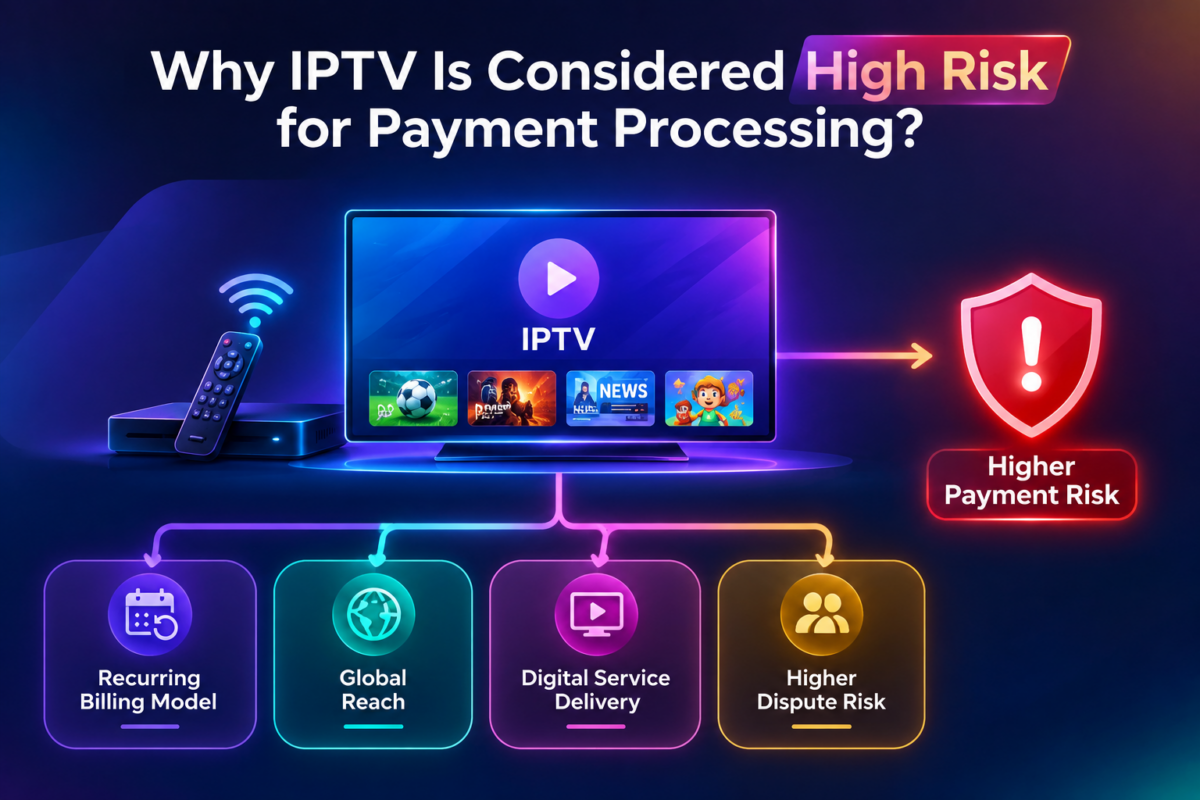
An IPTV business can have a legitimate service, paying customers, and a growing subscription base and still encounter additional scrutiny when trying to obtain payment processing. This often leads business owners to ask: Why is IPTV considered high risk industry for payment processing?
The answer is more complicated than simply saying that IPTV is a high-risk industry.
Payment providers generally assess the risk of an individual business based on its business model, transaction history, customer profile, subscription structure, geographic reach, dispute exposure, and other factors. Some IPTV businesses may therefore receive more underwriting attention than a conventional ecommerce merchant, while others may qualify for payment solutions with fewer restrictions.
Understanding how this assessment works is important before applying for an IPTV merchant account. It also helps businesses understand what payment providers are looking for and how to build a payment operation that can remain stable as transaction volume grows.
What Does High Risk Mean in Payment Processing?
In payment processing, “high risk” does not necessarily mean that a business is fraudulent, illegal, or poorly operated. It generally refers to a business that may create greater financial or operational exposure for a payment provider, acquiring bank, or other participant in the payment ecosystem.
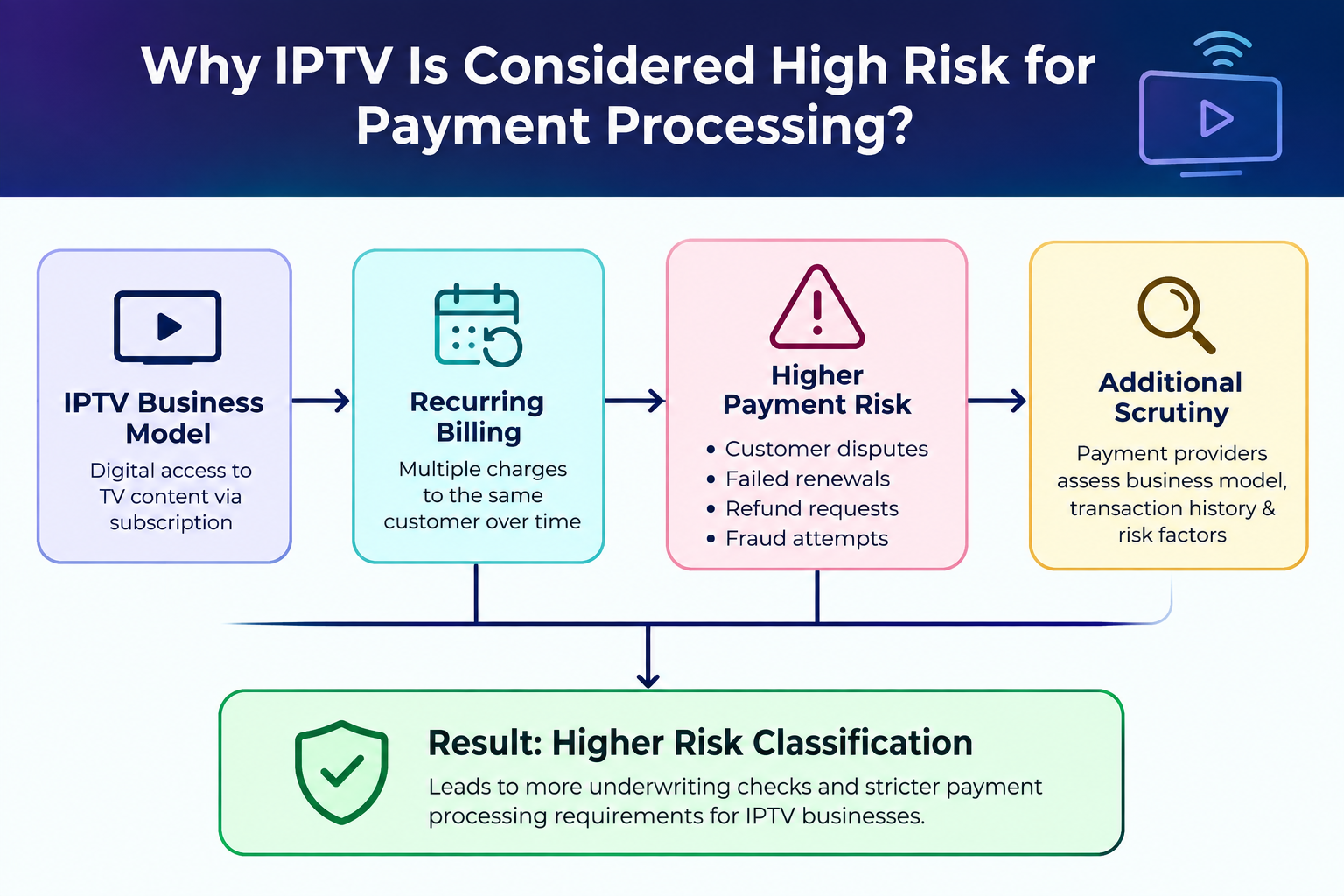
That exposure can come from several sources. A business may have a higher likelihood of customer disputes, recurring payment problems, fraud attempts, refunds, regulatory complications, or sudden changes in transaction activity.
For example, consider two businesses.
A traditional retailer sells a $50 physical product, receives payment, ships the product, and completes the transaction. An IPTV business might charge a customer $20 every month for continued digital access. The customer may continue being charged for several months, may forget about the subscription, may dispute a renewal, or may use a card issued in another country.
The payment provider therefore has to evaluate a different transaction lifecycle. This distinction is important because high-risk payment processing is primarily about managing potential payment exposure, not judging whether a business is legitimate.
Why IPTV Subscription Billing Can Increase Payment Risk?
The subscription model is one of the most important factors to understand. With a one-time ecommerce transaction, the payment relationship generally ends after the purchase. With an IPTV subscription, the merchant may attempt to charge the same customer repeatedly over months or years.
Every renewal creates another payment event.
Suppose an IPTV business has 8,000 subscribers paying $15 per month. The business is not processing 8,000 transactions only once. It may be attempting thousands of recurring transactions every billing cycle. That creates additional considerations for payment providers. Customers may:
- Forget that they subscribed.
- Fail to recognize a recurring charge.
- Change or cancel their payment method.
- Claim that they cancelled before a renewal.
- Dispute transactions they believe they did not authorize.
A payment provider therefore has an interest in understanding how the business communicates subscription terms, manages cancellations, processes refunds, and handles failed renewals. This is one reason recurring billing needs to be considered when evaluating IPTV payment processing, rather than treating the initial customer payment as the entire payment lifecycle.
Digital Service Delivery Creates Different Dispute Considerations
IPTV businesses generally provide digital access rather than shipping a physical product. That changes how transactions and customer disputes may need to be documented.
If a customer purchases a physical product and later claims that it was never delivered, a merchant may have shipping records, delivery confirmation, and tracking information. A digital subscription works differently. A merchant may instead need records showing when the customer subscribed, what plan was selected, when payment was authorized, when access was provided, and what communications occurred with the customer.
For example, if a subscriber disputes a $30 renewal three months after joining, the business should ideally be able to determine when the subscription began, what the customer agreed to, whether the subscription remained active, and what happened around the disputed transaction.
This does not automatically make digital services high risk. It means that clear subscription management and transaction records become particularly important.
Chargebacks Are a Major Part of Risk Assessment
Chargebacks can create financial and operational exposure for payment providers. A chargeback occurs when a customer disputes a card transaction through their issuing bank. The dispute then moves through the relevant payment network’s process. For IPTV businesses, recurring billing can create several situations that lead to disputes.
A customer may not recognize the name appearing on their card statement. Another may believe they cancelled a subscription before the next billing date. Someone else may claim that they did not authorize a particular transaction. The individual dispute may be small, but payment providers evaluate the overall pattern.
For example, an IPTV business processing 10,000 monthly transactions with very few disputes presents a different risk profile from a business processing the same number of transactions while generating a consistently high volume of customer disputes.
This is why businesses should not wait until chargebacks become a serious problem. Clear billing descriptions, transparent subscription terms, accessible customer support, and appropriate refund procedures can help reduce avoidable disputes.
Why Can International Transactions Receive More Scrutiny?
Many IPTV businesses serve customers outside their home country. International transactions can introduce additional complexity into payment processing.
A customer might have a card issued in one country while the business operates in another. Customers may also use different currencies or payment methods depending on their location. For the payment provider, this creates a broader transaction profile.
For example, imagine an IPTV business that initially processes payments primarily from customers in one domestic market. Six months later, international subscriptions account for a large portion of its transactions. The business has now changed its payment profile. The provider may need to understand where the new transactions originate, how the business handles international customers, what currencies are involved, and whether the transaction pattern matches the information originally provided during underwriting. International processing is therefore not simply a matter of switching on additional currencies. It can affect the overall risk profile of the merchant.
Sudden Transaction Growth Can Affect Risk Assessment
Rapid growth is normally positive for a business, but unexpected transaction growth can attract additional payment review.
Consider an IPTV business that historically processes $30,000 per month. It suddenly begins processing $300,000. That tenfold increase may cause a payment provider to ask whether the increase is consistent with the merchant’s expected business activity. The provider may want to understand what caused the change, whether the business has acquired a large number of new subscribers, whether pricing has changed, or whether new markets have been introduced. This is why realistic transaction estimates during merchant onboarding matter.
If a business expects its payment volume to increase significantly, maintaining communication with the payment provider can be preferable to allowing a major change in transaction activity to appear without explanation.
Business Transparency Matters During Underwriting
When applying for an IPTV merchant account, payment providers need enough information to understand the actual business. This can include the company’s ownership, website, services, subscription structure, customer markets, expected transaction volume, refund policy, and other operational information. Problems can arise when the information presented during onboarding does not match the business’s actual activity.
For example, a business that describes itself vaguely as a “digital services company” while actually operating a subscription-based IPTV service may create unnecessary uncertainty during underwriting. Clear and accurate information gives the provider a better basis for evaluating the merchant.
The objective is not to make the business appear less risky than it is. The objective is to give the payment provider an accurate picture of the business so the appropriate payment arrangement can be considered.
Does Every IPTV Business Need a High-Risk Merchant Account?
No. There is no universal rule that every IPTV business must use a high-risk merchant account.
Payment requirements can vary according to the individual business and its circumstances. Factors such as processing history, transaction volume, customer locations, dispute levels, business practices, and provider policies can all influence the outcome.
One IPTV business may receive additional underwriting but qualify for a suitable payment arrangement. Another may face stricter requirements because of its transaction profile. This is why businesses should avoid assuming that the word “IPTV” alone determines their payment classification. The more useful question is:
What characteristics of my particular business are influencing the payment provider’s risk assessment?
How Legitimate IPTV Businesses Can Prepare for Payment Processing?
A business cannot control every factor used by a payment provider, but it can make its operations easier to evaluate. Before applying, an IPTV business should have a clear understanding of its subscription model, expected transaction volume, customer markets, refund procedures, and ownership structure. It should also ensure that the information presented across its website, business documents, and payment application is accurate and consistent. Three areas are particularly important:
- Clear subscription terms: Customers should understand what they are purchasing, how much they will be charged, and how recurring billing and cancellation work.
- Accurate business information: Ownership, services, transaction expectations, and other information supplied during onboarding should reflect actual operations.
- Organized transaction records: The business should be able to understand its payments, refunds, cancellations, and customer disputes when questions arise.
These practices do not guarantee approval, but they can make the underwriting process more transparent and help establish a clearer picture of the merchant.
What Happens After Approval?
Getting approved for payment processing is not the end of the risk assessment. Payment providers can continue monitoring transaction activity after an account becomes operational. This can include changes in transaction volume, unusual payment patterns, dispute activity, geographic changes, or other characteristics that differ significantly from the merchant’s expected profile. For an IPTV business, maintaining stable payment operations therefore requires ongoing attention.
A business that starts with 500 subscribers and eventually grows to 20,000 may need to reassess its payment infrastructure, transaction capacity, reporting requirements, fraud controls, and recurring billing capabilities. The objective is to make sure the payment environment grows alongside the business rather than becoming a limitation.
Building a More Stable Payment Operation
The fact that an IPTV business may receive additional payment scrutiny does not mean payment processing has to become an obstacle to growth. It means the business needs to understand how payment risk is evaluated.
Subscription billing, recurring transactions, digital service delivery, customer disputes, international payments, and rapidly changing transaction volumes can all influence how a payment provider views a merchant. Businesses that understand these factors can make better decisions when selecting payment infrastructure and preparing for merchant underwriting.
Once the risk considerations are understood, the next question becomes more practical: What payment technology should an IPTV business actually use to accept and manage those transactions?
That is where the IPTV payment gateway becomes important, because the gateway connects the customer’s checkout experience with the underlying payment processing system and plays a central role in authorization, recurring payments, transaction management, and payment security.

Categories
- ACH Payments (10)
- adult payment processing (11)
- AI (9)
- Altcoins (10)
- Banking (10)
- Bitcoin (133)
- Bitcoin ETF (11)
- Bitcoin Price (30)
- Blockchain (50)
- Brokering World Hunger Away (16)
- Business (17)
- card payment processing (10)
- CBD (11)
- CBDC (11)
- Chargeback (8)
- coaching business (11)
- COVID-19 (3)
- Crypto ATMs (1)
- Crypto Banking (17)
- Crypto Bill (1)
- Crypto business owner platform (31)
- Crypto Investment (3)
- Crypto Markets (5)
- Crypto Payment (35)
- Crypto Payment Processor (4)
- Crypto Prices (1)
- Crypto Trading (92)
- Cryptocurrency (402)
- Cryptocurrency Exchange (108)
- Data Visualization (2)
- dating platforms (11)
- debt collection payment processing (10)
- Decentralized Finance (7)
- DeFi Payment (9)
- DEX (3)
- Digital Currency (23)
- dropshipping payment processing (12)
- Ethereum (2)
- FAQ (7)
- file sharing payment processing (11)
- Finance (25)
- Financial Equality (4)
- Financial Freedom (8)
- Forex (35)
- hemp (1)
- ICO (2)
- Investment (11)
- IPTV (11)
- Merchant Account (10)
- Mining (3)
- News (66)
- NFTs (2)
- online gambling (11)
- P2P (1)
- Paybito (147)
- PayBitoPro (693)
- PayBitoPro Coin Listing (6)
- PayBitoPro Exchange (2)
- Payment Gateway (48)
- peptide (10)
- Post COVID Digital Transformation (1)
- Press Release (130)
- Privacy & Security (3)
- Real Estate (1)
- Stablecoin (5)
- Technology (15)
- Travel (11)
- Uncategorized (10)
- US Presidential Election (2)
- Utility Coin (1)
- Web3 business (4)
- Web3 Wallets (2)
- White Label Crypto Exchange (8)
Recent Posts
- Payment Gateway vs. Payment Orchestration: What’s the Difference?
- What Is Smart Payment Routing? Strategies to Optimize Payment Performance
- How to Improve Payment Approval Rates for High-Risk Businesses?
- Why Are Online Payments Failing? Common Causes and How to Fix Them
- How to Use Multiple Payment Processors to Reduce Business Disruptions?