How to Accept Recurring Payments for IPTV Subscriptions?
- August 11, 2026
- Soham Guchait
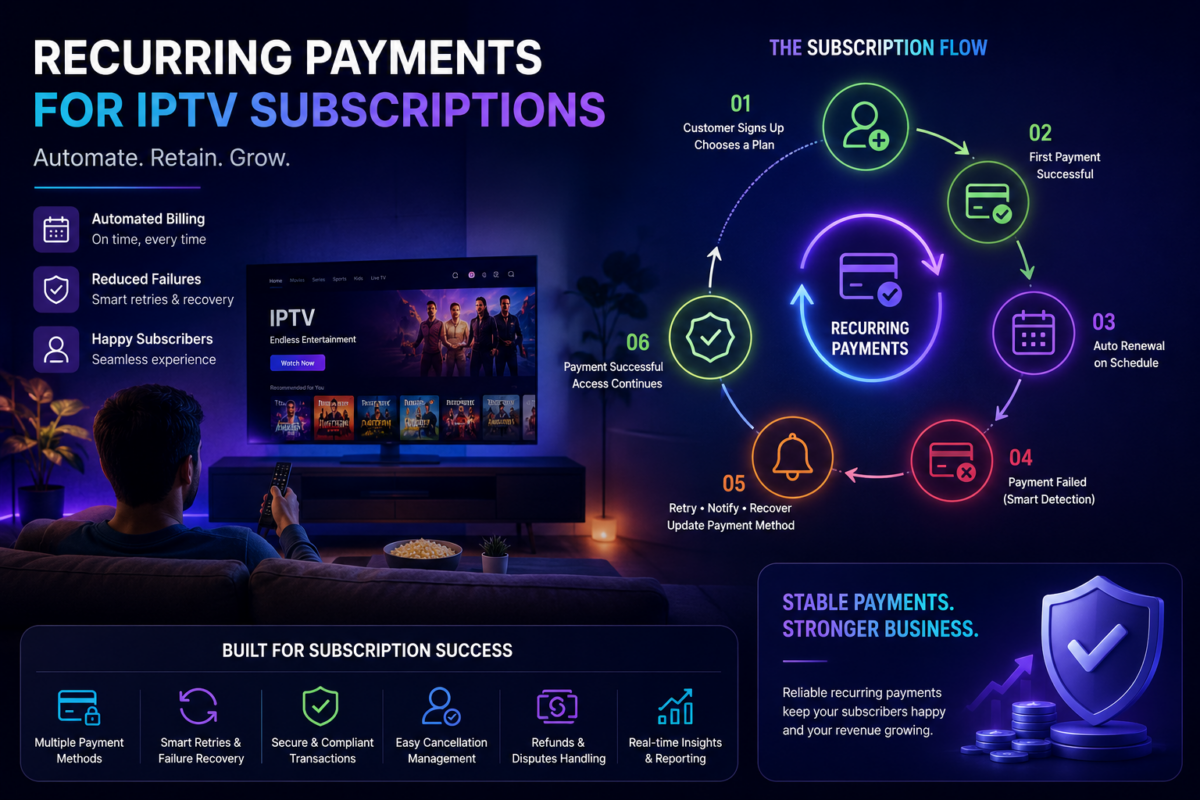
For an IPTV business built around monthly or annual subscriptions, accepting the customer’s first payment is only the beginning. The business also needs a reliable way to collect future subscription payments without requiring customers to manually complete the checkout process every billing cycle.
This is where recurring payments for IPTV subscriptions become important.
Recurring payment processing allows a customer to authorize a payment arrangement and then be charged automatically according to an agreed billing schedule. Subscription businesses commonly use recurring payments because they create a more convenient experience for customers while giving merchants a predictable way to collect subscription revenue.
For an IPTV provider, however, recurring billing involves more than automatically charging a card. The payment system must also manage renewals, failed transactions, payment-method changes, cancellations, refunds, and the connection between payment status and subscriber access.
What Are Recurring Payments for IPTV?
A recurring payment is a transaction that occurs automatically on a predefined schedule after a customer has agreed to a subscription. For example, an IPTV provider may offer:
- A $9.99 monthly subscription.
- A $49.99 quarterly subscription.
- A $149.99 annual subscription.
When a customer selects the monthly plan, the first payment is processed at signup. If the subscription remains active, another payment is attempted at the next billing date. The process continues until the customer cancels the subscription, the payment method can no longer be charged, or another event causes the billing relationship to end.
This is different from sending a payment link to a customer every month. A true recurring payment system is designed to manage the billing schedule and future payment events automatically.
How IPTV Subscription Payments Work?
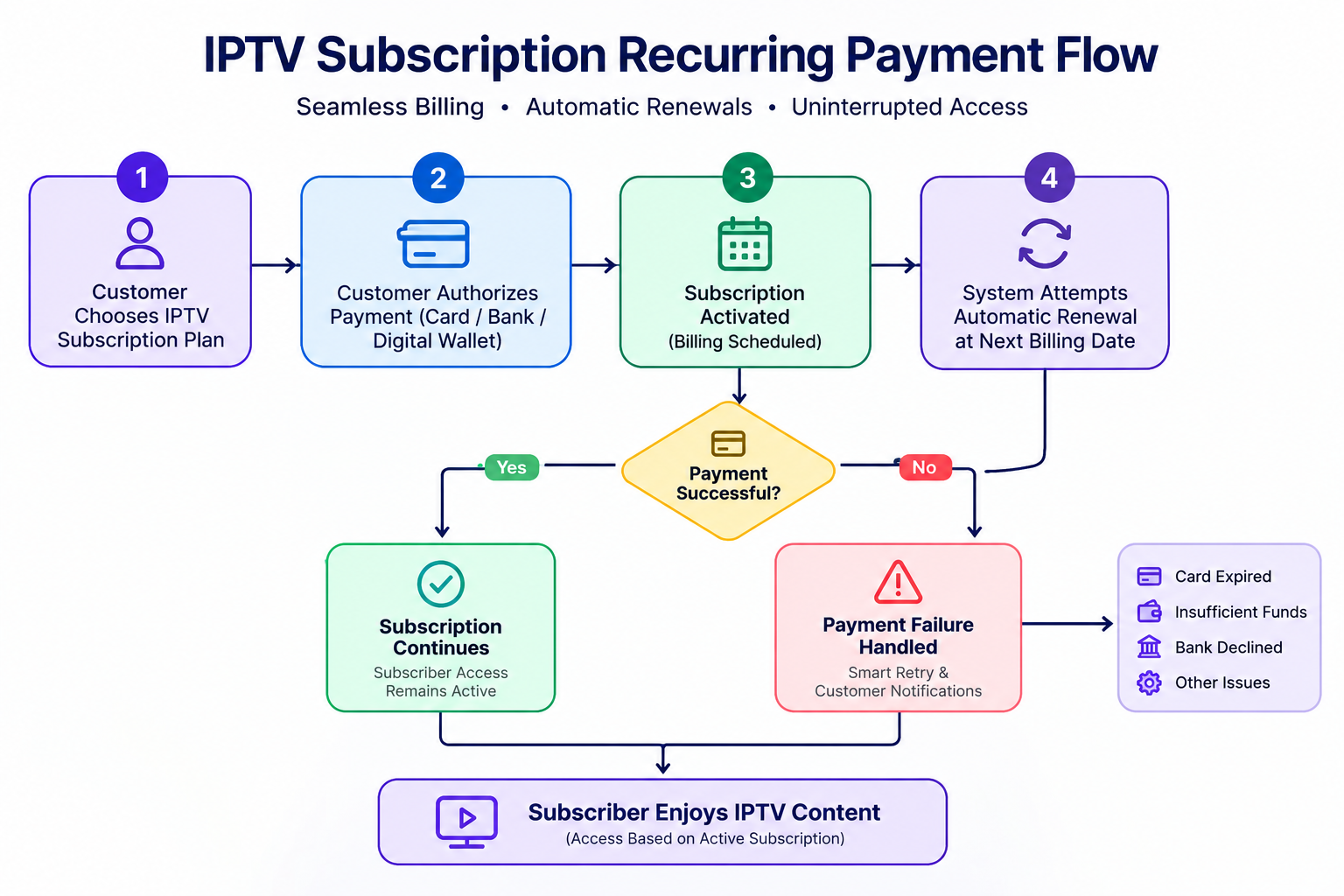
The recurring payment lifecycle starts when the customer selects a subscription plan and agrees to its billing terms. The initial transaction establishes the subscription. Depending on the payment method and provider, the system can use a securely stored payment credential, token, mandate, or another supported authorization mechanism for future billing.
At the next billing date, the system initiates the renewal transaction. If the payment succeeds, the subscription continues. The payment status can then be passed to the IPTV platform so that subscriber access remains active. If the payment fails, the system needs to determine what happens next.
For example, imagine an IPTV provider with 5,000 monthly subscribers. On the first of the month, the payment system attempts to renew all eligible subscriptions. Most transactions succeed, but 200 fail.
Those 200 failures are not all necessarily caused by the same issue. Some customers may have expired cards, some may have insufficient funds, and others may have transactions declined by their banks. A useful recurring payment system needs to distinguish between these situations and provide the business with enough information to manage them.
Why Recurring Billing Is Important for IPTV Businesses?
The biggest advantage of recurring billing is operational efficiency. Without automated recurring payments, an IPTV business would have to repeatedly ask existing subscribers to make another payment. That creates unnecessary friction and can lead to customers forgetting to renew.
With recurring billing, the customer authorizes the subscription once and future payments can occur according to the agreed schedule. This creates a more predictable revenue cycle.
For example, an IPTV business with 2,000 customers paying $15 per month has a potential recurring billing base of approximately $30,000 per monthly cycle before considering cancellations, failed payments, refunds, and other changes. The payment system therefore becomes directly connected to the company’s recurring revenue.
Which Payment Methods Can Support IPTV Recurring Payments?
Not every payment method works in exactly the same way for recurring billing.
- Card payments are commonly used for subscriptions because payment credentials can be securely stored or tokenized for future transactions where the applicable payment rules and provider capabilities allow it.
- Bank-based payment methods can also support recurring payments through appropriate authorization or mandate mechanisms.
- ACH can be particularly relevant for businesses serving customers who prefer bank-based payments. Depending on the provider and setup, ACH can be used for recurring debits rather than requiring the customer to manually initiate every payment.
- Digital payment methods and wallets can also support recurring or subscription payments when the specific wallet and payment provider allow it.
The key question for an IPTV business is therefore not simply whether a provider supports a particular payment method. It should determine whether that method supports the billing frequency, customer locations, authorization model, and renewal process the business requires.
What Happens When an IPTV Subscription Payment Fails?
Failed renewals are one of the most important parts of recurring payment management. A payment can fail for many reasons. The customer’s card may have expired, the account may not have sufficient funds, the bank may decline the transaction, or the payment may be blocked by risk control. The correct response depends on the reason for the failure.
For example, suppose a customer’s monthly IPTV renewal fails because their card has expired. Immediately cancelling the subscription may result in unnecessary revenue loss if the customer would have been happy to update the card.
A better subscription workflow can identify the failed renewal, notify the customer, provide a way to update the payment method, and retry the payment when appropriate.
Payment systems can use retry mechanisms and other recovery processes to attempt to recover legitimate failed payments. The exact approach depends on the provider, payment method, transaction rules, and reason for the decline.
Payment Retries and Failed Payment Recovery
Payment retries can be valuable, but simply attempting the same transaction repeatedly is not a complete recovery strategy. A good failed-payment workflow considers why the transaction failed.
For example, a temporary issue may potentially be recovered through a later retry, while an expired card requires the customer to provide updated payment information. This distinction becomes significant at scale.
Imagine an IPTV provider processing 20,000 monthly renewals. If 5% initially fail, that represents 1,000 affected subscriptions. Even if many of those customers are willing to continue, the business needs a structured way to identify and recover those payments.
The payment system should therefore provide visibility into failed renewals rather than simply returning a generic “payment failed” message.
Managing Subscription Cancellations
Recurring billing also requires a clear cancellation process. Customers should understand how to cancel their subscription and when cancellation takes effect.
For example, if a customer cancels halfway through a monthly billing period, the business needs a defined policy explaining whether the customer retains access until the end of the paid period or whether another arrangement applies.
The payment system and subscription platform should reflect that policy consistently. A cancellation should also prevent future recurring charges when the customer has validly ended the subscription. Poor cancellation processes can create customer complaints and unnecessary payment disputes.
Refunds and IPTV Subscription Payments
Refund handling is another important part of recurring billing.
A customer may request a refund because they were charged after intending to cancel, were billed incorrectly, or qualify for a refund under the business’s stated policy. The payment system should make it possible for the business to identify the relevant transaction and process refunds according to its procedures. Clear refund policies are especially important for subscription businesses because customers need to understand when they are eligible for a refund and how the process works.
Recurring Payments and Chargebacks
Recurring subscriptions can create chargeback exposure when customers do not recognize recurring charges or believe that a subscription was cancelled.
A recognizable billing descriptor, transparent subscription terms, clear cancellation procedures, and accessible customer support can help reduce avoidable disputes. Accurate transaction records are also important.
If a customer disputes a renewal, the business should be able to identify the original subscription, billing date, amount charged, and relevant cancellation or customer-service activity.
Recurring payment management should therefore be connected to broader IPTV payment processing and dispute-management practices rather than treated as a separate billing function.
Choosing a Recurring Payment Solution for IPTV
An IPTV business should evaluate recurring payment capabilities based on its actual subscription model.
Important considerations include:
- Supported billing frequencies and subscription plans.
- Card, ACH, digital wallet, and other supported payment methods.
- Secure handling of stored payment credentials or mandates.
- Failed-payment notifications and recovery options.
- Customer payment-method updates.
- Cancellation and refund management.
- Transaction reporting and subscription status visibility.
- Integration with the IPTV platform or customer management system.
- Support for the countries and currencies where subscribers are located.
- Whether a white-label payment platform is available for businesses that need greater control over payment infrastructure, branding, and payment operations.
A provider that supports recurring payments in theory may still be unsuitable if its recurring billing functionality does not integrate properly with the business’s subscription system.
Building a Reliable IPTV Subscription Payment System
Recurring payments are the foundation of predictable revenue for many IPTV businesses, but successful subscription billing requires more than automatic monthly charges.
The payment system needs to manage the entire lifecycle: initial signup, authorization, recurring renewal, failed payment recovery, payment-method updates, cancellation, refunds, and subscriber access.
For a small IPTV provider, these processes may initially involve only a few hundred customers. As the subscriber base grows, however, manual intervention becomes increasingly difficult. That is why recurring billing should be considered when selecting an IPTV payment gateway and merchant account from the beginning.
A payment setup that can process the first transaction but cannot efficiently manage thousands of future renewals can quickly become an operational bottleneck. The next consideration is the payment methods themselves. Understanding which payment methods are best for IPTV businesses, including cards, ACH, digital wallets, and other options, can help businesses build a payment strategy that matches their customers and subscription model.

Categories
- ACH Payments (10)
- adult payment processing (11)
- AI (9)
- Altcoins (10)
- Banking (10)
- Bitcoin (133)
- Bitcoin ETF (11)
- Bitcoin Price (30)
- Blockchain (50)
- Brokering World Hunger Away (16)
- Business (17)
- card payment processing (10)
- CBD (11)
- CBDC (11)
- Chargeback (8)
- coaching business (11)
- COVID-19 (3)
- Crypto ATMs (1)
- Crypto Banking (17)
- Crypto Bill (1)
- Crypto business owner platform (31)
- Crypto Investment (3)
- Crypto Markets (5)
- Crypto Payment (35)
- Crypto Payment Processor (4)
- Crypto Prices (1)
- Crypto Trading (92)
- Cryptocurrency (402)
- Cryptocurrency Exchange (108)
- Data Visualization (2)
- dating platforms (11)
- debt collection payment processing (10)
- Decentralized Finance (7)
- DeFi Payment (9)
- DEX (3)
- Digital Currency (23)
- dropshipping payment processing (12)
- Ethereum (2)
- FAQ (7)
- file sharing payment processing (11)
- Finance (25)
- Financial Equality (4)
- Financial Freedom (8)
- Forex (35)
- hemp (1)
- ICO (2)
- Investment (11)
- IPTV (11)
- Merchant Account (10)
- Mining (3)
- News (66)
- NFTs (2)
- online gambling (11)
- P2P (1)
- Paybito (147)
- PayBitoPro (693)
- PayBitoPro Coin Listing (6)
- PayBitoPro Exchange (2)
- Payment Gateway (48)
- peptide (10)
- Post COVID Digital Transformation (1)
- Press Release (130)
- Privacy & Security (3)
- Real Estate (1)
- Stablecoin (5)
- Technology (15)
- Travel (11)
- Uncategorized (10)
- US Presidential Election (2)
- Utility Coin (1)
- Web3 business (4)
- Web3 Wallets (2)
- White Label Crypto Exchange (8)
Recent Posts
- Payment Gateway vs. Payment Orchestration: What’s the Difference?
- What Is Smart Payment Routing? Strategies to Optimize Payment Performance
- How to Improve Payment Approval Rates for High-Risk Businesses?
- Why Are Online Payments Failing? Common Causes and How to Fix Them
- How to Use Multiple Payment Processors to Reduce Business Disruptions?