Why Are IPTV Payments Declined? Common Causes and Solutions
- August 11, 2026
- Soham Guchait
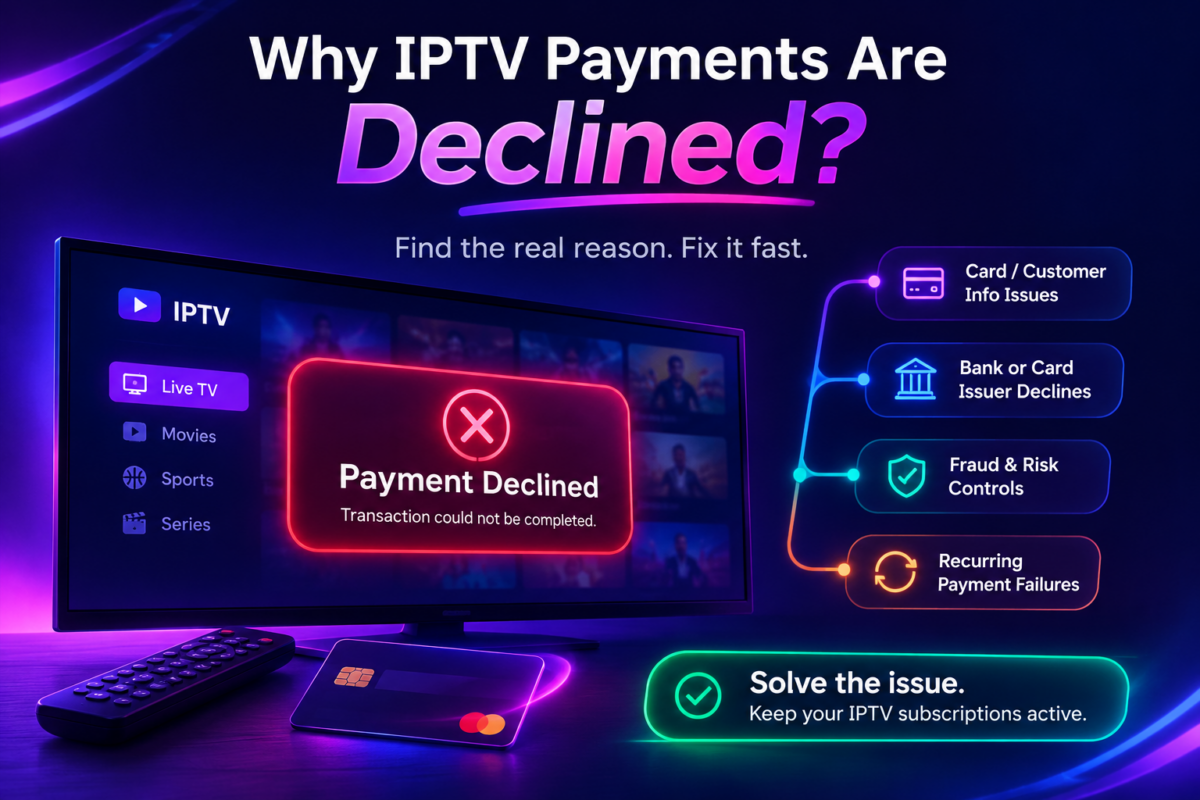
A customer reaches the IPTV checkout page, enters valid-looking payment details, and clicks Pay. Instead of completing the subscription, the transaction is declined. For an IPTV business, this can be more than a minor checkout problem. A declined payment can prevent a new customer from subscribing, interrupt an existing subscription, or cause a recurring customer to lose access after a failed renewal.
But an important point is often overlooked: An IPTV payment decline does not necessarily mean there is something wrong with the customer’s card.
A transaction can be declined by the card issuer, payment processor, payment gateway, fraud controls, merchant configuration, or other parts of the payment infrastructure. The correct solution therefore depends on identifying where and why the payment failed.
Understanding the most common causes of IPTV payments being declined can help businesses troubleshoot payment failures without assuming that the entire payment setup needs to be replaced.
What Does a Declined IPTV Payment Mean?
A declined payment means that a transaction request was not successfully authorized.
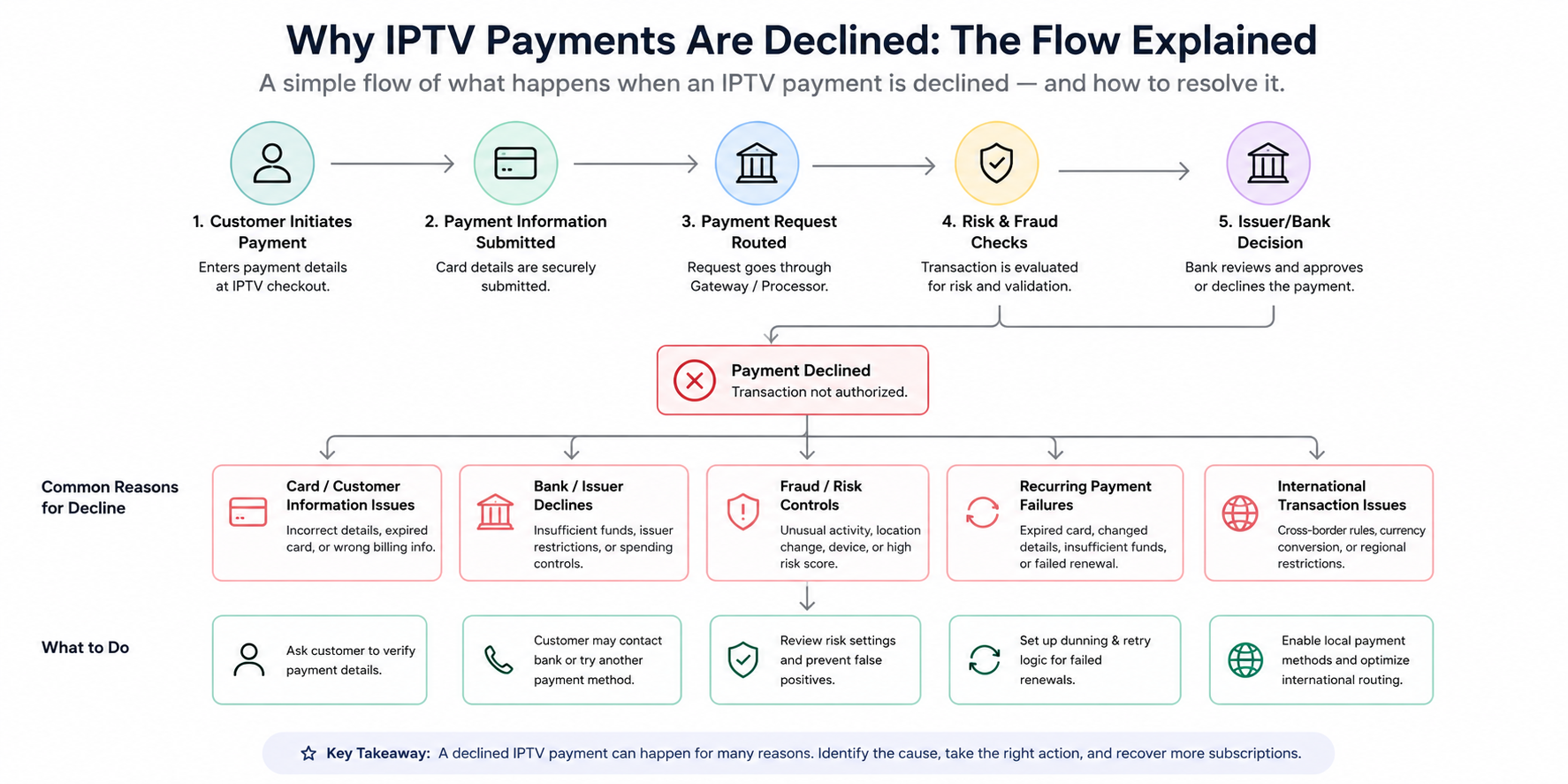
When an IPTV customer attempts to purchase a subscription, the payment request passes through several parts of the payment ecosystem before the transaction is approved. If one of those systems rejects the transaction, the customer may simply see a message such as “payment declined” or “transaction failed“. That message does not necessarily explain the underlying reason.
For example, a customer may have sufficient funds but still receive a decline because the issuing bank does not approve the transaction. Another customer may experience a decline because their card has expired. A third transaction may be stopped by a fraud or risk-control system.
This is why troubleshooting should begin with the reason for the decline, rather than immediately assuming that the payment gateway or merchant account is defective.
Why Are IPTV Payments Declined?
There are many reasons why payments for IPTV businesses, which are considered high risk, may get declined. Each reason requires a different solution.
Card or Customer Information Problems
The simplest explanation is incorrect or outdated payment information. A customer may enter an incorrect card number, expiration date, security code, or billing address. A saved payment method may also have expired since the customer’s previous successful transaction.
For example, an IPTV subscriber may successfully pay for six months and then experience a failed renewal because the card reached its expiration date. In this situation, changing the payment processor would not solve the problem. The customer needs to update their payment information.
Bank or Card Issuer Declines
The customer’s bank can also decline a transaction. Banks may reject payments for different reasons, including insufficient available funds, transaction restrictions, unusual spending patterns, or issuer-specific controls. The merchant may have little ability to change the issuer’s decision.
For example, an IPTV customer may have a valid card with sufficient funds but still receive a decline because their bank does not approve a particular online or international transaction.
The customer may need to contact their bank or use another supported payment method.
Fraud and Risk Controls
Payment systems use fraud and risk controls to identify transactions that appear unusual or potentially unauthorized. An IPTV business may receive a legitimate transaction that nevertheless triggers a risk rule.
Factors such as transaction location, payment behavior, device information, transaction amount, velocity, or unusual activity can influence how a transaction is evaluated.
For example, a customer normally paying from one country may suddenly attempt a transaction from another location. Depending on the payment infrastructure, that change could contribute to additional verification or a decline. Fraud controls are necessary, but overly restrictive settings can sometimes affect legitimate customers.
Recurring Payment Failures
IPTV businesses that rely on subscriptions have another category of payment declines: failed renewals.
A customer may successfully complete the initial subscription but experience a declined payment several weeks or months later. The reasons can include an expired card, changed payment details, insufficient funds, issuer restrictions, or a recurring transaction that can no longer be authorized under the applicable payment setup.
This makes recurring payment monitoring particularly important.
A business with 10,000 subscribers may have hundreds of renewal attempts fail during a billing cycle. Treating all of those failures as identical makes recovery difficult. The payment system should provide enough information to determine whether the customer needs to update their payment method, whether another attempt may be appropriate, or whether the transaction requires further investigation.
International Transactions Can Increase Payment Declines
An IPTV business serving customers internationally may experience different payment approval rates across countries. A customer may use a card issued in a different country from where the merchant operates. The transaction may also involve currency conversion or cross-border processing.
For example, an IPTV provider may have strong payment approval rates among domestic customers but experience more declines from international customers.
That does not automatically mean international payments are unsuitable. It means the business needs to understand where its customers are located and whether its payment infrastructure is designed to support those markets. Payment methods can also vary between countries. A customer who cannot successfully complete a card payment may have another supported payment option available.
Payment Gateway Configuration Can Cause Failed Transactions
The payment gateway is another part of the transaction that can affect payment success. Incorrect configuration can result in payment failures even when the customer’s payment information is valid. Problems may involve incorrect credentials, unsupported currencies, transaction limits, billing settings, integration errors, or payment methods that have not been properly configured.
For example, an IPTV website may display a payment option to customers even though the merchant account or gateway is not configured to process that particular transaction type.
This is why testing should cover different payment scenarios rather than only confirming that one test payment works.
Merchant Account Restrictions and Processing Limits
A merchant account can also affect whether an IPTV transaction is approved. Payment providers may establish processing limits, reserves, geographic restrictions, or other account conditions based on the merchant’s approved profile. Unexpected changes in transaction activity can become particularly important.
Suppose an IPTV business normally processes $20,000 per month but suddenly begins processing $200,000. A major increase can cause additional review or restrictions if it differs substantially from the business activity expected during onboarding. This is one reason businesses should provide realistic transaction estimates and maintain communication when their processing profile changes significantly.
What Should an IPTV Business Do When Payments Are Declined?
The first step is to identify the reason for the decline.
A business should avoid treating every failed payment as a payment-provider problem. Instead, it should examine whether the issue is related to the customer, bank, gateway, merchant account, recurring billing setup, or risk controls.
Three practical questions can help narrow the problem:
- Is the failure affecting one customer or many customers?
If one customer is affected, the problem may be related to their payment method or issuing bank. If many customers suddenly experience declines, the issue may be further upstream. - Are new payments failing, recurring payments failing, or both?
If only renewals are affected, the problem may involve recurring billing or stored payment credentials rather than the initial checkout. - Are declines concentrated in a particular country or payment method?
A geographic or payment-method pattern can indicate that the issue is related to a specific payment route or market.
This type of pattern analysis is more useful than simply counting the number of failed transactions.
How IPTV Businesses Can Reduce Avoidable Payment Declines?
Not every decline can be prevented. Banks and payment networks ultimately control many transaction decisions. However, businesses can reduce avoidable failures by improving the payment experience and monitoring transaction behavior.
Customers should be given clear instructions when payment information needs to be updated. Subscription systems should accurately reflect payment status. Payment forms should validate information before submitting transactions, and businesses should avoid unnecessary checkout friction. For recurring subscriptions, failed-payment recovery can be particularly valuable.
For example, if a customer’s card expires, the business can notify the customer and provide a secure method for updating their payment information instead of immediately terminating the subscription.
Payment reporting is equally important because it allows businesses to identify patterns rather than treating every decline as an isolated event.
Should You Change Your IPTV Payment Processor?
Repeated payment declines can make an IPTV business question whether it needs a different payment processor. Sometimes changing providers may be appropriate, particularly when the existing infrastructure does not support the business’s payment methods, customer markets, transaction volume, or subscription requirements.
But switching providers should not be the first response to every decline. If the problem is caused by customer information, issuing-bank decisions, or a poorly configured integration, changing processors may not solve the underlying issue. The better approach is to determine the source of the problem first.
If the business consistently experiences declines that cannot be explained by customer or issuer behavior, or if the existing provider cannot support the business’s required payment methods and markets, then evaluating alternative payment infrastructure may make sense.
Building a More Reliable IPTV Payment System
Payment declines are an unavoidable part of online payment processing. The objective is not to eliminate every decline, but to understand why transactions fail and recover legitimate payments wherever possible.
For IPTV businesses, this becomes particularly important because subscription revenue depends on successful payments continuing over time.
A reliable payment setup should provide visibility into transaction results, support appropriate payment methods, handle recurring billing correctly, and give the business enough information to investigate failed payments.
This also connects payment processing with the broader IPTV payment gateway and recurring billing infrastructure. The gateway handles the transaction connection, while the subscription system needs to understand whether the payment succeeded, failed, was refunded, or required customer action.
Once payment failures are understood, the next consideration is how to give customers more ways to complete successful transactions. That makes payment methods for IPTV businesses an important part of improving payment acceptance and creating a smoother subscription checkout experience.

Categories
- ACH Payments (10)
- adult payment processing (11)
- AI (9)
- Altcoins (10)
- Banking (10)
- Bitcoin (133)
- Bitcoin ETF (11)
- Bitcoin Price (30)
- Blockchain (50)
- Brokering World Hunger Away (16)
- Business (17)
- card payment processing (10)
- CBD (11)
- CBDC (11)
- Chargeback (8)
- coaching business (11)
- COVID-19 (3)
- Crypto ATMs (1)
- Crypto Banking (17)
- Crypto Bill (1)
- Crypto business owner platform (31)
- Crypto Investment (3)
- Crypto Markets (5)
- Crypto Payment (35)
- Crypto Payment Processor (4)
- Crypto Prices (1)
- Crypto Trading (92)
- Cryptocurrency (402)
- Cryptocurrency Exchange (108)
- Data Visualization (2)
- dating platforms (11)
- debt collection payment processing (10)
- Decentralized Finance (7)
- DeFi Payment (9)
- DEX (3)
- Digital Currency (23)
- dropshipping payment processing (12)
- Ethereum (2)
- FAQ (7)
- file sharing payment processing (11)
- Finance (25)
- Financial Equality (4)
- Financial Freedom (8)
- Forex (35)
- hemp (1)
- ICO (2)
- Investment (11)
- IPTV (11)
- Merchant Account (10)
- Mining (3)
- News (66)
- NFTs (2)
- online gambling (11)
- P2P (1)
- Paybito (147)
- PayBitoPro (693)
- PayBitoPro Coin Listing (6)
- PayBitoPro Exchange (2)
- Payment Gateway (48)
- peptide (10)
- Post COVID Digital Transformation (1)
- Press Release (130)
- Privacy & Security (3)
- Real Estate (1)
- Stablecoin (5)
- Technology (15)
- Travel (11)
- Uncategorized (10)
- US Presidential Election (2)
- Utility Coin (1)
- Web3 business (4)
- Web3 Wallets (2)
- White Label Crypto Exchange (8)
Recent Posts
- Payment Gateway vs. Payment Orchestration: What’s the Difference?
- What Is Smart Payment Routing? Strategies to Optimize Payment Performance
- How to Improve Payment Approval Rates for High-Risk Businesses?
- Why Are Online Payments Failing? Common Causes and How to Fix Them
- How to Use Multiple Payment Processors to Reduce Business Disruptions?