Payment Gateway vs. Payment Orchestration: What’s the Difference?
- October 9, 2026
- Soham Guchait
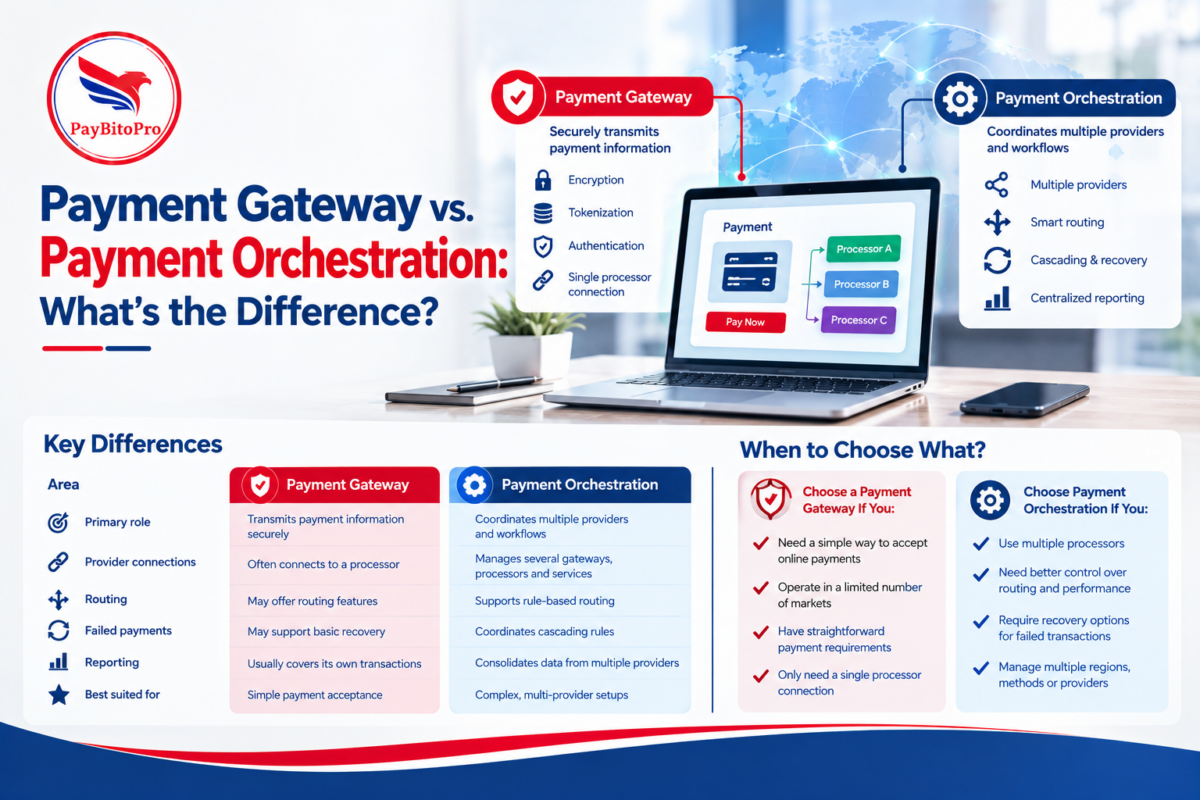
When a customer pays for an online purchase, several systems may work behind the scenes to complete the transaction. A payment gateway helps transmit payment information securely, while a payment orchestration platform coordinates multiple payment providers and related processes.
The terms are sometimes used interchangeably, but they serve different purposes. Understanding the distinction matters for online businesses that want to improve payment reliability, manage several processors, or expand into new markets.
For high-risk merchants, choosing the right setup can also affect how easily they manage provider restrictions, technical disruptions, and transaction performance.
What Is a Payment Gateway?
A payment gateway is a technology layer that securely captures and transmits payment information between a merchant’s checkout and the systems involved in processing a transaction.
When a customer enters their card details, the gateway helps send the payment data for processing and returns the transaction result to the merchant. Depending on the setup, it may also support encryption, tokenization, authentication, and integrations with other payment services.
For example, an online retailer may connect its checkout to a gateway that passes card transactions to its chosen processor. The customer sees a payment form, but the gateway handles important communication behind the scenes. A gateway does not necessarily provide the full processing service itself. The exact responsibilities depend on the provider and how its gateway connects to processors, acquiring banks, and other payment systems.
What Is Payment Orchestration?
Payment orchestration coordinates multiple payment providers and related services through a central platform or integration layer.
Rather than managing every processor separately, a business can use an orchestration platform to connect available providers, apply routing rules, monitor transaction results, and coordinate certain recovery workflows. Capabilities vary by platform.
Imagine an international subscription business using several processors. One supports its domestic transactions, another covers selected international markets, and a third provides a backup connection. An orchestration layer can help manage those connections through a common setup. This can support broader payment processing optimization for high-risk merchants, particularly when payment requirements differ by region, transaction type, or provider.
Payment Gateway vs. Payment Orchestration: Key Differences
The main difference is the scope of each solution. A gateway primarily facilitates payment-data transmission, while orchestration manages how multiple payment services work together.
| Area | Payment Gateway | Payment Orchestration |
|---|---|---|
| Primary role | Transmits payment information securely | Coordinates multiple payment providers and workflows |
| Provider connections | Often connects a merchant to a processor or processing setup | Can connect and manage multiple gateways, processors, or other services |
| Routing | May offer routing features, depending on the provider | Commonly supports rules for selecting among connected providers |
| Failed payments | May support certain retry or recovery features | May coordinate eligible recovery attempts across providers |
| Reporting | Usually covers its own integration or transactions | May consolidate data from several connected providers |
| Best suited for | Enabling payment acceptance through a gateway integration | Managing a more complex, multi-provider payment setup |
These are general distinctions, not absolute boundaries. Some gateways offer orchestration-like features, and some orchestration platforms include gateway functionality.
How Do They Work Together?
A gateway and an orchestration platform do not always compete with each other. In many payment setups, they perform complementary roles. A gateway may handle the secure transmission of payment details, while an orchestration layer determines which connected provider should receive the transaction. The gateway, processor, and other services then perform their respective functions.
For instance, a merchant may use an orchestration platform to select a suitable route for a transaction based on currency and provider availability. The payment is then passed through the relevant gateway or integration to the processing connection.
The precise flow depends on the architecture. Some orchestration platforms connect directly to processors, while others coordinate transactions through gateways. Understanding how payment orchestration works for online businesses helps clarify where a centralized management layer fits into an existing payment stack.
When Should a Business Choose a Payment Gateway?
A gateway may be sufficient when a business needs a straightforward way to accept online payments and its current processing arrangement meets its requirements.
It can be a practical option when the business:
- Needs to connect its checkout to a payment processor.
- Operates in a limited number of markets with relatively simple payment requirements.
- Has no immediate need to coordinate multiple processing providers.
- Wants a payment integration that fits its existing website or commerce platform.
However, businesses should confirm that the gateway supports their industry, payment methods, currencies, and target markets. High-risk merchants may face additional underwriting or account restrictions regardless of which gateway they choose.
When Does Payment Orchestration Make More Sense?
Orchestration becomes more useful as payment operations grow more complicated. Businesses using several processors may need consistent routing rules, centralized reporting, and a way to manage provider changes without maintaining every connection independently.
It can be particularly helpful when a merchant serves multiple regions or needs alternative processing routes during technical disruptions. Three situations where orchestration may be worth considering are:
- Multiple processors: The business wants to manage several provider connections through a common layer.
- Variable processing performance: Approval rates, availability, or costs differ across regions and transaction types.
- Payment recovery needs: The business wants to coordinate eligible retries or cascading rules when an initial attempt fails.
For example, smart payment routing strategies can help determine which provider should receive a transaction first. If an eligible transaction later fails, payment cascading may provide a controlled recovery path. Neither feature guarantees a successful payment. The available processors, routing rules, failure reasons, and applicable requirements still matter.
What Should High-Risk Merchants Consider?
For high-risk businesses, the decision should not be based on feature lists alone. Provider compatibility and operational reliability are just as important.
Before selecting a gateway or orchestration solution, confirm that it supports your business category, approved transaction types, currencies, and target markets. Review integration requirements, security responsibilities, reporting capabilities, pricing, and the availability of suitable processing partners.
It is also important to understand what happens when transactions fail. A well-designed setup should distinguish temporary technical problems from hard declines or suspected fraud rather than automatically resubmitting every unsuccessful payment. That distinction supports efforts to improve payment approval rates for high-risk businesses while helping merchants avoid unnecessary retries and added risk.
Final Thoughts
A payment gateway and a payment orchestration platform solve different problems. A gateway helps transmit payment information through the payment system, while orchestration coordinates multiple providers and payment workflows.
For a business with straightforward payment needs, a gateway may be enough. For a merchant managing several processors, markets, or recovery strategies, orchestration can provide a more centralized way to manage the wider setup.
The right choice depends on the complexity of the business, the providers it can access, and the level of control it needs. The goal is not to add another layer without a reason. It is to build a payment system that is reliable, manageable, and suited to the transactions the business actually handles.

Categories
- ACH Payments (10)
- adult payment processing (11)
- AI (9)
- Altcoins (10)
- Banking (10)
- Bitcoin (133)
- Bitcoin ETF (11)
- Bitcoin Price (30)
- Blockchain (50)
- Brokering World Hunger Away (16)
- Business (17)
- card payment processing (10)
- CBD (11)
- CBDC (11)
- Chargeback (8)
- coaching business (11)
- COVID-19 (3)
- Crypto ATMs (1)
- Crypto Banking (17)
- Crypto Bill (1)
- Crypto business owner platform (31)
- Crypto Investment (3)
- Crypto Markets (5)
- Crypto Payment (35)
- Crypto Payment Processor (4)
- Crypto Prices (1)
- Crypto Trading (92)
- Cryptocurrency (402)
- Cryptocurrency Exchange (108)
- Data Visualization (2)
- dating platforms (11)
- debt collection payment processing (10)
- Decentralized Finance (7)
- DeFi Payment (9)
- DEX (3)
- Digital Currency (23)
- dropshipping payment processing (12)
- Ethereum (2)
- FAQ (7)
- file sharing payment processing (11)
- Finance (25)
- Financial Equality (4)
- Financial Freedom (8)
- Forex (35)
- hemp (1)
- ICO (2)
- Investment (11)
- IPTV (11)
- Merchant Account (10)
- Mining (3)
- News (66)
- NFTs (2)
- online gambling (11)
- P2P (1)
- Paybito (147)
- PayBitoPro (693)
- PayBitoPro Coin Listing (6)
- PayBitoPro Exchange (2)
- Payment Gateway (48)
- peptide (10)
- Post COVID Digital Transformation (1)
- Press Release (130)
- Privacy & Security (3)
- Real Estate (1)
- Stablecoin (5)
- Technology (15)
- Travel (11)
- Uncategorized (10)
- US Presidential Election (2)
- Utility Coin (1)
- Web3 business (4)
- Web3 Wallets (2)
- White Label Crypto Exchange (8)
Recent Posts
- Payment Gateway vs. Payment Orchestration: What’s the Difference?
- What Is Smart Payment Routing? Strategies to Optimize Payment Performance
- How to Improve Payment Approval Rates for High-Risk Businesses?
- Why Are Online Payments Failing? Common Causes and How to Fix Them
- How to Use Multiple Payment Processors to Reduce Business Disruptions?