Payment Processing Optimization: How High-Risk Merchants Can Improve Payment Performance ?
- October 9, 2026
- Soham Guchait
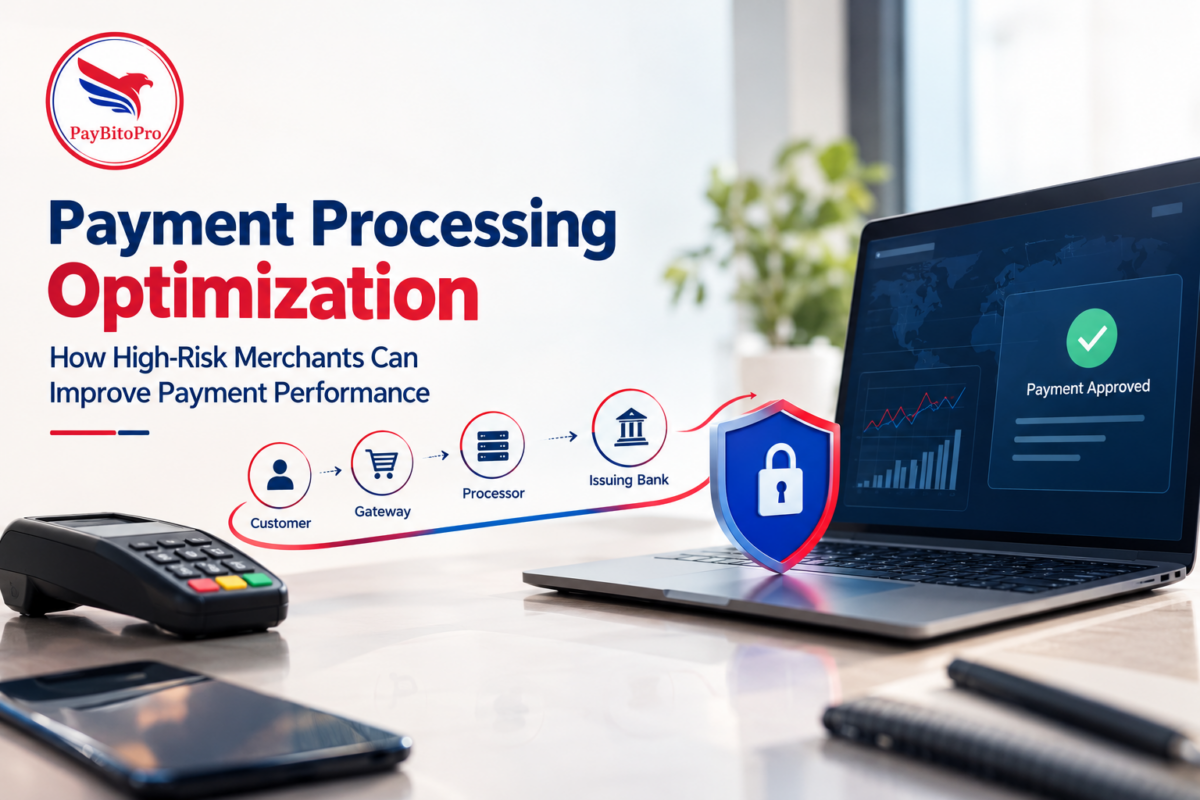
A declined payment does not always mean a customer lacks money or wants to abandon a purchase. Sometimes, the bank rejects the transaction. Sometimes, the gateway encounters an error, the processor applies a restriction, or the checkout asks for information that the customer cannot provide. For high-risk merchants, even small problems like these can affect revenue.
The real challenge is knowing which problem to fix first. Adding another processor or changing a routing rule may help, but neither will solve every decline. Payment processing optimization starts with understanding what happens between the moment a customer clicks Pay and the moment the transaction receives a final response.
Where Payment Processing Problems Actually Begin?
When a customer submits a payment, the checkout sends transaction details to a payment gateway, which securely passes the request into the processing system. The processor and acquiring bank help route the transaction through the relevant card network to the issuing bank. The issuer then approves or declines it, and the response travels back to the merchant.
Several parties handle this process, and each can introduce a different problem.
A gateway timeout, for example, does not necessarily mean the bank declined the payment. The issuer might have approved the transaction even though the merchant never received the response. If the checkout immediately submits the same payment again, the customer could face a duplicate charge.
That distinction matters. Merchants should separate technical errors from issuer declines, fraud-related rejections, authentication failures, and account restrictions before changing their payment setup. This is also where a closer look at the common reasons online payments fail and how merchants can resolve them becomes useful.
Why High-Risk Merchants Face Additional Challenges?
Processors do not assess every business in the same way. A subscription company, an online gaming operator, and a merchant selling certain digital products may face different underwriting requirements, transaction limits, pricing, and monitoring conditions.
A processor might also restrict particular markets or payment types under its merchant agreement. Another provider may support those transactions but charge different fees or require additional documentation.
Merchants cannot solve every problem through technology. If an acquiring bank restricts a business model, changing a technical setting will not remove that restriction. The merchant must work within its approved processing arrangements. The practical goal is to identify the issues the business can control, such as checkout errors, poor transaction data, or unsuitable routing rules, while addressing provider-related restrictions directly with the relevant parties.
Fix the Weakest Parts of the Payment Setup First
1. Use Transaction Data to Find the Real Problem
Start by examining payment attempts across different providers, markets, payment methods, and transaction types. Look at approval rates, decline codes, gateway errors, settlement records, and customer complaints together.
Suppose a merchant notices that transactions from one market fail more frequently than others. The cause might involve issuer behaviour, authentication requirements, currency support, or a processor’s limitations. Without breaking down the results, the merchant could mistakenly blame the checkout.
A useful first step is to group failed transactions by their actual failure reason. Then investigate the largest recurring problems before spending money on new infrastructure.
2. Route Transactions According to Their Needs
Payment routing determines which processor or acquiring connection receives a transaction. A merchant with several approved processing connections can create rules based on currency, card region, payment method, provider availability, or other relevant factors.
Consider an online business that serves customers in several countries. One processor may offer suitable coverage for a particular market, while another may handle a different transaction type more effectively. Routing rules can direct each payment to an appropriate connection rather than sending everything through the same provider.
But here is the catch: A different route does not guarantee an approval. The issuing bank still makes the approval decision, and merchants must respect provider restrictions and network requirements. Understanding how payment routing selects the right processing connection helps merchants build rules around actual transaction requirements instead of assumptions.
3. Retry Failed Payments Only When It Makes Sense
Payment cascading allows a system to send an eligible failed transaction to another processor. It can help when a technical issue or an unavailable processing connection prevents the original attempt from completing successfully.
However, not every decline deserves another attempt. A transaction rejected because of insufficient funds, suspected fraud, or an issuer’s explicit refusal may not benefit from another processor. Repeated attempts can increase costs, trigger additional risk checks, or frustrate customers.
Merchants should also check whether the first transaction actually failed before initiating another attempt. A missing response does not always mean a missing payment. This is why the circumstances in which payment cascading can recover failed transactions deserve attention before a merchant enables automatic retries.
4. Improve Approvals Without Weakening Fraud Controls
A healthy approval rate reflects successful legitimate transactions, not simply fewer declines. Merchants should examine checkout design, billing information, authentication, fraud screening, and recurring-payment settings.
For instance, a subscription business may lose payments because customers have replaced their cards. Where supported, account updater services can refresh eligible stored card details. A carefully timed retry may also recover a payment after a temporary problem, while a clear customer notification can help resolve an expired card.
The merchant should compare results by transaction type and failure reason rather than applying one rule to every customer. Understanding which factors influence approval rates for high-risk businesses helps connect these changes to measurable outcomes.
When Multiple Processors or Orchestration Make Sense
A second processor can protect a merchant from some disruptions, but only if the provider has approved the business and can handle the required transactions. Merchants must also manage separate fees, settlement schedules, reserves, integrations, and reconciliation processes.
A backup account that has never processed a live transaction may not provide the protection the merchant expects. Businesses should test their failover procedures and confirm that the alternative connection can support the relevant payment methods and markets. The operational trade-offs become clearer when examining how multiple payment processors support business continuity.
As the setup grows, payment orchestration may help coordinate gateways, processors, routing rules, and reporting through a common layer. Depending on the platform, it can simplify provider management and automate parts of the transaction flow.
Still, orchestration adds another system to configure, monitor, and maintain. A merchant with straightforward payment needs may not require it. A business operating across multiple providers and markets may find the additional control worthwhile. The distinction becomes easier to understand when considering how payment orchestration coordinates different payment services.
A Practical Plan for Better Payment Performance
Merchants do not need to rebuild their payment infrastructure overnight. They should begin with a few measurable actions:
- Establish a baseline: Track approval rates, decline reasons, technical errors, chargebacks, settlement delays, and total processing costs.
- Fix recurring problems: Resolve checkout errors, incorrect transaction data, and avoidable authentication issues before introducing complex routing rules.
- Test changes carefully: Compare results before and after each adjustment, including its effects on fraud, duplicate charges, and processing expenses.
- Review provider performance: Check account restrictions, fees, settlement terms, and backup arrangements regularly.
This approach gives merchants a clearer view of what actually improves performance. It also reduces the risk of paying for extra technology that does not solve the original problem.
Conclusion
Payment processing optimization is not about forcing every transaction through or adding as many providers as possible. It is about understanding why payments fail, selecting suitable processing connections, recovering eligible transactions, and keeping fraud and operational risks under control.
For high-risk merchants, the best setup depends on the business model, customer markets, transaction patterns, and available processing relationships. Start with the evidence, fix the problems that the business can control, and introduce more complex systems only when the benefits justify the cost.

Categories
- ACH Payments (10)
- adult payment processing (11)
- AI (9)
- Altcoins (10)
- Banking (10)
- Bitcoin (133)
- Bitcoin ETF (11)
- Bitcoin Price (30)
- Blockchain (50)
- Brokering World Hunger Away (16)
- Business (17)
- card payment processing (10)
- CBD (11)
- CBDC (11)
- Chargeback (8)
- coaching business (11)
- COVID-19 (3)
- Crypto ATMs (1)
- Crypto Banking (17)
- Crypto Bill (1)
- Crypto business owner platform (31)
- Crypto Investment (3)
- Crypto Markets (5)
- Crypto Payment (35)
- Crypto Payment Processor (4)
- Crypto Prices (1)
- Crypto Trading (92)
- Cryptocurrency (402)
- Cryptocurrency Exchange (108)
- Data Visualization (2)
- dating platforms (11)
- debt collection payment processing (10)
- Decentralized Finance (7)
- DeFi Payment (9)
- DEX (3)
- Digital Currency (23)
- dropshipping payment processing (12)
- Ethereum (2)
- FAQ (7)
- file sharing payment processing (11)
- Finance (25)
- Financial Equality (4)
- Financial Freedom (8)
- Forex (35)
- hemp (1)
- ICO (2)
- Investment (11)
- IPTV (11)
- Merchant Account (10)
- Mining (3)
- News (66)
- NFTs (2)
- online gambling (11)
- P2P (1)
- Paybito (147)
- PayBitoPro (693)
- PayBitoPro Coin Listing (6)
- PayBitoPro Exchange (2)
- Payment Gateway (48)
- peptide (10)
- Post COVID Digital Transformation (1)
- Press Release (130)
- Privacy & Security (3)
- Real Estate (1)
- Stablecoin (5)
- Technology (15)
- Travel (11)
- Uncategorized (10)
- US Presidential Election (2)
- Utility Coin (1)
- Web3 business (4)
- Web3 Wallets (2)
- White Label Crypto Exchange (8)
Recent Posts
- Payment Gateway vs. Payment Orchestration: What’s the Difference?
- What Is Smart Payment Routing? Strategies to Optimize Payment Performance
- How to Improve Payment Approval Rates for High-Risk Businesses?
- Why Are Online Payments Failing? Common Causes and How to Fix Them
- How to Use Multiple Payment Processors to Reduce Business Disruptions?