Chargeback Prevention for Dropshipping Businesses: How Online Stores Reduce Payment Disputes?
- August 7, 2026
- Soham Guchait
For a dropshipping business, a completed sale does not always mean the transaction is finalized. A customer can still dispute a payment weeks after placing an order, creating financial losses, operational challenges, and additional pressure on the merchant.
Chargebacks are one of the biggest payment challenges faced by online businesses because they affect more than revenue. They can increase payment processing costs, damage merchant reputation, create additional administrative work, and make it harder to maintain stable payment operations.
Understanding chargeback prevention for dropshipping businesses helps merchants identify why disputes happen, improve customer experiences, and create processes that reduce unnecessary payment reversals. Unlike traditional retailers that control inventory and shipping directly, dropshipping businesses depend on suppliers and external fulfillment partners. This creates unique challenges that require stronger communication, better order management, and proactive customer support.
What Is a Chargeback?
A chargeback occurs when a customer asks their bank or card issuer to reverse a payment instead of resolving the issue directly with the merchant. The process exists to protect consumers from unauthorized transactions, fraud, and situations where purchased goods or services are not delivered as expected. However, chargebacks can also occur because of misunderstandings, poor communication, or customer dissatisfaction.
For example, a customer purchases a product from a dropshipping store and expects delivery within ten days. Due to supplier delays, the order arrives after three weeks. If the customer believes the product will never arrive and contacts their bank instead of the merchant, the transaction may become a chargeback.
The merchant may have successfully fulfilled the order, but the lack of communication created a dispute. This is why chargeback prevention is not only about fighting fraudulent claims. It is about creating a customer experience that prevents disputes from happening in the first place.
Why Dropshipping Businesses Experience More Chargebacks?
Every ecommerce business faces payment disputes, but dropshipping businesses, which are considered as high risk businesses, often encounter specific situations that increase chargeback risk. The biggest factor is the distance between the merchant and the fulfillment process. Since products are shipped by third-party suppliers, merchants have less direct control over delivery speed, inventory availability, and product quality.
Some common reasons for dropshipping chargebacks include:
- Customers not recognizing the transaction on their bank statement.
- Products arriving later than expected.
- Items not matching customer expectations.
- Refund requests not being handled quickly.
- Customers believing they were charged incorrectly.
Consider a customer purchasing a smartwatch from a dropshipping store. The product description highlights premium features, but when the customer receives it, they believe the quality does not match their expectations. Instead of requesting a return, they contact their bank and dispute the payment. From the merchant’s perspective, the order was delivered. From the customer’s perspective, the purchase experience was disappointing.
Reducing this gap between expectations and reality is one of the most effective ways to prevent disputes.
Set Clear Customer Expectations Before Purchase
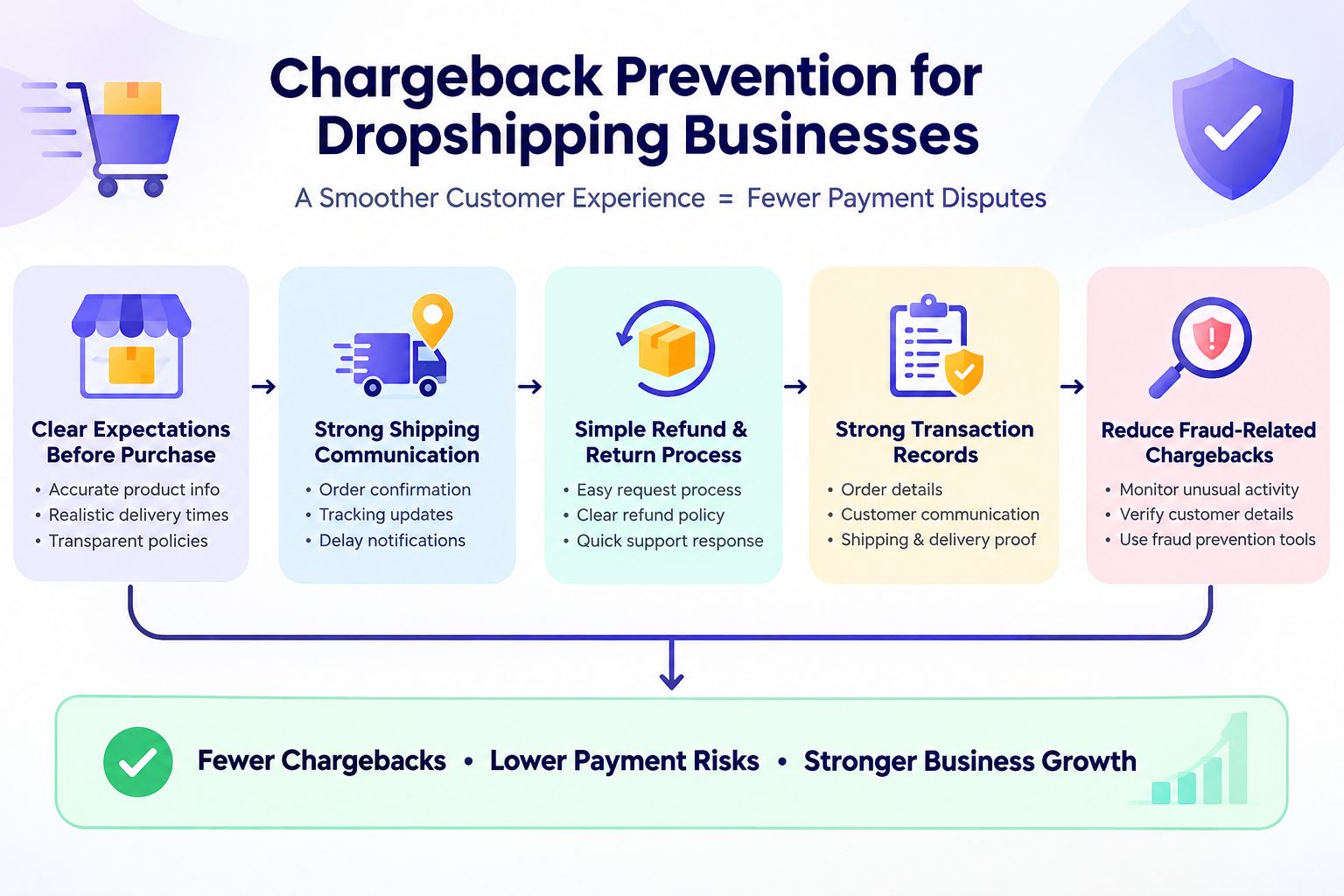
Many chargebacks begin because customers feel surprised after completing an order. Dropshipping stores should provide accurate information about products, shipping timelines, returns, and order fulfillment before customers make a purchase.
A customer who understands that an item may take two to three weeks to arrive is less likely to assume something has gone wrong compared with a customer who expected delivery within a few days. Important information should be easy to find, including:
- Estimated delivery times.
- Product specifications.
- Return and refund policies.
- Contact information.
- Order tracking details.
For example, a store selling imported home accessories should clearly explain that products are shipped internationally and provide realistic delivery estimates. Transparency creates trust and reduces frustration.
Improve Shipping Communication and Order Tracking
Shipping delays are one of the most common triggers for dropshipping disputes. When customers do not receive updates after placing an order, they often assume the business is unreliable. Regular communication helps customers understand where their order is and when they can expect delivery.
A strong shipping communication process includes:
- Order confirmation emails.
- Tracking information.
- Delivery updates.
- Notifications about delays.
- Easy access to customer support.
Imagine a customer orders fitness equipment and receives tracking information within 24 hours. Even if delivery takes longer than expected, regular updates reassure the customer that the order is being handled. Communication can turn a potentially disputed transaction into a satisfied customer experience.
Make Refund and Return Processes Simple
A complicated refund process is one of the fastest ways to increase customer frustration. When customers cannot easily request assistance, they may bypass the merchant completely and file a chargeback through their bank. A clear refund policy should explain:
- When refunds are available?
- How can customers request returns?
- Expected processing timelines.
- Any conditions that apply.
Businesses should also respond quickly when customers raise concerns. A customer who receives timely support is much less likely to escalate the issue into a payment dispute.
The goal is not to prevent every refund. Refunds are a normal part of ecommerce. The goal is to resolve problems before they become chargebacks.
Maintain Strong Transaction Records
When a chargeback occurs, merchants need evidence to demonstrate that the transaction was legitimate and properly fulfilled. Keeping accurate records helps businesses respond effectively to disputes.
Useful documentation may include:
- Order confirmation details.
- Customer communication history.
- Shipping information.
- Delivery confirmation.
- Product descriptions shown at purchase.
- Refund policy acceptance.
For example, if a customer claims they never received an order, tracking information showing successful delivery can become important evidence during the dispute process.
Strong documentation does not prevent every chargeback, but it gives merchants a better ability to respond when disputes occur.
Reduce Fraud-Related Chargebacks
Not all chargebacks result from customer dissatisfaction. Some involve unauthorized transactions, stolen payment information, or fraudulent purchasing activity. Dropshipping businesses can become targets because many operate entirely online and often receive customers from multiple countries.
Merchants should monitor unusual activity, such as:
- Multiple expensive orders placed within a short period.
- Different payment methods used with the same account.
- Shipping addresses that do not match customer information.
- Repeated failed payment attempts.
Fraud prevention tools and transaction monitoring systems help identify suspicious behavior before products are shipped. Preventing fraudulent orders is especially important because once an item has been shipped, recovering the lost revenue can become difficult.
How Chargeback Prevention Supports Long-Term Growth?
Reducing chargebacks is not only about protecting individual transactions. It also helps businesses maintain healthier payment operations as they grow.
High dispute rates can lead to additional monitoring, increased operational challenges, and difficulties managing payment relationships. A dropshipping business that focuses on accurate product information, reliable suppliers, customer communication, and effective order tracking creates a stronger foundation for sustainable growth.
For example, a store processing hundreds of monthly orders cannot manually resolve every customer concern after a dispute occurs. Building prevention systems early allows the business to handle higher sales volumes without increasing payment problems.
Chargebacks Are a Customer Experience Problem Too
Many merchants view chargebacks only as payment issues, but they are often symptoms of broader customer experience problems. A customer who files a dispute is usually responding to something that happened earlier:
- Confusing product information.
- Poor communication.
- Unexpected delays.
- Difficulty receiving support.
Improving the overall buying experience naturally reduces payment disputes. This approach also connects with other important payment areas, including fraud prevention for dropshipping stores, payment failures, international payment processing, and merchant account management.
Final Thoughts
Chargeback prevention for dropshipping businesses requires more than responding to disputes after they happen. The strongest approach is creating a transparent, reliable, and customer-focused purchasing experience from the beginning.
Clear product descriptions, realistic shipping expectations, responsive support, accurate tracking, and strong transaction records all help reduce unnecessary disputes.
Dropshipping businesses will always face some level of payment risk, but merchants that actively manage customer expectations and payment operations are better positioned to maintain successful transactions, protect revenue, and build long-term trust with customers.

Categories
- ACH Payments (10)
- adult payment processing (11)
- AI (9)
- Altcoins (10)
- Banking (10)
- Bitcoin (133)
- Bitcoin ETF (11)
- Bitcoin Price (30)
- Blockchain (50)
- Brokering World Hunger Away (16)
- Business (17)
- card payment processing (10)
- CBD (11)
- CBDC (11)
- Chargeback (8)
- coaching business (11)
- COVID-19 (3)
- Crypto ATMs (1)
- Crypto Banking (17)
- Crypto Bill (1)
- Crypto business owner platform (31)
- Crypto Investment (3)
- Crypto Markets (5)
- Crypto Payment (35)
- Crypto Payment Processor (4)
- Crypto Prices (1)
- Crypto Trading (92)
- Cryptocurrency (402)
- Cryptocurrency Exchange (108)
- Data Visualization (2)
- dating platforms (11)
- debt collection payment processing (10)
- Decentralized Finance (7)
- DeFi Payment (9)
- DEX (3)
- Digital Currency (23)
- dropshipping payment processing (12)
- Ethereum (2)
- FAQ (7)
- file sharing payment processing (11)
- Finance (25)
- Financial Equality (4)
- Financial Freedom (8)
- Forex (35)
- hemp (1)
- ICO (2)
- Investment (11)
- IPTV (11)
- Merchant Account (10)
- Mining (3)
- News (66)
- NFTs (2)
- online gambling (11)
- P2P (1)
- Paybito (147)
- PayBitoPro (693)
- PayBitoPro Coin Listing (6)
- PayBitoPro Exchange (2)
- Payment Gateway (48)
- peptide (10)
- Post COVID Digital Transformation (1)
- Press Release (130)
- Privacy & Security (3)
- Real Estate (1)
- Stablecoin (5)
- Technology (15)
- Travel (11)
- Uncategorized (10)
- US Presidential Election (2)
- Utility Coin (1)
- Web3 business (4)
- Web3 Wallets (2)
- White Label Crypto Exchange (8)
Recent Posts
- Payment Gateway vs. Payment Orchestration: What’s the Difference?
- What Is Smart Payment Routing? Strategies to Optimize Payment Performance
- How to Improve Payment Approval Rates for High-Risk Businesses?
- Why Are Online Payments Failing? Common Causes and How to Fix Them
- How to Use Multiple Payment Processors to Reduce Business Disruptions?