How to Set Up an Online Coaching Payment System? : A Complete Guide for Coaches
- August 6, 2026
- Soham Guchait
A coaching business can have excellent programs, strong client relationships, and a proven service model, but collecting payments efficiently can become an operational challenge as the business grows.
Many coaches begin by manually sending payment instructions, sharing bank details, or collecting fees through disconnected tools. While this may work with a small number of clients, it becomes harder to track payments, manage recurring billing, handle failed transactions, and maintain a consistent customer experience at scale.
An online coaching payment system provides a structured way to accept payments, manage transactions, automate billing, and connect payment activity with other business processes. Whether a business offers one-on-one coaching, group programs, memberships, workshops, or digital coaching packages, the right payment setup can reduce administrative work while making it easier for clients to purchase and continue using coaching services.
What Is an Online Coaching Payment System?
An online coaching payment system is a combination of payment tools and processes that allows coaching businesses to accept and manage digital payments from clients.
Depending on the business model, it may include a payment gateway, checkout page, invoices, card payments, recurring billing, payment links, transaction tracking, and integrations with scheduling or customer-management tools.
For example, a career coach selling a 12-week job transformation program may need a payment flow where a potential client can:
- Select a coaching package
- Review the price and payment terms
- Complete payment online
- Receive payment confirmation
- Start the onboarding process
Instead of manually confirming payments through messages or emails, the payment process can become more organized and easier to monitor. A good system should therefore do more than process a transaction. It should create a reliable payment journey from checkout through confirmation, billing, and client onboarding.
How Do Coaching Businesses Set Up Online Payment Systems?
The setup depends on the type of coaching service, pricing structure, target customers, and sales process.
A coach offering individual sessions may need a straightforward payment link, while a coaching platform with hundreds of members may require recurring billing, automated payment recovery, multiple payment methods, and more advanced transaction management.
1. Choose the Right Payment Structure
First, determine how clients will be charged. Common coaching payment models include:
- One-time payments for individual sessions or workshops
- Installments for high-value coaching programs
- Recurring payments for memberships and ongoing coaching
- Invoices for corporate or customized coaching engagements
For example, an executive coach selling a six-month leadership program could offer an upfront price or monthly installments, while a wellness coaching business might use monthly recurring billing. The payment infrastructure should support the existing business model rather than forcing the business to redesign its pricing.
2. Create a Simple Checkout Experience
The checkout page is an important part of the client journey, particularly for higher-priced coaching services.
Imagine a business coach selling a $3,000 growth program. A prospective client has already decided to purchase but encounters unclear pricing, unnecessary manual steps, or no immediate payment confirmation. That friction can cause the customer to abandon the purchase. A clear checkout should communicate:
- The coaching package being purchased
- Total price and applicable charges
- Available payment methods
- Whether the payment is one-time or recurring
- Refund or cancellation terms
- What happens after payment
A transparent checkout helps clients understand exactly what they are purchasing before completing the transaction.
3. Connect Payments With Business Operations
Payment collection should ideally connect with the processes that happen after a successful transaction. For example, when a client completes payment, the business may need to:
- Confirm the transaction
- Send an invoice or receipt
- Trigger onboarding instructions
- Schedule coaching sessions
- Provide access to courses or resources
- Update customer records
Connecting these activities can reduce repetitive administrative work and create a more consistent onboarding experience.
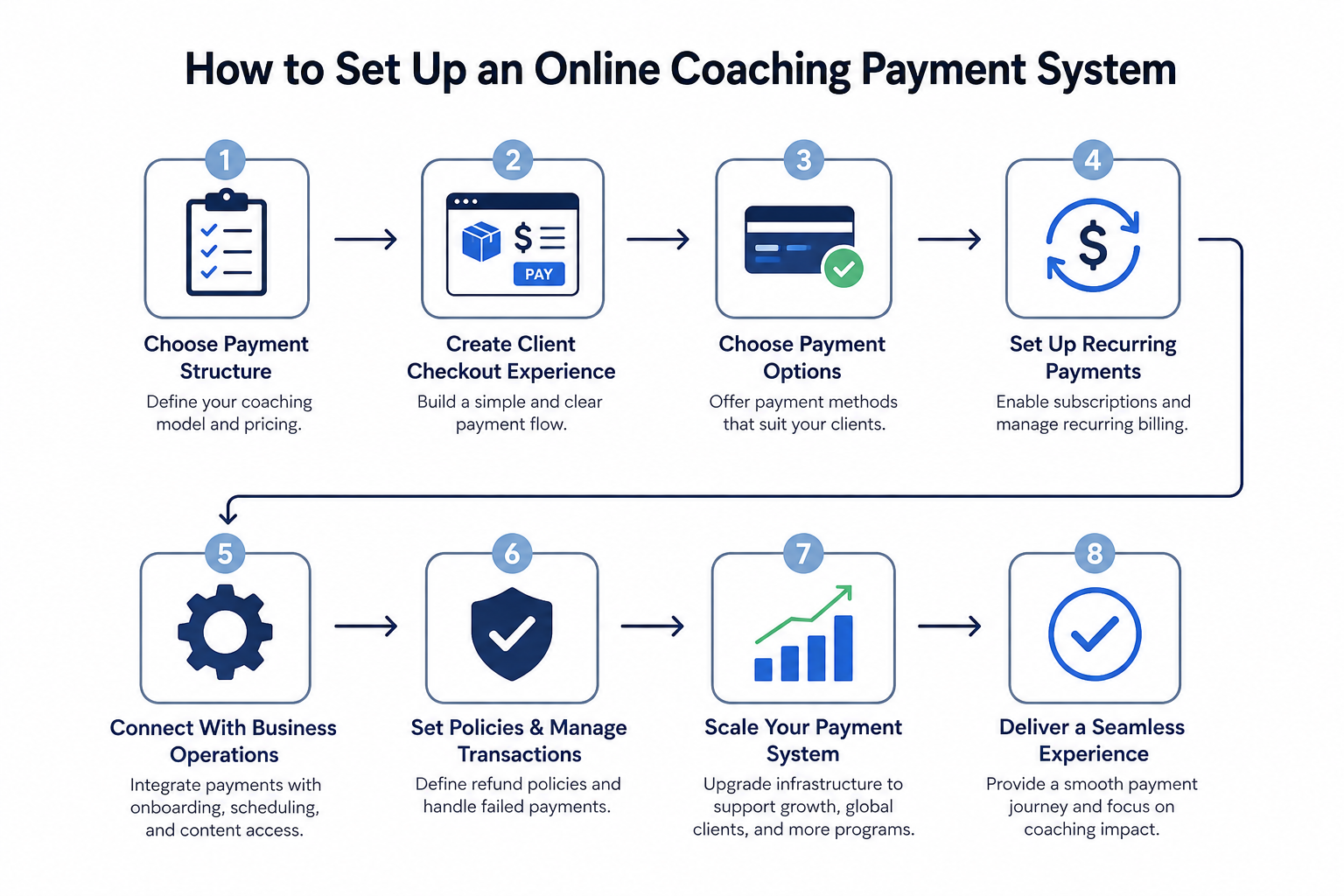
Payment Options for Online Coaching Businesses
The most suitable payment methods depend on the coaching audience, transaction value, location, and business model.
Many coaching businesses accept card payments because they provide a familiar online checkout experience. Other businesses may also need bank transfers or alternative payment methods, particularly when working with corporate customers or international clients.
For example, a corporate leadership coaching company may receive payments through business invoices or bank transfers, while a personal fitness coach selling monthly programs may prioritize online checkout and automated recurring payments.
Businesses planning to accept different payment methods should consider factors such as customer convenience, transaction reliability, currency support, settlement processes, and payment authorization.
Setting Up Recurring Payments for Coaching Programs
Recurring billing can be useful for coaching businesses that provide continuing services rather than one-time sessions. Common examples include:
- Monthly coaching memberships
- Accountability communities
- Ongoing mentorship
- Subscription-based wellness programs
- Long-term professional coaching
Recurring payments allow clients to continue paying according to an agreed schedule without manually initiating every transaction.
However, recurring billing also requires a process for handling failed payments. Transactions can fail because of an expired card, insufficient funds, incorrect payment information, bank restrictions, or other authorization issues.
A reliable recurring payment setup should therefore provide appropriate payment status information and support processes for recovering unsuccessful payments without unnecessarily disrupting an active client relationship.
Common Mistakes When Setting Up Coaching Payments
Payment operations are sometimes overlooked while businesses focus on marketing and client acquisition. Common problems include:
- Relying on manual payment collection as client volume increases
- Offering limited payment options for higher-value programs
- Failing to clearly communicate refund and cancellation policies
- Not having a process for failed or overdue payments
- Overlooking international payment requirements
- Using disconnected tools that make transaction tracking difficult
For example, a coaching business may successfully attract clients from multiple countries but encounter payment problems because its payment setup does not adequately support international customers or currencies. Establishing clear payment processes early can make future growth easier to manage.
How to Scale an Online Coaching Payment System?
A payment process that works for ten clients may become inefficient when a business serves hundreds. As coaching businesses expand, they may need capabilities for:
- Multiple coaching programs
- Automated recurring billing
- Installment payments
- International customers
- Transaction reporting
- Payment failure management
- Integration with other business systems
A coaching marketplace, for example, may have additional requirements because payments need to support transactions involving multiple coaches or service providers.
At this stage, businesses may explore more advanced payment infrastructure, including merchant account solutions and white-label payment platforms.
The objective is to choose infrastructure that can support increasing transaction volumes and changing business requirements without creating unnecessary complexity.
Final Thoughts
An online coaching payment system is more than a way to collect money. It connects the client’s purchasing experience with billing, transaction management, onboarding, and ongoing service delivery.
A well-structured setup can make it easier for clients to pay, help businesses manage one-time and recurring transactions, and reduce the amount of manual payment administration.
As coaching businesses expand from individual sessions into structured programs, memberships, installment plans, and international services, choosing payment infrastructure that supports their business model becomes an important part of building a scalable operation.

Categories
- ACH Payments (10)
- adult payment processing (11)
- AI (9)
- Altcoins (10)
- Banking (10)
- Bitcoin (133)
- Bitcoin ETF (11)
- Bitcoin Price (30)
- Blockchain (50)
- Brokering World Hunger Away (16)
- Business (17)
- card payment processing (10)
- CBD (11)
- CBDC (11)
- Chargeback (8)
- coaching business (11)
- COVID-19 (3)
- Crypto ATMs (1)
- Crypto Banking (17)
- Crypto Bill (1)
- Crypto business owner platform (31)
- Crypto Investment (3)
- Crypto Markets (5)
- Crypto Payment (35)
- Crypto Payment Processor (4)
- Crypto Prices (1)
- Crypto Trading (92)
- Cryptocurrency (402)
- Cryptocurrency Exchange (108)
- Data Visualization (2)
- dating platforms (11)
- debt collection payment processing (10)
- Decentralized Finance (7)
- DeFi Payment (9)
- DEX (3)
- Digital Currency (23)
- dropshipping payment processing (12)
- Ethereum (2)
- FAQ (7)
- file sharing payment processing (11)
- Finance (25)
- Financial Equality (4)
- Financial Freedom (8)
- Forex (35)
- hemp (1)
- ICO (2)
- Investment (11)
- IPTV (11)
- Merchant Account (10)
- Mining (3)
- News (66)
- NFTs (2)
- online gambling (11)
- P2P (1)
- Paybito (147)
- PayBitoPro (693)
- PayBitoPro Coin Listing (6)
- PayBitoPro Exchange (2)
- Payment Gateway (48)
- peptide (10)
- Post COVID Digital Transformation (1)
- Press Release (130)
- Privacy & Security (3)
- Real Estate (1)
- Stablecoin (5)
- Technology (15)
- Travel (11)
- Uncategorized (10)
- US Presidential Election (2)
- Utility Coin (1)
- Web3 business (4)
- Web3 Wallets (2)
- White Label Crypto Exchange (8)
Recent Posts
- Payment Gateway vs. Payment Orchestration: What’s the Difference?
- What Is Smart Payment Routing? Strategies to Optimize Payment Performance
- How to Improve Payment Approval Rates for High-Risk Businesses?
- Why Are Online Payments Failing? Common Causes and How to Fix Them
- How to Use Multiple Payment Processors to Reduce Business Disruptions?