Common Payment Processing Challenges for IPTV Businesses and How to Solve Them
- August 11, 2026
- Soham Guchait
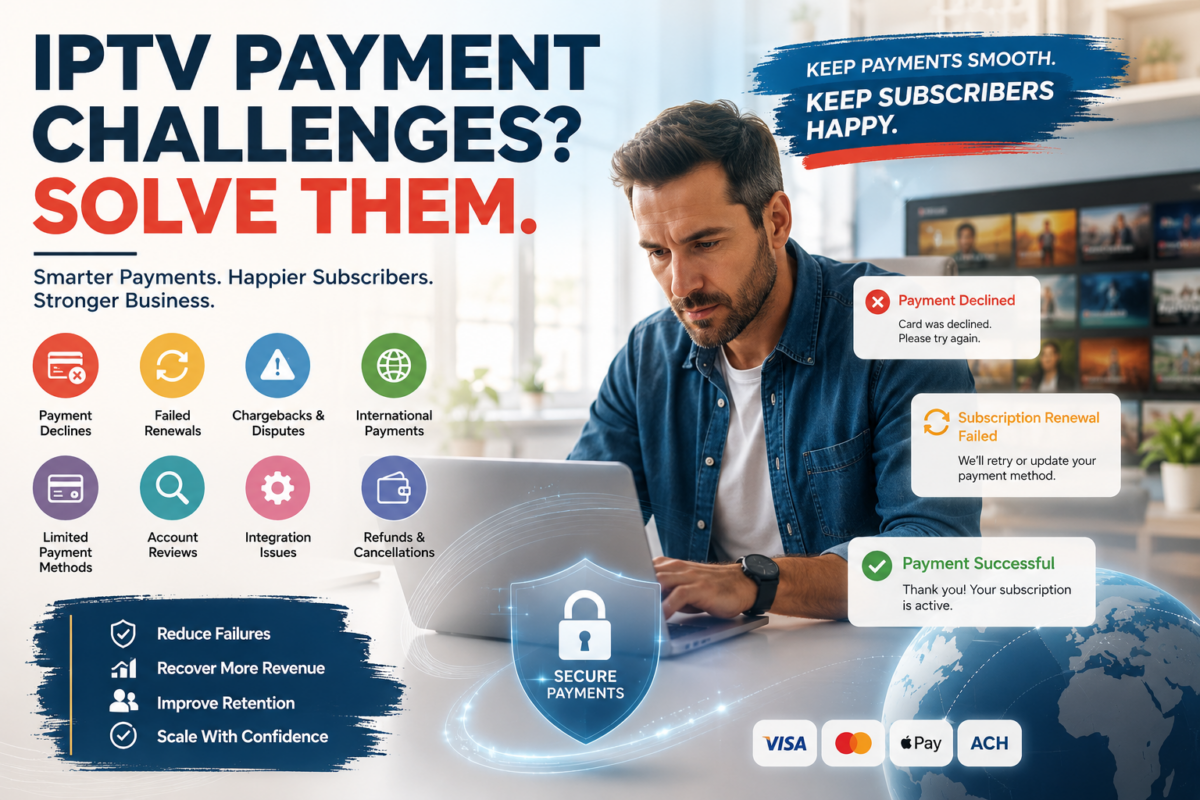
Getting payment processing for an IPTV business is only the first step. Once customers begin subscribing, the business has to manage a much broader set of payment-related challenges.
Payments can fail even when a customer has a valid card. Recurring subscriptions can stop renewing. International transactions can behave differently from domestic payments. Chargebacks can affect revenue, while sudden changes in transaction volume can trigger additional reviews. For an IPTV business, these problems can directly affect subscription revenue and customer retention.
Understanding the common payment processing challenges for IPTV businesses can help operators build a payment system that is prepared for problems instead of reacting to them after revenue has already been affected.
Why Payment Processing Can Be Challenging for IPTV Businesses?
IPTV businesses often operate differently from traditional online stores. A typical ecommerce business may process a customer payment once when an order is placed. An IPTV provider may charge the same customer every month, quarter, or year.
The business may also serve customers across different countries, accept multiple payment methods, deal with recurring transactions, and depend on uninterrupted payment processing to maintain subscriber access. This creates a payment lifecycle rather than a single transaction.
For example, a customer may:
- Subscribe using a card.
- Renew automatically the following month.
- Update their payment method after the card expires.
- Receive a refund after cancelling.
- Dispute a transaction with their bank.
Each event creates a different payment requirement.
1. Payment Declines
One of the most common problems for IPTV, being a high risk business is a customer attempting to pay and receiving a declined transaction.
A payment can be declined for many reasons. The customer’s bank may reject it, payment information may be incorrect, a risk-control system may flag the transaction, or there may be an issue with the merchant’s payment configuration.
The important point is that not every decline has the same cause.
For example, suppose an IPTV business receives 500 failed transactions in one day. If those failures are caused by expired cards, the appropriate solution is different from a situation where transactions from an entire country suddenly stop being approved. This is why payment reporting and decline information matter.
Businesses should look for patterns in failed payments rather than treating every decline as an isolated incident. The detailed causes and solutions are covered in why IPTV payments are declined, which is particularly relevant when payment failures begin affecting subscription conversions.
2. Failed Recurring Payments
Recurring billing creates another major challenge.
A customer can successfully complete their first IPTV subscription payment but fail to make a payment during a later renewal. This can happen because a card has expired, payment information has changed, the customer does not have sufficient funds, or the transaction is rejected by the issuing bank.
Imagine an IPTV provider with 15,000 monthly subscribers. If only 3% of renewal transactions fail during a billing cycle, that represents 450 subscriptions requiring attention. Immediately cancelling all 450 subscriptions may result in unnecessary revenue loss.
A better approach is to have a defined failed-payment process that can identify the reason for the failure, notify the customer when appropriate, allow payment information to be updated, and retry eligible transactions according to the payment provider’s capabilities and applicable rules. This is why recurring billing should be evaluated when selecting an IPTV payment gateway, rather than assuming that successful initial payments automatically mean subscription renewals will work smoothly.
3. Chargebacks and Payment Disputes
Chargebacks can become expensive for subscription businesses. A customer may dispute a payment because they do not recognize the transaction, believe they cancelled the subscription, expected a refund, or claim that they did not authorize the payment. Recurring billing can make this particularly important.
For example, a customer subscribes to an IPTV service in January and forgets about the subscription. A renewal appears on their bank statement in June, and the customer disputes the transaction rather than contacting the merchant.
The business may then need to respond to the dispute and provide relevant transaction and subscription information. Clear billing descriptions, transparent subscription terms, straightforward cancellation procedures, and accessible customer support can help reduce avoidable disputes.
Businesses should also maintain accurate records showing when subscriptions were created, when payments were made, and when cancellations or refunds occurred. Effective chargeback prevention for IPTV businesses should therefore be part of payment operations from the beginning rather than something introduced only after disputes increase.
4. Payment Processing Restrictions or Account Reviews
Another challenge can occur when a payment provider reviews a merchant account or places temporary restrictions on processing. Payment providers monitor merchant activity because actual transaction behavior needs to remain consistent with the business profile established during onboarding.
Consider an IPTV business that originally expects to process $30,000 per month. After a successful marketing campaign, monthly processing suddenly reaches $300,000. The increase may be completely legitimate. However, the transaction pattern is substantially different from the original expectation, so the provider may request additional information or review the account.
This is one reason accurate onboarding information matters.
Businesses should provide realistic estimates and keep their payment provider informed when significant changes occur in transaction volume, customer geography, or business operations.
5. International Payment Problems
An IPTV business serving customers internationally can encounter additional payment challenges. A customer may use a foreign-issued card, pay in another currency, or use a payment method that is common in their country but not widely used in the merchant’s home market. Cross-border transactions can also be affected by issuer restrictions, fraud controls, currency conversion, and payment-provider capabilities.
For example, an IPTV provider may have a high approval rate for domestic customers but experience significantly more failed transactions from customers in a particular international market.
Rather than assuming that all international payments are problematic, the business should examine transaction data by country and payment method. This can reveal whether the problem is concentrated in one market or payment route.
Businesses expanding internationally should also understand how their payment provider handles international payment processing for IPTV businesses, including currencies, settlement, recurring transactions, and cross-border costs.
6. Limited Payment Methods
Customers do not all prefer the same way to pay. An IPTV business that accepts only one payment method may lose potential subscribers who are willing to purchase but cannot use the available option.
For example, one customer may prefer a credit card while another may prefer ACH or a supported digital payment method. However, adding payment methods without considering their actual usefulness can create unnecessary complexity.
The business should consider where its customers are located, which payment methods they commonly use, whether those methods support recurring billing, and how much each method costs to process. The goal is not to offer every possible payment method. It is to offer the payment methods that are most relevant to the customer base.
7. Refund and Cancellation Problems
Subscription businesses need clear rules for cancellations and refunds.
Consider a customer who cancels their IPTV subscription one day before the next billing date. The payment system and subscription platform need to understand whether the cancellation stops the upcoming charge and whether the customer retains access until the end of the current billing period.
If payment and subscription systems do not communicate properly, a customer may be charged after cancellation. That can create unnecessary complaints, refund requests, and potentially chargebacks. The business should therefore make sure its cancellation process is connected to its recurring billing system.
Customers should also be able to understand how cancellations work before subscribing.
8. Payment Integration Problems
Payment processing also depends on the technical connection between the IPTV website, checkout, payment gateway, and subscription system. An integration can appear to work during initial testing but fail under a specific scenario.
For example, the first payment may succeed, but the subscription platform may fail to receive the correct payment status. A successful renewal could then be incorrectly marked as unpaid.
Another possibility is that a failed payment does not automatically update the subscriber’s account, leaving the customer with either continued access despite non-payment or unnecessary service interruption after a temporary payment failure. Testing should therefore cover more than a successful checkout.
Businesses should test successful payments, failed payments, refunds, cancellations, recurring renewals, and payment-method updates.
9. Settlement and Cash-Flow Issues
Processing a payment does not necessarily mean the merchant immediately receives the money in its bank account. Settlement can involve processing timelines, business days, payment-method differences, currencies, and account-specific arrangements. For an IPTV business with recurring monthly expenses, unexpected settlement delays can create cash-flow pressure.
For example, a business may have payroll, infrastructure, content, marketing, and other operating expenses that depend on predictable incoming revenue. Understanding settlement schedules is therefore just as important as understanding transaction approval.
Businesses should know when funds are expected to become available and whether different payment methods or international transactions have different settlement timelines.
10. Scaling Payment Processing With Subscriber Growth
A payment setup that works for 500 subscribers may not work equally well for 50,000. As transaction volume grows, previously minor problems can become major operational issues.
A 1% payment failure rate may seem manageable when processing 1,000 transactions. At 100,000 transactions, the same rate represents 1,000 failed payments. The same principle applies to chargebacks, refunds, customer support requests, reconciliation, and payment reporting.
Growing IPTV businesses therefore need payment infrastructure that can scale with transaction volume rather than simply processing the transactions that exist today.
How IPTV Businesses Can Manage Payment Challenges?
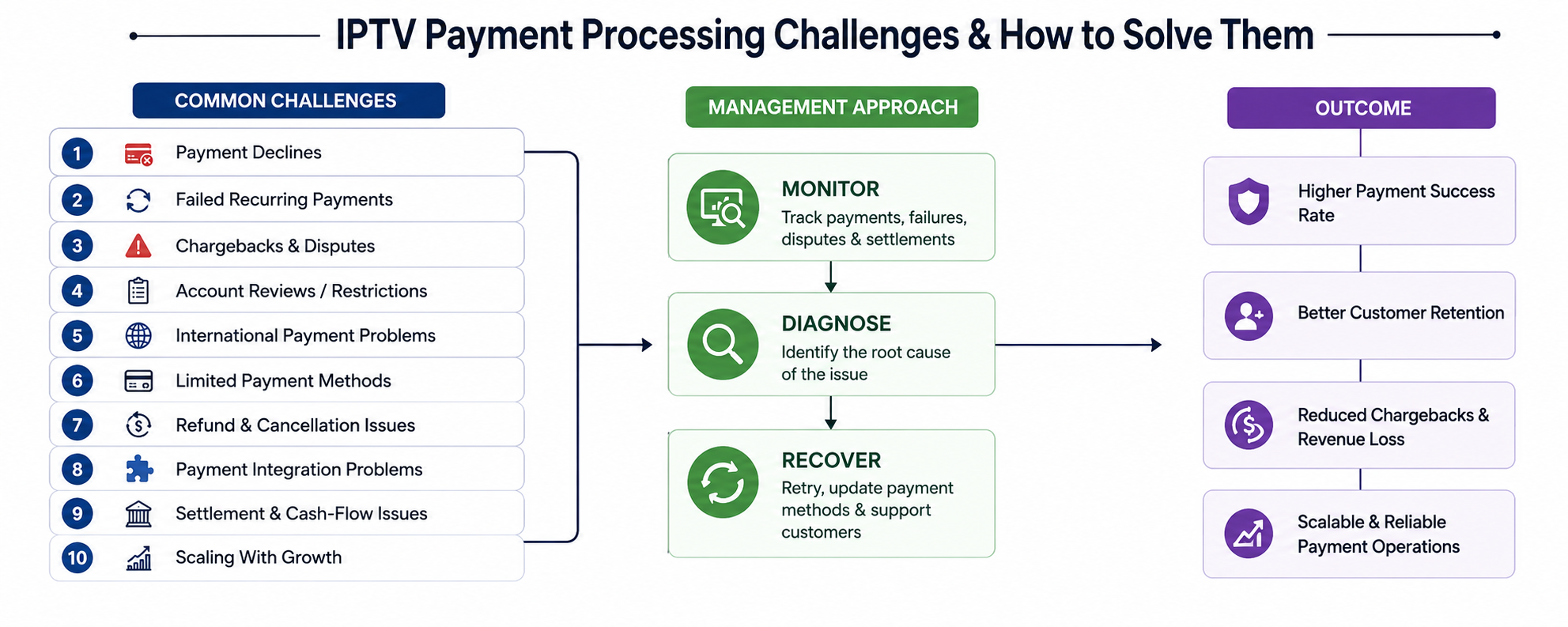
Payment problems cannot always be eliminated. Banks can decline legitimate transactions, customers can enter incorrect information, and payment networks can experience disruptions. The objective is to build processes that identify problems quickly and provide an appropriate response. A practical payment-management approach should focus on three areas:
Monitor: Track approval rates, failed transactions, recurring-payment failures, refunds, disputes, and settlement activity.
Diagnose: Determine whether a problem is related to the customer, payment method, issuing bank, gateway, merchant configuration, geographic market, or another part of the payment process.
Recover: Give legitimate customers an opportunity to complete payment through appropriate retries, payment-method updates, alternative payment options, or customer support.
This approach is much more effective than simply replacing the payment provider every time a payment problem appears.
Choosing Payment Infrastructure for an IPTV Business
The right payment infrastructure should be evaluated against the business’s actual operating model.
An IPTV business should consider whether the payment setup can support its subscription structure, customer locations, payment methods, transaction volume, recurring billing, refunds, disputes, reporting, and settlement requirements. It should also consider what happens when something goes wrong.
A payment system is not truly reliable because it processes successful transactions. Its reliability becomes more apparent when a card is declined, a renewal fails, a customer requests a refund, an international transaction is rejected, or transaction volume suddenly increases.
The strongest IPTV payment setup is therefore one that combines payment acceptance with effective monitoring, recovery, customer management, and scalable infrastructure. By understanding these challenges before selecting a payment provider, an IPTV business can make a more informed decision about the features and capabilities its payment infrastructure actually needs.
The final step in this payment-processing journey is understanding how a business can offer payment infrastructure under its own brand and integrate it into its broader IPTV operation. This is where a white-label payment platform for IPTV businesses can become relevant for companies looking for greater control over their payment experience.

Categories
- ACH Payments (10)
- adult payment processing (11)
- AI (9)
- Altcoins (10)
- Banking (10)
- Bitcoin (133)
- Bitcoin ETF (11)
- Bitcoin Price (30)
- Blockchain (50)
- Brokering World Hunger Away (16)
- Business (17)
- card payment processing (10)
- CBD (11)
- CBDC (11)
- Chargeback (8)
- coaching business (11)
- COVID-19 (3)
- Crypto ATMs (1)
- Crypto Banking (17)
- Crypto Bill (1)
- Crypto business owner platform (31)
- Crypto Investment (3)
- Crypto Markets (5)
- Crypto Payment (35)
- Crypto Payment Processor (4)
- Crypto Prices (1)
- Crypto Trading (92)
- Cryptocurrency (402)
- Cryptocurrency Exchange (108)
- Data Visualization (2)
- dating platforms (11)
- debt collection payment processing (10)
- Decentralized Finance (7)
- DeFi Payment (9)
- DEX (3)
- Digital Currency (23)
- dropshipping payment processing (12)
- Ethereum (2)
- FAQ (7)
- file sharing payment processing (11)
- Finance (25)
- Financial Equality (4)
- Financial Freedom (8)
- Forex (35)
- hemp (1)
- ICO (2)
- Investment (11)
- IPTV (11)
- Merchant Account (10)
- Mining (3)
- News (66)
- NFTs (2)
- online gambling (11)
- P2P (1)
- Paybito (147)
- PayBitoPro (693)
- PayBitoPro Coin Listing (6)
- PayBitoPro Exchange (2)
- Payment Gateway (48)
- peptide (10)
- Post COVID Digital Transformation (1)
- Press Release (130)
- Privacy & Security (3)
- Real Estate (1)
- Stablecoin (5)
- Technology (15)
- Travel (11)
- Uncategorized (10)
- US Presidential Election (2)
- Utility Coin (1)
- Web3 business (4)
- Web3 Wallets (2)
- White Label Crypto Exchange (8)
Recent Posts
- Payment Gateway vs. Payment Orchestration: What’s the Difference?
- What Is Smart Payment Routing? Strategies to Optimize Payment Performance
- How to Improve Payment Approval Rates for High-Risk Businesses?
- Why Are Online Payments Failing? Common Causes and How to Fix Them
- How to Use Multiple Payment Processors to Reduce Business Disruptions?