Why Do Adult Entertainment Payments Get Declined and How to Fix Them?
- August 4, 2026
- Soham Guchait
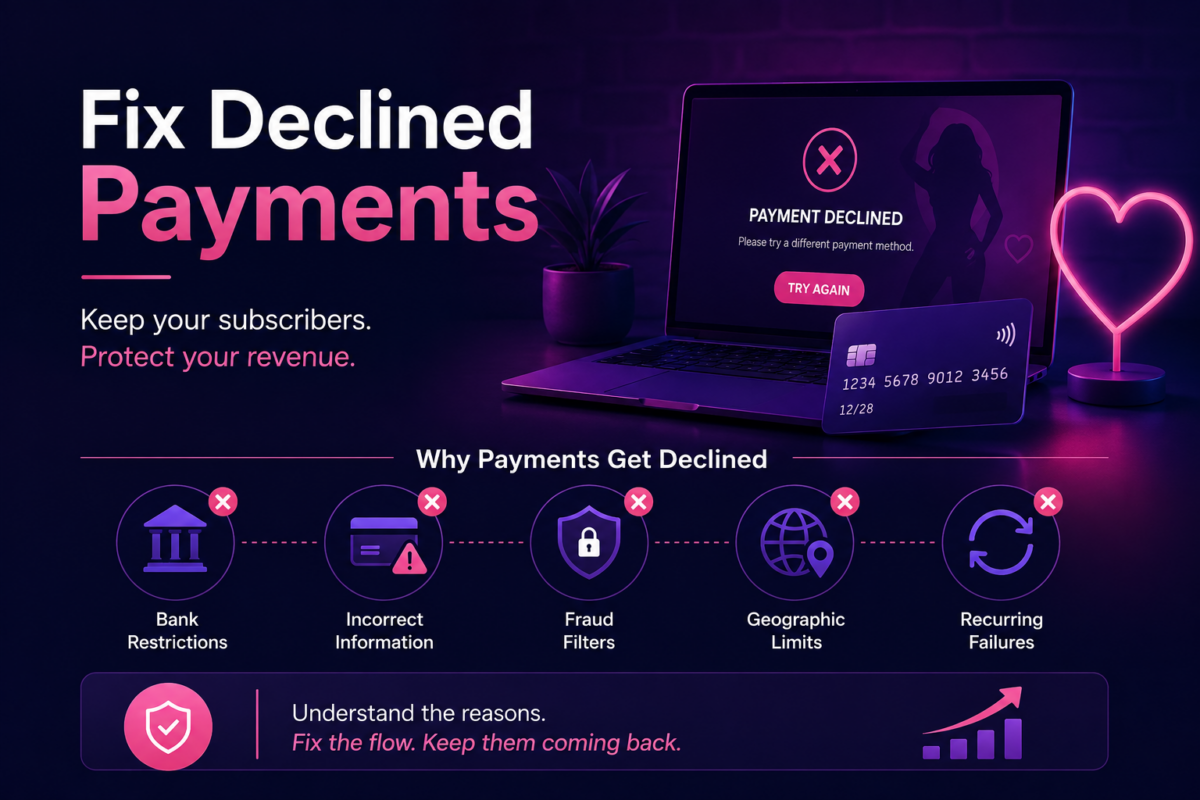
A customer reaches the checkout page, enters their payment information, and expects the transaction to complete within seconds. Instead, the payment fails. For an adult business, a declined transaction does not only mean lost revenue – it can also affect customer trust, subscription retention, and overall business growth.
Payment declines are common across online businesses, but adult entertainment companies often experience additional challenges because of industry risk factors, fraud monitoring systems, recurring billing models, and customer privacy concerns. Understanding why adult payments get declined is the first step toward reducing failed transactions and creating a smoother payment experience.
Why Do Adult Business Payments Get Declined?
A declined payment does not always mean there is a problem with the customer’s card or account. Payment approvals involve multiple systems, and a transaction can fail at different points during the authorization process.
For example, a customer subscribing to a creator membership may have sufficient funds available, enter the correct card details, and still receive a decline. The reason could be related to the issuing bank, fraud detection rules, transaction patterns, or technical issues. Businesses that understand the causes behind payment failures can make better decisions about their checkout experience and payment infrastructure.
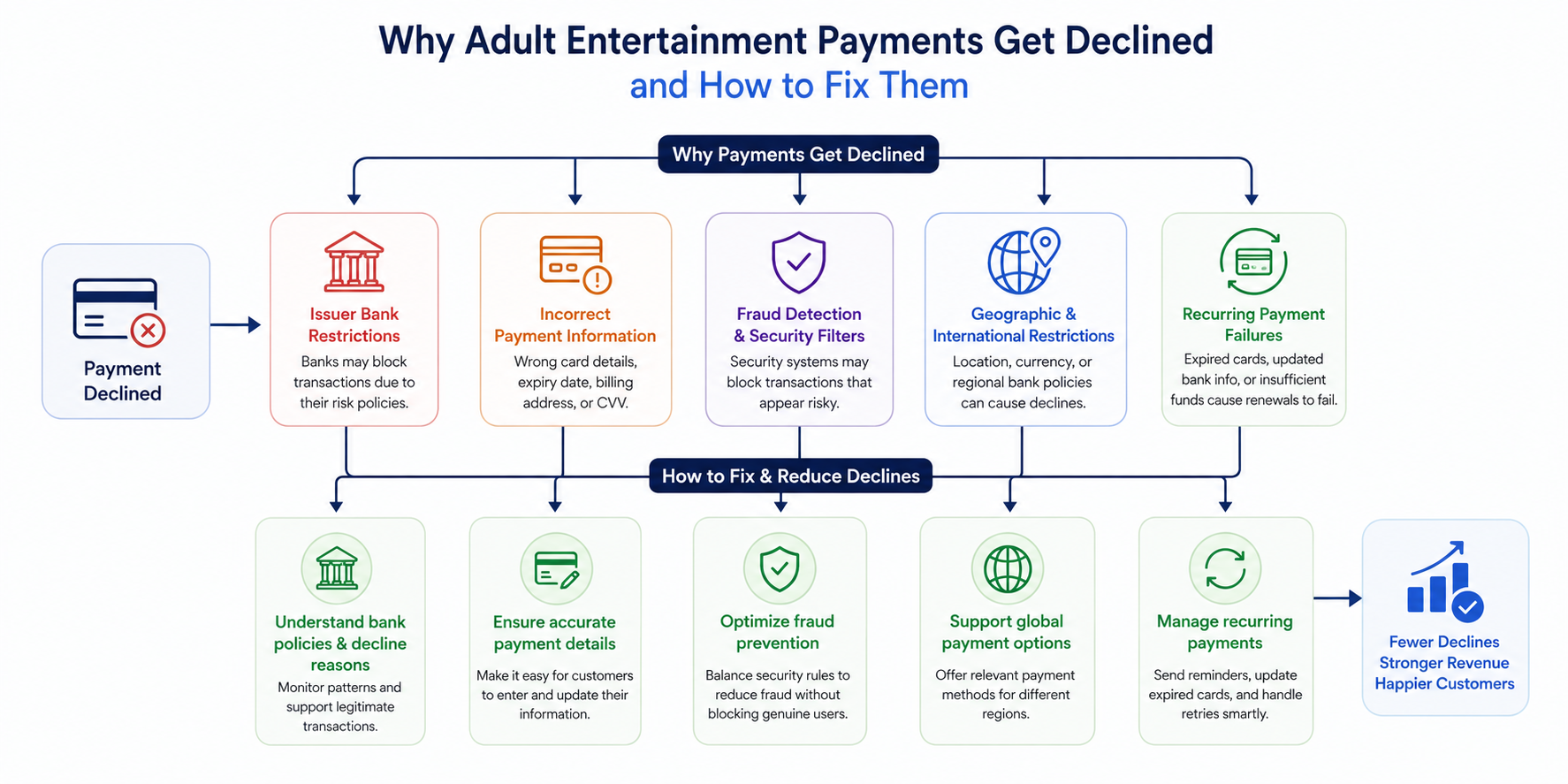
Common Reasons Adult Payments Fail
Issuer Bank Restrictions
The customer’s bank plays an important role in approving or declining transactions. Banks use internal risk systems to evaluate purchases, and some transactions may be declined based on their own policies or risk assessments.
For example, a customer who has never made an online subscription purchase before may attempt to join an adult membership platform. The bank’s fraud system may consider the transaction unusual and decline it as a precaution.
In many cases, the customer is legitimate, but the payment is blocked because the transaction does not match their normal spending behavior.
Incorrect Payment Information
Simple errors are another common reason payments fail.
Customers may enter:
- An incorrect card number.
- An outdated expiration date.
- An incorrect billing address.
- A wrong security code.
For example, a subscriber updating their membership after replacing an old card may accidentally enter outdated information, causing the payment attempt to fail. Although these issues appear minor, repeated failed attempts can increase frustration and lead customers to abandon the purchase.
Fraud Detection and Security Filters
Adult businesses often face increased fraud attempts, including stolen card usage, automated payment testing, and unauthorized transactions. Because of this, payment systems may apply stricter security checks.
Fraud prevention systems analyze factors such as:
- Transaction frequency.
- Customer location.
- Device information.
- Previous payment behavior.
- Unusual purchase patterns.
For example, a customer account attempting multiple subscription purchases using different cards within a short period may trigger fraud controls, even if some transactions are legitimate.
Businesses should understand that fraud protection is designed to prevent losses, but overly aggressive filtering can sometimes block genuine customers. Companies dealing with these issues should also explore fraud prevention for adult entertainment payment processing to understand how risk controls affect payment approvals.
Geographic and International Restrictions
Payments may also fail because of differences between the customer’s location, card issuer, and business operations. International transactions often involve additional considerations, including:
- Currency differences.
- Regional banking policies.
- Card issuer restrictions.
- Local payment availability.
For example, an adult subscription platform serving customers globally may notice that payments succeed in one country but experience higher decline rates in another. This does not always indicate a technical issue; it may reflect regional banking behavior.
Recurring Payment Failures
Subscription-based adult businesses face a unique challenge: payments must continue working after the initial purchase.
A customer may successfully subscribe today but fail to renew months later because:
- Their card expired.
- Their bank replaced the card.
- Their available balance changed.
- Their payment details were updated incorrectly.
For example, a customer joins a premium creator membership and continues using the service for several months. When the renewal date arrives, the payment fails because the card on file is no longer active.
Without proper subscription management, businesses can lose customers who never intended to cancel. Companies operating subscription models should understand recurring billing for adult subscription websites and how payment failures can be managed before they become lost revenue.
How Adult Businesses Can Reduce Payment Declines?
Reducing payment failures requires understanding customer behavior, improving payment processes, and monitoring transaction patterns.
Some important practices include:
- Providing a simple and clear checkout process.
- Allowing customers to update payment information easily.
- Monitoring decline reasons instead of treating every failure the same.
- Supporting appropriate payment options for different customer markets.
- Maintaining accurate transaction information.
- Using payment systems that provide useful decline insights.
For example, if a membership platform notices that many failed renewals occur because cards have expired, it can focus on improving payment update reminders instead of assuming customers are leaving intentionally.
Improving the Customer Experience After a Declined Payment
A declined transaction does not have to become a lost customer. The way a business handles failed payments can influence whether customers complete the purchase later.
A helpful payment recovery process may include:
- Clear decline messages.
- Easy retry options.
- Alternative payment methods where available.
- Simple payment detail updates.
- Customer support assistance.
Imagine a customer trying to renew a membership but receiving only a generic “payment failed” message. They may assume the platform is unavailable and leave. A more informative experience explaining that the card needs verification or updating gives the customer a clear next step. Businesses should also ensure their payment systems support reliable checkout experiences. Understanding how adult businesses can accept payments online helps companies build better payment flows from the beginning.
Conclusion
Adult payment declines happen for many reasons, including bank restrictions, incorrect information, fraud screening, geographic limitations, and recurring billing failures. The solution is not simply processing more transactions – it is understanding why payments fail and improving the systems around them.
By monitoring decline patterns, improving customer payment experiences, and choosing suitable payment infrastructure, adult businesses can recover more legitimate transactions while reducing unnecessary payment friction.
A reliable payment process helps protect revenue, improves customer satisfaction, and creates a stronger foundation for long-term business growth.

Categories
- ACH Payments (10)
- adult payment processing (11)
- AI (9)
- Altcoins (10)
- Banking (10)
- Bitcoin (133)
- Bitcoin ETF (11)
- Bitcoin Price (30)
- Blockchain (50)
- Brokering World Hunger Away (16)
- Business (17)
- card payment processing (10)
- CBD (11)
- CBDC (11)
- Chargeback (8)
- coaching business (11)
- COVID-19 (3)
- Crypto ATMs (1)
- Crypto Banking (17)
- Crypto Bill (1)
- Crypto business owner platform (31)
- Crypto Investment (3)
- Crypto Markets (5)
- Crypto Payment (35)
- Crypto Payment Processor (4)
- Crypto Prices (1)
- Crypto Trading (92)
- Cryptocurrency (402)
- Cryptocurrency Exchange (108)
- Data Visualization (2)
- dating platforms (11)
- debt collection payment processing (10)
- Decentralized Finance (7)
- DeFi Payment (9)
- DEX (3)
- Digital Currency (23)
- dropshipping payment processing (12)
- Ethereum (2)
- FAQ (7)
- file sharing payment processing (11)
- Finance (25)
- Financial Equality (4)
- Financial Freedom (8)
- Forex (35)
- hemp (1)
- ICO (2)
- Investment (11)
- IPTV (11)
- Merchant Account (10)
- Mining (3)
- News (66)
- NFTs (2)
- online gambling (11)
- P2P (1)
- Paybito (147)
- PayBitoPro (693)
- PayBitoPro Coin Listing (6)
- PayBitoPro Exchange (2)
- Payment Gateway (48)
- peptide (10)
- Post COVID Digital Transformation (1)
- Press Release (130)
- Privacy & Security (3)
- Real Estate (1)
- Stablecoin (5)
- Technology (15)
- Travel (11)
- Uncategorized (10)
- US Presidential Election (2)
- Utility Coin (1)
- Web3 business (4)
- Web3 Wallets (2)
- White Label Crypto Exchange (8)
Recent Posts
- Payment Gateway vs. Payment Orchestration: What’s the Difference?
- What Is Smart Payment Routing? Strategies to Optimize Payment Performance
- How to Improve Payment Approval Rates for High-Risk Businesses?
- Why Are Online Payments Failing? Common Causes and How to Fix Them
- How to Use Multiple Payment Processors to Reduce Business Disruptions?