Why Are Peptide Businesses Considered High Risk by Payment Processors?
- July 28, 2026
- Soham Guchait
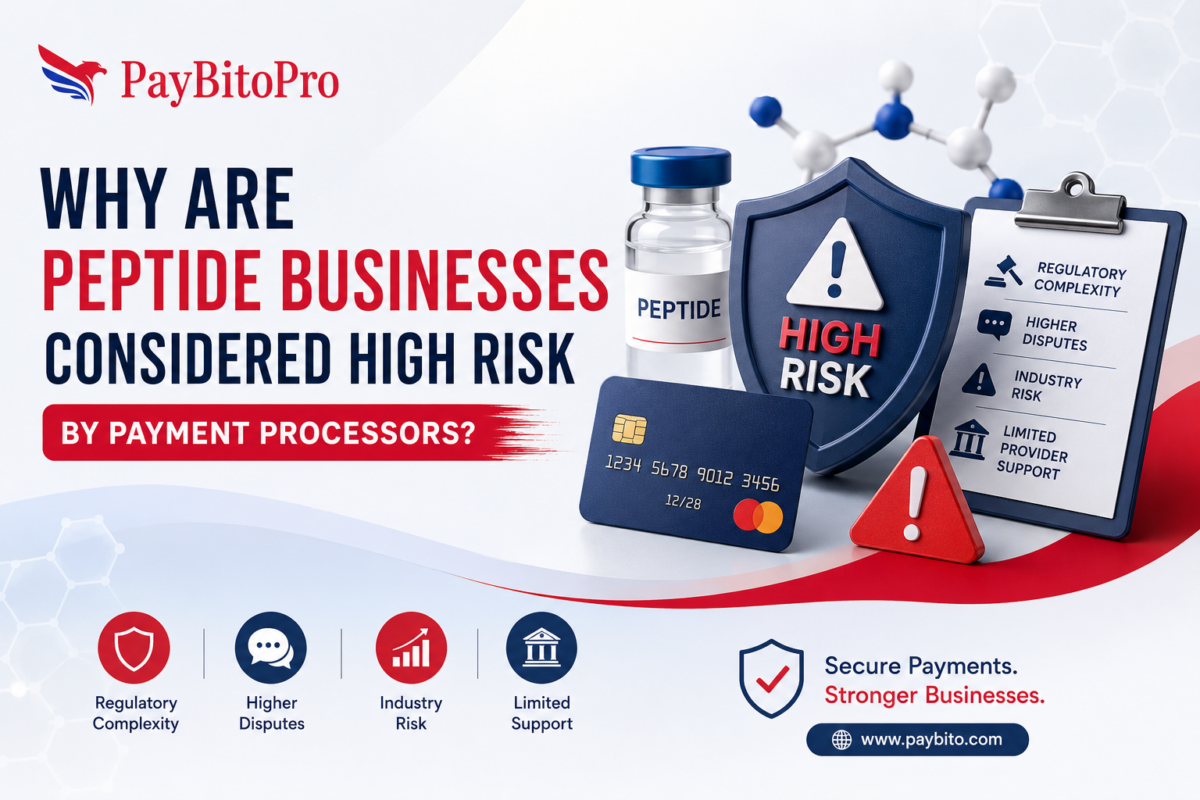
The peptide industry has expanded significantly, with businesses offering research peptides, laboratory products, and related solutions to customers worldwide. However, many peptide companies face an unexpected challenge when setting up payment processing: being classified as a high-risk business.
A high-risk classification can affect how businesses obtain merchant accounts, process customer payments, manage transaction approvals, and maintain reliable payment operations.
Understanding why peptide businesses are considered high risk can help companies prepare better documentation, improve approval chances, and choose payment solutions that match their business requirements.
What Does “High Risk” Mean in Payment Processing?
In payment processing, a high-risk business is a company that payment providers consider more likely to experience financial risks compared to traditional businesses.
These risks may include:
- Higher chargeback rates
- Regulatory uncertainty
- Increased fraud exposure
- Customer disputes
- Industry restrictions
Being labeled high risk does not mean a business is illegal or unable to accept payments. It means payment providers conduct additional reviews before approving payment processing services.
For example, a clothing store with thousands of successful transactions may receive standard processing approval. A peptide company, however, may go through additional underwriting because the payment provider needs to understand the nature of the products, customer base, and compliance practices.
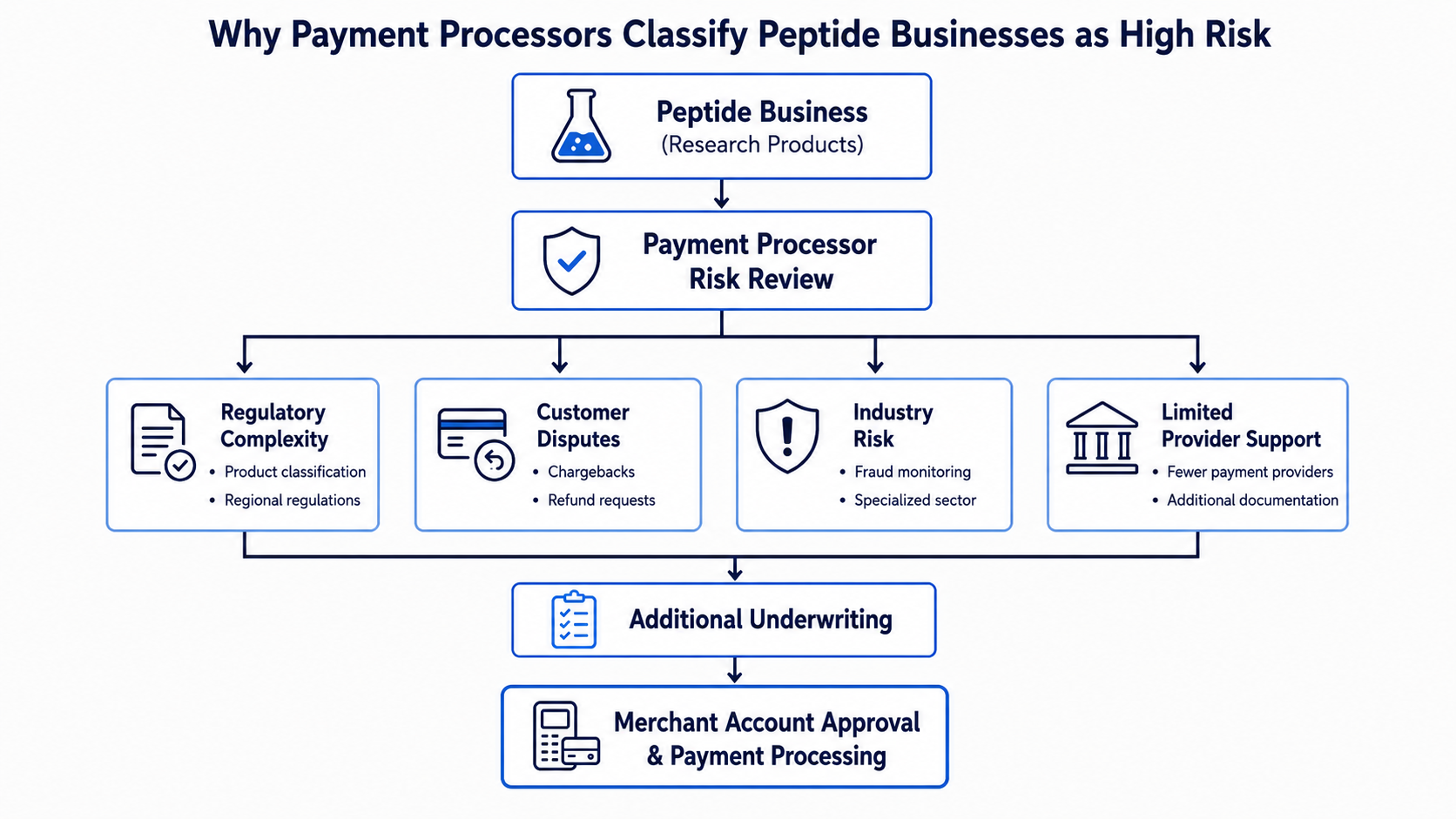
Why Are Peptide Businesses Classified as High Risk?
Several factors contribute to why peptide companies may receive additional scrutiny from payment processors.
1. Regulatory Complexity Around Peptide Products
One of the biggest reasons peptide businesses face additional review is the complexity surrounding peptide products.
Different regions may have different rules regarding:
- Product classification
- Marketing claims
- Intended use
- Distribution requirements
Payment providers need to evaluate whether a business operates transparently and follows applicable requirements.
For example:
A peptide company selling products for laboratory research purposes may need clear product descriptions, disclaimers, and business documentation to demonstrate how products are marketed and distributed.
2. Higher Potential for Customer Disputes
Chargebacks are one of the biggest concerns for payment processors. A chargeback occurs when a customer disputes a transaction with their bank and requests a reversal of payment.
For peptide businesses, disputes may happen because of:
- Customers misunderstanding product information
- Delivery delays
- Subscription confusion
- Product expectation issues
Example:
A customer purchases a peptide product expecting a certain result but later disputes the transaction because expectations were not clearly communicated. The payment processor may view this as a potential dispute risk.
Businesses can reduce these risks by maintaining:
- Clear product descriptions
- Transparent policies
- Customer support channels
- Accurate transaction records
3. Industry Risk Classification
Payment processors evaluate businesses based on historical transaction data across industries.
Some industries naturally experience higher levels of:
- Refund requests
- Fraud attempts
- Customer complaints
- Regulatory review
Because peptide businesses operate in a specialized market, some payment providers may categorize them differently from standard e-commerce businesses.
This does not mean every peptide company has the same risk level. Payment providers also evaluate individual factors such as:
- Business history
- Website quality
- Transaction volume
- Customer verification methods
- Compliance procedures
4. Limited Payment Provider Availability
Some traditional payment providers have restrictions on certain industries or products.
As a result, peptide companies may experience:
- Merchant account application rejections
- Sudden payment restrictions
- Limited processing options
- Requests for additional documentation
For example:
A peptide company that previously processed payments without issues may suddenly face account limitations if a provider changes its risk policies or reviews the business category differently.
This is why many peptide businesses look for payment providers experienced with high-risk industries.
How Does High-Risk Classification Affect Peptide Businesses?
Being classified as high risk can influence several areas of payment operations.
Merchant Account Approval
High-risk businesses usually undergo more detailed underwriting.
Payment providers may request:
- Business registration documents
- Ownership information
- Website details
- Product information
- Processing history
- Refund policies
- Shipping information
A complete application can make the approval process smoother.
Payment Processing Costs
High-risk businesses may have different pricing structures because payment providers assume additional risk.
Factors that influence costs include:
- Industry category
- Transaction volume
- Chargeback history
- Business location
- Processing requirements
Payment Monitoring
High-risk merchants may experience increased transaction monitoring.
Payment providers may review:
- Unusual transaction patterns
- Sudden volume increases
- High refund rates
- Suspicious activity
This helps reduce fraud and maintain payment stability.
How Can Peptide Businesses Improve Merchant Account Approval Chances?
Although peptide businesses may face additional challenges, companies can improve their chances of approval by preparing properly.
1. Maintain a Professional Website
Payment providers often review a company’s online presence.
A business website should clearly include:
- Product information
- Contact details
- Terms and conditions
- Privacy policy
- Refund policy
- Shipping information
2. Provide Clear Product Information
Unclear product descriptions can increase risk concerns.
Businesses should clearly explain:
- Product purpose
- Usage information
- Available documentation
- Customer expectations
3. Keep Strong Business Records
Having organized documentation helps demonstrate legitimacy.
Examples include:
- Registration documents
- Supplier information
- Sales records
- Compliance documentation
4. Monitor Customer Disputes
Managing chargebacks effectively is important for maintaining a healthy payment relationship.
Businesses should track:
- Reasons for disputes
- Refund patterns
- Customer complaints
Example: Two Peptide Businesses, Two Different Risk Profiles
Consider two peptide businesses.
Business A:
- Professional website
- Clear product information
- Transparent policies
- Low dispute rate
- Organized documentation
This business may appear lower risk during underwriting.
Business B:
- Limited website information
- Unclear product descriptions
- Poor customer support
- Frequent disputes
This business may face additional approval challenges.
The difference is not only the industry. Payment providers evaluate the overall business operation.
Conclusion
Peptide businesses are often considered high risk by payment processors because of regulatory complexity, potential customer disputes, and industry-specific payment risks.
However, high-risk classification does not prevent businesses from building reliable payment operations. By maintaining transparent business practices, preparing proper documentation, reducing chargebacks, and understanding payment requirements, peptide companies can improve their chances of obtaining stable payment processing.
For businesses operating in the peptide industry, understanding how payment processors evaluate risk is the first step toward creating a smoother and more reliable payment experience.

Categories
- ACH Payments (10)
- adult payment processing (11)
- AI (9)
- Altcoins (10)
- Banking (10)
- Bitcoin (133)
- Bitcoin ETF (11)
- Bitcoin Price (30)
- Blockchain (50)
- Brokering World Hunger Away (16)
- Business (17)
- card payment processing (10)
- CBD (11)
- CBDC (11)
- coaching business (11)
- COVID-19 (3)
- Crypto ATMs (1)
- Crypto Banking (17)
- Crypto Bill (1)
- Crypto business owner platform (31)
- Crypto Investment (3)
- Crypto Markets (5)
- Crypto Payment (35)
- Crypto Payment Processor (4)
- Crypto Prices (1)
- Crypto Trading (92)
- Cryptocurrency (402)
- Cryptocurrency Exchange (108)
- Data Visualization (2)
- dating platforms (11)
- debt collection payment processing (10)
- Decentralized Finance (7)
- DeFi Payment (9)
- DEX (3)
- Digital Currency (23)
- dropshipping payment processing (12)
- Ethereum (2)
- FAQ (7)
- file sharing payment processing (11)
- Finance (25)
- Financial Equality (4)
- Financial Freedom (8)
- Forex (35)
- hemp (1)
- ICO (2)
- Investment (11)
- IPTV (11)
- Merchant Account (10)
- Mining (3)
- News (66)
- NFTs (2)
- online gambling (11)
- P2P (1)
- Paybito (139)
- PayBitoPro (693)
- PayBitoPro Coin Listing (6)
- PayBitoPro Exchange (2)
- Payment Gateway (40)
- peptide (10)
- Post COVID Digital Transformation (1)
- Press Release (130)
- Privacy & Security (3)
- Real Estate (1)
- Stablecoin (5)
- Technology (15)
- Travel (11)
- Uncategorized (9)
- US Presidential Election (2)
- Utility Coin (1)
- Web3 business (4)
- Web3 Wallets (2)
- White Label Crypto Exchange (8)
Recent Posts
- ACH vs Wire Transfer: Which Payment Method Is Better for Businesses?
- ACH Fraud Prevention: How Businesses Can Secure Bank Account Payments?
- ACH Credit vs ACH Debit: What’s the Difference? With Real Examples
- ACH vs Credit Card: Which Payment Method Is Better for Businesses?
- How Long Do ACH Payments Take? Processing Times, Settlement, and Same Day ACH