Payment Processing for Peptide Businesses: A Complete Guide
- July 28, 2026
- Soham Guchait
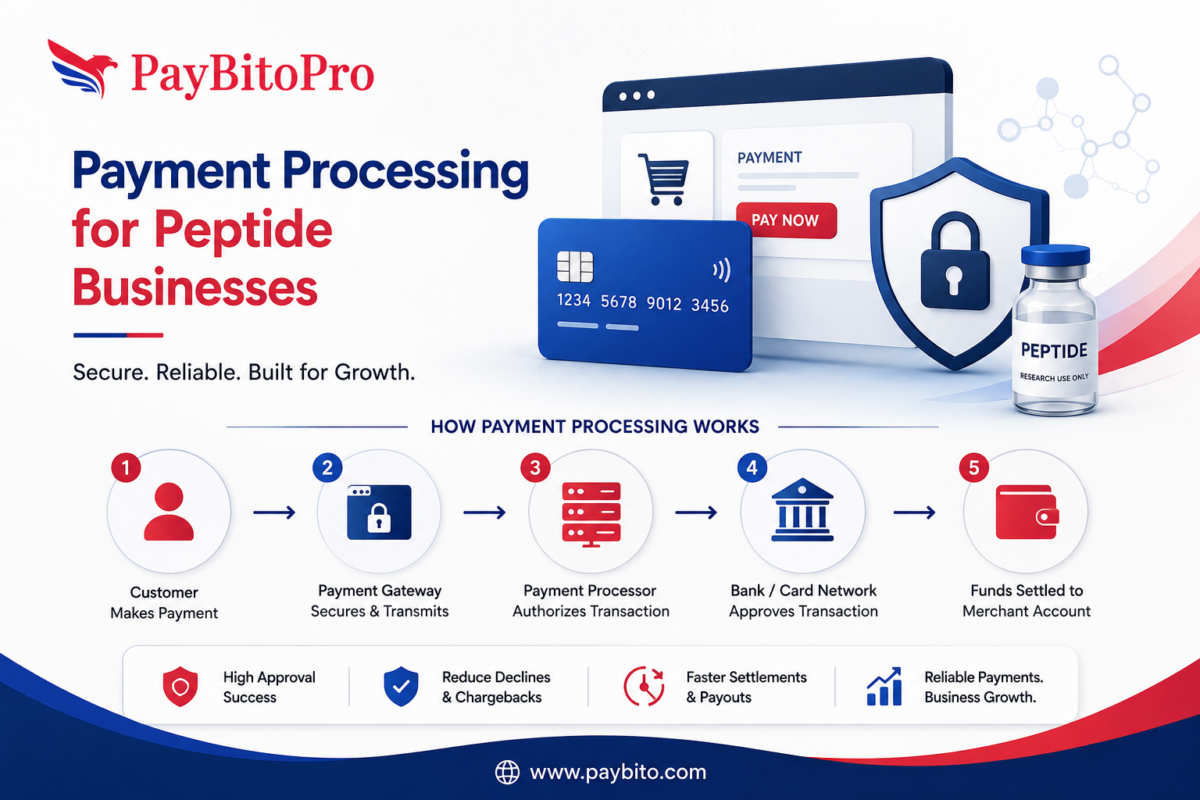
The peptide industry has grown rapidly with businesses selling research peptides, laboratory products, and related services online. However, many peptide companies face challenges when setting up reliable payment processing. Traditional payment providers may classify peptide businesses as high risk due to regulatory concerns, transaction disputes, and industry-specific risk factors.
Understanding how payment processing works, why peptide businesses face approval challenges, and what factors influence payment acceptance can help companies build a more stable payment operation.
What Is Payment Processing for Peptide Businesses?
Payment processing for peptide businesses refers to the systems and services that allow companies to accept customer payments through methods such as credit cards, debit cards, ACH transfers, and other digital payment options.
A typical payment transaction involves several parties:
- Customer making the payment
- Merchant selling the product or service
- Payment gateway handling transaction information
- Payment processor managing authorization and settlement
- Banks approving and transferring funds
For example, when a customer purchases a research peptide product online, the payment request travels through multiple systems before the transaction is approved and the funds reach the business account.
Why Are Peptide Businesses Considered High Risk?
Many financial institutions classify certain industries as high risk because of increased possibilities of payment disputes, regulatory complexity, or compliance concerns.
Peptide businesses may receive additional scrutiny because:
- Products can fall into specialized regulatory categories
- Customers may misunderstand product usage or expectations
- Certain transactions may carry higher dispute risks
- Some payment providers have restrictions on specific industries
Being classified as high risk does not necessarily mean a business cannot accept payments. It means payment providers usually perform additional reviews before approving processing services.
For example, an online peptide supplier may need to provide:
- Business registration information
- Website details
- Product descriptions
- Refund and shipping policies
- Transaction history
- Compliance documentation
How Does Payment Processing Work for Peptide Companies?
The payment process usually follows several steps:
1. Customer Initiates a Payment
A customer enters payment details during checkout, such as card information or bank account details.
Example:
A research company purchases peptide products from an online supplier and completes payment through the website checkout page.
2. Payment Gateway Sends Transaction Data
The payment gateway securely transfers transaction information between the customer, merchant, and financial institutions.
It verifies payment details and sends the request for approval.
3. Payment Processor Handles Authorization
The payment processor communicates with banks and card networks to determine whether the transaction can be approved.
Factors considered may include:
- Available funds
- Fraud indicators
- Transaction history
- Risk rules
4. Settlement Takes Place
After approval, funds are transferred to the merchant according to the agreed settlement schedule.
Settlement times can vary depending on the payment provider, business type, location, and risk profile.
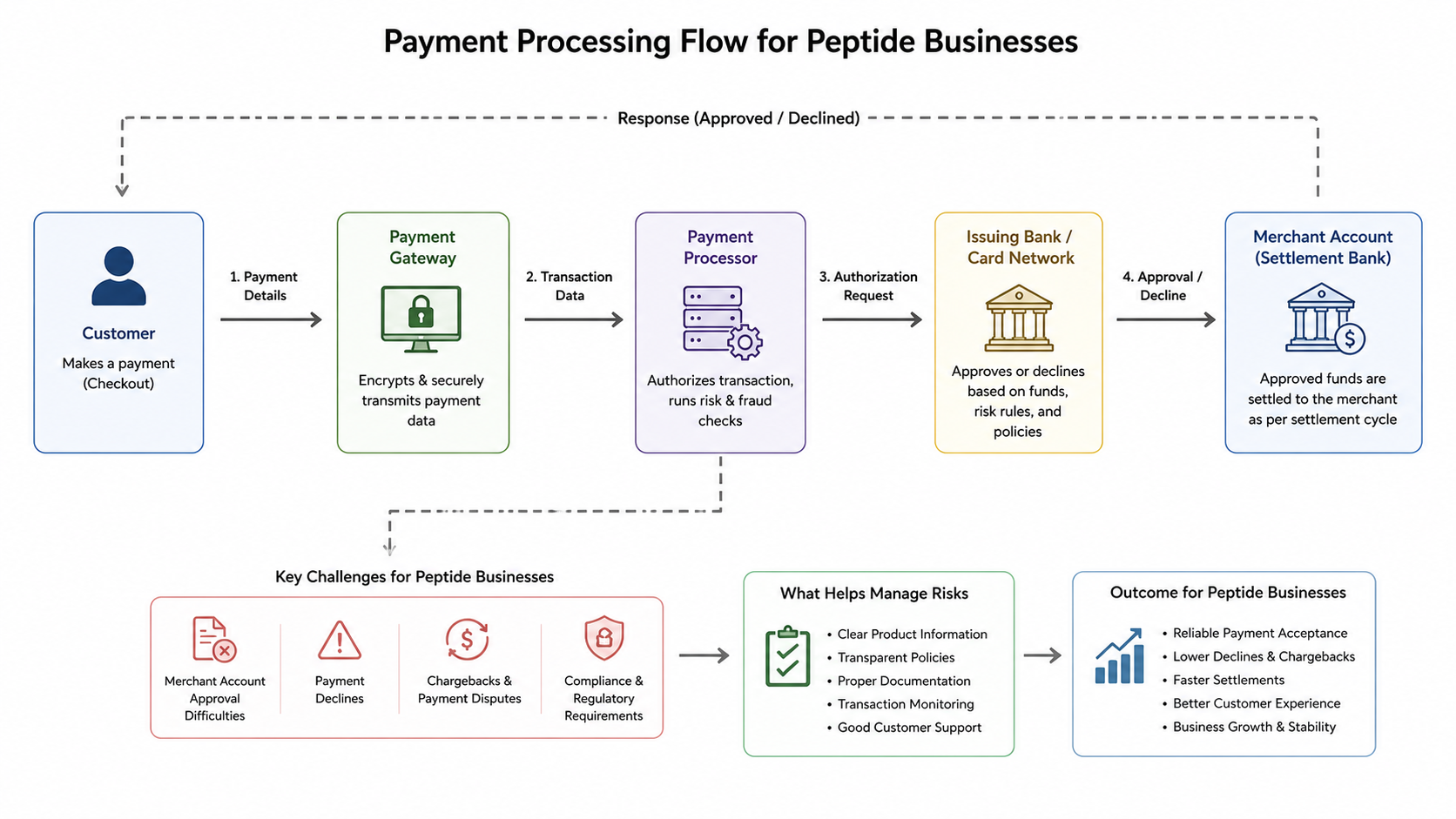
Common Payment Challenges Faced by Peptide Businesses
1. Merchant Account Approval Difficulties
One of the biggest challenges for peptide companies is finding payment providers willing to support their industry.
Businesses may experience:
- Application rejection
- Additional compliance reviews
- Requests for more documentation
- Higher processing requirements
A strong application with clear business information can improve the approval process.
2. Payment Declines
Even after approval, businesses may experience declined transactions.
Common reasons include:
- Fraud protection systems blocking legitimate customers
- Incorrect transaction information
- Customer bank restrictions
- Unusual purchasing patterns
Reducing unnecessary declines requires proper payment setup, accurate customer information, and effective transaction monitoring.
3. Chargebacks and Payment Disputes
Chargebacks occur when customers dispute transactions with their bank.
For peptide businesses, common causes may include:
- Customers not recognizing a transaction
- Delivery issues
- Confusion about product descriptions
- Dissatisfaction with purchases
Businesses can reduce chargebacks by maintaining:
- Clear product information
- Transparent policies
- Customer support channels
- Proper transaction records
What Should Peptide Businesses Look for in a Payment Solution?
A suitable payment processing solution should support the specific needs of peptide companies.
Important features include:
Reliable Payment Acceptance
Businesses should be able to accept payments consistently without frequent interruptions or unexpected restrictions.
Secure Checkout Experience
Customers expect secure payment pages that protect sensitive financial information.
Multiple Payment Methods
Different customers prefer different payment options. Supporting various methods can improve conversion rates.
Examples include:
- Credit and debit cards
- ACH card payments
- Alternative payment methods
Transaction Monitoring
Risk monitoring tools help identify suspicious activity and reduce fraud.
Clear Reporting
Businesses need visibility into:
- Successful transactions
- Failed payments
- Refunds
- Settlements
- Customer disputes
How Can Peptide Businesses Improve Payment Approval Chances?
Companies can improve their chances of approval by maintaining a professional and transparent business operation.
Helpful practices include:
- Creating a complete business website
- Clearly explaining products and services
- Publishing refund and shipping policies
- Maintaining accurate business records
- Using proper customer verification methods
- Monitoring chargeback rates
Payment providers evaluate the overall risk profile of a business, not just the industry category.
The Future of Payment Processing for Peptide Businesses
As the peptide market continues to expand, businesses will need payment systems that support reliability, compliance, and customer convenience.
Successful peptide companies will focus on building strong payment operations that include:
- Stable payment acceptance
- Effective risk management
- Secure checkout experiences
- Efficient settlement processes
Understanding payment processing requirements early can help peptide businesses avoid disruptions and create a stronger foundation for growth.
Conclusion
Payment processing for peptide businesses can be more complex than traditional online retail because of industry-specific risk factors and compliance requirements. By understanding merchant approval, payment workflows, chargebacks, international payment processing and transaction management, peptide companies can make better decisions when choosing payment solutions.
A well-structured payment system allows businesses to provide customers with a smoother checkout experience while maintaining reliable financial operations.

Categories
- ACH Payments (10)
- adult payment processing (11)
- AI (9)
- Altcoins (10)
- Banking (10)
- Bitcoin (133)
- Bitcoin ETF (11)
- Bitcoin Price (30)
- Blockchain (50)
- Brokering World Hunger Away (16)
- Business (17)
- card payment processing (10)
- CBD (11)
- CBDC (11)
- Chargeback (8)
- coaching business (11)
- COVID-19 (3)
- Crypto ATMs (1)
- Crypto Banking (17)
- Crypto Bill (1)
- Crypto business owner platform (31)
- Crypto Investment (3)
- Crypto Markets (5)
- Crypto Payment (35)
- Crypto Payment Processor (4)
- Crypto Prices (1)
- Crypto Trading (92)
- Cryptocurrency (402)
- Cryptocurrency Exchange (108)
- Data Visualization (2)
- dating platforms (11)
- debt collection payment processing (10)
- Decentralized Finance (7)
- DeFi Payment (9)
- DEX (3)
- Digital Currency (23)
- dropshipping payment processing (12)
- Ethereum (2)
- FAQ (7)
- file sharing payment processing (11)
- Finance (25)
- Financial Equality (4)
- Financial Freedom (8)
- Forex (35)
- hemp (1)
- ICO (2)
- Investment (11)
- IPTV (11)
- Merchant Account (10)
- Mining (3)
- News (66)
- NFTs (2)
- online gambling (11)
- P2P (1)
- Paybito (147)
- PayBitoPro (693)
- PayBitoPro Coin Listing (6)
- PayBitoPro Exchange (2)
- Payment Gateway (48)
- peptide (10)
- Post COVID Digital Transformation (1)
- Press Release (130)
- Privacy & Security (3)
- Real Estate (1)
- Stablecoin (5)
- Technology (15)
- Travel (11)
- Uncategorized (10)
- US Presidential Election (2)
- Utility Coin (1)
- Web3 business (4)
- Web3 Wallets (2)
- White Label Crypto Exchange (8)
Recent Posts
- Payment Gateway vs. Payment Orchestration: What’s the Difference?
- What Is Smart Payment Routing? Strategies to Optimize Payment Performance
- How to Improve Payment Approval Rates for High-Risk Businesses?
- Why Are Online Payments Failing? Common Causes and How to Fix Them
- How to Use Multiple Payment Processors to Reduce Business Disruptions?