ACH Payment Processing: A Complete Guide for Peptide Businesses
- July 29, 2026
- Soham Guchait
As payment costs continue to rise, many businesses are looking for faster and more cost-effective ways to accept payments. One payment method that has gained significant popularity is ACH payment processing.
For peptide businesses that regularly work with research institutions, biotechnology companies, wholesalers, or recurring customers, ACH payments offer an efficient alternative to traditional card transactions. They can lower processing costs, simplify large transactions, and improve cash flow for business-to-business (B2B) payments.
This guide explains how ACH payment processing works, its advantages, common challenges, and when peptide businesses should consider offering ACH as a payment option.
What Is ACH Payment Processing?
ACH (Automated Clearing House) payment processing is an electronic payment system that transfers funds directly between bank accounts without using paper checks or card networks.
Unlike credit card payments, ACH payments move money through the ACH network, allowing businesses to securely receive payments from customers’ bank accounts. Unlike credit card payments, ACH payments move money through the ACH network, allowing businesses to securely receive payments from customers’ bank accounts. Businesses that want to accept multiple payment methods can also explore how a payment gateway enables secure transaction processing between customers, merchants, and financial institutions.
Example:
A biotechnology company purchases $12,000 worth of peptide products from a supplier.
Instead of paying with a credit card, the customer authorizes an ACH payment directly from its business bank account. The funds are electronically transferred through the ACH network and deposited into the supplier’s account after processing.
How Does ACH Payment Processing Work?
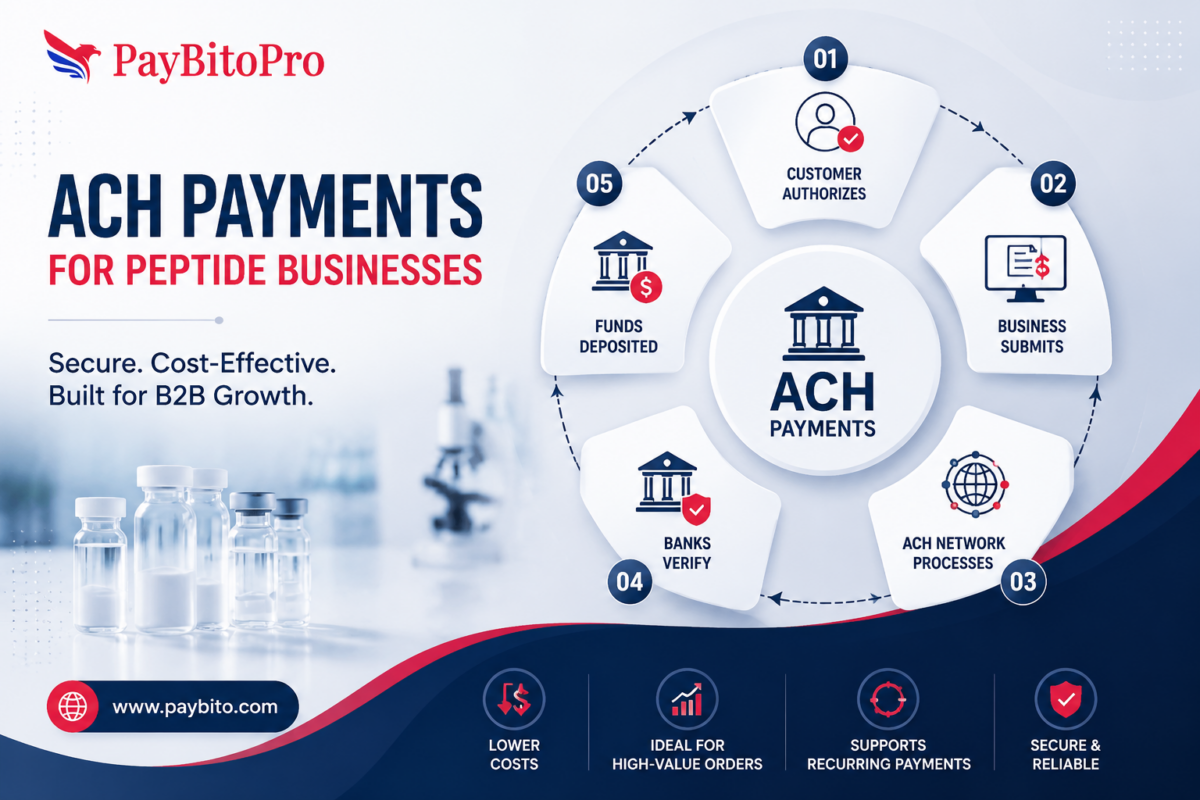
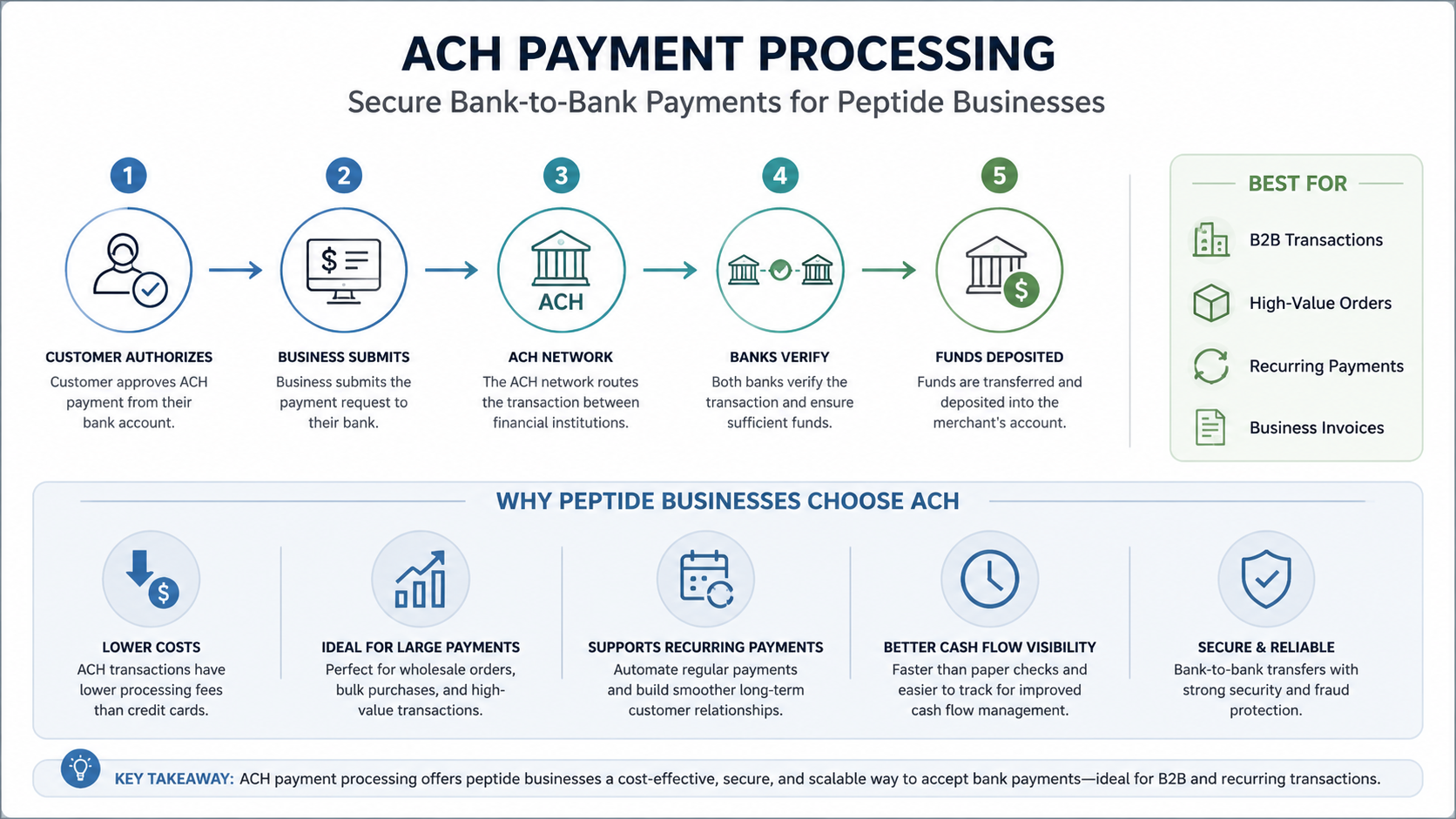
The ACH payment process generally follows these steps:
- The customer authorizes payment.
- The business submits the payment request.
- The ACH network processes the transaction.
- Both financial institutions verify the transfer.
- Funds are deposited into the merchant’s account.
Although ACH payments typically take longer than card authorizations, they are often preferred for larger business transactions because of their lower costs.
Benefits of ACH Payment Processing
1. Lower Processing Costs
One of the biggest advantages of ACH payments is reduced transaction costs. Since ACH transfers move funds directly between bank accounts, businesses often pay lower processing fees than they would for credit card transactions.
Example:
A peptide wholesaler processes hundreds of high-value B2B orders every month. Switching some customers from card payments to ACH transactions may reduce overall payment processing expenses while maintaining a convenient payment experience.
2. Ideal for High-Value Transactions
Large purchases may exceed internal company card limits or generate significant card processing fees.
ACH payments are often a practical solution for:
- Wholesale purchases
- Bulk laboratory orders
- Distributor payments
- Corporate procurement
Businesses handling larger invoices frequently include ACH as a payment option.
3. Supports Recurring Payments
ACH payment processing integrates well with recurring billing. Customers who place regular monthly orders can authorize automatic bank payments instead of manually initiating each transaction.
This creates a smoother payment experience while reducing administrative work.
4. Improved Cash Flow Management
Electronic bank transfers eliminate many of the delays associated with paper checks. Businesses can monitor incoming payments more efficiently and maintain better visibility into expected cash flow.
Common Challenges with ACH Payments
Although ACH payment processing provides many benefits, businesses should understand its limitations.
Longer Settlement Times
ACH payments usually require one to three business days for settlement. Businesses should account for these timelines when managing inventory and cash flow.
Payment Authorization
ACH transactions require customer authorization before funds can be withdrawn. Clear authorization procedures help reduce payment disputes and improve compliance.
Bank Account Accuracy
Incorrect banking information may result in failed transactions. Businesses should verify account details before processing payments.
Best Practices for ACH Payment Processing
To maximize the benefits of ACH payments, businesses should follow these recommendations.
Verify Customer Information
Confirm bank account details before initiating transactions to reduce processing errors.
Use Secure Payment Systems
Sensitive banking information should always be protected through encryption and secure payment technology.
Offer ACH for Large Orders
ACH is especially useful for:
- Wholesale purchases
- Subscription billing
- Business invoices
- Recurring customer relationships
Providing ACH alongside card payments gives customers greater flexibility.
Maintain Clear Payment Policies
Customers should understand:
- Payment schedules
- Processing timelines
- Authorization requirements
- Refund procedures
Transparent communication reduces confusion and improves the payment experience.
Example: Choosing the Right Payment Method
Consider two peptide suppliers.
Business A
Accepts only credit card payments.
A research laboratory placing a $25,000 order prefers to pay directly from its business bank account but has no ACH option available.
The purchasing process becomes more complicated.
Business B
Accepts both credit cards and ACH payments.
The laboratory authorizes an ACH transfer, completes the purchase efficiently, and continues using the same payment method for future monthly orders.
By offering multiple payment options, Business B creates a smoother purchasing experience and strengthens long-term customer relationships.
Future of ACH Payment Processing
Electronic bank payments continue to grow as businesses seek faster and more efficient payment methods. Companies looking to build their own branded payment infrastructure can also explore white label payment solutions, which allow businesses to launch customized payment platforms without developing the entire system from scratch.
Current trends include:
- Greater adoption of recurring ACH payments
- Improved payment automation
- Enhanced fraud detection
- Integration with digital invoicing
- Faster ACH settlement capabilities
As payment technology evolves, ACH is expected to remain an important component of modern business payment strategies.
Conclusion
ACH payment processing provides peptide businesses with a secure and cost-effective way to accept bank-to-bank payments, particularly for B2B transactions and recurring orders.
By reducing processing costs, supporting high-value transactions, and simplifying recurring payments, ACH helps businesses build a more efficient payment operation.
Offering both ACH and card payment options allows peptide businesses to meet a wider range of customer preferences while improving flexibility, operational efficiency, and long-term payment performance.

Categories
- ACH Payments (10)
- adult payment processing (11)
- AI (9)
- Altcoins (10)
- Banking (10)
- Bitcoin (133)
- Bitcoin ETF (11)
- Bitcoin Price (30)
- Blockchain (50)
- Brokering World Hunger Away (16)
- Business (17)
- card payment processing (10)
- CBD (11)
- CBDC (11)
- coaching business (11)
- COVID-19 (3)
- Crypto ATMs (1)
- Crypto Banking (17)
- Crypto Bill (1)
- Crypto business owner platform (31)
- Crypto Investment (3)
- Crypto Markets (5)
- Crypto Payment (35)
- Crypto Payment Processor (4)
- Crypto Prices (1)
- Crypto Trading (92)
- Cryptocurrency (402)
- Cryptocurrency Exchange (108)
- Data Visualization (2)
- dating platforms (11)
- debt collection payment processing (10)
- Decentralized Finance (7)
- DeFi Payment (9)
- DEX (3)
- Digital Currency (23)
- dropshipping payment processing (12)
- Ethereum (2)
- FAQ (7)
- file sharing payment processing (11)
- Finance (25)
- Financial Equality (4)
- Financial Freedom (8)
- Forex (35)
- hemp (1)
- ICO (2)
- Investment (11)
- IPTV (11)
- Merchant Account (10)
- Mining (3)
- News (66)
- NFTs (2)
- online gambling (11)
- P2P (1)
- Paybito (139)
- PayBitoPro (693)
- PayBitoPro Coin Listing (6)
- PayBitoPro Exchange (2)
- Payment Gateway (40)
- peptide (10)
- Post COVID Digital Transformation (1)
- Press Release (130)
- Privacy & Security (3)
- Real Estate (1)
- Stablecoin (5)
- Technology (15)
- Travel (11)
- Uncategorized (9)
- US Presidential Election (2)
- Utility Coin (1)
- Web3 business (4)
- Web3 Wallets (2)
- White Label Crypto Exchange (8)
Recent Posts
- ACH vs Wire Transfer: Which Payment Method Is Better for Businesses?
- ACH Fraud Prevention: How Businesses Can Secure Bank Account Payments?
- ACH Credit vs ACH Debit: What’s the Difference? With Real Examples
- ACH vs Credit Card: Which Payment Method Is Better for Businesses?
- How Long Do ACH Payments Take? Processing Times, Settlement, and Same Day ACH