High-Risk Payment Gateway for Peptide Businesses: Features to Look For
- July 29, 2026
- Soham Guchait
Choosing the right high-risk payment gateway is one of the most important decisions for a peptide business. While product quality and customer experience drive sales, a reliable payment gateway determines whether customers can successfully complete their purchases.
Many peptide businesses face challenges because some payment providers classify the industry as high risk. As a result, businesses may experience payment declines, account restrictions, or difficulties finding a payment gateway that supports their operations.
Understanding what a payment gateway does and which features matter most can help peptide businesses create a secure, reliable, and scalable payment experience.
What Is a Payment Gateway?
A payment gateway is the technology that securely transfers payment information between a customer, the merchant, payment processor, and financial institutions.
It acts as the secure connection that allows online payments to be authorized without exposing sensitive payment information.
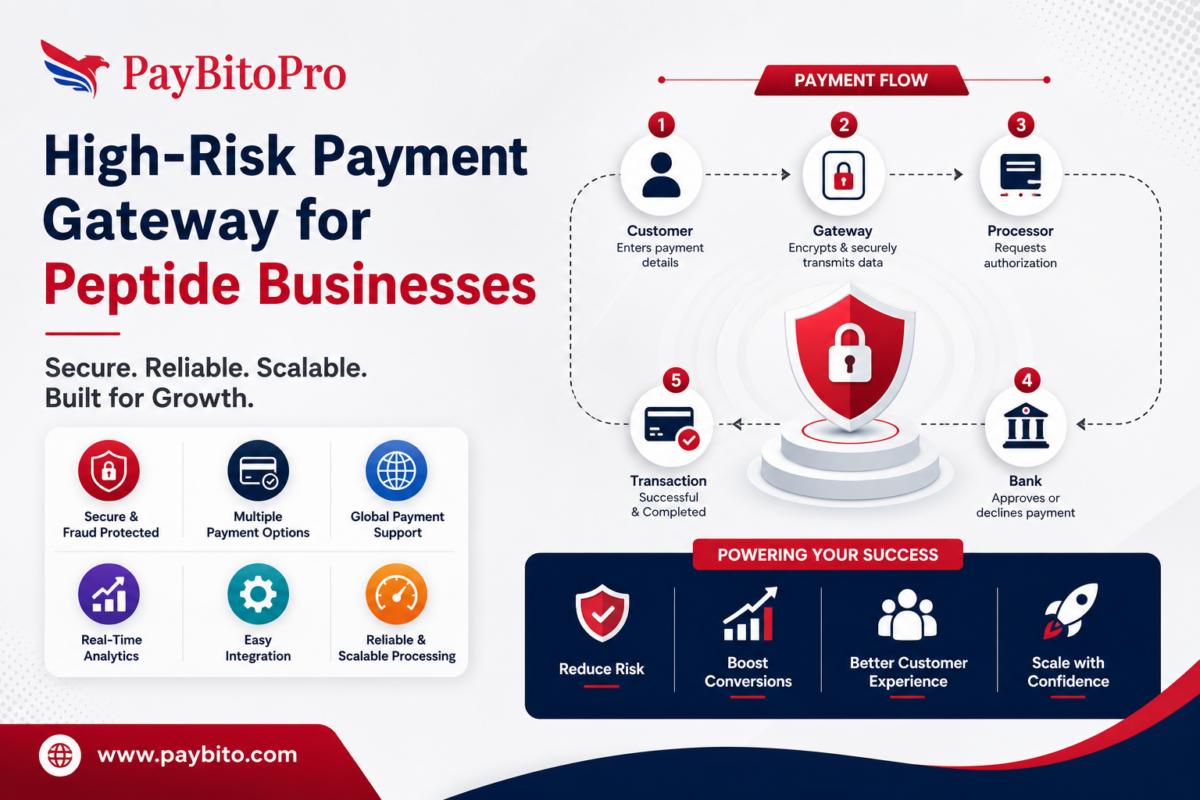
A typical payment flow looks like this:
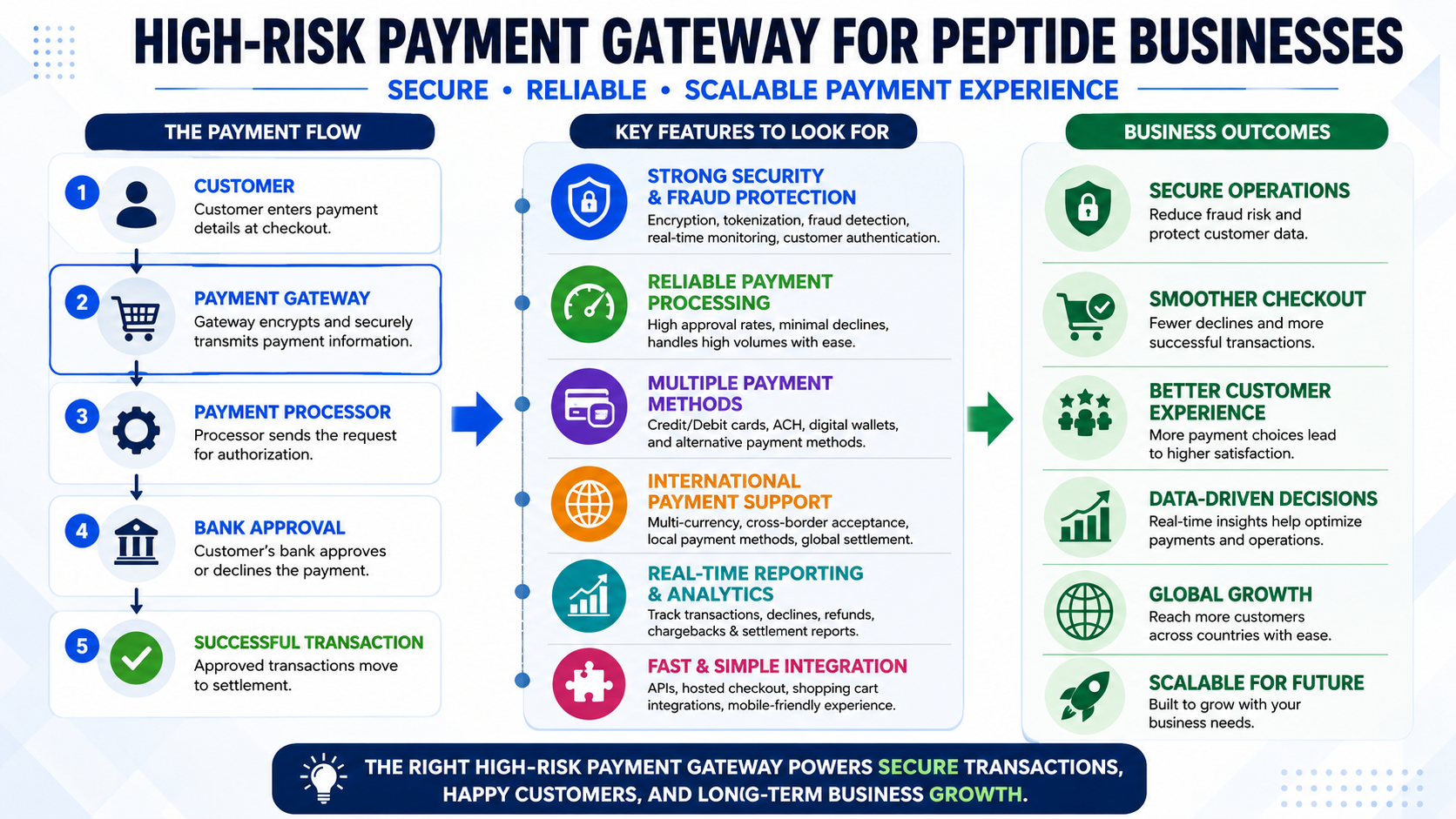
- Customer enters payment details at checkout.
- The payment gateway encrypts the information.
- The payment processor requests authorization.
- The customer’s bank approves or declines the payment.
- Approved transactions move to settlement.
For example, when a research laboratory purchases peptide products from an online supplier, the payment gateway securely transmits the payment request so the transaction can be verified and completed within seconds.
Why Do Peptide Businesses Need a High-Risk Payment Gateway?
Not every payment gateway is designed to support industries that require additional underwriting or risk evaluation.
Peptide businesses often need payment solutions that can handle:
- Higher transaction scrutiny
- Increased fraud monitoring
- Industry-specific compliance requirements
- Larger transaction volumes
- International customer payments
A payment gateway built for high-risk businesses is generally better equipped to manage these operational challenges.
Features to Look for in a High-Risk Payment Gateway
1. Reliable Payment Processing
The first priority is consistent payment acceptance. An effective gateway should help businesses process transactions smoothly while minimizing unnecessary payment declines.
Example:
A peptide company launches a promotional campaign that doubles its daily sales. A scalable payment gateway should continue processing transactions efficiently without creating checkout interruptions.
2. Strong Security and Fraud Protection
Payment security is essential for every online business.
Look for features such as:
- Data encryption
- Tokenization
- Fraud detection tools
- Customer authentication
- Real-time transaction monitoring
For example, if a customer attempts multiple purchases using different payment cards within a short period, fraud detection tools can identify unusual behavior and trigger additional verification.
3. Support for Multiple Payment Methods
Customers expect flexibility during checkout.
A modern payment gateway should support multiple payment options, including:
- Credit cards
- Debit cards
- ACH payments
- Digital wallets
- Alternative payment methods
Providing more payment choices can reduce cart abandonment and improve conversion rates.
4. Fast and Simple Integration
Whether using an eCommerce platform or a custom website, businesses benefit from payment gateways that are easy to integrate.
Many gateways offer:
- Hosted checkout pages
- APIs
- Shopping cart integrations
- Mobile-friendly payment experiences
Example:
A peptide business using a custom-built website may choose an API integration, while a smaller online store may prefer a hosted checkout page that requires minimal development.
5. Real-Time Reporting and Analytics
Payment data helps businesses make informed decisions.
Useful reporting features include:
- Successful transactions
- Declined payments
- Refund activity
- Chargeback trends
- Settlement reports
By reviewing transaction reports regularly, businesses can identify recurring payment issues before they affect revenue.
6. International Payment Support
Many peptide businesses serve customers across multiple countries.
A payment gateway that supports international transactions can provide:
- Multi-currency capabilities
- Cross-border payment acceptance
- Local payment methods
- Global settlement options
Example:
A peptide supplier based in one country receives orders from customers in Europe and North America. A gateway with international payment support allows customers to complete purchases using familiar payment methods.
Common Mistakes When Choosing a Payment Gateway
Many businesses focus only on processing fees while overlooking other important factors.
Common mistakes include:
- Choosing a gateway without high-risk industry experience
- Ignoring fraud prevention features
- Limited payment method support
- Poor reporting capabilities
- No scalability for future growth
The lowest-cost option is not always the best long-term solution if it results in payment failures or operational limitations.
Payment Gateway vs Payment Processor
These terms are often confused, but they perform different roles.
|
Payment Gateway |
Payment Processor |
|
Collects and securely transmits payment information |
Moves payment information between banks and card networks |
|
Encrypts customer payment data |
Requests payment authorization |
| Connects checkout to payment systems |
Handles transaction approval and settlement |
Both work together to complete online payments, but each performs a different function within the payment process.
Example: Choosing the Right Gateway
Imagine two peptide companies.
Business A chooses a gateway designed for low-risk retail stores. During periods of increased sales, it experiences frequent payment declines and limited reporting.
Business B selects a gateway that supports high-risk businesses, offers fraud monitoring, multiple payment methods, detailed reporting, and international payment capabilities. Customers complete purchases smoothly, and the business has greater visibility into payment performance.
The difference is not simply the gateway itself but whether it matches the operational needs of the business.
Conclusion
Selecting the right high-risk payment gateway is about more than accepting payments. It is about creating a secure, reliable, and scalable checkout experience that supports long-term business growth.
For peptide businesses, important considerations include payment reliability, fraud prevention, flexible payment methods, reporting, international support, and seamless integration. Evaluating these features carefully helps businesses reduce payment issues, improve customer satisfaction, and build a stronger payment infrastructure as they grow.

Categories
- ACH Payments (10)
- adult payment processing (11)
- AI (9)
- Altcoins (10)
- Banking (10)
- Bitcoin (133)
- Bitcoin ETF (11)
- Bitcoin Price (30)
- Blockchain (50)
- Brokering World Hunger Away (16)
- Business (17)
- card payment processing (10)
- CBD (11)
- CBDC (11)
- Chargeback (8)
- coaching business (11)
- COVID-19 (3)
- Crypto ATMs (1)
- Crypto Banking (17)
- Crypto Bill (1)
- Crypto business owner platform (31)
- Crypto Investment (3)
- Crypto Markets (5)
- Crypto Payment (35)
- Crypto Payment Processor (4)
- Crypto Prices (1)
- Crypto Trading (92)
- Cryptocurrency (402)
- Cryptocurrency Exchange (108)
- Data Visualization (2)
- dating platforms (11)
- debt collection payment processing (10)
- Decentralized Finance (7)
- DeFi Payment (9)
- DEX (3)
- Digital Currency (23)
- dropshipping payment processing (12)
- Ethereum (2)
- FAQ (7)
- file sharing payment processing (11)
- Finance (25)
- Financial Equality (4)
- Financial Freedom (8)
- Forex (35)
- hemp (1)
- ICO (2)
- Investment (11)
- IPTV (11)
- Merchant Account (10)
- Mining (3)
- News (66)
- NFTs (2)
- online gambling (11)
- P2P (1)
- Paybito (147)
- PayBitoPro (693)
- PayBitoPro Coin Listing (6)
- PayBitoPro Exchange (2)
- Payment Gateway (48)
- peptide (10)
- Post COVID Digital Transformation (1)
- Press Release (130)
- Privacy & Security (3)
- Real Estate (1)
- Stablecoin (5)
- Technology (15)
- Travel (11)
- Uncategorized (10)
- US Presidential Election (2)
- Utility Coin (1)
- Web3 business (4)
- Web3 Wallets (2)
- White Label Crypto Exchange (8)
Recent Posts
- Payment Gateway vs. Payment Orchestration: What’s the Difference?
- What Is Smart Payment Routing? Strategies to Optimize Payment Performance
- How to Improve Payment Approval Rates for High-Risk Businesses?
- Why Are Online Payments Failing? Common Causes and How to Fix Them
- How to Use Multiple Payment Processors to Reduce Business Disruptions?