Fraud Prevention in Online Gambling Payments: Protecting Your Business and Players
- July 31, 2026
- Soham Guchait
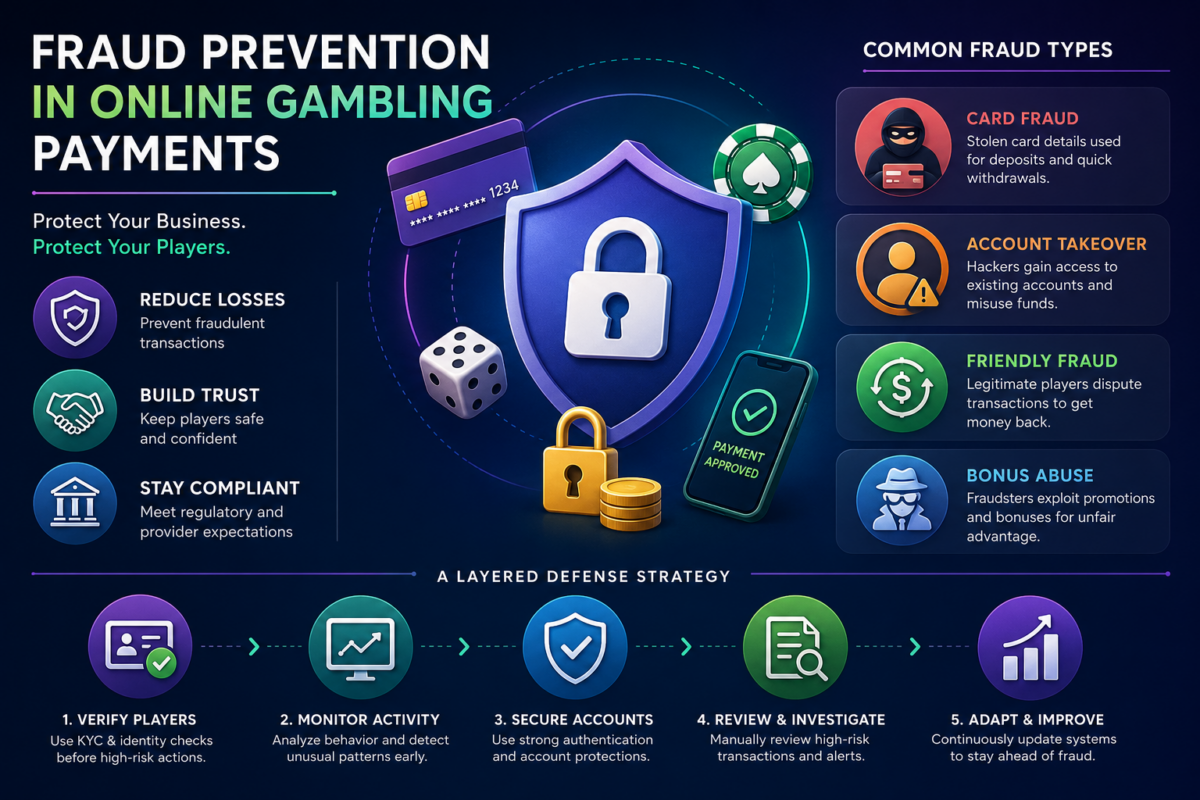
A player creates an account, deposits funds using a stolen payment card, places a few small bets, and requests a withdrawal before anyone notices. Scenarios like this can create serious problems for online casinos and sportsbooks.
Without effective fraud prevention measures, even a small number of fraudulent transactions can lead to chargebacks, financial losses, account abuse, and increased scrutiny from payment providers.
The good news is that many types of payment fraud follow recognizable patterns. Businesses that understand these patterns and build multiple layers of protection are better prepared to identify suspicious activity than operators that rely on a single security measure.
Why Is Online Gambling a Frequent Target for Fraud?
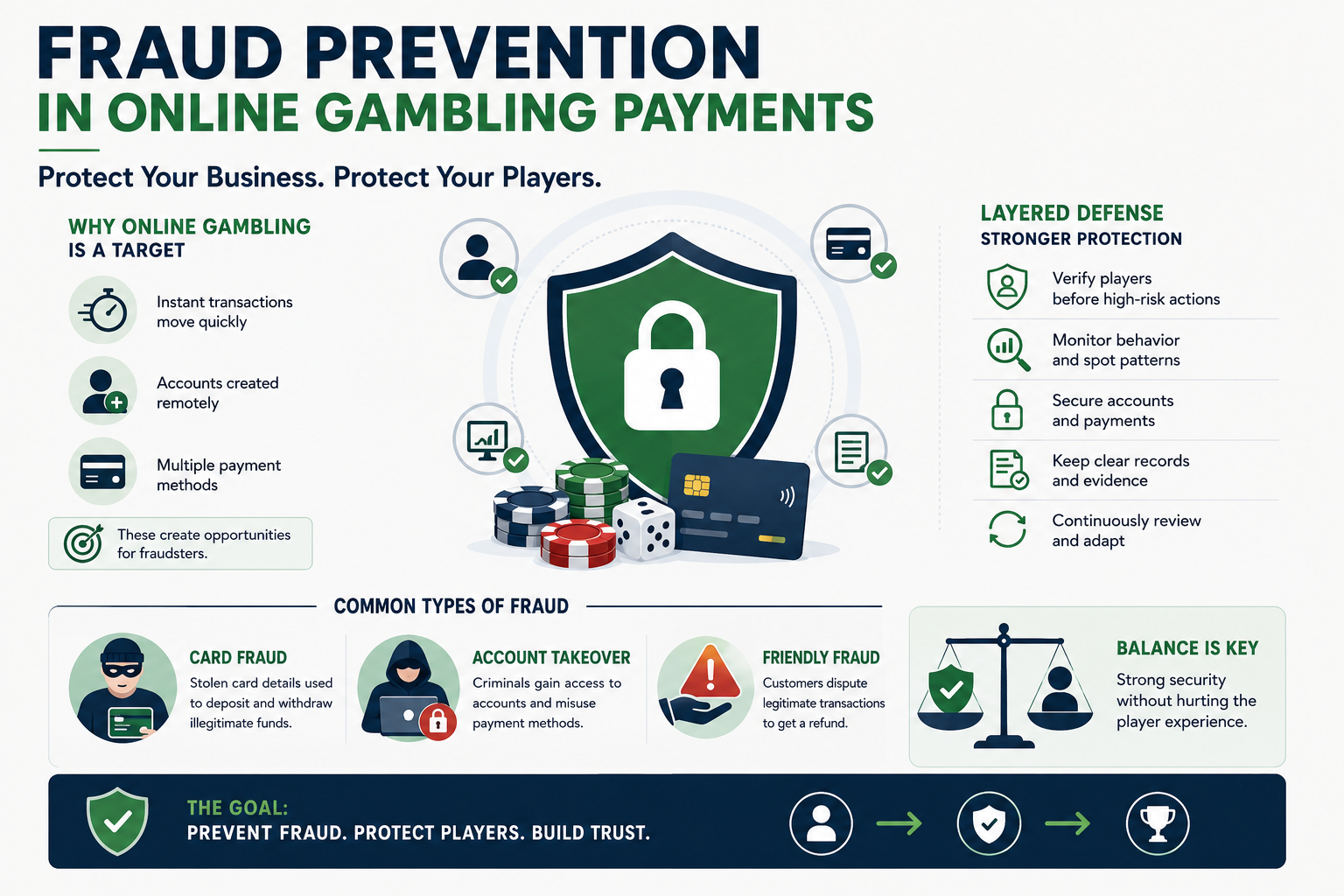
Online gambling combines several characteristics that can make it attractive to fraudsters. Players create accounts remotely, transactions can happen quickly, and funds can move between different payment methods. These conditions can create opportunities for criminals to test stolen payment information, compromise accounts, or exploit weaknesses in payment and account security.
For example, imagine a fraudster obtains stolen card details through an unrelated data breach. Instead of making one large purchase that could immediately attract attention, they may attempt several smaller deposits across different gambling websites. If a transaction succeeds, they may learn that the payment credentials are still active.
Situations like this demonstrate why online gambling payment processing requires appropriate security and risk controls.
Fraud prevention is not about assuming every player is suspicious. It is about identifying unusual activity while allowing legitimate customers to deposit, bet, and withdraw without unnecessary friction.
Common Types of Payment Fraud in Online Gambling
Fraud techniques continue to evolve, but several types of fraud can affect online casinos and sportsbooks. Understanding the difference between these schemes is important because each type can require different prevention and monitoring measures.
Card Fraud
Card fraud occurs when stolen or unauthorized payment details are used to fund a gambling account. The fraudster may attempt to use the deposited funds for betting activity and eventually withdraw money before the legitimate cardholder identifies the unauthorized transaction.
For example, someone uses a stolen credit card to deposit funds, places a small number of bets to make the account appear legitimate, and then requests a withdrawal.
If the legitimate cardholder later reports the transaction as unauthorized, the operator may face a chargeback and lose the transaction amount in addition to associated costs. Operators should therefore monitor payment activity rather than assuming that a successful deposit is automatically legitimate.
Account Takeover
An account takeover occurs when criminals gain unauthorized access to an existing player’s account. This can happen through:
- Stolen passwords
- Phishing attacks
- Reused login credentials
- Compromised email accounts
- Credential-stuffing attacks
Once inside an account, an attacker may change account information, use stored payment methods, make deposits, or attempt withdrawals.
For example, a player uses the same password on several websites. After another service experiences a data breach, criminals attempt those credentials on the player’s gambling account. Additional authentication and unusual-login monitoring can make this type of attack more difficult.
Friendly Fraud
Not every disputed transaction involves stolen payment information.
Friendly fraud occurs when a legitimate customer disputes a transaction they actually authorized. This may happen because the player does not recognize the billing descriptor, forgets making the deposit, regrets gambling losses, or attempts to recover funds through their bank instead of contacting the operator. Although friendly fraud cannot always be eliminated, accurate transaction records and clear customer communication can make disputes easier to investigate and respond to.
Operators implementing effective chargeback prevention for online casinos and sports betting sites can also reduce the impact of preventable payment disputes.
Building a Layered Fraud Prevention Strategy
The most effective fraud prevention programs do not depend on one security tool. Instead, operators can combine identity verification, transaction monitoring, account security, payment controls, and ongoing risk assessment. A layered approach is useful because different controls address different stages of the payment and account lifecycle.
Verify Players Before High-Risk Transactions
Identity verification can help operators determine whether customers are genuine and whether account activity is consistent with the information provided during registration. Operators may apply additional verification when a transaction or account activity presents a higher level of risk.
For example, an operator may require additional verification before processing a large withdrawal or when account activity changes significantly.
This is one reason KYC and AML in online gambling payment processing remain important parts of gambling payment operations.
Verification should be applied according to the operator’s legal and regulatory obligations rather than simply as a blanket requirement for every transaction.
Monitor Transaction Behavior
Looking at individual transactions is rarely enough to identify every type of fraud. Operators should also monitor customer and payment behavior over time. Examples of potentially unusual activity include:
- Multiple accounts using the same payment method
- Rapid deposits followed by withdrawal requests
- Several failed payment attempts within a short period
- Sudden changes in deposit behavior
- Unusual account or login activity
- Payment activity that differs significantly from a customer’s normal behavior
A single event does not necessarily indicate fraud. However, several unusual signals occurring together may justify additional review.
For example, a newly created account that makes multiple deposits using different payment cards and quickly requests a withdrawal may warrant closer investigation than a long-established account making a normal deposit.
Use Risk-Based Controls
Not every transaction presents the same level of risk.
A useful fraud prevention strategy can assign different levels of review based on factors such as transaction behavior, account history, payment activity, and other available risk signals.
Lower-risk activity may require a normal payment experience, while higher-risk activity can trigger additional verification or manual review. This approach can help operators avoid unnecessarily blocking legitimate players.
Balance Security With Player Experience
One common mistake is making fraud controls so strict that legitimate players struggle to complete normal transactions.
For example, requiring extensive documentation for every small deposit can create unnecessary friction and may discourage genuine customers.
Instead, operators can use appropriate risk-based controls and apply additional verification when specific activity requires it. The goal is to reduce fraudulent activity without turning the payment process into an unnecessarily difficult experience for legitimate players.
Fraud Prevention Is an Ongoing Process
Fraud prevention is not something operators can configure once and then ignore. Criminal techniques change over time, and transaction patterns can change as a gambling business grows.
Successful operators should regularly review:
- Fraud trends
- Payment analytics
- Customer complaints
- Failed transaction patterns
- Chargeback activity
- Suspicious account behavior
- Existing security procedures
For example, if an operator notices an increase in failed deposits from a particular region followed by multiple new account registrations, further investigation may reveal an organized fraud attempt rather than isolated customer problems.
Similarly, understanding why online gambling payments get declined can help operators distinguish legitimate payment failures from suspicious activity that may require additional investigation.
Protecting Accounts From Fraud
Payment fraud and account security are closely connected. Even when payment processing controls are strong, a compromised player account can create significant risk if an attacker gains access to stored payment information or withdrawal functionality.
Operators can strengthen account security by considering measures such as:
- Strong password requirements
- Multi-factor authentication where appropriate
- Login and account activity monitoring
- Detection of unusual account behavior
- Additional verification for sensitive account changes
- Controls around withdrawals and payment-method changes
For example, a sudden change in account details followed shortly by a withdrawal request may deserve additional review, particularly when it differs from the customer’s normal behavior.
Creating a Security-Focused Culture
Technology plays an important role in fraud prevention, but people and processes are equally important.
Customer support teams, compliance staff, fraud analysts, and payment specialists should understand how to recognize suspicious behavior and follow consistent procedures. Clear internal processes can make investigations faster and reduce avoidable mistakes.
For example, if customer support receives multiple reports about suspicious account activity, having a defined escalation process allows the issue to reach the appropriate fraud or compliance team quickly. Fraud prevention becomes more effective when security is treated as an ongoing business function rather than simply a technical feature.
What Should Operators Monitor?
A practical fraud monitoring program should look at more than individual payment outcomes. Operators can review trends across:
| Area | What to Monitor |
|---|---|
| Payments | Failed, successful, and unusual transactions |
| Accounts | Multiple accounts and unusual account activity |
| Deposits | Frequency, amounts, and payment-method patterns |
| Withdrawals | Rapid withdrawals and unusual withdrawal behavior |
| Chargebacks | Dispute frequency and recurring dispute patterns |
| Security | Suspicious logins and account changes |
| Customer support | Repeated fraud-related complaints |
Final Thoughts
Fraud is one of the significant risks facing online gambling businesses, but it can be managed more effectively when operators use a layered and continuously updated approach.
Effective fraud prevention for online gambling payments combines customer verification, transaction monitoring, account security, payment controls, chargeback management, and ongoing risk assessment.
The strongest payment operations are not necessarily those that block every unusual transaction. They are the ones that can identify genuine risks while allowing legitimate players to use the platform without unnecessary friction. By monitoring payment and account behavior, reviewing emerging fraud patterns, and regularly improving security procedures, online gambling operators can reduce financial losses, protect players, and build a more reliable payment environment as the business grows.

Categories
- ACH Payments (10)
- adult payment processing (11)
- AI (9)
- Altcoins (10)
- Banking (10)
- Bitcoin (133)
- Bitcoin ETF (11)
- Bitcoin Price (30)
- Blockchain (50)
- Brokering World Hunger Away (16)
- Business (17)
- card payment processing (10)
- CBD (11)
- CBDC (11)
- coaching business (11)
- COVID-19 (3)
- Crypto ATMs (1)
- Crypto Banking (17)
- Crypto Bill (1)
- Crypto business owner platform (31)
- Crypto Investment (3)
- Crypto Markets (5)
- Crypto Payment (35)
- Crypto Payment Processor (4)
- Crypto Prices (1)
- Crypto Trading (92)
- Cryptocurrency (402)
- Cryptocurrency Exchange (108)
- Data Visualization (2)
- dating platforms (11)
- debt collection payment processing (10)
- Decentralized Finance (7)
- DeFi Payment (9)
- DEX (3)
- Digital Currency (23)
- dropshipping payment processing (12)
- Ethereum (2)
- FAQ (7)
- file sharing payment processing (11)
- Finance (25)
- Financial Equality (4)
- Financial Freedom (8)
- Forex (35)
- hemp (1)
- ICO (2)
- Investment (11)
- IPTV (11)
- Merchant Account (10)
- Mining (3)
- News (66)
- NFTs (2)
- online gambling (11)
- P2P (1)
- Paybito (139)
- PayBitoPro (693)
- PayBitoPro Coin Listing (6)
- PayBitoPro Exchange (2)
- Payment Gateway (40)
- peptide (10)
- Post COVID Digital Transformation (1)
- Press Release (130)
- Privacy & Security (3)
- Real Estate (1)
- Stablecoin (5)
- Technology (15)
- Travel (11)
- Uncategorized (9)
- US Presidential Election (2)
- Utility Coin (1)
- Web3 business (4)
- Web3 Wallets (2)
- White Label Crypto Exchange (8)
Recent Posts
- ACH vs Wire Transfer: Which Payment Method Is Better for Businesses?
- ACH Fraud Prevention: How Businesses Can Secure Bank Account Payments?
- ACH Credit vs ACH Debit: What’s the Difference? With Real Examples
- ACH vs Credit Card: Which Payment Method Is Better for Businesses?
- How Long Do ACH Payments Take? Processing Times, Settlement, and Same Day ACH