Why Do Online Gambling Payments Get Declined? (And How to Fix Them)
- July 31, 2026
- Soham Guchait
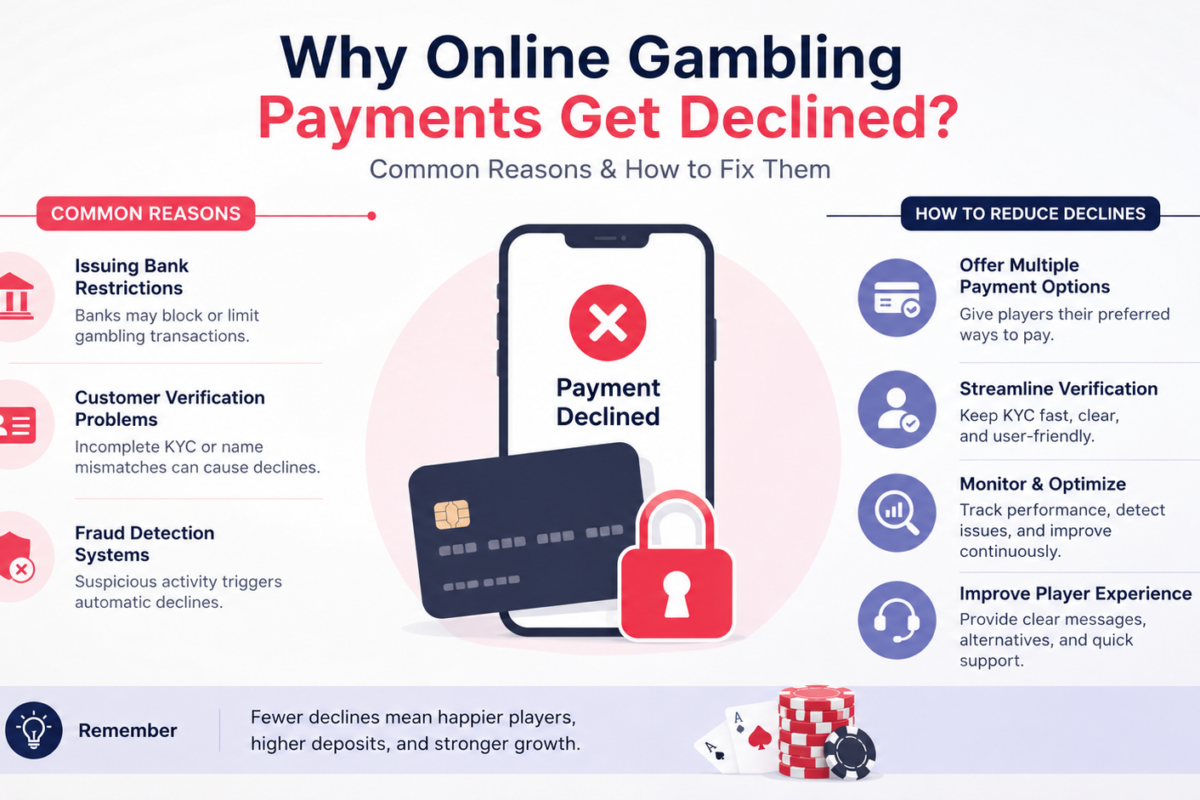
Nothing is more frustrating for an online gambling operator than seeing players abandon deposits because their payments keep getting declined. Every failed transaction represents lost revenue, a poor customer experience, and the possibility that a player will leave for a competing platform.
Payment declines are common in the iGaming industry, but they are rarely caused by a single issue. A declined payment could result from the player’s bank, fraud prevention systems, verification requirements, regional restrictions, or even technical configuration problems.
How Online Gambling Payment Declines Happen?
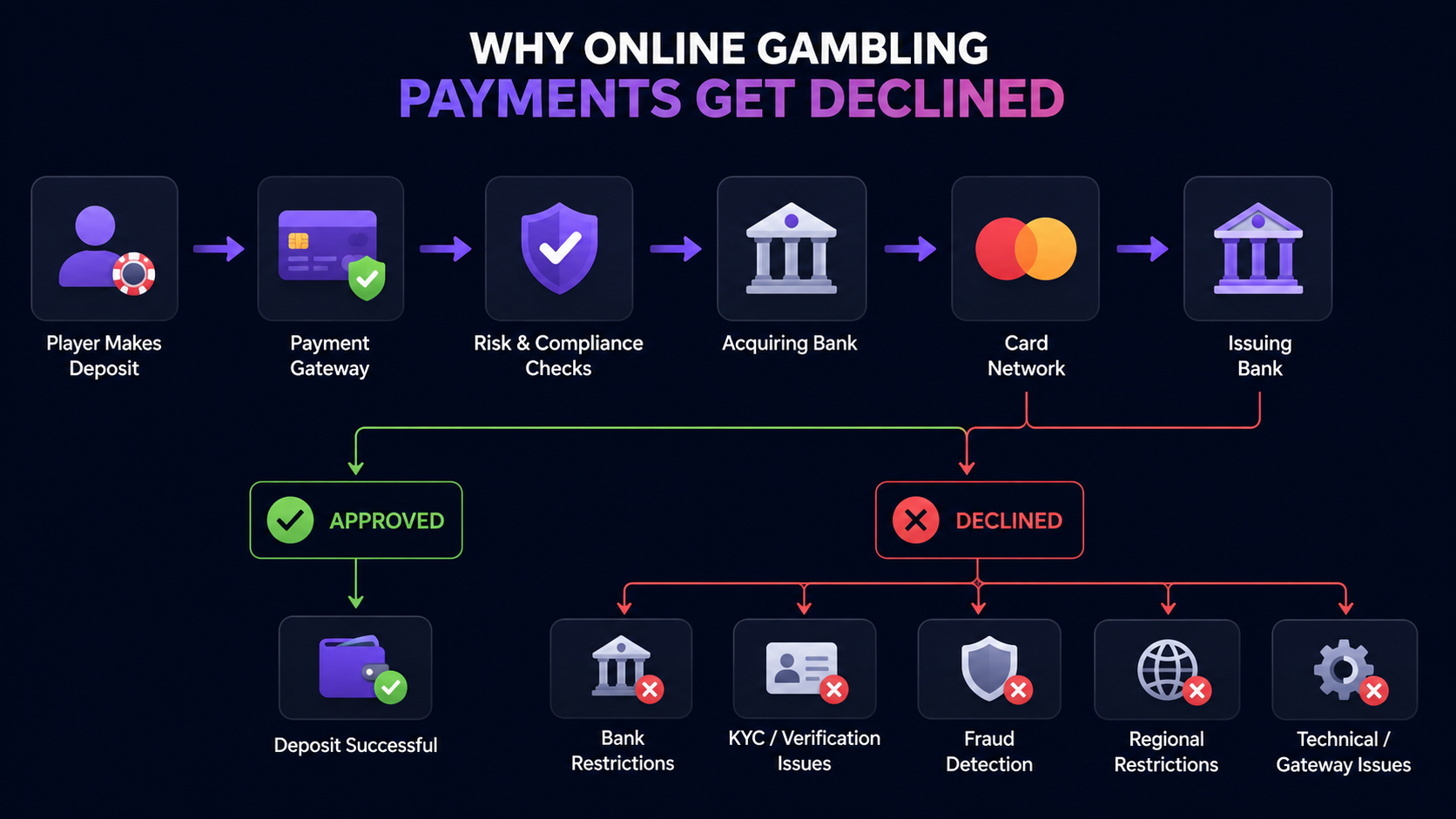
When a player attempts to deposit funds, the transaction passes through several systems before it is approved. The payment gateway securely sends the transaction to the acquiring bank, which communicates with the card network and the player’s issuing bank. Throughout this process, fraud screening and compliance checks may also take place.
If any participant determines that the transaction should not proceed, the payment is declined.
For example, a player attempts to deposit $100 into an online casino using their debit card. Although they have enough money in their account, their bank has a policy of declining transactions to online gambling websites. As a result, the payment is rejected before it can be processed by the operator.
Understanding the overall online gambling payment processing workflow helps explain why multiple parties can influence whether a transaction succeeds or fails.
The Most Common Reasons Gambling Payments Get Declined
Although every declined payment is different, several issues appear repeatedly across the industry.
Issuing Bank Restrictions
Many banks apply their own policies regarding gambling transactions.
Some banks:
- Block all gambling-related payments.
- Restrict gambling transactions in certain countries.
- Require additional customer authentication.
- Decline transactions based on internal risk policies.
For example, a player attempting to deposit using a personal debit card may receive an immediate decline because their bank does not support online gambling transactions, even though the operator’s payment system is functioning correctly.
Customer Verification Problems
Identity verification plays an important role in licensed gambling operations.
If a player’s identity has not been verified or required documentation is incomplete, some deposits or withdrawals may be delayed or declined. For instance, a customer may register an account using one name but attempt to make a deposit with a payment card registered under another name. This mismatch can trigger verification checks before the payment is approved.
Understanding how KYC and AML work in online gambling payment processing helps operators design smoother verification processes while meeting regulatory requirements.
Fraud Detection Systems
Modern payment systems continuously monitor transactions for suspicious activity.
Common triggers include:
- Multiple failed payment attempts
- Rapid deposits within a short period
- Unusual geographic locations
- Device changes
- High-value transactions that differ from normal behavior
Imagine a player normally deposits $50 every weekend but suddenly attempts five deposits of $1,000 from another country within ten minutes. Automated fraud systems may temporarily decline these transactions until further verification is completed.
Operational Factors That Affect Payment Success
Not every payment decline originates from the player’s bank. In many cases, the operator’s own payment setup contributes to the problem.
Limited Payment Options
Player preferences differ significantly between countries.
Some users prefer:
- Credit or debit cards
- Digital wallets
- Bank transfers
- Open Banking
- Regional payment methods
If an operator only supports one or two payment methods, players whose preferred option is unavailable may abandon the transaction entirely. This is why selecting the best payment methods for online gambling websites is an important part of improving deposit success rates.
Payment Gateway Configuration
A poorly configured payment gateway can also increase transaction failures.
Examples include:
- Incorrect routing
- Unsupported currencies
- Technical integration errors
- Temporary processing outages
Choosing the right payment gateway for an online casino or sportsbook involves more than comparing features. Reliability, uptime, regional coverage, and integration quality all contribute to higher payment approval rates.
Merchant Account Issues
Merchant account restrictions may also affect payment performance.
For example, if transaction limits are exceeded or compliance reviews are underway, some transactions may be delayed until the issue is resolved. Operators that understand merchant account requirements for gambling companies before applying are often better prepared to maintain healthy payment operations after approval.
How Operators Can Reduce Payment Declines?
While some declines are unavoidable, many can be reduced through careful planning and continuous monitoring.
Some practical steps include:
- Offer multiple trusted payment methods.
- Keep customer verification efficient and transparent.
- Monitor fraud alerts without creating unnecessary friction.
- Review payment analytics regularly.
- Provide clear instructions when payments fail.
- Keep payment systems updated and tested.
For example, if players from one country frequently experience card declines, adding a locally preferred payment method may significantly improve successful deposit rates without changing the rest of the payment infrastructure.
When Declined Payments Become a Bigger Problem
Occasional declines are normal. However, consistently high decline rates may indicate deeper operational issues.
These could include:
- Compliance weaknesses
- Fraud attacks
- Technical integration problems
- Poor payment method coverage
- Merchant account restrictions
Operators experiencing repeated payment issues should investigate the underlying causes rather than treating every failed transaction as an isolated incident.
Many of these issues also appear among the common payment challenges for online gambling startups, especially during the first months after launch. Likewise, businesses that experience frequent payment disputes should strengthen their chargeback prevention for online casinos and sports betting sites, since high dispute rates can negatively affect long-term payment stability.
Improving the Player Experience
Players rarely know why a payment fails. They simply see a declined transaction. Providing helpful error messages, alternative payment options, and responsive customer support can significantly improve the overall experience.
For example, instead of displaying a generic “Transaction Failed” message, the platform could suggest another payment method or ask the player to complete identity verification if required.
Small improvements like these help retain players while reducing unnecessary support requests.
Final Thoughts
Payment declines are an inevitable part of operating an online gambling business, but they should not become a constant source of lost revenue. By understanding how payment processing works, identifying common causes of declined transactions, and continuously monitoring payment performance, operators can improve approval rates and create a better experience for their players.
Successful payment operations are built through a combination of reliable infrastructure, effective fraud controls, regulatory compliance, and ongoing optimization. Businesses that invest in these areas are better positioned to reduce payment failures while supporting sustainable long-term growth.

Categories
- ACH Payments (10)
- adult payment processing (11)
- AI (9)
- Altcoins (10)
- Banking (10)
- Bitcoin (133)
- Bitcoin ETF (11)
- Bitcoin Price (30)
- Blockchain (50)
- Brokering World Hunger Away (16)
- Business (17)
- card payment processing (10)
- CBD (11)
- CBDC (11)
- Chargeback (8)
- coaching business (11)
- COVID-19 (3)
- Crypto ATMs (1)
- Crypto Banking (17)
- Crypto Bill (1)
- Crypto business owner platform (31)
- Crypto Investment (3)
- Crypto Markets (5)
- Crypto Payment (35)
- Crypto Payment Processor (4)
- Crypto Prices (1)
- Crypto Trading (92)
- Cryptocurrency (402)
- Cryptocurrency Exchange (108)
- Data Visualization (2)
- dating platforms (11)
- debt collection payment processing (10)
- Decentralized Finance (7)
- DeFi Payment (9)
- DEX (3)
- Digital Currency (23)
- dropshipping payment processing (12)
- Ethereum (2)
- FAQ (7)
- file sharing payment processing (11)
- Finance (25)
- Financial Equality (4)
- Financial Freedom (8)
- Forex (35)
- hemp (1)
- ICO (2)
- Investment (11)
- IPTV (11)
- Merchant Account (10)
- Mining (3)
- News (66)
- NFTs (2)
- online gambling (11)
- P2P (1)
- Paybito (143)
- PayBitoPro (693)
- PayBitoPro Coin Listing (6)
- PayBitoPro Exchange (2)
- Payment Gateway (44)
- peptide (10)
- Post COVID Digital Transformation (1)
- Press Release (130)
- Privacy & Security (3)
- Real Estate (1)
- Stablecoin (5)
- Technology (15)
- Travel (11)
- Uncategorized (10)
- US Presidential Election (2)
- Utility Coin (1)
- Web3 business (4)
- Web3 Wallets (2)
- White Label Crypto Exchange (8)
Recent Posts
- How to Use Multiple Payment Processors to Reduce Business Disruptions?
- What Is Payment Orchestration? A Complete Guide for Online Businesses
- Payment Cascading Explained: How to Recover Failed Transactions
- What Is Payment Routing? How It Works and Why It Matters for High-Risk Businesses
- Payment Processing Optimization: How High-Risk Merchants Can Improve Payment Performance ?