Online Gambling Payment Processing: A Complete Guide for iGaming Businesses
- July 30, 2026
- Soham Guchait
Launching an online casino or sportsbook involves much more than creating games and attracting players. One of the biggest challenges every operator faces is building a payment system that is secure, compliant, and reliable. Without a smooth payment experience, even the best gaming platform can struggle to retain players and generate revenue.
Online gambling payment processing is different from payment processing in traditional eCommerce. Operators must deal with stricter regulations, higher fraud risks, player verification requirements, and financial institutions that often classify gambling businesses as high risk.
This guide explains how online gambling payment processing works, the challenges operators commonly face, and the key components required to build a reliable payment ecosystem.
What Is Online Gambling Payment Processing?
Online gambling payment processing is the system that enables players to deposit funds into their gaming accounts and withdraw their winnings securely. It connects the player, the gambling platform, banks, card networks, payment gateways, fraud prevention systems, and acquiring institutions.
Unlike a standard online store, an iGaming platform processes thousands of transactions that require additional risk assessments and regulatory compliance. Every transaction may involve identity verification, fraud screening, payment authorization, and settlement before funds reach the operator.
For example, when a player deposits $100 using a debit card, the payment request passes through several parties before the transaction is approved. If any step detects unusual activity or fails compliance checks, the payment may be declined.
Why Payment Processing Is Different for Gambling Businesses?
Financial institutions consider online gambling a higher-risk industry for several reasons:
- Higher chargeback rates
- Increased fraud attempts
- Regulatory complexity across different jurisdictions
- Cross-border transactions
- Strict responsible gaming requirements
These factors make it more difficult for operators to obtain payment services compared to traditional online businesses.
Understanding why online gambling businesses are considered high risk is an important first step for new operators because it explains why many payment providers have stricter onboarding and monitoring requirements.
How Online Gambling Payment Processing Works?
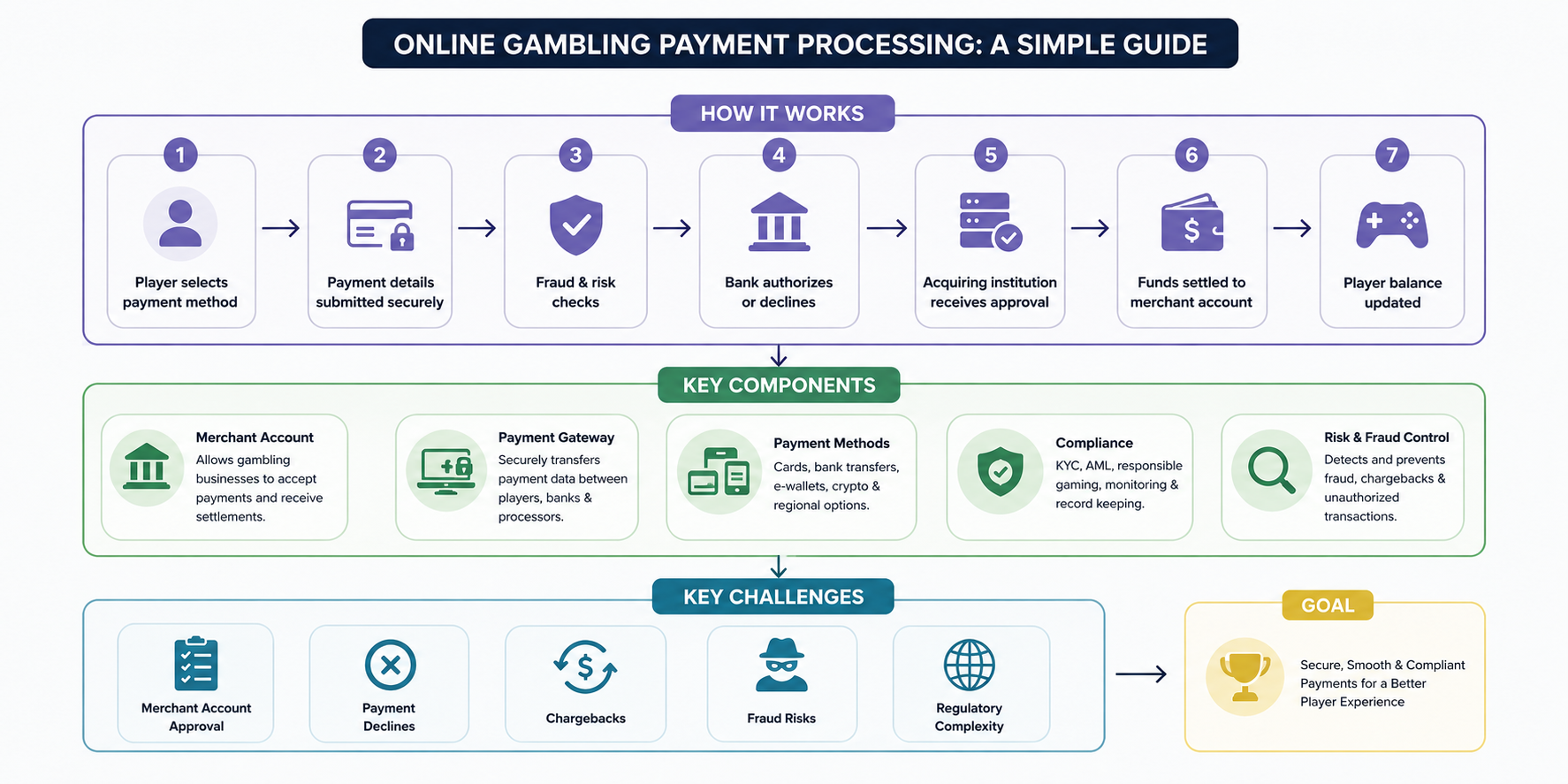
A typical gambling payment follows several stages:
- The player selects a payment method.
- Payment details are securely submitted.
- Fraud and risk checks are performed.
- The issuing bank authorizes or declines the transaction.
- The acquiring institution receives approval.
- Funds are settled into the operator’s merchant account.
- The player’s gaming balance is updated.
Withdrawals follow a similar process but usually require additional verification before funds are released. Each stage helps reduce fraud while ensuring compliance with gaming regulations.
The Main Components of an iGaming Payment System
A successful payment ecosystem consists of several interconnected services.
Merchant Account
A merchant account allows operators to accept card payments and receive settlements from approved transactions. Obtaining a merchant account for an online gambling business often requires more documentation than a standard business because providers carefully assess regulatory compliance and financial risk.
Payment Gateway
The payment gateway securely transfers payment information between players, banks, and processors while encrypting sensitive financial data.
When evaluating providers, operators should carefully consider how to choose the right payment gateway for an online casino or sportsbook, paying attention to reliability, security, integration options, and scalability.
Payment Methods
Player preferences vary by country and demographic. Offering multiple payment options improves convenience and increases completed deposits.
Common payment methods include:
- Credit and debit cards
- Bank transfers
- Open Banking
- Digital wallets
- Cryptocurrencies
- Regional payment solutions
Choosing the best payment methods for online gambling websites depends largely on the target market and licensing jurisdiction.
Compliance Is Essential
Payment processing in iGaming is heavily regulated. Most licensed operators must implement:
- Customer identity verification (KYC)
- Anti-money laundering procedures (AML)
- Responsible gambling controls
- Transaction monitoring
- Record keeping
These measures help protect both operators and players while meeting regulatory obligations. Learning how KYC and AML work in online gambling payment processing can help operators understand why payment providers request extensive compliance documentation during onboarding.
Common Payment Challenges
Every new gambling operator is likely to encounter payment-related challenges.
Merchant Account Approval
Many first-time operators are surprised when their applications are rejected because their websites, policies, or licensing documentation are incomplete. Understanding gambling merchant account requirements before applying can significantly improve approval chances.
Payment Declines
Player deposits may fail for many reasons, including:
- Issuer bank restrictions
- Fraud detection systems
- Geographic limitations
- Verification issues
- Spending limits
Knowing why online gambling payments get declined allows operators to identify recurring issues and improve payment success rates.
Chargebacks
Chargebacks occur when players dispute completed transactions with their card issuer. Frequent chargebacks increase processing costs and may even result in losing payment processing privileges.
Implementing effective chargeback prevention for online casinos and sports betting sites helps protect revenue and maintain healthy relationships with payment providers.
Fraud
Fraud continues to evolve as criminals develop new techniques to exploit gaming platforms.
Common threats include:
- Stolen payment cards
- Account takeover attacks
- Identity fraud
- Friendly fraud
- Bonus abuse
Strong security controls and transaction monitoring are essential for effective fraud prevention in online gambling payments.
Building a Better Payment Experience
A reliable payment experience goes beyond simply accepting deposits.
Successful operators focus on:
- Fast payment approvals
- Multiple trusted payment methods
- Transparent fees
- Secure transactions
- Quick withdrawals
- Clear communication during failed payments
For example, if a player’s card is declined because their issuing bank blocks gambling transactions, offering an alternative payment option such as a digital wallet or bank transfer can help complete the transaction without frustrating the customer.
Small improvements like these often increase deposit success rates and improve player retention.
Preparing for Long-Term Growth
As an online gambling business grows, payment operations become increasingly complex. Operators may expand into new regions, introduce additional payment methods, strengthen fraud prevention systems, and meet new regulatory requirements.
Many startups also encounter operational issues such as delayed settlements, cross-border payment restrictions, fraud attempts, and evolving compliance obligations. Understanding these common payment challenges for online gambling startups helps businesses prepare for growth before problems become costly.
Building scalable payment operations from the beginning allows operators to focus on acquiring and retaining players rather than constantly resolving payment issues.
Final Thoughts
Online gambling payment processing is far more than moving money between players and operators. It is a combination of technology, compliance, fraud prevention, customer experience, and financial infrastructure working together to create secure and reliable transactions.
Operators who understand the payment ecosystem early are better equipped to choose suitable payment solutions, prepare for compliance requirements, reduce payment failures, and build trust with players.
Whether you are launching your first online casino or expanding an existing sportsbook, investing time in understanding payment processing will help create a smoother player experience and a stronger foundation for long-term growth.

Categories
- ACH Payments (10)
- adult payment processing (11)
- AI (9)
- Altcoins (10)
- Banking (10)
- Bitcoin (133)
- Bitcoin ETF (11)
- Bitcoin Price (30)
- Blockchain (50)
- Brokering World Hunger Away (16)
- Business (17)
- card payment processing (10)
- CBD (11)
- CBDC (11)
- Chargeback (8)
- coaching business (11)
- COVID-19 (3)
- Crypto ATMs (1)
- Crypto Banking (17)
- Crypto Bill (1)
- Crypto business owner platform (31)
- Crypto Investment (3)
- Crypto Markets (5)
- Crypto Payment (35)
- Crypto Payment Processor (4)
- Crypto Prices (1)
- Crypto Trading (92)
- Cryptocurrency (402)
- Cryptocurrency Exchange (108)
- Data Visualization (2)
- dating platforms (11)
- debt collection payment processing (10)
- Decentralized Finance (7)
- DeFi Payment (9)
- DEX (3)
- Digital Currency (23)
- dropshipping payment processing (12)
- Ethereum (2)
- FAQ (7)
- file sharing payment processing (11)
- Finance (25)
- Financial Equality (4)
- Financial Freedom (8)
- Forex (35)
- hemp (1)
- ICO (2)
- Investment (11)
- IPTV (11)
- Merchant Account (10)
- Mining (3)
- News (66)
- NFTs (2)
- online gambling (11)
- P2P (1)
- Paybito (147)
- PayBitoPro (693)
- PayBitoPro Coin Listing (6)
- PayBitoPro Exchange (2)
- Payment Gateway (48)
- peptide (10)
- Post COVID Digital Transformation (1)
- Press Release (130)
- Privacy & Security (3)
- Real Estate (1)
- Stablecoin (5)
- Technology (15)
- Travel (11)
- Uncategorized (10)
- US Presidential Election (2)
- Utility Coin (1)
- Web3 business (4)
- Web3 Wallets (2)
- White Label Crypto Exchange (8)
Recent Posts
- Payment Gateway vs. Payment Orchestration: What’s the Difference?
- What Is Smart Payment Routing? Strategies to Optimize Payment Performance
- How to Improve Payment Approval Rates for High-Risk Businesses?
- Why Are Online Payments Failing? Common Causes and How to Fix Them
- How to Use Multiple Payment Processors to Reduce Business Disruptions?