Chargeback Prevention for Online Casinos and Sports Betting Sites
- July 31, 2026
- Soham Guchait
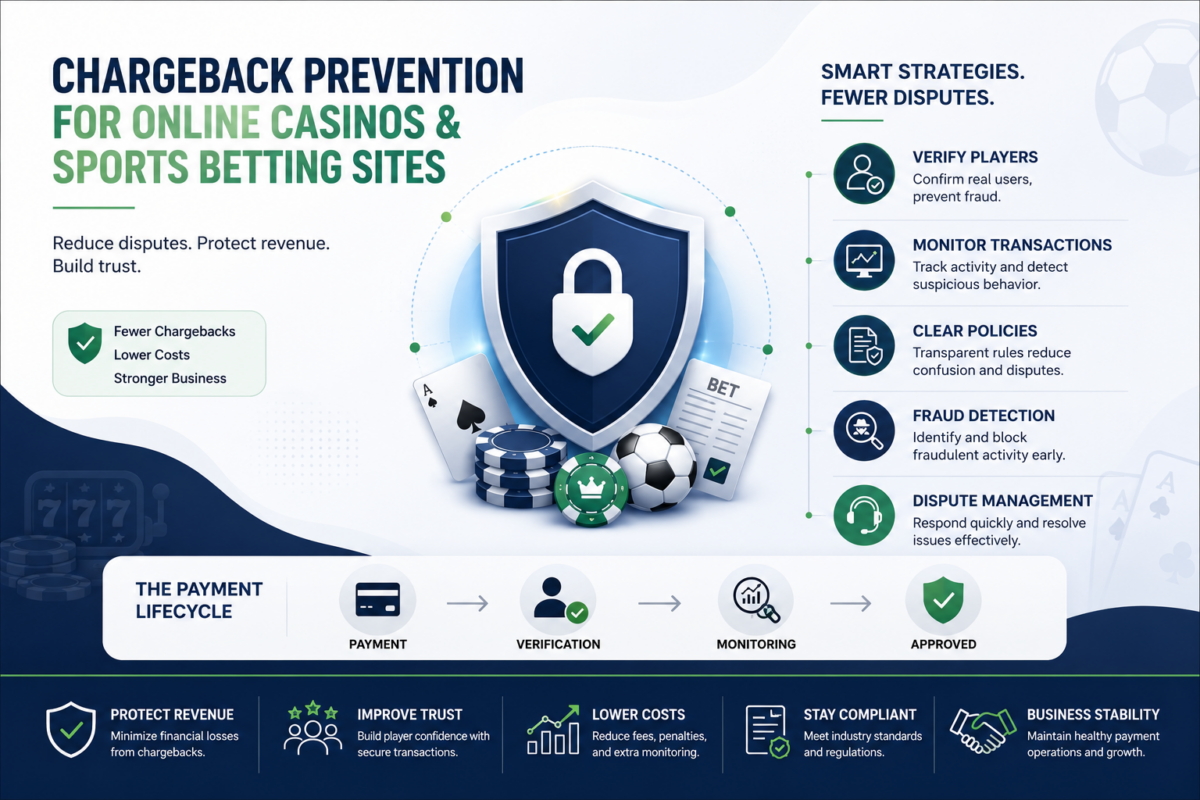
Chargebacks are a significant payment challenge for online casinos and sports betting businesses. While some disputes are unavoidable, excessive chargebacks can create financial and operational problems for gambling operators, including additional fees, increased monitoring, and greater scrutiny from payment providers.
For new and established operators, effective chargeback prevention is an important part of maintaining reliable payment operations. Disputes can arise from unrecognized transactions, account takeovers, friendly fraud, misunderstandings about deposits, or problems with refunds and withdrawals.
Understanding chargeback prevention for online casinos and sports betting sites can help operators identify the causes of disputes and reduce preventable losses through stronger verification, transaction monitoring, clearer communication, and better payment processes.
What Is a Chargeback in Online Gambling?
A chargeback occurs when a player contacts their bank or card issuer to dispute a completed transaction. Instead of requesting a refund directly from the gambling operator, the customer asks their financial institution to review and potentially reverse the payment.
For example, a player deposits $200 into a sportsbook, uses the funds for betting, and later claims that the transaction was unauthorized. If the dispute is accepted, the operator may lose the original transaction amount and incur additional chargeback-related costs.
A chargeback is different from a normal refund because the dispute is handled through the customer’s financial institution. This distinction is particularly important for gambling operators because online gambling businesses operate in a higher-risk payment environment.
Understanding why online gambling businesses are considered high risk can help explain why payment providers pay close attention to transaction quality, fraud levels, and dispute rates.
Why Do Online Gambling Businesses Experience Chargebacks?
Several factors can contribute to chargebacks for online casinos and sports betting businesses.
Player Disputes and Transaction Confusion
Some disputes occur because players do not recognize a transaction on their bank statement or misunderstand how a gambling payment is identified.
For example, a player may know a casino by its brand name but see the operator’s legal company name or another unfamiliar descriptor on their statement. They may then assume the transaction is unauthorized.
Using recognizable payment descriptors and providing clear transaction confirmations can help reduce this type of confusion.
Friendly Fraud
Friendly fraud occurs when a legitimate customer disputes a transaction even though they made or authorized the payment.
This can happen when:
- A player regrets losing deposited funds.
- A customer does not recognize the transaction description.
- Someone else has access to the player’s account.
- A player disputes a transaction after using the gambling service.
- A customer misunderstands the difference between a deposit and another account transaction.
For example, a player deposits $100, uses the funds to participate in games, and later claims that the payment was unauthorized. Without reliable transaction and account records, the operator may have difficulty demonstrating what occurred.
Fraudulent Transactions
Criminal activity can also result in chargebacks. Fraudsters may attempt to use:
- Stolen payment cards
- Compromised player accounts
- Fake identities
- Unauthorized payment methods
- Stolen account credentials
If a fraudulent deposit is successfully processed, the operator may face a financial loss even if the funds have already been used. This makes effective fraud prevention in online gambling payments an important component of chargeback management.
Common Causes of Gambling Chargebacks
Not every chargeback is caused by criminal fraud. Many disputes can be connected to customer communication, account security, or payment-management problems.
Poor Customer Communication
Players may be more likely to dispute transactions when they cannot easily understand their payment or account activity. Operators should provide clear information about:
- Deposit confirmations
- Withdrawal status
- Account balances
- Transaction history
- Payment amounts
- Relevant account activity
For example, sending a confirmation after a $200 deposit with the amount, date, transaction reference, and relevant account information gives the player a clear record of the payment.
Weak Account Security
Account takeovers can result in unauthorized deposits, withdrawals, or other account activity.
If criminals gain access to a player’s account, they may attempt to use stored payment methods or make transactions using compromised credentials.
Strong authentication, suspicious-login monitoring, and account security controls can reduce these risks. Operators should also understand how KYC and AML work in online gambling payment processing because identity verification and transaction monitoring can help identify suspicious activity.
Ineffective Dispute Management
Operators should not wait until chargebacks become widespread before examining the underlying causes.
Useful indicators to monitor include:
- Increasing dispute rates
- Repeated customer complaints
- Suspicious account behavior
- Unusual deposit patterns
- Multiple payment methods used on one account
- Repeated disputes associated with specific transaction types
Identifying these patterns early can help operators address problems before they result in larger financial or operational issues.
Practical Strategies for Chargeback Prevention
Effective chargeback prevention requires more than responding to disputes after they occur. Operators should combine customer verification, fraud controls, transaction monitoring, communication, and appropriate payment procedures.
1. Maintain Clear Deposit and Withdrawal Policies
Players should be able to understand the rules that apply to their accounts and transactions.
Important information may include:
- Deposit requirements
- Withdrawal conditions
- Refund policies
- Account restrictions
- Verification requirements
- Relevant transaction limitations
Clear policies can reduce misunderstandings and give operators useful documentation when a dispute occurs.
2. Use Strong Player Verification
Player verification helps operators establish that customers are genuine and can reduce certain types of fraudulent activity.
Verification procedures may include checking customer identity and reviewing account information before allowing certain transactions or withdrawals. The specific verification requirements will depend on the operator’s jurisdiction, licensing obligations, payment providers, and applicable regulations.
3. Monitor Transactions for Suspicious Activity
Transaction monitoring can help operators identify unusual patterns before they result in significant losses.
Examples include:
- Multiple cards being used on one player account
- Several accounts using the same payment method
- Unusual deposit patterns
- Rapid deposits followed by withdrawal attempts
- Sudden changes in normal account behavior
- Transactions inconsistent with the customer’s previous activity
Monitoring does not automatically prove that a transaction is fraudulent, but it can help operators identify accounts or transactions that require additional review.
4. Provide Appropriate Payment Options
Payment flexibility can contribute to a smoother customer experience.
Players who repeatedly encounter failed transactions or have limited payment choices may become frustrated and contact their bank instead of resolving the problem with the operator.
Offering suitable payment methods is therefore part of a broader payment strategy. Operators should evaluate the best payment methods for online gambling websites according to their target markets, customer preferences, transaction requirements, and applicable regulations.
5. Keep Detailed Transaction and Account Records
Accurate records can be valuable when reviewing or responding to a chargeback.
Depending on the transaction and applicable requirements, operators may retain information such as:
- Transaction date and amount
- Payment method
- Deposit confirmation
- Account activity
- Authentication records
- Relevant customer communications
- Withdrawal information
- Verification records
These records should be accurate, securely maintained, and handled according to applicable privacy and regulatory requirements.
How Do Chargebacks Affect Merchant Accounts?
Excessive chargebacks can affect more than an operator’s immediate revenue.
High dispute levels may result in:
- Additional monitoring
- Compliance reviews
- Higher processing costs
- Greater scrutiny from payment providers
- Potential restrictions on payment services
The exact consequences depend on the payment provider, acquiring relationship, transaction history, jurisdiction, and other risk factors.
This is why chargeback prevention should be considered when establishing payment operations rather than treated as a problem only after disputes increase.
For new operators, this includes understanding how to get a merchant account for an online gambling business and maintaining appropriate transaction practices after the account is established.
Chargeback Prevention Process
A practical chargeback prevention process can follow a continuous cycle:
Verify → Monitor → Communicate → Detect → Review → Respond → Improve
First, verify players and transactions using appropriate controls. Next, monitor account and payment activity for unusual patterns. Maintain clear communication with customers and investigate suspicious activity when detected.
If a chargeback occurs, review the transaction and available evidence, determine the appropriate response, and then analyze the underlying reason for the dispute. This final step is important because responding to individual chargebacks does not address the process that caused them.
Chargeback Prevention Checklist for Gambling Operators
Online casinos and sports betting businesses can use this checklist when reviewing their payment operations:
- Clear deposit and withdrawal terms are available.
- Players receive understandable payment confirmations.
- Account security controls are in place.
- Player verification procedures are appropriate.
- Suspicious transactions are monitored.
- Multiple payment methods are evaluated carefully.
- Transaction and account records are maintained.
- Customer complaints are monitored for recurring patterns.
- Chargeback reasons are categorized and analyzed.
- Disputes are reviewed and handled promptly.
Final Thoughts
Chargeback prevention for online casinos and sports betting businesses requires a combination of payment security, customer communication, player verification, transaction monitoring, and effective dispute management.
Not every chargeback can be prevented, but operators can reduce avoidable disputes by making transactions easier to understand, securing player accounts, monitoring unusual payment behavior, and maintaining accurate records.
A strong approach focuses on identifying why chargebacks occur rather than simply responding after they happen. By building these controls into their overall payment processes, gambling operators can create more reliable payment operations while providing players with a clearer and more secure payment experience.

Categories
- ACH Payments (10)
- adult payment processing (11)
- AI (9)
- Altcoins (10)
- Banking (10)
- Bitcoin (133)
- Bitcoin ETF (11)
- Bitcoin Price (30)
- Blockchain (50)
- Brokering World Hunger Away (16)
- Business (17)
- card payment processing (10)
- CBD (11)
- CBDC (11)
- Chargeback (8)
- coaching business (11)
- COVID-19 (3)
- Crypto ATMs (1)
- Crypto Banking (17)
- Crypto Bill (1)
- Crypto business owner platform (31)
- Crypto Investment (3)
- Crypto Markets (5)
- Crypto Payment (35)
- Crypto Payment Processor (4)
- Crypto Prices (1)
- Crypto Trading (92)
- Cryptocurrency (402)
- Cryptocurrency Exchange (108)
- Data Visualization (2)
- dating platforms (11)
- debt collection payment processing (10)
- Decentralized Finance (7)
- DeFi Payment (9)
- DEX (3)
- Digital Currency (23)
- dropshipping payment processing (12)
- Ethereum (2)
- FAQ (7)
- file sharing payment processing (11)
- Finance (25)
- Financial Equality (4)
- Financial Freedom (8)
- Forex (35)
- hemp (1)
- ICO (2)
- Investment (11)
- IPTV (11)
- Merchant Account (10)
- Mining (3)
- News (66)
- NFTs (2)
- online gambling (11)
- P2P (1)
- Paybito (139)
- PayBitoPro (693)
- PayBitoPro Coin Listing (6)
- PayBitoPro Exchange (2)
- Payment Gateway (40)
- peptide (10)
- Post COVID Digital Transformation (1)
- Press Release (130)
- Privacy & Security (3)
- Real Estate (1)
- Stablecoin (5)
- Technology (15)
- Travel (11)
- Uncategorized (9)
- US Presidential Election (2)
- Utility Coin (1)
- Web3 business (4)
- Web3 Wallets (2)
- White Label Crypto Exchange (8)