KYC and AML Explained for CBD Payment Processing
- August 3, 2026
- Soham Guchait
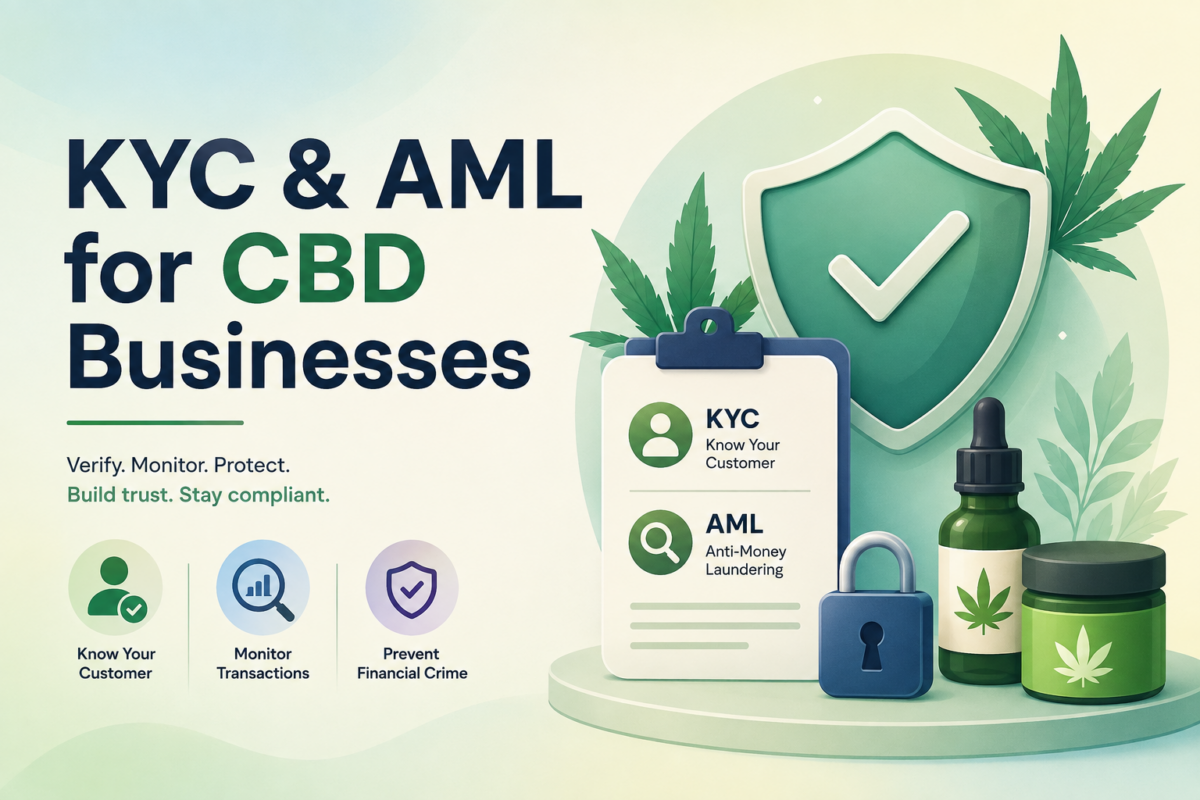
When a CBD business applies for payment processing, one of the first things it may encounter is a request for business documents, ownership information, and compliance details. For many entrepreneurs, this process can feel confusing. They may wonder why payment providers need information about their company, products, customers, and operations before allowing transactions to be processed.
The answer is compliance.
KYC (Know Your Customer) and AML (Anti-Money Laundering) procedures are important parts of payment processing, especially for industries such as CBD, hemp, and cannabis where financial institutions often apply additional review standards.
These processes help payment providers verify who they are working with, understand business activity, and reduce risks related to fraud, illegal transactions, and financial crime.
What Is KYC in CBD Payment Processing?
KYC stands for Know Your Customer. It refers to the process businesses and financial institutions use to verify the identity and legitimacy of the people and companies they work with.
For CBD payment processing, KYC is not only about confirming that a business exists. It also helps providers understand the nature of the business, who owns it, and whether its operations match the information provided during application.
For example, an online CBD retailer applying for payment processing may be asked to provide:
- Business registration details
- Ownership information
- Identification documents
- Business address verification
- Product information
These checks help confirm that the company is legitimate and operating transparently.
Imagine a payment provider receives an application from a company selling hemp-derived wellness products. The business claims to operate a professional online store, but the website contains limited information, unclear product descriptions, and no ownership details. Additional verification would likely be required before approval.
KYC helps reduce uncertainty and allows payment providers to better understand the businesses they support.
Why KYC Matters for CBD and Hemp Businesses?
CBD, hemp, and cannabis-related businesses often receive additional scrutiny for they being a part of high risk industry because payment providers need to manage regulatory and financial risks.
A proper KYC process helps answer important questions:
- Who owns the business?
- What products are being sold?
- Where does the business operate?
- Does the business have appropriate documentation?
- Are transactions consistent with the company’s activities?
For example, a hemp wellness company selling CBD skincare products should have information that matches its website, product labels, and business documentation.
If the details provided during onboarding do not match actual operations, it can create delays or additional reviews. Maintaining accurate business information from the beginning can make the approval process smoother and help establish trust with payment providers.
What Is AML in CBD Payment Processing?
AML stands for Anti-Money Laundering.
While KYC focuses on identifying and verifying businesses and customers, AML focuses on detecting and preventing suspicious financial activity. Payment providers use AML procedures to monitor transactions and identify patterns that may indicate fraud, money laundering, or other prohibited activities.
For CBD businesses, AML monitoring may involve reviewing unusual transaction behavior, unexpected changes in processing activity, or payments that do not match normal business operations.
For example, an online CBD store that normally processes small consumer purchases suddenly receives multiple unusually large transactions from unrelated accounts. This activity may require additional review to determine whether the transactions are legitimate. AML procedures help create a safer payment environment for businesses, customers, and financial institutions.
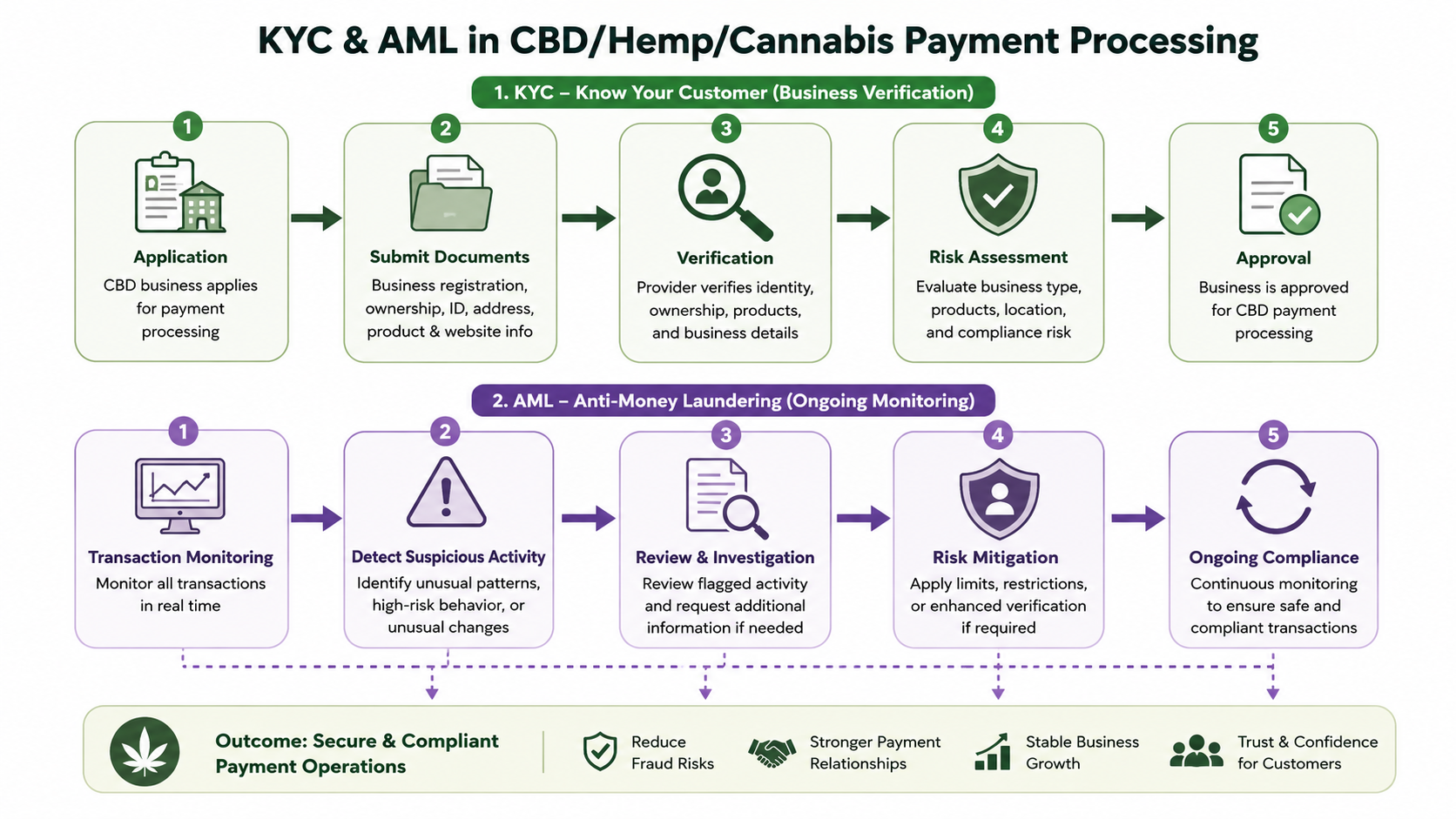
Common KYC and AML Requirements for CBD Businesses
The exact requirements vary depending on the payment provider and business model, but CBD companies are often asked to provide information about their operations.
Common requirements may include:
- Company formation documents
- Ownership and management details
- Government-issued identification
- Business website information
- Product details
- Sales information
- Transaction expectations
- Compliance-related documentation
Businesses may also need to provide supporting product documentation, such as Certificates of Analysis (COAs), depending on what they sell and where they operate.
For example, a CBD company selling hemp-derived supplements may need to demonstrate that its products are accurately represented and supported by appropriate documentation. Being prepared with these materials can reduce unnecessary delays during onboarding.
Customer Verification and Payment Security
KYC and AML are not limited to business verification. Customer activity can also be monitored depending on the payment environment. Businesses may need to pay attention to transactions that appear unusual, such as:
- Multiple failed payment attempts
- Large purchases that differ from normal behavior
- Suspicious account activity
- Transactions from unusual locations
Consider a CBD subscription company where a customer suddenly changes their shipping address and places several high-value orders. Additional verification may help determine whether the activity is legitimate or potentially fraudulent. This type of monitoring protects businesses while helping maintain a secure payment experience for genuine customers.
How KYC and AML Affect Business Operations?
Some business owners view compliance checks as obstacles, but they are an important part of building stable payment operations.
Strong KYC and AML practices can help businesses:
- Reduce fraud risks
- Maintain better payment relationships
- Identify suspicious activity earlier
- Create more transparent operations
A business that keeps accurate records and regularly updates information is generally easier for payment providers to evaluate. This becomes especially important as companies expand. A small CBD brand may start with a simple online store but later add subscriptions, wholesale sales, or new product categories. Keeping compliance information updated helps prevent unexpected disruptions.
Businesses preparing for payment processing should also understand how to get approved for a CBD merchant account, as compliance documentation is often a key part of the approval process.
KYC, AML, and Long-Term Payment Stability
KYC and AML are ongoing processes, not one-time checks completed during account setup. Payment providers may continue reviewing business activity to ensure transactions remain consistent with expected operations.
For example, if a CBD company significantly increases sales volume or begins selling new product categories, additional information may be requested to understand the change. Regularly maintaining documentation, monitoring transactions, and following transparent business practices helps create stronger payment operations over time.
Final Thoughts
KYC and AML play an important role in CBD payment processing by helping verify businesses, monitor transactions, and reduce financial risks.
For CBD, hemp, and cannabis-related companies, these procedures are not simply administrative requirements. They are part of creating a trustworthy payment environment where businesses can operate responsibly and customers can transact with confidence.
Understanding how KYC and AML work allows business owners to prepare better, avoid unnecessary delays, and build stronger foundations for long-term growth.

Categories
- ACH Payments (10)
- adult payment processing (11)
- AI (9)
- Altcoins (10)
- Banking (10)
- Bitcoin (133)
- Bitcoin ETF (11)
- Bitcoin Price (30)
- Blockchain (50)
- Brokering World Hunger Away (16)
- Business (17)
- card payment processing (10)
- CBD (11)
- CBDC (11)
- coaching business (11)
- COVID-19 (3)
- Crypto ATMs (1)
- Crypto Banking (17)
- Crypto Bill (1)
- Crypto business owner platform (31)
- Crypto Investment (3)
- Crypto Markets (5)
- Crypto Payment (35)
- Crypto Payment Processor (4)
- Crypto Prices (1)
- Crypto Trading (92)
- Cryptocurrency (402)
- Cryptocurrency Exchange (108)
- Data Visualization (2)
- dating platforms (11)
- debt collection payment processing (10)
- Decentralized Finance (7)
- DeFi Payment (9)
- DEX (3)
- Digital Currency (23)
- dropshipping payment processing (12)
- Ethereum (2)
- FAQ (7)
- file sharing payment processing (11)
- Finance (25)
- Financial Equality (4)
- Financial Freedom (8)
- Forex (35)
- hemp (1)
- ICO (2)
- Investment (11)
- IPTV (11)
- Merchant Account (10)
- Mining (3)
- News (66)
- NFTs (2)
- online gambling (11)
- P2P (1)
- Paybito (139)
- PayBitoPro (693)
- PayBitoPro Coin Listing (6)
- PayBitoPro Exchange (2)
- Payment Gateway (40)
- peptide (10)
- Post COVID Digital Transformation (1)
- Press Release (130)
- Privacy & Security (3)
- Real Estate (1)
- Stablecoin (5)
- Technology (15)
- Travel (11)
- Uncategorized (9)
- US Presidential Election (2)
- Utility Coin (1)
- Web3 business (4)
- Web3 Wallets (2)
- White Label Crypto Exchange (8)
Recent Posts
- ACH vs Wire Transfer: Which Payment Method Is Better for Businesses?
- ACH Fraud Prevention: How Businesses Can Secure Bank Account Payments?
- ACH Credit vs ACH Debit: What’s the Difference? With Real Examples
- ACH vs Credit Card: Which Payment Method Is Better for Businesses?
- How Long Do ACH Payments Take? Processing Times, Settlement, and Same Day ACH