Fraud Prevention for CBD Payment Processing: Protecting Your Business and Customers
- August 3, 2026
- Soham Guchait
A CBD customer places an order online, receives a confirmation email, and expects their product to arrive within a few days. However, the payment details used for the purchase were stolen, and the legitimate cardholder later reports the transaction as unauthorized.
For the business, the situation creates multiple problems. The payment may be reversed, the product may already be shipped, and additional costs may arise from investigating the transaction.
This is why fraud prevention is an important part of payment management for CBD, hemp, and cannabis-related businesses. While fraud affects businesses across many industries, companies operating in regulated or high-risk sectors often require stronger monitoring because fraudulent activity can create financial losses, customer disputes, and payment disruptions. A successful fraud prevention strategy is not about blocking every unusual transaction. It is about identifying genuine risks while allowing legitimate customers to complete purchases smoothly.
Why Fraud Prevention Matters for CBD Businesses?
Online CBD businesses often process transactions without meeting customers face-to-face. This makes digital payment security especially important.
A customer purchasing CBD products through an online store may appear completely legitimate, but businesses still need to consider risks such as stolen payment cards, fake identities, account takeover attempts, and unauthorized purchases.
For example, a fraudster may use stolen card information to purchase expensive CBD wellness products and request express shipping. The order may look normal initially, but once the actual cardholder notices the unauthorized charge, the business may lose both the payment and the product. These situations demonstrate why businesses need systems and processes that identify suspicious activity before it becomes a financial loss.
Common Types of Payment Fraud Affecting CBD Businesses
Fraud can occur in different ways depending on how a business sells products and interacts with customers.
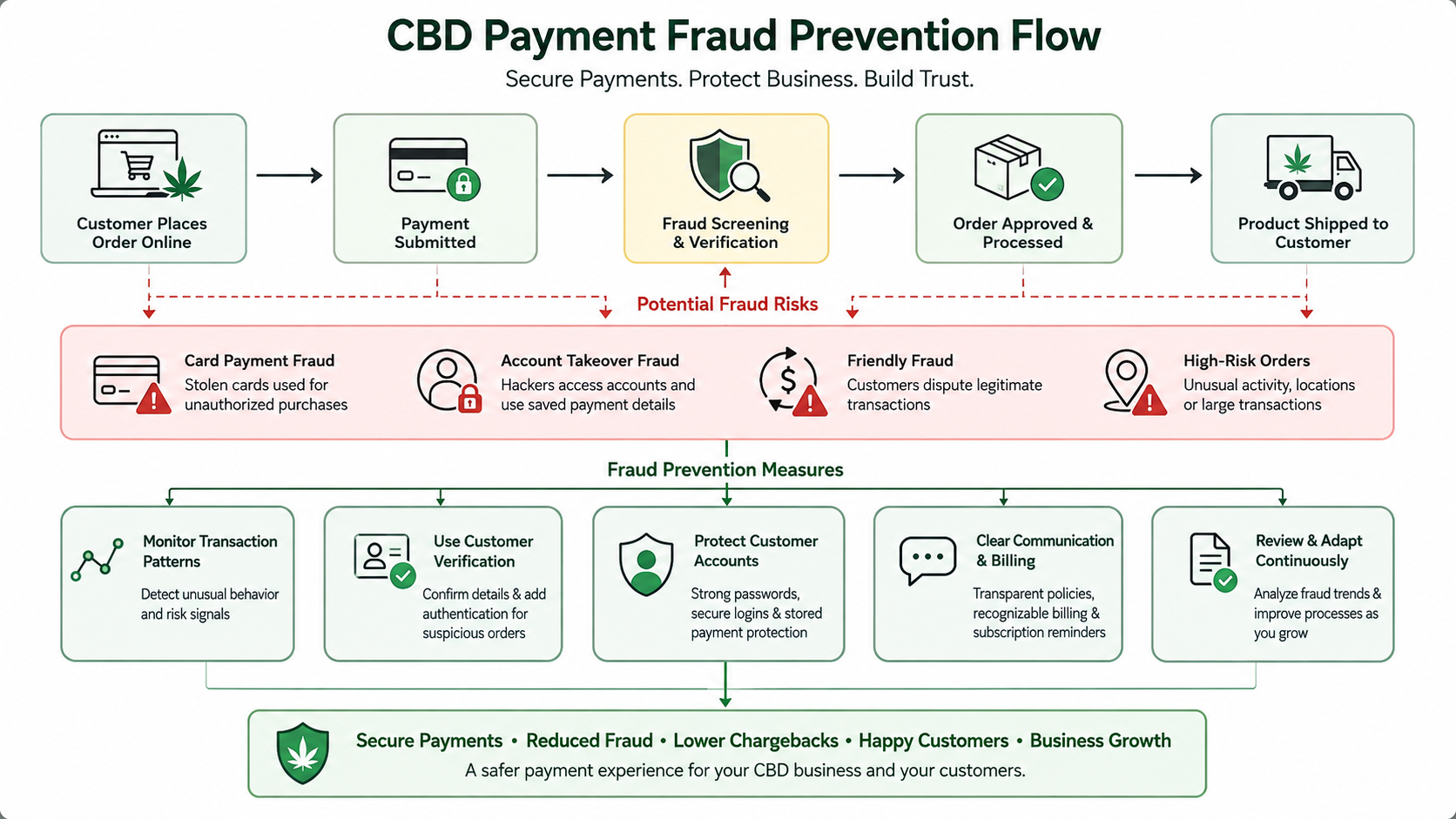
Card Payment Fraud
Card fraud occurs when criminals use stolen card information to make unauthorized purchases. This is one of the most common risks for online businesses.
For example, someone obtains stolen card details and places a large CBD order using a different shipping address. The payment may initially appear successful, but the real cardholder later disputes the transaction.
Businesses can reduce this risk by monitoring unusual transaction patterns and using appropriate verification methods.
Account Takeover Fraud
Account takeover occurs when criminals gain access to a customer’s existing account and use stored payment information to make purchases. This can happen when customers reuse passwords across multiple websites or when login information is exposed through security breaches.
Imagine a customer who regularly purchases CBD supplements through an online account. A criminal gains access to that account, changes the shipping address, and places several orders using saved payment details.
Protecting customer accounts with stronger authentication methods and monitoring unusual account behavior can help reduce this type of fraud.
Friendly Fraud
Not all fraud involves criminals. Friendly fraud occurs when customers dispute legitimate purchases, either intentionally or because they do not recognize the transaction.
For example, a customer may purchase a CBD subscription box, forget about the recurring payment, and report the charge as unauthorized.
Clear subscription terms, recognizable billing information, and strong customer communication can help reduce these disputes. Businesses should also understand how to prevent chargebacks for CBD businesses, since many friendly fraud situations eventually become payment disputes.
How CBD Businesses Can Prevent Payment Fraud?
Fraud prevention works best when businesses combine multiple layers of protection rather than relying on one security measure.
Monitor Transaction Patterns
Looking at individual transactions is useful, but analyzing broader patterns can reveal suspicious behavior.
Businesses should pay attention to activity such as:
- Multiple orders from the same device
- Unusually large purchases
- Several failed payment attempts
- Frequent changes to customer information
- Orders from unexpected locations
For example, a customer who normally purchases one CBD product every month may suddenly attempt five high-value purchases using different payment cards. This type of behavior may require additional review.
Use Customer Verification Measures
Verification helps confirm that the person making a purchase is likely the legitimate account holder.
Depending on the business model, verification may involve:
- Confirming customer details
- Reviewing unusual orders
- Using additional authentication steps
- Monitoring account activity
The goal is not to create unnecessary friction but to add protection when transactions appear risky. A regular customer making a normal purchase should have a simple experience, while unusual activity may require additional checks.
Protect Customer Accounts
Strong account security is especially important for businesses that store customer information or offer subscription services.
Basic security practices include:
- Encouraging strong passwords
- Monitoring suspicious login attempts
- Protecting stored payment information
- Limiting unauthorized account access
For example, a customer with a monthly CBD subscription should not have their account compromised simply because their login credentials were exposed elsewhere.
Balancing Fraud Protection and Customer Experience
One of the biggest challenges in fraud prevention is avoiding excessive restrictions. If security systems block too many legitimate customers, businesses may lose sales and create frustration.
Imagine a returning customer ordering their usual CBD wellness products while traveling. A system may flag the transaction because the location has changed, even though the purchase is legitimate.
Effective fraud prevention focuses on identifying meaningful risks rather than treating every unusual activity as fraudulent. The best approach combines security tools, transaction monitoring, and customer-friendly verification processes.
Fraud Prevention and Payment Growth
As CBD businesses grow, fraud prevention becomes increasingly important. A small business processing a few orders per day may manually review unusual transactions. However, a larger company handling hundreds or thousands of payments needs more structured processes.
Growth introduces new challenges, including:
- Higher transaction volumes
- More customer accounts
- Larger order values
- Multiple sales channels
Businesses should regularly review fraud patterns and adjust their payment processes as operations expand. Understanding common payment processing challenges for CBD businesses can also help merchants prepare for the broader operational issues that appear as transaction volumes increase.
Final Thoughts
Fraud prevention is an essential part of running a successful CBD, hemp, or cannabis-related business.
While fraud cannot be eliminated completely, businesses can significantly reduce risks by monitoring transactions, protecting customer accounts, verifying suspicious activity, and maintaining clear communication with customers. The goal is to create a payment environment that protects both the business and legitimate shoppers. Strong fraud prevention should not make purchasing difficult – it should create confidence that every transaction is secure, reliable, and trustworthy.

Categories
- ACH Payments (10)
- adult payment processing (11)
- AI (9)
- Altcoins (10)
- Banking (10)
- Bitcoin (133)
- Bitcoin ETF (11)
- Bitcoin Price (30)
- Blockchain (50)
- Brokering World Hunger Away (16)
- Business (17)
- card payment processing (10)
- CBD (11)
- CBDC (11)
- Chargeback (8)
- coaching business (11)
- COVID-19 (3)
- Crypto ATMs (1)
- Crypto Banking (17)
- Crypto Bill (1)
- Crypto business owner platform (31)
- Crypto Investment (3)
- Crypto Markets (5)
- Crypto Payment (35)
- Crypto Payment Processor (4)
- Crypto Prices (1)
- Crypto Trading (92)
- Cryptocurrency (402)
- Cryptocurrency Exchange (108)
- Data Visualization (2)
- dating platforms (11)
- debt collection payment processing (10)
- Decentralized Finance (7)
- DeFi Payment (9)
- DEX (3)
- Digital Currency (23)
- dropshipping payment processing (12)
- Ethereum (2)
- FAQ (7)
- file sharing payment processing (11)
- Finance (25)
- Financial Equality (4)
- Financial Freedom (8)
- Forex (35)
- hemp (1)
- ICO (2)
- Investment (11)
- IPTV (11)
- Merchant Account (10)
- Mining (3)
- News (66)
- NFTs (2)
- online gambling (11)
- P2P (1)
- Paybito (147)
- PayBitoPro (693)
- PayBitoPro Coin Listing (6)
- PayBitoPro Exchange (2)
- Payment Gateway (48)
- peptide (10)
- Post COVID Digital Transformation (1)
- Press Release (130)
- Privacy & Security (3)
- Real Estate (1)
- Stablecoin (5)
- Technology (15)
- Travel (11)
- Uncategorized (10)
- US Presidential Election (2)
- Utility Coin (1)
- Web3 business (4)
- Web3 Wallets (2)
- White Label Crypto Exchange (8)
Recent Posts
- Payment Gateway vs. Payment Orchestration: What’s the Difference?
- What Is Smart Payment Routing? Strategies to Optimize Payment Performance
- How to Improve Payment Approval Rates for High-Risk Businesses?
- Why Are Online Payments Failing? Common Causes and How to Fix Them
- How to Use Multiple Payment Processors to Reduce Business Disruptions?