CBD Payment Processing: A Complete Guide for CBD, Hemp, and Cannabis Businesses
- August 3, 2026
- Soham Guchait
A customer visits an online wellness store looking for a CBD sleep tincture. They add the product to their cart, enter their card details, and click Pay Now. Instead of a confirmation page, they see a payment failure message. They try another card with the same result and eventually abandon the purchase.
From the customer’s perspective, it looks like a simple technical issue. For the business owner, however, that failed payment could be the result of banking restrictions, underwriting policies, fraud prevention systems, or the complexities of operating in a high-risk industry. This is one of the biggest realities of selling CBD, hemp, or cannabis-related products. Creating quality products and attracting customers are only part of the equation. Successfully accepting payments – and doing so consistently – is often one of the greatest operational challenges businesses face.
Whether you sell CBD oils, hemp-derived wellness products, cannabis accessories, subscription boxes, or operate a licensed cannabis dispensary where regulations permit, understanding how payment processing works can help you avoid unnecessary disruptions and create a smoother purchasing experience for your customers.
This guide explains the fundamentals of CBD payment processing, why the industry faces unique payment challenges, and the key components every business owner should understand before accepting online or in-store payments.
What Is CBD Payment Processing?
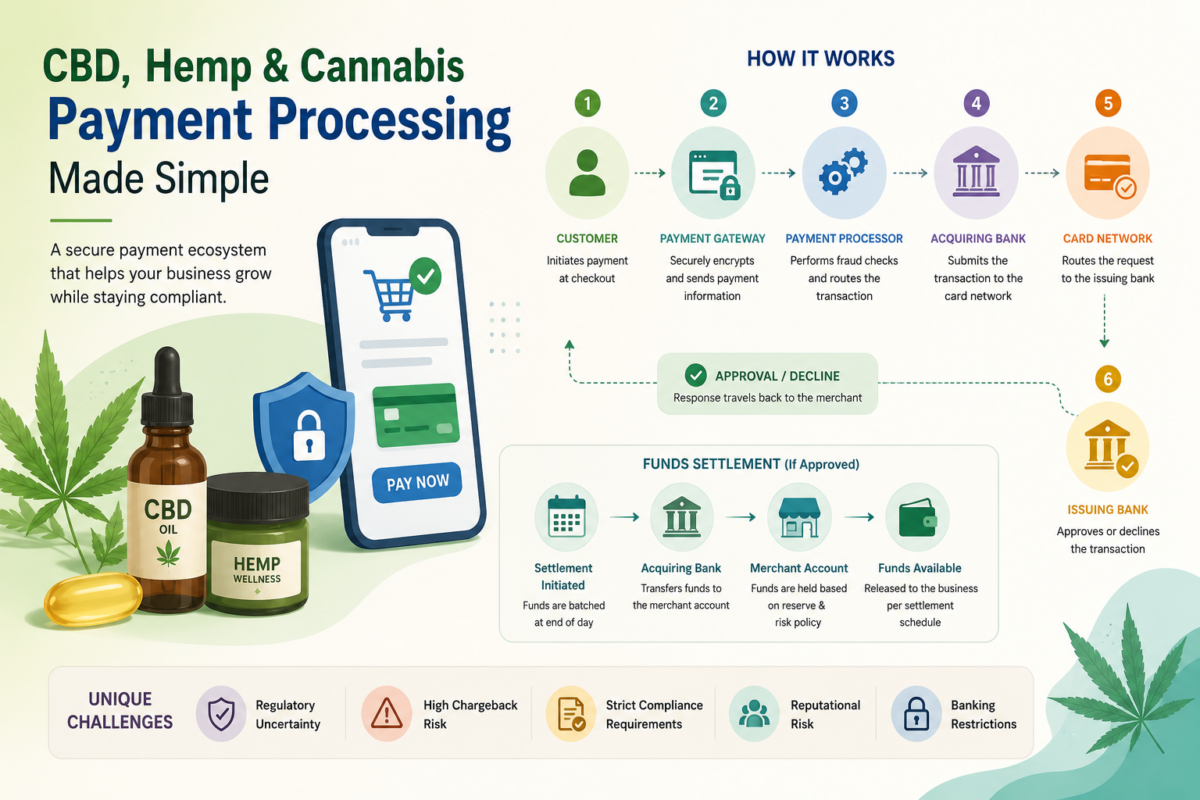
CBD payment processing is the system that allows businesses selling CBD, hemp, or cannabis-related products to securely accept and process electronic payments from customers. Although the checkout experience may appear straightforward, several organizations work together behind the scenes to authorize, verify, and settle every transaction.
For example, imagine a customer purchasing a month’s supply of CBD gummies from an online wellness retailer. Within a few seconds:
- The customer’s payment information is securely transmitted.
- The issuing bank checks whether the card can be used.
- Security systems evaluate the transaction for signs of fraud.
- The payment is either approved or declined.
- Funds are scheduled for settlement into the merchant’s account.
All of these steps happen almost instantly, yet each introduces its own set of rules and risk assessments.
For businesses operating in regulated industries, payment processing involves additional scrutiny. Payment providers may evaluate products, business practices, website content, and compliance documentation before approving a merchant account. Understanding this ecosystem is the first step toward building a reliable payment operation.
Why Payment Processing Is More Complex for CBD, Hemp, and Cannabis Businesses?
Many new business owners are surprised to learn that selling legal products does not automatically guarantee easy access to payment services.
Financial institutions assess businesses based on perceived risk rather than product popularity. Even if a company operates legally within its jurisdiction, payment providers still evaluate factors such as regulatory uncertainty, chargeback potential, fraud exposure, and reputational risk.
Consider two online stores:
The first sells handmade ceramic mugs. The second sells hemp-derived CBD tinctures. Both businesses have professional websites, transparent policies, and satisfied customers. Yet the CBD business often undergoes a much more detailed review before receiving payment processing approval.
This additional scrutiny exists because financial institutions must manage their own compliance obligations while minimizing financial and operational risk. If you’re interested in understanding the reasons behind these classifications, our guide on why CBD and hemp businesses are considered high risk explores the factors in much greater detail.
How the CBD Payment Ecosystem Works?
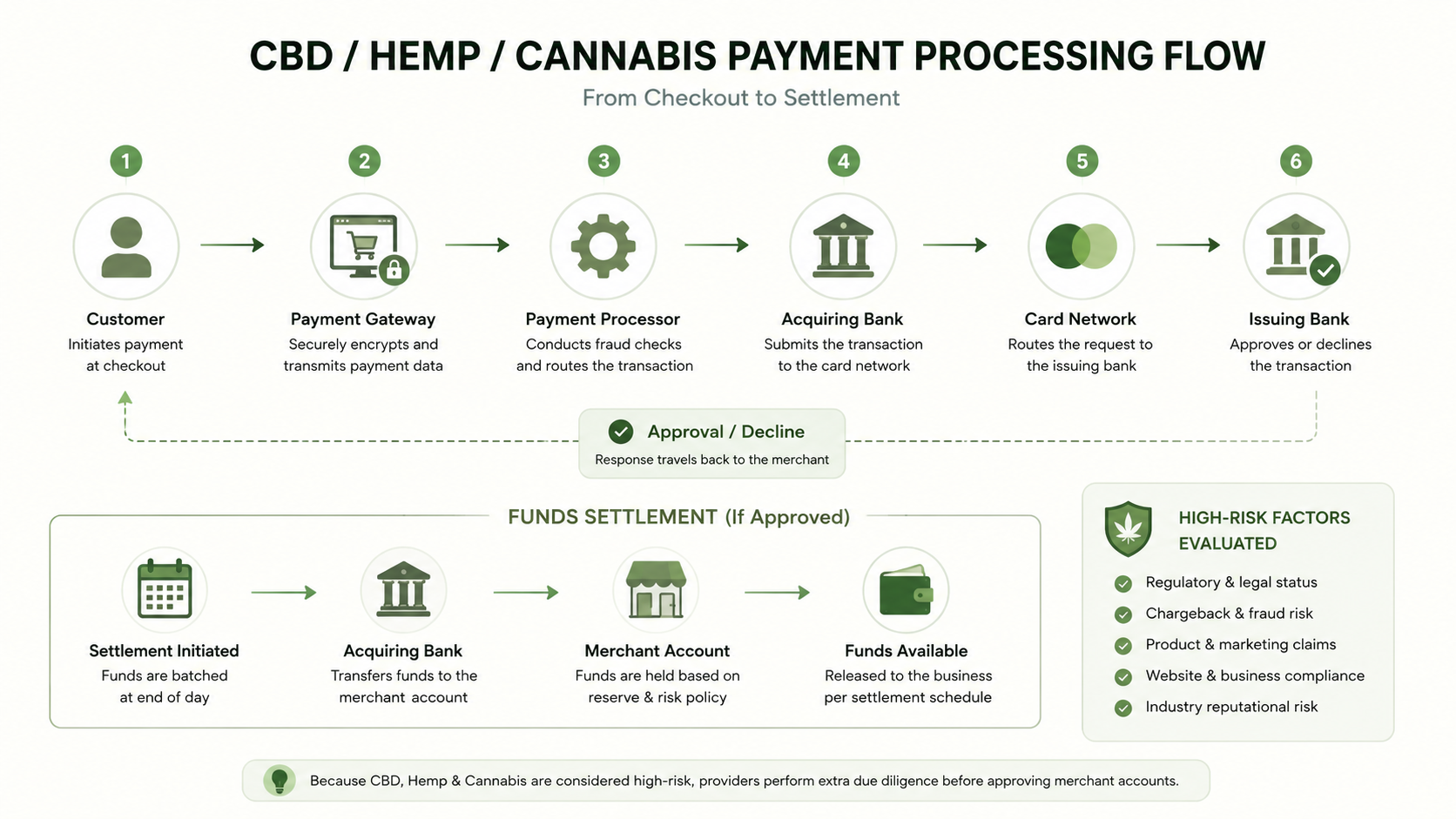
Many people think payment processing involves only the customer and the business. In reality, several organizations work together to complete a single transaction. Understanding these participants helps explain why payment issues can occur even when everything appears to be functioning normally.
Customer
The customer initiates the payment using a credit card, debit card, bank account, or another supported payment method.
Merchant
The merchant is the CBD, hemp, or cannabis business accepting payment for products or services.
Payment Gateway
The payment gateway securely transmits payment information between the customer’s checkout page and the payment processor. It also encrypts sensitive payment data before it reaches financial institutions.
Choosing the right gateway becomes increasingly important as transaction volume grows or customer expectations evolve. Businesses comparing different gateway features should also understand how to choose a payment gateway for your CBD business, especially when evaluating reliability, security, and checkout experience.
Payment Processor
The payment processor communicates with banks, card networks, and financial institutions to facilitate transaction authorization and settlement.
Acquiring Bank
The acquiring bank maintains the merchant account that receives approved funds after transactions are successfully settled.
Issuing Bank
The issuing bank evaluates whether the customer’s payment should be approved based on available funds, fraud checks, spending limits, and other risk criteria.
Although customers usually see only an approval or decline message, multiple organizations make decisions during those few seconds.
What Makes a Payment Successful?
A successful payment involves much more than having enough money available on a customer’s card.
Several checks take place before approval is granted.
- The customer’s payment information must be valid.
- Fraud screening systems evaluate the transaction.
- The merchant account must remain in good standing.
- Product categories must comply with provider policies.
- Banks must approve the transaction.
- Technical communication between all parties must succeed.
If any one of these checks fails, the payment may be declined.
For example, a returning customer may attempt to reorder a monthly CBD wellness subscription while traveling abroad. Because the purchase originates from a new country using an unfamiliar device, automated fraud systems could temporarily block the transaction until additional verification is completed.
Situations like these illustrate why payment declines are not always caused by insufficient funds. They often result from a combination of security controls designed to reduce fraud while protecting both businesses and customers.
We’ll examine these scenarios in greater detail in our guide on why CBD payments get declined and how to fix them.
Common Payment Methods Used by CBD Businesses
Customers expect flexibility when paying online. Offering only one payment option can increase cart abandonment, particularly if a preferred method is unavailable. While the exact payment methods available depend on business type, jurisdiction, and payment provider, most CBD and hemp businesses rely on a combination of traditional and alternative payment options.
Some of the most commonly accepted methods include:
- Credit and debit cards
- ACH bank transfers
- Digital wallets
- Bank transfers
- Buy Now, Pay Later services (where permitted)
- Crypto Payments
- Alternative payment methods available in specific regions
Each option offers different advantages in terms of customer convenience, transaction costs, settlement speed, and approval rates. Rather than adopting every available method, businesses should focus on offering a payment mix that aligns with their customers’ purchasing preferences and operational needs.
Building a Reliable Payment Strategy for Your Business
Choosing a payment solution isn’t simply about finding a provider that can process transactions. It’s about creating a payment experience that supports your business today while remaining flexible as you grow.
For example, a small business selling CBD skincare products through its website may initially process only a few dozen transactions each week. A year later, it could introduce a subscription program, expand into wholesale, or begin selling through multiple online channels. If the payment setup can’t support those changes, the business may need to switch providers, update its checkout process, and retrain staff – all of which can disrupt operations.
Planning ahead helps reduce these growing pains. When evaluating your payment setup, consider questions such as:
- Can it support both online and in-store payments if your business expands?
- Does it integrate with your eCommerce platform or point-of-sale system?
- Can it handle recurring payments if you introduce subscriptions?
- Does it offer reporting tools that simplify reconciliation?
- Is it designed to scale as transaction volume increases?
Thinking beyond your current needs can save considerable time and effort later.
Common Payment Challenges CBD, Hemp, and Cannabis Businesses Face
Accepting payments in the CBD, hemp, and cannabis industry isn’t always straightforward. Even established businesses can encounter operational challenges that affect revenue and customer experience.
One common challenge is merchant account approval. Payment providers often perform additional reviews before onboarding businesses that sell regulated products. These reviews may include evaluating product information, website content, business documentation, and compliance practices.
Another challenge involves payment declines. Sometimes a transaction is blocked because of fraud prevention systems. In other cases, the issuing bank or card network applies restrictions based on its own risk policies.
Chargebacks also deserve attention. Unlike ordinary refunds, chargebacks involve customers disputing transactions through their card issuer. Frequent chargebacks can increase processing costs and may even affect a merchant’s ability to continue accepting certain payment methods.
Fraud presents another layer of complexity. Criminals may attempt to use stolen payment credentials, create fake customer accounts, or exploit weaknesses in online checkout systems. Businesses must balance fraud prevention with providing a smooth customer experience, since overly aggressive security checks can also lead to legitimate purchases being declined.
Each of these topics requires its own strategy, which is why they’re explored in dedicated guides throughout this content series rather than being covered in detail here.
Compliance Plays a Bigger Role Than Many Businesses Expect
Many first-time business owners assume compliance only matters when applying for licenses or registering a company. In reality, compliance influences payment processing throughout the life of a business.
Payment providers regularly assess whether merchants continue to meet their requirements. Depending on the products being sold and the markets served, businesses may be asked to provide updated documentation or verify operational changes.
Examples include:
- Updated Certificates of Analysis (COAs) for CBD products
- Changes to business ownership
- Expansion into new geographic markets
- Launch of new product categories
- Updated website policies
- Revised licensing information where applicable
Imagine a company that originally sold only hemp-derived topical products but later expands into ingestible CBD supplements. Even though the business itself hasn’t changed, its payment provider may conduct another review because the product profile has evolved.
Maintaining accurate records and keeping business information current helps reduce unnecessary interruptions.
Customer Trust Is Closely Connected to Payments
Customers rarely think about payment processing until something goes wrong. A confusing checkout page, repeated payment failures, or unexpected delays can quickly undermine confidence – even if the products themselves are excellent. On the other hand, a secure and transparent payment experience reassures customers that they’re buying from a professional business.
Simple practices can make a noticeable difference:
- Clearly display refund and shipping policies.
- Provide order confirmations immediately after purchase.
- Make billing descriptors easy for customers to recognize.
- Offer responsive customer support for payment-related questions.
- Keep customers informed about shipping and delivery status.
Consider an online CBD retailer that sells monthly wellness bundles. If subscribers receive timely renewal reminders, clear invoices, and shipment notifications, they’re far less likely to forget a purchase and dispute the transaction later. Often, good communication prevents payment problems before they arise.
The Future of CBD Payment Processing
The payment landscape continues to evolve alongside the CBD and cannabis industries.
As regulations develop and payment technologies improve, businesses are likely to see greater flexibility in how they accept and manage payments. Alternative payment methods, stronger fraud prevention technologies, faster settlement options, and improved customer authentication are already becoming more common across many sectors. At the same time, expectations from consumers continue to rise.
Customers increasingly expect:
- Fast, secure checkout experiences
- Multiple payment options
- Mobile-friendly purchasing
- Transparent billing
- Reliable order tracking
Businesses that regularly review and improve their payment processes are generally better positioned to adapt as customer expectations and industry standards change. Rather than treating payment processing as a one-time setup, successful businesses view it as an ongoing part of delivering a positive customer experience.

Categories
- ACH Payments (10)
- adult payment processing (11)
- AI (9)
- Altcoins (10)
- Banking (10)
- Bitcoin (133)
- Bitcoin ETF (11)
- Bitcoin Price (30)
- Blockchain (50)
- Brokering World Hunger Away (16)
- Business (17)
- card payment processing (10)
- CBD (11)
- CBDC (11)
- Chargeback (8)
- coaching business (11)
- COVID-19 (3)
- Crypto ATMs (1)
- Crypto Banking (17)
- Crypto Bill (1)
- Crypto business owner platform (31)
- Crypto Investment (3)
- Crypto Markets (5)
- Crypto Payment (35)
- Crypto Payment Processor (4)
- Crypto Prices (1)
- Crypto Trading (92)
- Cryptocurrency (402)
- Cryptocurrency Exchange (108)
- Data Visualization (2)
- dating platforms (11)
- debt collection payment processing (10)
- Decentralized Finance (7)
- DeFi Payment (9)
- DEX (3)
- Digital Currency (23)
- dropshipping payment processing (12)
- Ethereum (2)
- FAQ (7)
- file sharing payment processing (11)
- Finance (25)
- Financial Equality (4)
- Financial Freedom (8)
- Forex (35)
- hemp (1)
- ICO (2)
- Investment (11)
- IPTV (11)
- Merchant Account (10)
- Mining (3)
- News (66)
- NFTs (2)
- online gambling (11)
- P2P (1)
- Paybito (147)
- PayBitoPro (693)
- PayBitoPro Coin Listing (6)
- PayBitoPro Exchange (2)
- Payment Gateway (48)
- peptide (10)
- Post COVID Digital Transformation (1)
- Press Release (130)
- Privacy & Security (3)
- Real Estate (1)
- Stablecoin (5)
- Technology (15)
- Travel (11)
- Uncategorized (10)
- US Presidential Election (2)
- Utility Coin (1)
- Web3 business (4)
- Web3 Wallets (2)
- White Label Crypto Exchange (8)
Recent Posts
- Payment Gateway vs. Payment Orchestration: What’s the Difference?
- What Is Smart Payment Routing? Strategies to Optimize Payment Performance
- How to Improve Payment Approval Rates for High-Risk Businesses?
- Why Are Online Payments Failing? Common Causes and How to Fix Them
- How to Use Multiple Payment Processors to Reduce Business Disruptions?