How to Prevent Payment Fraud in Adult Entertainment Businesses?
- August 4, 2026
- Soham Guchait
Payment fraud is an ongoing challenge for online businesses, but adult entertainment companies often face greater exposure because they operate in a digital-first environment where transactions happen instantly and services are usually delivered immediately. Subscription websites, creator platforms, live-streaming services, digital content marketplaces, and adult eCommerce stores all process payments that can become targets for fraudsters looking to exploit weaknesses in payment systems.
Unlike customer disputes or chargebacks, payment fraud involves someone intentionally using stolen payment credentials, compromised accounts, or deceptive techniques to complete unauthorized transactions. If businesses fail to identify these activities early, they may lose revenue, face chargebacks, damage their relationship with payment providers, and spend significant resources investigating fraudulent activity.
The good news is that payment fraud is manageable. By understanding how fraud occurs and implementing multiple layers of protection, adult businesses can reduce financial losses while providing a secure payment experience for legitimate customers.
Understanding Payment Fraud in the Adult Industry
Payment fraud occurs when someone intentionally uses deception to complete or attempt a financial transaction they are not authorized to make. The fraudster’s goal may be to obtain premium content, purchase subscription access, exploit promotional offers, or simply test stolen payment credentials.
For example, imagine a fraudster obtains a stolen credit card and uses it to purchase a premium membership on an adult creator platform. The payment is initially approved because the card information appears valid. Days later, the real cardholder notices the unauthorized transaction and reports it to their bank. The business loses both the revenue and the digital service that was already delivered.
This situation differs from a customer forgetting about a subscription renewal or disputing a recognizable purchase. Those situations often fall under chargebacks or friendly fraud rather than criminal payment fraud. Understanding this distinction is important because each problem requires a different solution. Businesses experiencing customer disputes should also understand how to prevent chargebacks for adult entertainment businesses, since not every disputed payment involves criminal activity.
Common Types of Payment Fraud Affecting Adult Businesses
Fraud evolves constantly, but several methods appear repeatedly across adult payment processing.
Stolen Card Fraud
One of the most common forms of payment fraud involves stolen or compromised payment cards. Fraudsters obtain card details through phishing attacks, malware, or previous data breaches before using them to make purchases. Identity theft and unauthorized use of personal and financial information are major forms of consumer fraud tracked by regulatory agencies.
For example, a fraudster may purchase hundreds of tokens on a live-streaming platform using multiple stolen cards. By the time the legitimate cardholders report the transactions, the fraudster has already used or transferred the purchased credits.
Account Takeover
Rather than stealing payment information directly, some criminals target customer accounts. If login credentials are compromised through password reuse or phishing, the attacker can access saved payment methods and purchase subscriptions or digital products without the account owner’s knowledge.
Imagine a customer who has stored payment details on a membership website. After their password is compromised on another website, the same credentials are used to access their adult platform account. The attacker upgrades the membership and purchases additional content using the stored payment method.
Card Testing
Card testing is another common threat for businesses processing online payments. Fraudsters often possess large lists of stolen card numbers but do not know which cards are still active. They use automated software to make multiple low-value transactions until they identify cards that successfully process.
For example, a platform may suddenly receive dozens of small payment attempts from different cards within a few minutes. While the transaction values appear insignificant, the real objective is to identify valid cards for larger fraudulent purchases elsewhere.
Promotional and Bonus Abuse
Businesses offering introductory discounts, promotional credits, or referral rewards may also experience abuse. Fraudsters sometimes create multiple fake accounts to repeatedly claim promotional offers that were intended for new customers.
A creator platform offering free signup credits may discover that one individual has created dozens of accounts using different email addresses while accessing the platform from the same device.
How Adult Businesses Can Reduce Their Payment Fraud?
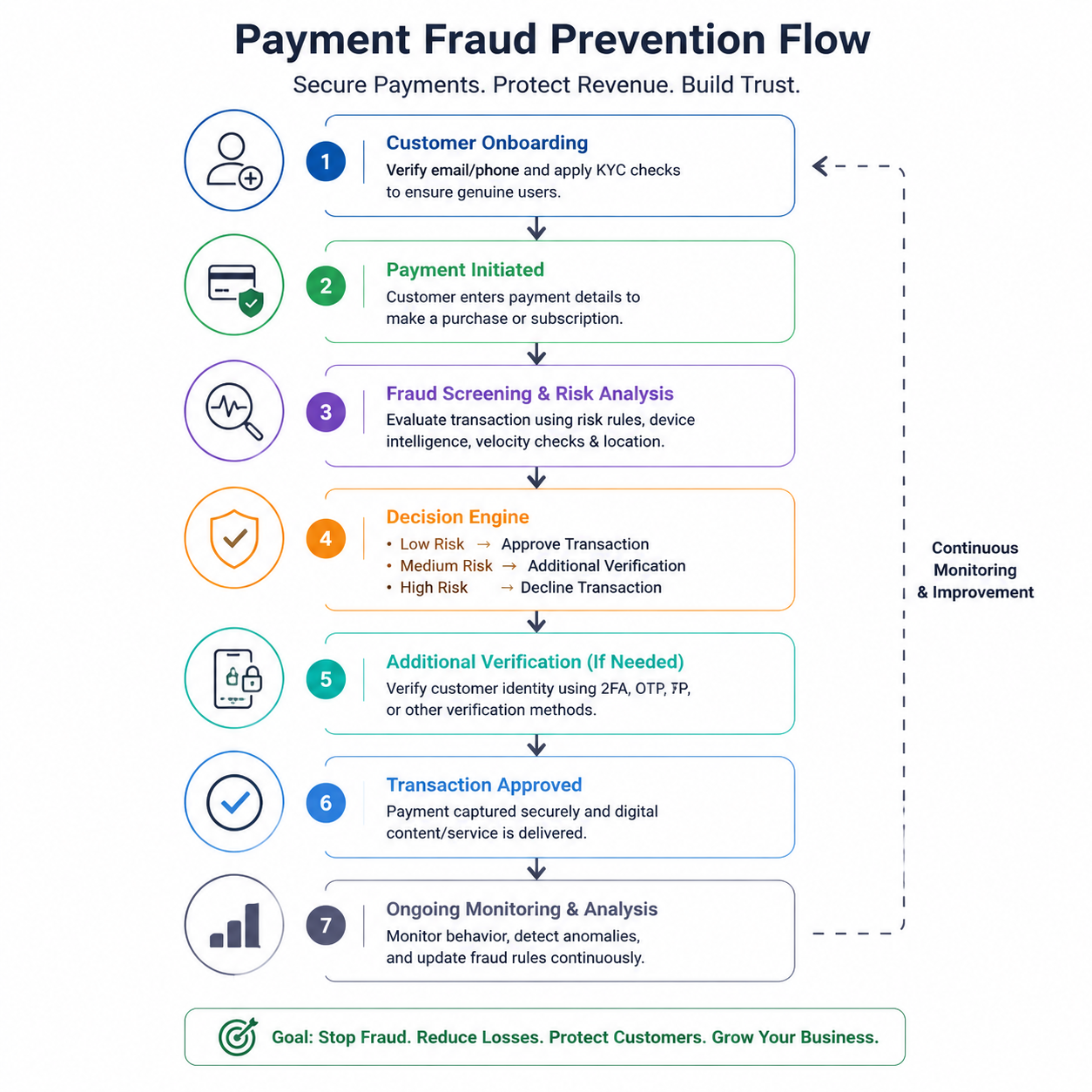
Preventing fraud requires more than a single security tool. The strongest payment systems use multiple layers of protection that work together without making legitimate purchases unnecessarily difficult. Businesses processing online payments should follow recognized payment security standards such as PCI DSS, which provides guidelines for protecting payment card information and reducing security risks.
Some of the most effective fraud prevention practices include:
- Monitoring unusual transaction patterns and sudden spikes in payment activity.
- Using device intelligence to identify suspicious login behavior.
- Applying velocity checks to detect repeated payment attempts within short time periods.
- Reviewing transactions originating from unusual geographic locations.
- Verifying customer identity when higher-risk activity is detected.
- Monitoring account behavior after successful payments, not just during checkout.
For example, if a new customer creates an account, attempts five different cards within two minutes, and immediately purchases a large quantity of digital credits, that combination of behaviors presents a much higher fraud risk than a customer purchasing a standard monthly membership from their usual device.
Balancing Fraud Prevention with Customer Experience
One of the biggest challenges for adult businesses is finding the right balance between security and convenience. Strict fraud controls may successfully stop fraudulent transactions but can also decline legitimate customers. Authentication technologies such as EMV® 3-D Secure help merchants and payment providers verify customers during online transactions while reducing card-not-present fraud and unnecessary payment friction. On the other hand, weak security may increase approval rates while exposing the business to unnecessary losses.
Consider a loyal subscriber who travels internationally and attempts to renew their membership from another country. An aggressive fraud filter might decline the payment because the location differs from previous purchases. Without an easy way to verify the customer’s identity or retry the payment, the business risks losing a legitimate subscriber.
Businesses experiencing a high number of legitimate payment failures should also understand why adult entertainment payments get declined and how to fix them, as not every declined transaction is caused by fraud.
Building a Long-Term Fraud Prevention Strategy
Fraud prevention should evolve as the business grows. A payment system that works well for a small creator platform may not provide sufficient protection once thousands of transactions are processed every day.
Long-term fraud management typically includes:
- Regularly reviewing fraud reports and transaction trends.
- Updating fraud rules based on new attack patterns.
- Monitoring repeat offenders and suspicious accounts.
- Training support teams to recognize fraudulent behavior.
- Working with payment providers that offer detailed fraud monitoring tools.
Businesses should also ensure their payment infrastructure supports these security measures from the beginning. Choosing a reliable payment system with appropriate fraud management capabilities makes it easier to identify suspicious activity before financial losses occur. Companies evaluating payment technology should understand how to choose a payment gateway for an adult entertainment business, since fraud controls are often built directly into the payment infrastructure.
Fraud Prevention Is Different from Compliance
Fraud prevention focuses on stopping unauthorized or criminal payment activity. Compliance, however, focuses on verifying businesses, monitoring transactions, and meeting financial regulations.
For example, identifying stolen-card activity is a fraud prevention measure. Verifying business ownership during onboarding is part of compliance. Both are important, but they solve different problems. Businesses should understand KYC and AML for adult entertainment payment processing to learn how verification and ongoing monitoring support safer payment operations alongside fraud prevention.
Conclusion
Payment fraud is an unavoidable reality for adult entertainment businesses, but it does not have to become a major financial burden. Understanding how fraudsters operate, recognizing suspicious payment behavior, and implementing multiple layers of protection can significantly reduce risk without disrupting the customer experience.
The most effective fraud prevention strategies combine technology, transaction monitoring, customer verification, and continuous analysis rather than relying on a single security measure. As adult businesses grow, regularly reviewing fraud patterns and adapting payment controls becomes just as important as attracting new customers. By treating fraud prevention as an ongoing business process instead of a one-time setup, adult businesses can protect revenue, maintain healthier relationships with payment providers, and build greater trust with legitimate customers.

Categories
- ACH Payments (10)
- adult payment processing (11)
- AI (9)
- Altcoins (10)
- Banking (10)
- Bitcoin (133)
- Bitcoin ETF (11)
- Bitcoin Price (30)
- Blockchain (50)
- Brokering World Hunger Away (16)
- Business (17)
- card payment processing (10)
- CBD (11)
- CBDC (11)
- coaching business (11)
- COVID-19 (3)
- Crypto ATMs (1)
- Crypto Banking (17)
- Crypto Bill (1)
- Crypto business owner platform (31)
- Crypto Investment (3)
- Crypto Markets (5)
- Crypto Payment (35)
- Crypto Payment Processor (4)
- Crypto Prices (1)
- Crypto Trading (92)
- Cryptocurrency (402)
- Cryptocurrency Exchange (108)
- Data Visualization (2)
- dating platforms (11)
- debt collection payment processing (10)
- Decentralized Finance (7)
- DeFi Payment (9)
- DEX (3)
- Digital Currency (23)
- dropshipping payment processing (12)
- Ethereum (2)
- FAQ (7)
- file sharing payment processing (11)
- Finance (25)
- Financial Equality (4)
- Financial Freedom (8)
- Forex (35)
- hemp (1)
- ICO (2)
- Investment (11)
- IPTV (11)
- Merchant Account (10)
- Mining (3)
- News (66)
- NFTs (2)
- online gambling (11)
- P2P (1)
- Paybito (139)
- PayBitoPro (693)
- PayBitoPro Coin Listing (6)
- PayBitoPro Exchange (2)
- Payment Gateway (40)
- peptide (10)
- Post COVID Digital Transformation (1)
- Press Release (130)
- Privacy & Security (3)
- Real Estate (1)
- Stablecoin (5)
- Technology (15)
- Travel (11)
- Uncategorized (9)
- US Presidential Election (2)
- Utility Coin (1)
- Web3 business (4)
- Web3 Wallets (2)
- White Label Crypto Exchange (8)
Recent Posts
- ACH vs Wire Transfer: Which Payment Method Is Better for Businesses?
- ACH Fraud Prevention: How Businesses Can Secure Bank Account Payments?
- ACH Credit vs ACH Debit: What’s the Difference? With Real Examples
- ACH vs Credit Card: Which Payment Method Is Better for Businesses?
- How Long Do ACH Payments Take? Processing Times, Settlement, and Same Day ACH