Merchant Account for Coaching Businesses: How to Get Approved and Accept Client Payments?
- August 6, 2026
- Soham Guchait
Launching a coaching business involves much more than creating programs and attracting clients. Once customers are ready to pay, businesses need a reliable way to accept and process those transactions.
Many coaches begin by using basic payment tools, but as their client base grows, they often discover that accepting payments consistently requires more than simply adding a checkout page. Behind every successful online payment is a financial infrastructure that allows funds to move securely between the customer, the acquiring bank, and the business. This is where a merchant account becomes important.
Whether you run a life coaching practice, an executive coaching firm, an online coaching academy, or a membership-based coaching community, understanding merchant accounts helps you build a payment system that can support long-term business growth.
What Is a Merchant Account?
A merchant account is a specialized business account that temporarily holds customer card payments before they are transferred to the business’s bank account.
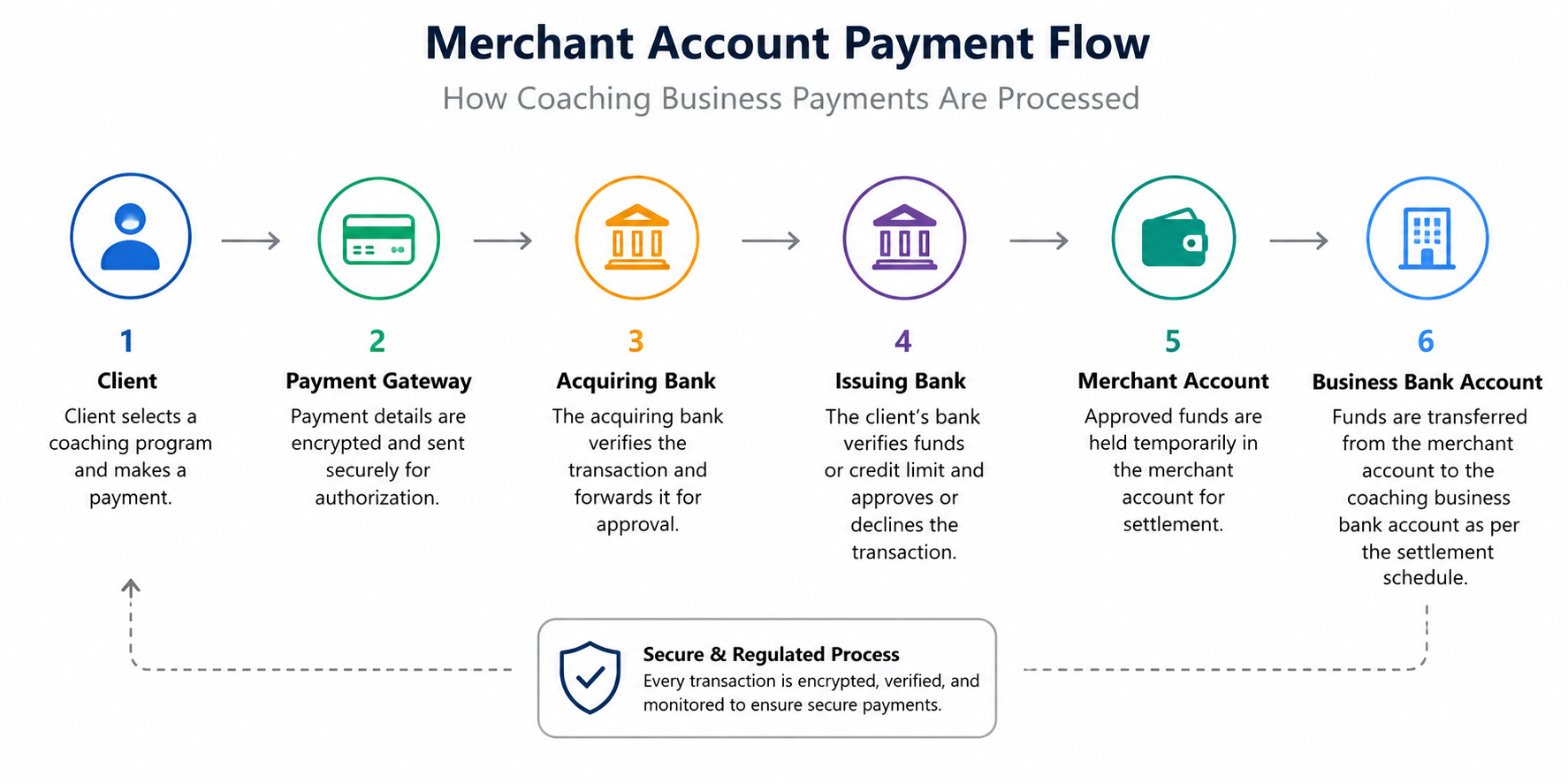
Unlike a standard business bank account, a merchant account is specifically designed to process electronic payments. When a client purchases a coaching program, the payment does not move directly from the customer’s card to the business account. Instead, the transaction passes through several stages of authorization, verification, settlement, and fund transfer.
For example, imagine a leadership coach selling a six-month executive coaching package worth $4,000.
After the client enters their payment details:
- The payment request is sent for authorization.
- The customer’s bank confirms whether the transaction can proceed.
- The merchant account receives the approved transaction for settlement.
- The funds are transferred to the coach’s business account according to the settlement schedule.
Although this entire process usually takes only a short time, multiple financial systems work together behind the scenes to complete the transaction securely.
Why Do Coaching Businesses Need a Merchant Account?
As coaching businesses grow, payment requirements become more complex. An independent coach offering occasional sessions may process only a few transactions each month.
However, businesses selling high-value coaching packages, recurring memberships, or online programs often require a more structured payment infrastructure. A merchant account supports this growth by providing a reliable framework for accepting digital payments.
For example, an online coaching platform serving hundreds of members cannot rely solely on manual payment collection. It needs a system capable of handling multiple customer payments, subscription renewals, and transaction reporting efficiently.
Merchant accounts also support businesses that:
- Sell premium coaching programs
- Offer installment payment plans
- Manage recurring memberships
- Serve international clients
- Process large monthly transaction volumes
As revenue grows, having the right payment infrastructure becomes increasingly important.
How Merchant Account Approval Works?
Many coaching business owners are surprised to learn that merchant accounts require an approval process.
Payment providers review businesses before allowing them to process card payments because they assume financial risk whenever transactions occur. The review helps providers understand how the business operates and whether its payment activity aligns with acceptable risk levels.
Several factors are commonly evaluated during the approval process.
Business Information
Providers typically verify basic business details, including:
- Business registration
- Legal entity information
- Business address
- Ownership details
- Tax identification information
This confirms that the coaching business is operating as a legitimate commercial entity.
Website Review
For online coaching businesses, the website is often one of the first things payment providers examine. They may review whether the website clearly explains:
- Coaching services
- Pricing information
- Contact details
- Privacy policy
- Terms and conditions
- Refund policy
For example, if a business sells premium coaching packages without explaining what clients receive, payment providers may request additional clarification before approval. A transparent website demonstrates professionalism and helps reduce potential customer disputes.
Business Model Assessment
Providers also review how coaching services are delivered. For example, they may evaluate:
- One-on-one coaching
- Group coaching
- Membership communities
- Online courses
- Subscription services
Businesses offering recurring billing or high-ticket coaching packages may receive additional review because these models involve ongoing payment commitments. The purpose is not necessarily to reject these businesses but to understand how payments will be processed over time.
Documents Coaching Businesses May Need
Although requirements vary, coaching businesses are often asked to provide documentation during the application process. Common examples include:
- Business registration documents
- Government-issued identification
- Business bank account details
- Website information
- Processing estimates
- Description of coaching services
For example, a business coach applying for a merchant account may be asked to explain average transaction values and expected monthly sales volume. Providing accurate information helps create a smoother approval process.
Common Reasons Merchant Account Applications Are Delayed
Approval delays do not always indicate that a coaching business is unsuitable. In many cases, providers simply need additional information.
Some common reasons include:
- Incomplete business documentation
- Missing website policies
- Unclear coaching service descriptions
- Inconsistent business information
- Limited operating history
For example, if the application lists one business name while the website displays another, the provider may request clarification before proceeding. Preparing complete and consistent information helps reduce unnecessary delays.
Choosing a Merchant Account That Supports Growth
Not every merchant account is equally suited to every coaching business. A life coach working with individual clients may have different requirements than a coaching marketplace managing hundreds of coaches and thousands of customer transactions.
When evaluating payment capabilities, businesses should consider:
- Support for recurring billing
- International payment acceptance
- Multiple payment methods
- Reporting and transaction visibility
- Integration with existing business systems
The goal is to select payment infrastructure that can continue supporting the business as client numbers increase.
Merchant Accounts and Customer Experience
Although clients rarely think about merchant accounts directly, they influence the overall payment experience. Reliable payment infrastructure helps businesses create:
- Faster payment processing
- Smoother checkout experiences
- Consistent payment approvals
- Better subscription management
- More reliable transaction records
For example, a coaching membership platform with stable payment processing is less likely to experience interruptions during monthly subscription renewals.
That consistency improves both customer satisfaction and operational efficiency.
Final Thoughts
A merchant account is one of the core components of online payment processing for coaching businesses.
It enables businesses to accept card payments securely while supporting the financial processes that occur behind every successful transaction.
Whether you operate an independent coaching practice or a growing coaching platform, understanding how merchant accounts work, what providers review during approval, and how payment infrastructure supports business growth can help you create a more reliable and scalable payment operation. Strong payment foundations allow coaching businesses to focus on what matters most – delivering valuable coaching experiences while managing revenue with confidence.

Categories
- ACH Payments (10)
- adult payment processing (11)
- AI (9)
- Altcoins (10)
- Banking (10)
- Bitcoin (133)
- Bitcoin ETF (11)
- Bitcoin Price (30)
- Blockchain (50)
- Brokering World Hunger Away (16)
- Business (17)
- card payment processing (10)
- CBD (11)
- CBDC (11)
- coaching business (11)
- COVID-19 (3)
- Crypto ATMs (1)
- Crypto Banking (17)
- Crypto Bill (1)
- Crypto business owner platform (31)
- Crypto Investment (3)
- Crypto Markets (5)
- Crypto Payment (35)
- Crypto Payment Processor (4)
- Crypto Prices (1)
- Crypto Trading (92)
- Cryptocurrency (402)
- Cryptocurrency Exchange (108)
- Data Visualization (2)
- dating platforms (11)
- debt collection payment processing (10)
- Decentralized Finance (7)
- DeFi Payment (9)
- DEX (3)
- Digital Currency (23)
- dropshipping payment processing (12)
- Ethereum (2)
- FAQ (7)
- file sharing payment processing (11)
- Finance (25)
- Financial Equality (4)
- Financial Freedom (8)
- Forex (35)
- hemp (1)
- ICO (2)
- Investment (11)
- IPTV (11)
- Merchant Account (10)
- Mining (3)
- News (66)
- NFTs (2)
- online gambling (11)
- P2P (1)
- Paybito (139)
- PayBitoPro (693)
- PayBitoPro Coin Listing (6)
- PayBitoPro Exchange (2)
- Payment Gateway (40)
- peptide (10)
- Post COVID Digital Transformation (1)
- Press Release (130)
- Privacy & Security (3)
- Real Estate (1)
- Stablecoin (5)
- Technology (15)
- Travel (11)
- Uncategorized (9)
- US Presidential Election (2)
- Utility Coin (1)
- Web3 business (4)
- Web3 Wallets (2)
- White Label Crypto Exchange (8)
Recent Posts
- ACH vs Wire Transfer: Which Payment Method Is Better for Businesses?
- ACH Fraud Prevention: How Businesses Can Secure Bank Account Payments?
- ACH Credit vs ACH Debit: What’s the Difference? With Real Examples
- ACH vs Credit Card: Which Payment Method Is Better for Businesses?
- How Long Do ACH Payments Take? Processing Times, Settlement, and Same Day ACH