Why Do Dropshipping Payments Get Declined? Common Causes and How to Fix Payment Failures
- August 7, 2026
- Soham Guchait
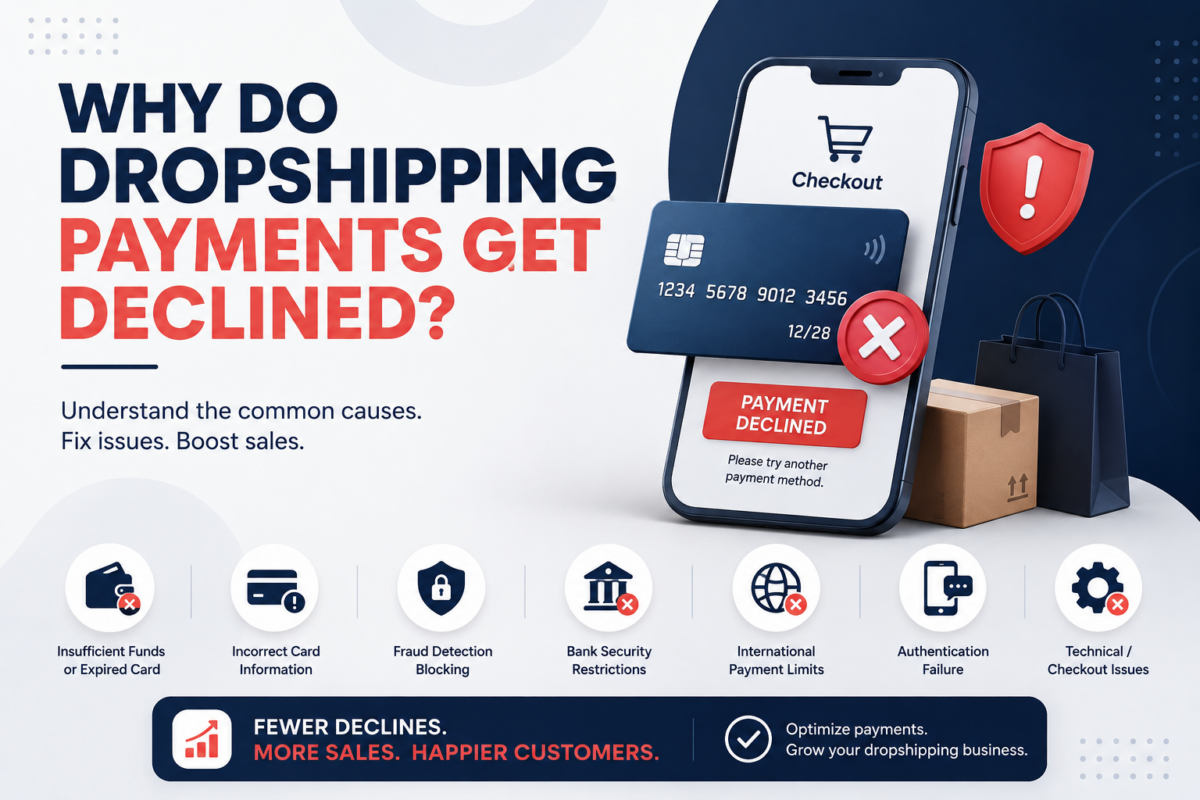
Nothing is more frustrating for an online business than seeing a customer reach the checkout page, attempt to pay, and then abandon the purchase because the payment fails. For dropshipping businesses, every declined transaction represents more than a lost sale – it can also mean wasted advertising spend, lower conversion rates, reduced customer trust, and missed opportunities to build repeat business.
Many entrepreneurs assume that a declined payment simply means the customer’s card has insufficient funds. In reality, payment declines occur for a wide variety of reasons, ranging from bank security measures and fraud detection systems to technical checkout issues and international payment restrictions. Understanding why dropshipping payments get declined allows merchants to identify payment bottlenecks, improve checkout performance, and increase successful transaction rates.
What Does a Declined Payment Mean?
A declined payment occurs when a transaction is not approved during the authorization process. Before a payment is accepted, several organizations – including the payment gateway, payment processor, card network, and issuing bank – evaluate the transaction in just a few seconds. If any part of this process identifies an issue, the payment may be rejected.
Importantly, a declined payment does not always indicate a problem with the customer’s card or the merchant’s business. Sometimes the decline is simply a precautionary security measure designed to protect both parties.
For example, a customer attempting to purchase a product while traveling overseas may have their bank temporarily reject the transaction because the purchase appears unusual compared to their previous spending habits.
Understanding where declines occur helps merchants focus on solving the right problem rather than assuming every failed payment has the same cause.
How a Payment Gets Approved – or Declined?
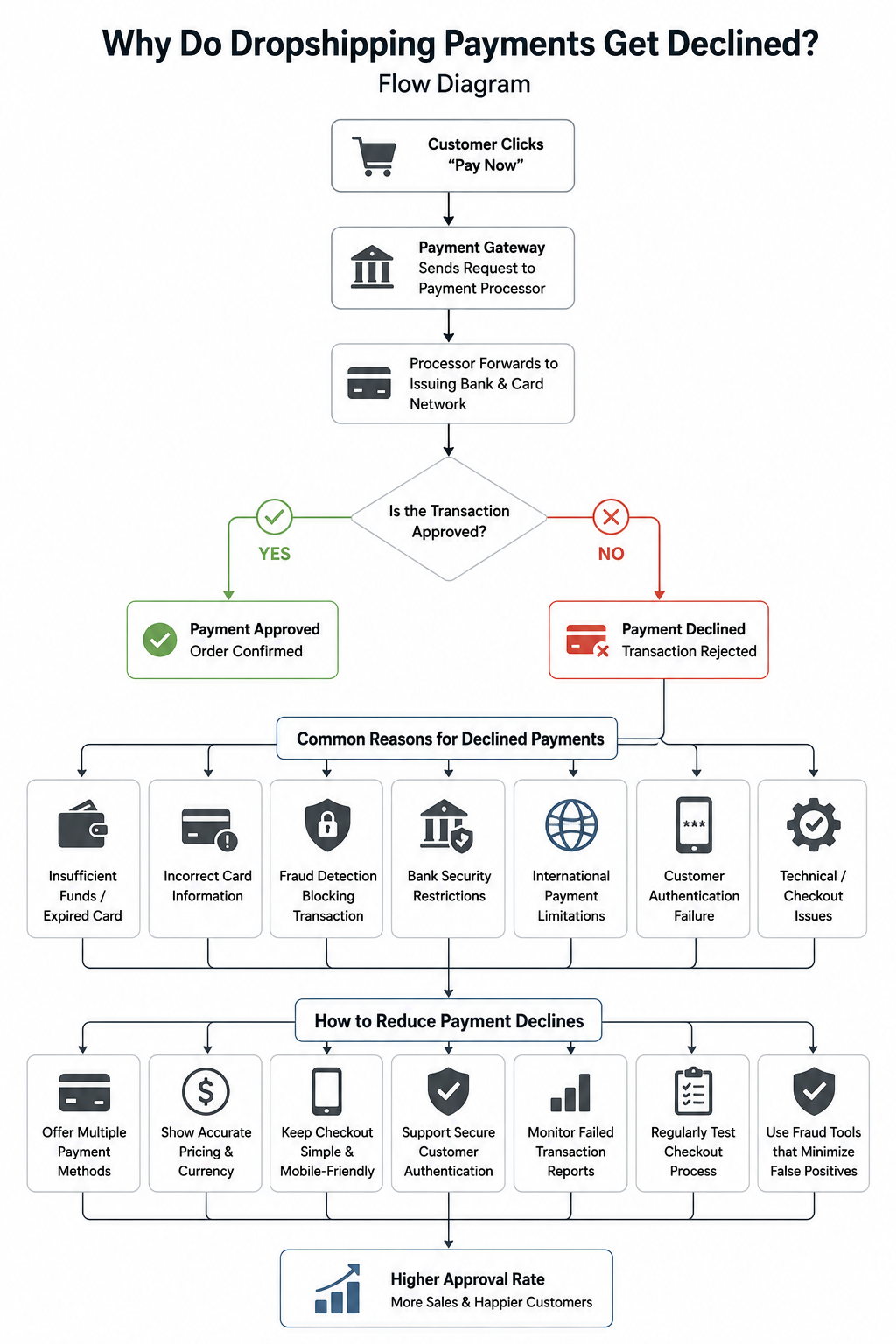
When a customer clicks “Pay Now,” multiple systems work together almost instantly.
The payment gateway securely forwards transaction information to the payment processor, which communicates with the customer’s issuing bank. The bank reviews several factors before making a decision, including card validity, available funds, spending behavior, security checks, and fraud indicators.
If everything appears legitimate, the payment is authorized and the merchant receives confirmation to process the order. However, if any verification step raises concerns, the transaction is declined before funds are transferred. Although this process usually takes only a few seconds, it involves sophisticated risk analysis designed to protect customers, merchants, and financial institutions.
Common Reasons Dropshipping Payments Get Declined
Payment declines are often the result of multiple factors rather than a single issue. Some of the most common causes include:
- Insufficient funds or expired payment cards.
- Incorrect card information entered during checkout.
- Fraud prevention systems blocking suspicious transactions.
- Bank security restrictions.
- International payment limitations.
- Failed customer authentication.
- Temporary technical issues during checkout.
Each of these scenarios requires a different solution, making it important to understand the underlying cause before attempting to resolve the problem.
Fraud Detection Can Block Legitimate Customers
Modern payment systems use advanced fraud detection tools to identify suspicious purchasing behavior. While these systems successfully prevent many fraudulent transactions, they can occasionally block genuine customers.
Imagine a customer who has never purchased internationally before. They discover a dropshipping store selling specialty coffee equipment and decide to place a high-value order using a new shipping address. From the fraud detection system’s perspective, several unusual factors appear simultaneously:
- First international purchase.
- High transaction value.
- New delivery location.
- Different browsing location from previous purchases.
Even though the customer is legitimate, the transaction may be declined until additional verification is completed. For merchants, reducing false declines involves balancing strong fraud protection with a smooth customer experience.
International Transactions Often Require Additional Verification
Dropshipping businesses frequently sell products to customers across multiple countries. While this creates growth opportunities, international payments naturally involve additional security checks. Banks often examine cross-border transactions more closely because they carry increased fraud exposure.
For example, a customer in Germany purchases from a US-based dropshipping store using a payment card issued in France while traveling in Spain. Although the purchase is legitimate, the combination of different countries may trigger additional verification requirements.
Supporting multiple currencies, regional payment preferences, and secure authentication methods can improve payment success rates for international customers.
Customer Authentication Failures
Many online transactions now require additional customer verification before payment approval. These authentication methods help reduce fraud but can also introduce friction during checkout.
If a customer does not complete the required verification step or closes the authentication window before confirmation, the payment may be declined even though sufficient funds are available.
Consider a shopper purchasing home décor products during their lunch break. Their bank sends a one-time verification request to their mobile device, but they ignore the notification and return to work. Without completing the authentication process, the transaction expires and is automatically declined. Providing a clear and user-friendly checkout experience helps reduce this type of payment failure.
Technical Checkout Problems Can Interrupt Payments
Not every declined payment originates from banks or fraud systems. Sometimes the issue lies within the ecommerce checkout itself. Technical problems such as interrupted internet connections, outdated software integrations, session timeouts, or incomplete payment requests can prevent successful authorization.
For example, a customer spends several minutes comparing products before checking out. During that time, their checkout session expires without notice. When they submit payment details, the transaction fails because the session is no longer active.
Regular testing of the checkout process helps identify these issues before they affect large numbers of customers.
How Merchants Can Reduce Payment Declines?
While some payment declines are outside a merchant’s control, many can be reduced by improving both the payment experience and business operations. Effective strategies include:
- Offering multiple trusted payment methods.
- Displaying accurate pricing and currency information.
- Keeping checkout simple and mobile-friendly.
- Supporting secure customer authentication.
- Monitoring failed transaction reports.
- Regularly testing the checkout process.
- Using fraud tools that minimize false positives.
Imagine a dropshipping business that notices a growing number of failed payments from customers in Europe. After reviewing transaction reports, the merchant discovers that many customers prefer local payment methods that are not currently supported. Expanding payment options improves both customer convenience and successful payment rates.
Small operational improvements often produce measurable increases in completed purchases.
Why Monitoring Payment Performance Matters?
Many businesses only investigate payment issues after customer complaints increase. Successful merchants instead monitor payment performance continuously. Tracking approval rates, decline reasons, abandoned checkouts, and regional payment trends helps identify patterns before they become significant business problems.
For instance, if approval rates suddenly decline after introducing a new checkout update, merchants can investigate technical changes before customer trust is affected.
Monitoring payment data also helps businesses make informed decisions about fraud prevention, payment methods, international expansion, and future payment infrastructure improvements.
Looking Beyond Individual Transactions
A single declined payment is usually a temporary inconvenience. However, consistently high decline rates can indicate broader operational issues.
Businesses experiencing frequent payment failures should evaluate their checkout process, payment gateway configuration, merchant account performance, fraud screening rules, and customer authentication flow. Improving these areas not only increases successful transactions but also contributes to lower cart abandonment rates and stronger customer confidence.
As a dropshipping business grows, payment performance becomes a competitive advantage rather than simply a technical requirement.
Final Thoughts
Payment declines are a normal part of online commerce, but understanding why they happen enables dropshipping businesses to reduce unnecessary transaction failures and improve the customer experience.
Rather than assuming every declined payment is caused by insufficient funds, merchants should recognize the many factors involved, including bank security measures, fraud prevention systems, international transactions, customer authentication, and technical checkout performance.
By monitoring payment trends, optimizing the checkout experience, supporting multiple payment methods, and maintaining reliable payment infrastructure, dropshipping businesses can improve authorization rates while building greater customer trust. A smoother payment experience not only increases completed purchases but also creates the foundation for long-term ecommerce growth.

Categories
- ACH Payments (10)
- adult payment processing (11)
- AI (9)
- Altcoins (10)
- Banking (10)
- Bitcoin (133)
- Bitcoin ETF (11)
- Bitcoin Price (30)
- Blockchain (50)
- Brokering World Hunger Away (16)
- Business (17)
- card payment processing (10)
- CBD (11)
- CBDC (11)
- coaching business (11)
- COVID-19 (3)
- Crypto ATMs (1)
- Crypto Banking (17)
- Crypto Bill (1)
- Crypto business owner platform (31)
- Crypto Investment (3)
- Crypto Markets (5)
- Crypto Payment (35)
- Crypto Payment Processor (4)
- Crypto Prices (1)
- Crypto Trading (92)
- Cryptocurrency (402)
- Cryptocurrency Exchange (108)
- Data Visualization (2)
- dating platforms (11)
- debt collection payment processing (10)
- Decentralized Finance (7)
- DeFi Payment (9)
- DEX (3)
- Digital Currency (23)
- dropshipping payment processing (12)
- Ethereum (2)
- FAQ (7)
- file sharing payment processing (11)
- Finance (25)
- Financial Equality (4)
- Financial Freedom (8)
- Forex (35)
- hemp (1)
- ICO (2)
- Investment (11)
- IPTV (11)
- Merchant Account (10)
- Mining (3)
- News (66)
- NFTs (2)
- online gambling (11)
- P2P (1)
- Paybito (139)
- PayBitoPro (693)
- PayBitoPro Coin Listing (6)
- PayBitoPro Exchange (2)
- Payment Gateway (40)
- peptide (10)
- Post COVID Digital Transformation (1)
- Press Release (130)
- Privacy & Security (3)
- Real Estate (1)
- Stablecoin (5)
- Technology (15)
- Travel (11)
- Uncategorized (9)
- US Presidential Election (2)
- Utility Coin (1)
- Web3 business (4)
- Web3 Wallets (2)
- White Label Crypto Exchange (8)
Recent Posts
- ACH vs Wire Transfer: Which Payment Method Is Better for Businesses?
- ACH Fraud Prevention: How Businesses Can Secure Bank Account Payments?
- ACH Credit vs ACH Debit: What’s the Difference? With Real Examples
- ACH vs Credit Card: Which Payment Method Is Better for Businesses?
- How Long Do ACH Payments Take? Processing Times, Settlement, and Same Day ACH