Best Payment Methods for Dropshipping Businesses: Choosing the Right Options for Online Stores
- August 7, 2026
- Soham Guchait
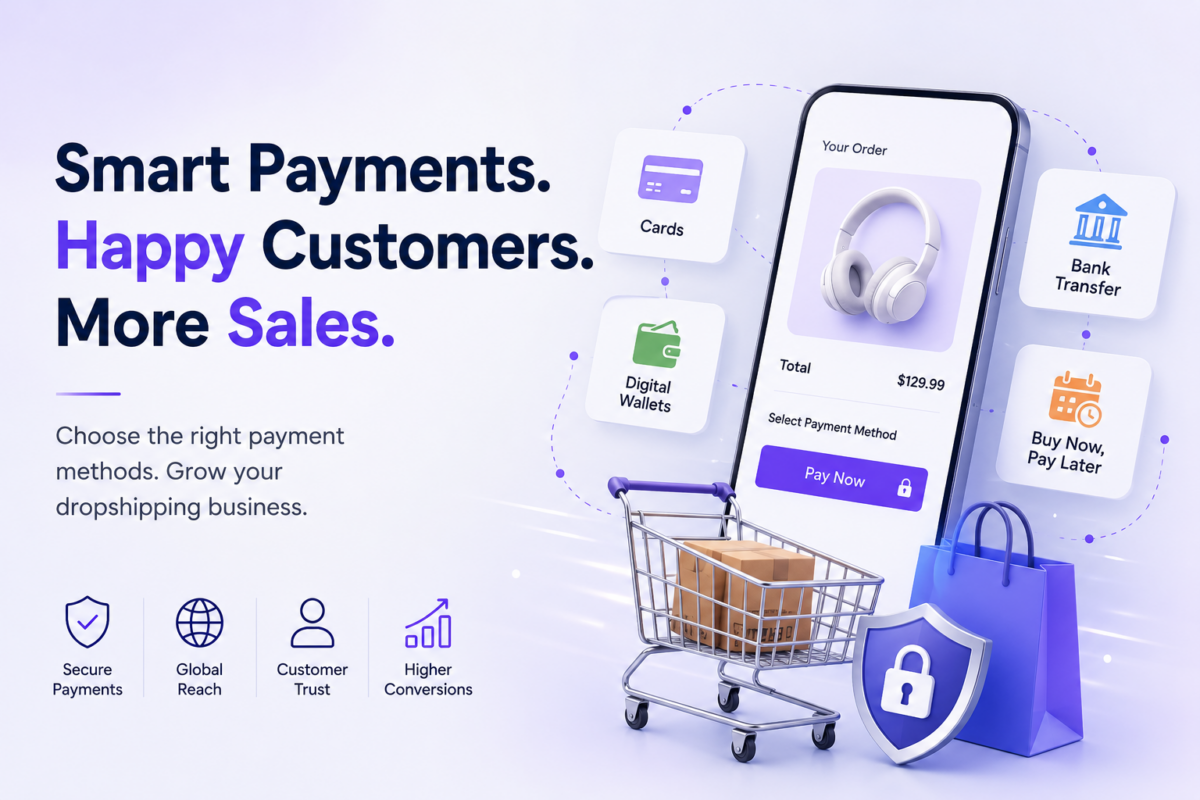
When customers reach the checkout page, they have already decided they want your product. The final step of completing the payment should be simple, secure, and convenient. However, many dropshipping businesses lose potential sales because they don’t offer the payment methods customers expect.
Today’s online shoppers use more than just credit and debit cards. Some prefer digital wallets, while others rely on bank transfers or region-specific payment options. International customers often have completely different payment preferences than domestic buyers. If those options aren’t available, many customers abandon their carts before completing their purchase.
Choosing the best payment methods for dropshipping businesses is therefore more than a convenience feature. It directly affects conversion rates, customer trust, international expansion, and overall business growth. Understanding which payment methods suit your customers helps create a smoother checkout experience while reducing friction during online purchases.
Why Payment Methods Matter More Than Ever?
A payment method is the way customers choose to complete a purchase. While every payment eventually moves through a payment processor and merchant account, the customer’s preferred way of paying can significantly influence whether they complete the transaction.
Imagine two customers shopping for the same product.
The first customer is comfortable entering credit card details directly on the checkout page. The second customer prefers using a digital wallet because they don’t want to type their payment information every time they shop online. If your store only supports one payment option, you risk losing customers who prefer another.
Customer expectations have changed over the last few years. Online buyers now expect checkout pages to be fast, secure, and flexible. Offering multiple payment methods helps meet these expectations while making purchases easier for different types of shoppers.
Understanding the Most Common Payment Methods
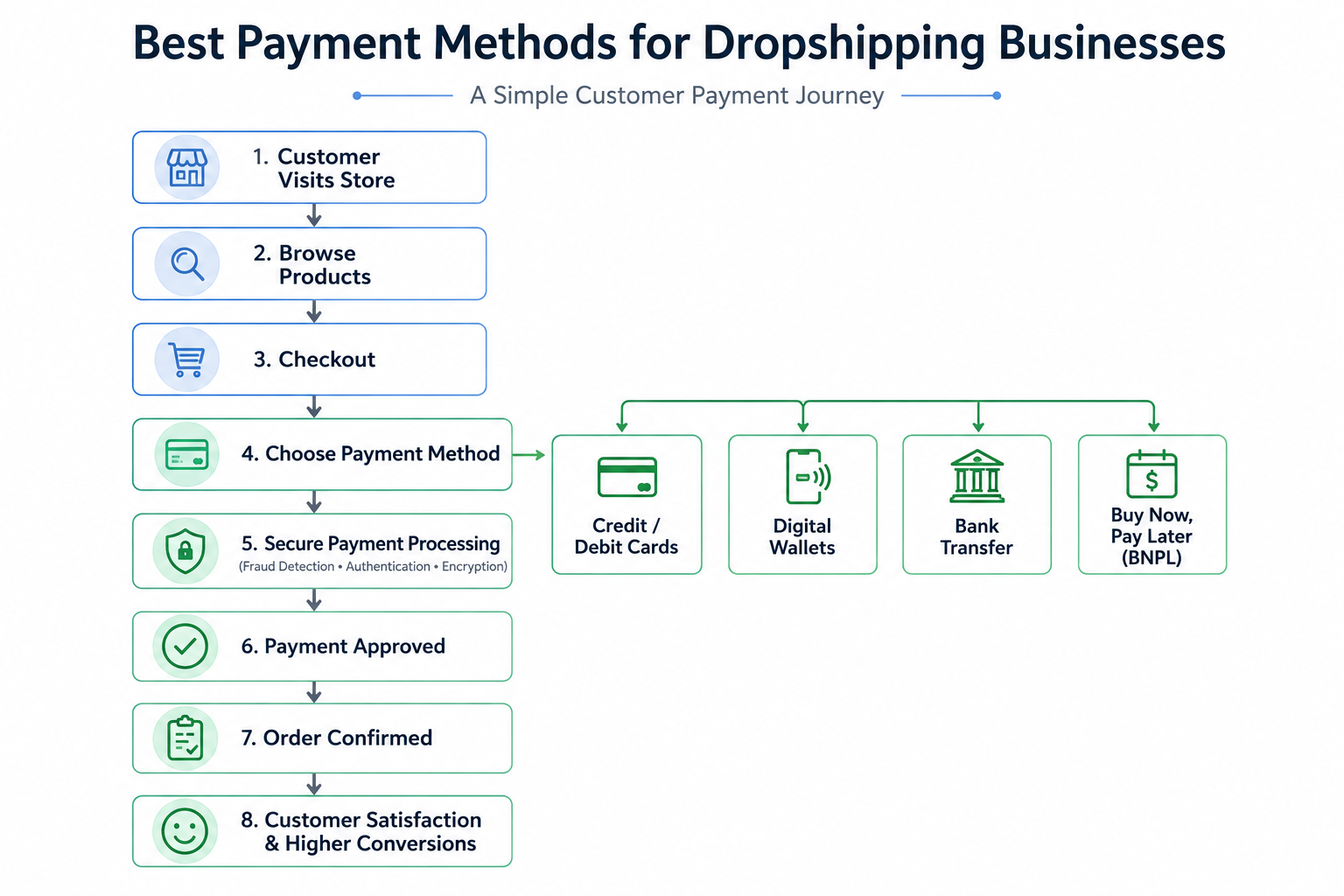
Different payment methods serve different customer needs. Rather than choosing the option with the lowest processing cost, businesses should understand how each method fits into the overall customer journey.
Credit and Debit Cards
Credit and debit cards remain the most widely accepted payment methods for ecommerce businesses. They offer familiarity, global acceptance, and quick transaction processing. Customers can complete purchases in just a few clicks, making cards an essential part of almost every dropshipping checkout.
However, card payments also require strong fraud prevention measures and secure payment processing because they remain a common target for fraudulent transactions. For businesses selling internationally, supporting major card networks ensures that customers from multiple countries can complete purchases without unnecessary obstacles.
Digital Wallets
Digital wallets have become one of the fastest-growing payment methods in online commerce. Instead of manually entering payment details, customers authorize purchases using stored payment information.
For example, a customer browsing your dropshipping store on a smartphone may complete a purchase using a digital wallet within seconds. This faster checkout experience often reduces cart abandonment, particularly for mobile users. Digital wallets also provide additional security because customers don’t repeatedly share their card details with every online store.
Bank Transfers
Although less common for everyday consumer purchases, bank transfers remain important for certain types of transactions.
Businesses selling higher-value products or serving corporate customers may encounter buyers who prefer transferring funds directly from their bank accounts. While settlement can sometimes take longer than card payments, bank transfers provide another payment option that increases flexibility for specific customer segments.
Buy Now, Pay Later (BNPL)
Buy Now, Pay Later services have become increasingly popular, especially for larger online purchases. Instead of paying the full amount immediately, customers divide payments into smaller installments.
Imagine a customer purchasing premium office furniture from a dropshipping store. Rather than paying the entire amount upfront, they choose installment payments that better fit their budget.
For merchants, offering installment payment options can increase average order value while making expensive products more accessible to customers.
Why Offering Multiple Payment Methods Increases Sales?
One of the biggest mistakes new ecommerce businesses make is assuming every customer prefers the same payment option. Customer preferences vary depending on age, location, device, purchasing habits, and trust in the online store.
Consider a dropshipping business selling fitness equipment internationally. A customer in the United States may prefer paying with a credit card, while another customer in Europe might feel more comfortable using a digital wallet or a locally popular payment method. If the preferred option isn’t available, they may simply leave the website and purchase elsewhere.
Providing multiple payment methods reduces this friction by allowing customers to choose the option they already trust. The goal isn’t to overwhelm customers with dozens of payment choices. Instead, merchants should support the payment methods that align with their target audience and the regions they serve.
Choosing Payment Methods for International Customers
One of the biggest advantages of dropshipping is the ability to sell products globally. However, international expansion also requires understanding how customers pay in different markets.
Payment preferences vary significantly between countries. Some regions rely heavily on traditional card payments, while others favor mobile wallets, bank transfers, or local payment systems.
A customer shopping from Japan, Germany, or Brazil may not expect the same checkout experience as someone purchasing from the United States or Canada. Businesses planning to expand internationally should evaluate:
- Local payment preferences.
- Currency support.
- Cross-border transaction capabilities.
- Mobile payment adoption.
- Customer trust during checkout.
Supporting relevant payment methods for each market creates a more familiar purchasing experience and improves conversion rates.
Balancing Customer Convenience with Security
While adding more payment options improves flexibility, merchants must also ensure those methods are supported by secure payment infrastructure. Every payment method should integrate with fraud prevention systems, transaction monitoring, and customer authentication where appropriate.
For example, suppose a fraudster attempts to purchase multiple high-value electronics using stolen payment credentials. Regardless of the payment method selected, security tools should identify unusual purchasing patterns before the order is fulfilled.
Offering convenient payment options should never come at the expense of transaction security. Businesses should regularly review fraud reports, payment decline rates, and customer feedback to ensure their checkout process remains both secure and user-friendly.
Common Mistakes When Selecting Payment Methods
Many dropshipping businesses either offer too few payment options or choose methods based solely on processing costs. Common mistakes include:
- Ignoring customer payment preferences.
- Offering payment methods unsuitable for international customers.
- Failing to optimize the checkout experience for mobile devices.
- Adding unnecessary complexity during checkout.
- Not reviewing payment performance over time.
For example, a business targeting international customers may discover that most abandoned carts occur because buyers cannot use their preferred payment method. Expanding payment options often produces a greater impact than redesigning the website itself. The best payment strategy combines customer convenience with operational efficiency.
Building a Payment Strategy That Grows with Your Business
Payment methods should evolve alongside your business. A newly launched dropshipping store may begin with a few trusted payment options. As sales increase and new markets are added, businesses should regularly evaluate customer behavior and payment trends.
For businesses managing multiple dropshipping stores, seller networks, or expanding ecommerce operations, a white label payment platform for dropshipping businesses can provide a more scalable way to manage payment experiences, transaction flows, and payment operations under a unified system.
Monitoring completed transactions, abandoned carts, and regional purchasing patterns helps merchants decide when to introduce additional payment methods. This approach also supports future growth by improving customer satisfaction and reducing unnecessary payment barriers.
Remember that payment methods represent only one part of a complete payment ecosystem. Merchant account approval, payment gateways, fraud prevention, chargeback management, international payment processing, and compliance all work together to create a reliable payment experience.
Final Thoughts
Choosing the best payment methods for dropshipping businesses is about understanding how customers prefer to pay rather than simply accepting online payments. By offering trusted payment options, supporting international customers, maintaining strong security, and regularly reviewing payment performance, businesses can create a checkout experience that encourages more successful transactions.
As your store grows, payment methods should continue evolving alongside customer expectations and market opportunities. Businesses that invest in flexible, secure, and customer-focused payment strategies are better positioned to improve conversion rates, build customer trust, and support sustainable ecommerce growth.
Categories
- ACH Payments (10)
- adult payment processing (11)
- AI (9)
- Altcoins (10)
- Banking (10)
- Bitcoin (133)
- Bitcoin ETF (11)
- Bitcoin Price (30)
- Blockchain (50)
- Brokering World Hunger Away (16)
- Business (17)
- card payment processing (10)
- CBD (11)
- CBDC (11)
- Chargeback (8)
- coaching business (11)
- COVID-19 (3)
- Crypto ATMs (1)
- Crypto Banking (17)
- Crypto Bill (1)
- Crypto business owner platform (31)
- Crypto Investment (3)
- Crypto Markets (5)
- Crypto Payment (35)
- Crypto Payment Processor (4)
- Crypto Prices (1)
- Crypto Trading (92)
- Cryptocurrency (402)
- Cryptocurrency Exchange (108)
- Data Visualization (2)
- dating platforms (11)
- debt collection payment processing (10)
- Decentralized Finance (7)
- DeFi Payment (9)
- DEX (3)
- Digital Currency (23)
- dropshipping payment processing (12)
- Ethereum (2)
- FAQ (7)
- file sharing payment processing (11)
- Finance (25)
- Financial Equality (4)
- Financial Freedom (8)
- Forex (35)
- hemp (1)
- ICO (2)
- Investment (11)
- IPTV (11)
- Merchant Account (10)
- Mining (3)
- News (66)
- NFTs (2)
- online gambling (11)
- P2P (1)
- Paybito (147)
- PayBitoPro (693)
- PayBitoPro Coin Listing (6)
- PayBitoPro Exchange (2)
- Payment Gateway (48)
- peptide (10)
- Post COVID Digital Transformation (1)
- Press Release (130)
- Privacy & Security (3)
- Real Estate (1)
- Stablecoin (5)
- Technology (15)
- Travel (11)
- Uncategorized (10)
- US Presidential Election (2)
- Utility Coin (1)
- Web3 business (4)
- Web3 Wallets (2)
- White Label Crypto Exchange (8)
Recent Posts
- Payment Gateway vs. Payment Orchestration: What’s the Difference?
- What Is Smart Payment Routing? Strategies to Optimize Payment Performance
- How to Improve Payment Approval Rates for High-Risk Businesses?
- Why Are Online Payments Failing? Common Causes and How to Fix Them
- How to Use Multiple Payment Processors to Reduce Business Disruptions?