IPTV Merchant Account: Requirements, Approval Process and How to Get One
- August 11, 2026
- Soham Guchait
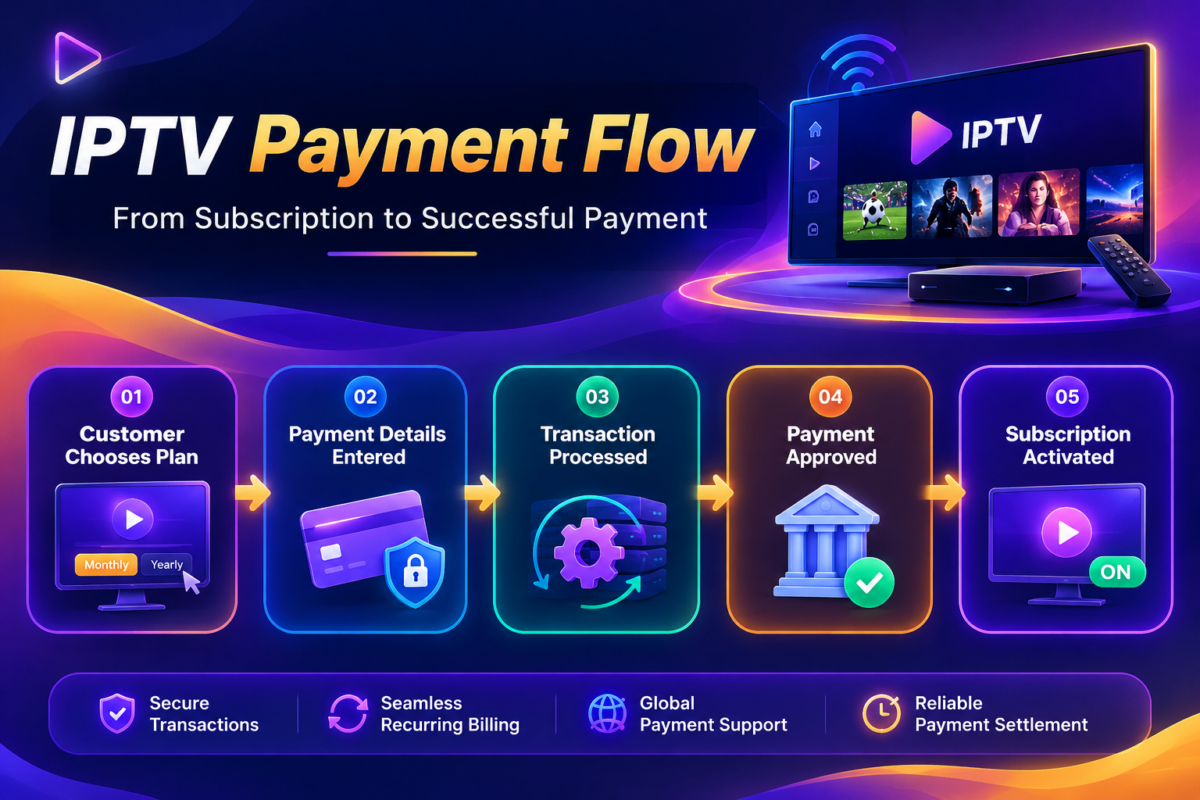
For an IPTV business, accepting customer payments requires more than simply adding a checkout page to a website. Behind every successful payment transaction is a merchant account that allows the business to receive card payments, process subscriptions, and manage ongoing customer billing.
An IPTV merchant account is a payment account designed to help IPTV businesses accept electronic payments from customers while working with payment processors and financial institutions.
For subscription-based IPTV businesses, having the right merchant account is especially important because revenue depends on recurring payments. A customer may subscribe today, but the business also needs the ability to process future renewals, handle failed payments, manage refunds, and maintain stable payment operations.
Getting approved for a merchant account depends on several factors, including the business model, transaction history, expected processing volume, customer base, and the information provided during the application process.
What Is an IPTV Merchant Account?
A merchant account is a specialized business account that allows a company to accept card payments and receive funds from customer transactions.
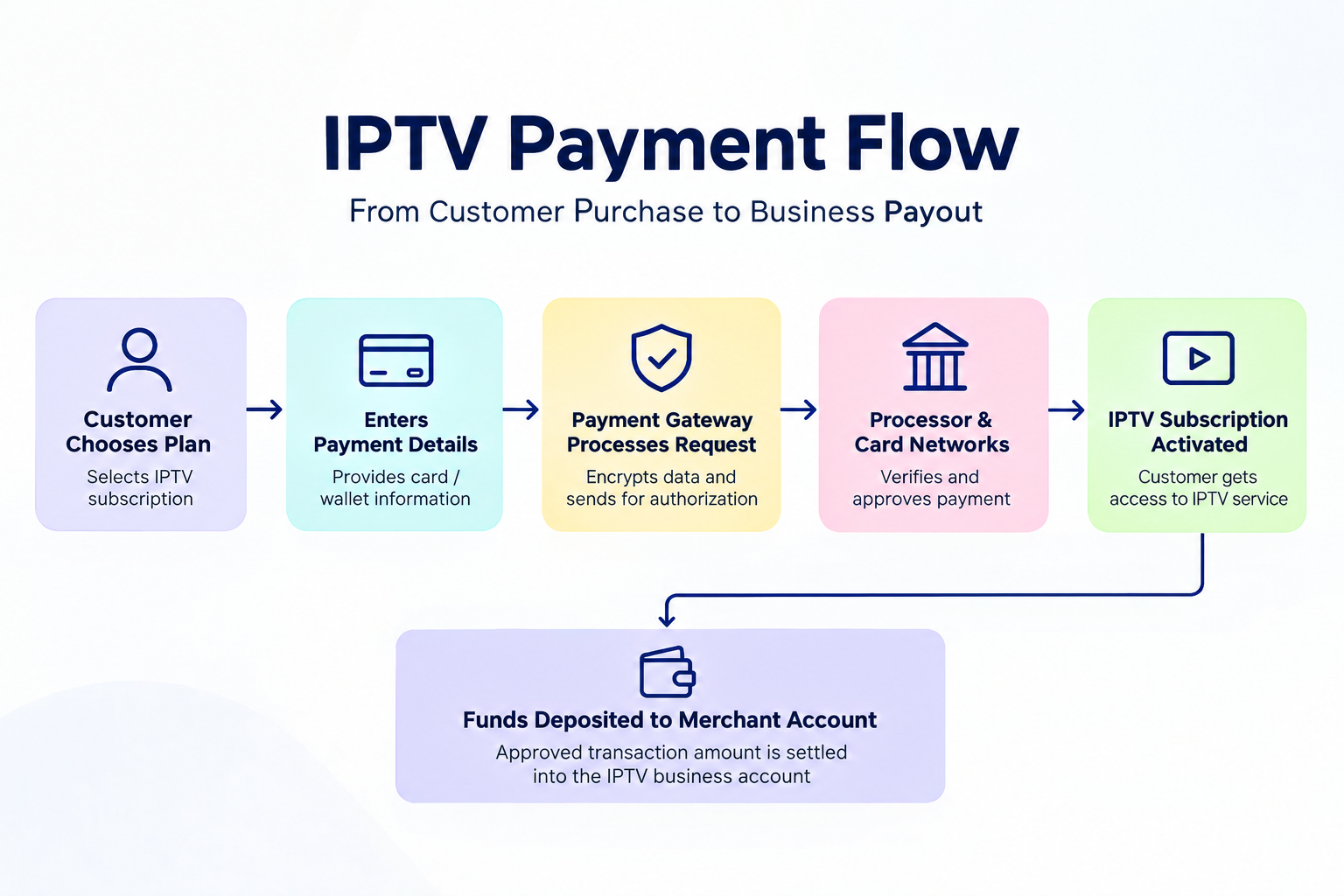
Unlike a regular business bank account, a merchant account is connected to the payment processing ecosystem. When a customer purchases an IPTV subscription, the payment transaction moves through multiple stages before funds reach the business.
For example: A customer selects a monthly IPTV subscription and enters their card details. The payment gateway securely sends the transaction information, the processor communicates with the payment networks, and the approved funds are eventually deposited into the merchant account according to the settlement terms.
The merchant account acts as the connection between the IPTV business, payment processor, card networks, and banking system.
Without a suitable merchant account, an IPTV business may struggle to accept card payments, support recurring billing, or provide customers with a reliable checkout experience.
Why Do IPTV Businesses Need a Dedicated Merchant Account?
Many IPTV businesses operate differently from traditional ecommerce stores.
Instead of selling a physical product through a one-time transaction, IPTV providers usually offer digital subscriptions. This means payment providers need to understand factors such as:
- How customers subscribe and are billed.
- Whether payments are recurring or one-time.
- Expected transaction volume.
- Customer locations.
- Refund and cancellation procedures.
- Business ownership and operations.
For example, an IPTV company with 500 subscribers may process hundreds of recurring payments every month. A business with thousands of subscribers may need additional payment capabilities such as automated billing management, detailed reporting, and stronger transaction monitoring.
The merchant account needs to support the way the IPTV business actually operates.
IPTV Merchant Account Requirements
The approval process for an IPTV merchant account usually involves reviewing the business, its owners, and its expected payment activity. This mainly happens due to it being a high risk business.
While requirements vary between providers, businesses are commonly asked to provide information such as:
- Business registration documents and ownership details.
- Identification information for business owners or authorized representatives.
- Business website and service information.
- Bank account details.
- Expected transaction volume and customer locations.
- Refund, cancellation, and customer service policies.
Payment providers typically want to understand whether the information provided during application matches the actual business operations.
For example, if an IPTV business expects customers from multiple countries and plans to process international subscription payments, that information should be clearly explained during onboarding.
Transparency helps payment providers evaluate the business more accurately.
How IPTV Merchant Account Approval Works?
Getting approved for an IPTV merchant account generally involves an underwriting process.
Underwriting is the review process where the payment provider evaluates the potential risks associated with processing payments for the business. During this process, providers may review:
- Business model: The provider needs to understand what services the company offers, how customers access those services, and how subscriptions are structured.
- Transaction profile: Expected sales volume, average transaction size, recurring billing frequency, and customer locations can influence the approval decision.
- KYC and AML information: Payment providers may need to verify the identity of the business and its owners, understand the source and nature of expected transaction activity, and complete applicable Know Your Customer (KYC) and Anti-Money Laundering (AML) checks.
- Compliance and operational information: A professional website, clear customer policies, accurate business information, transparent subscription terms, and appropriate compliance procedures can help demonstrate that the business is properly prepared to process payments.
KYC and AML checks are an important part of merchant account onboarding because payment providers need to know who operates the business and understand how the payment account will be used. Depending on the provider and jurisdiction, this may involve verifying business registration documents, ownership information, identification documents, banking details, and other information relevant to the business.
Compliance requirements can also vary depending on factors such as the business model, customer locations, transaction volume, and payment markets being served. An IPTV business should therefore provide accurate and consistent information throughout the application process.
For example, a newly launched IPTV business expecting very high transaction volumes immediately may receive more questions compared to an established business with predictable payment history. Similarly, a business serving customers across multiple countries may need to provide additional information about its markets and payment activity.
Approval decisions are generally based on the overall business profile rather than a single factor.
For example, a newly launched IPTV business expecting very high transaction volumes immediately may receive more questions compared to an established business with predictable payment history.
Approval decisions are generally based on the overall business profile rather than a single factor.
Why IPTV Merchant Account Applications May Be Declined?
A declined application does not always mean a business cannot process payments. In many cases, applications are rejected because the provider does not have enough information to properly evaluate the business or because certain requirements are not met.
Common reasons may include:
- Incomplete business documentation.
- Unclear website information.
- Missing refund or cancellation policies.
- Unexpected transaction volumes.
- Inconsistent business details.
- Lack of previous processing history.
For example, an IPTV website that does not clearly explain its subscription plans, billing terms, or customer support process may create uncertainty during review.
Improving transparency and providing accurate business information can help businesses present a stronger application.
Merchant Account vs Payment Gateway: Understanding the Difference
Many IPTV businesses confuse merchant accounts and payment gateways because both are involved in accepting payments.
A merchant account allows the business to receive processed payment funds.
A payment gateway provides the technology that securely collects payment information and sends transaction requests for authorization.
Think of it this way:
A customer completes checkout through the payment gateway, the transaction is processed through the payment network, and approved funds are deposited into the merchant account. Both components work together, but they solve different parts of the payment process.
A reliable IPTV payment setup usually requires understanding how the merchant account, payment gateway, and payment processor operate together.
How to Choose the Right IPTV Merchant Account Provider?
Choosing a merchant account provider should not only be based on whether payments can be accepted. An IPTV business should evaluate whether the provider supports its long-term payment requirements. Important factors include:
- Support for recurring subscription payments.
- Ability to process the expected transaction volume.
- Available payment methods.
- International payment capabilities.
- Transaction reporting tools.
- Refund and dispute management processes.
- Settlement timelines and account terms.
- Integration options with existing systems.
For example, a small IPTV business may only need basic subscription payment capabilities, while a larger IPTV platform may require advanced payment management features.
The right merchant account should match the current business model while allowing room for future growth.
Building a Stable Payment Foundation for an IPTV Business
An IPTV merchant account is not just a tool for accepting payments. It becomes the foundation for managing customer subscriptions, recurring revenue, and long-term payment operations.
A properly structured merchant account helps businesses create a smoother payment experience, reduce unnecessary payment interruptions, and build better visibility into transaction activity.
Before applying, IPTV businesses should understand their subscription model, expected customer base, payment requirements, and operational processes.
The next step after understanding merchant accounts is choosing the right payment infrastructure – including how an IPTV payment gateway works, what features matter, and how businesses can select the right payment technology for their subscription model.
Categories
- ACH Payments (10)
- adult payment processing (11)
- AI (9)
- Altcoins (10)
- Banking (10)
- Bitcoin (133)
- Bitcoin ETF (11)
- Bitcoin Price (30)
- Blockchain (50)
- Brokering World Hunger Away (16)
- Business (17)
- card payment processing (10)
- CBD (11)
- CBDC (11)
- Chargeback (8)
- coaching business (11)
- COVID-19 (3)
- Crypto ATMs (1)
- Crypto Banking (17)
- Crypto Bill (1)
- Crypto business owner platform (31)
- Crypto Investment (3)
- Crypto Markets (5)
- Crypto Payment (35)
- Crypto Payment Processor (4)
- Crypto Prices (1)
- Crypto Trading (92)
- Cryptocurrency (402)
- Cryptocurrency Exchange (108)
- Data Visualization (2)
- dating platforms (11)
- debt collection payment processing (10)
- Decentralized Finance (7)
- DeFi Payment (9)
- DEX (3)
- Digital Currency (23)
- dropshipping payment processing (12)
- Ethereum (2)
- FAQ (7)
- file sharing payment processing (11)
- Finance (25)
- Financial Equality (4)
- Financial Freedom (8)
- Forex (35)
- hemp (1)
- ICO (2)
- Investment (11)
- IPTV (11)
- Merchant Account (10)
- Mining (3)
- News (66)
- NFTs (2)
- online gambling (11)
- P2P (1)
- Paybito (147)
- PayBitoPro (693)
- PayBitoPro Coin Listing (6)
- PayBitoPro Exchange (2)
- Payment Gateway (48)
- peptide (10)
- Post COVID Digital Transformation (1)
- Press Release (130)
- Privacy & Security (3)
- Real Estate (1)
- Stablecoin (5)
- Technology (15)
- Travel (11)
- Uncategorized (10)
- US Presidential Election (2)
- Utility Coin (1)
- Web3 business (4)
- Web3 Wallets (2)
- White Label Crypto Exchange (8)
Recent Posts
- Payment Gateway vs. Payment Orchestration: What’s the Difference?
- What Is Smart Payment Routing? Strategies to Optimize Payment Performance
- How to Improve Payment Approval Rates for High-Risk Businesses?
- Why Are Online Payments Failing? Common Causes and How to Fix Them
- How to Use Multiple Payment Processors to Reduce Business Disruptions?