IPTV Payment Gateway: How It Works, Setup and Features to Look For
- August 11, 2026
- Soham Guchait
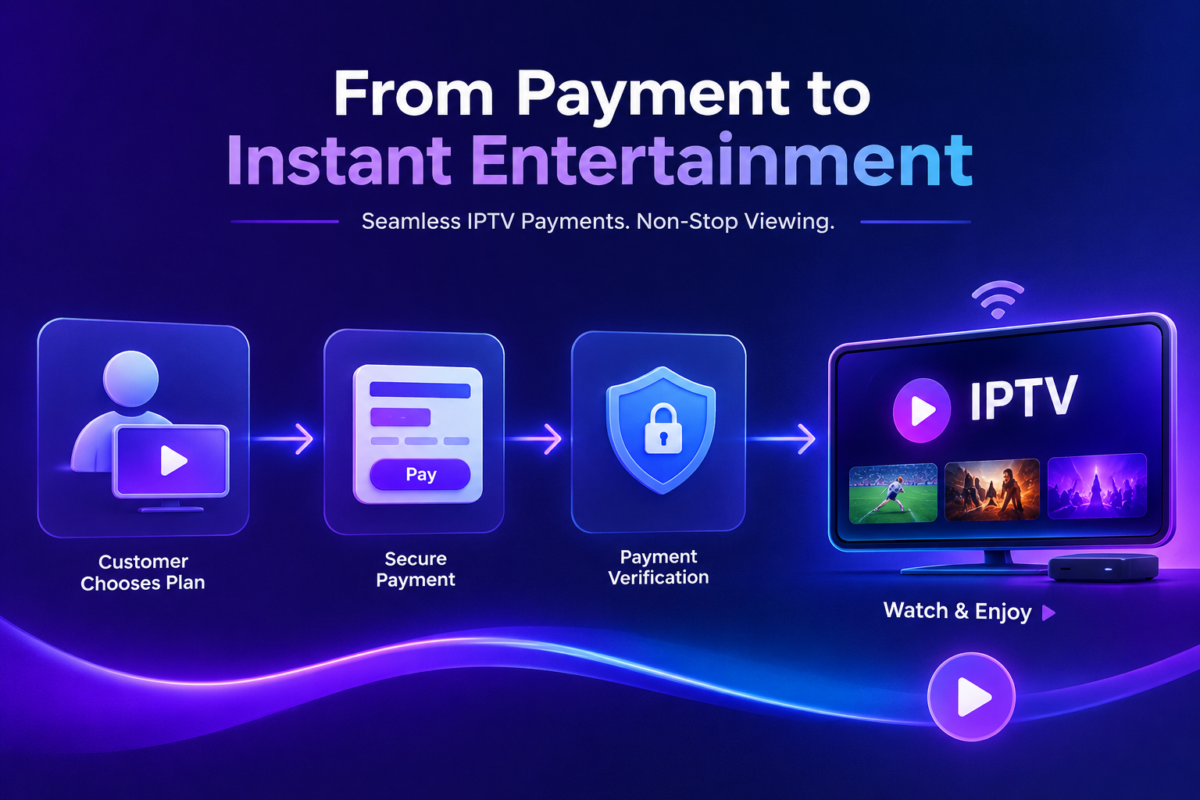
An IPTV payment gateway is the technology that allows an IPTV business to securely accept online payments from customers. It connects the customer’s checkout experience with the underlying payment processing infrastructure and helps transmit transaction information for authorization.
For an IPTV business, however, a payment gateway is more than a payment form on a website. IPTV services commonly operate through monthly, quarterly, or annual subscriptions, which means the payment system must support an ongoing billing relationship rather than a single transaction. Such a payment gateway can help a business manage customer payments, recurring subscriptions, failed transactions, refunds, and transaction information while providing customers with a convenient checkout experience.
Understanding how the gateway works and what features actually matter can help an IPTV business choose payment infrastructure that fits its subscription model and expected growth.
What Is an IPTV Payment Gateway?
A payment gateway is a technology layer that securely transfers payment information from a customer’s checkout to the systems responsible for processing the transaction.
When an IPTV subscriber enters their payment information and clicks the payment button, the gateway securely sends the transaction request through the appropriate payment infrastructure. The transaction is then authorized or declined, and the result is returned to the merchant’s checkout system. The gateway itself is not the same thing as a merchant account or payment processor.
A merchant account provides the account structure through which an approved business can receive card-processing funds. A payment processor facilitates transaction processing and communication between the different participants in the payment ecosystem. The payment gateway provides the technology that connects the merchant’s checkout with that processing environment.
This distinction becomes important when comparing IPTV payment providers because a company may offer a gateway, merchant account, processing services, or a combination of these components.
How Does an IPTV Payment Gateway Work?
Consider an IPTV business selling a $20 monthly subscription.
A customer selects the plan, enters their payment information, and submits the order. The gateway securely receives the payment information and sends the transaction request to the appropriate processing infrastructure.
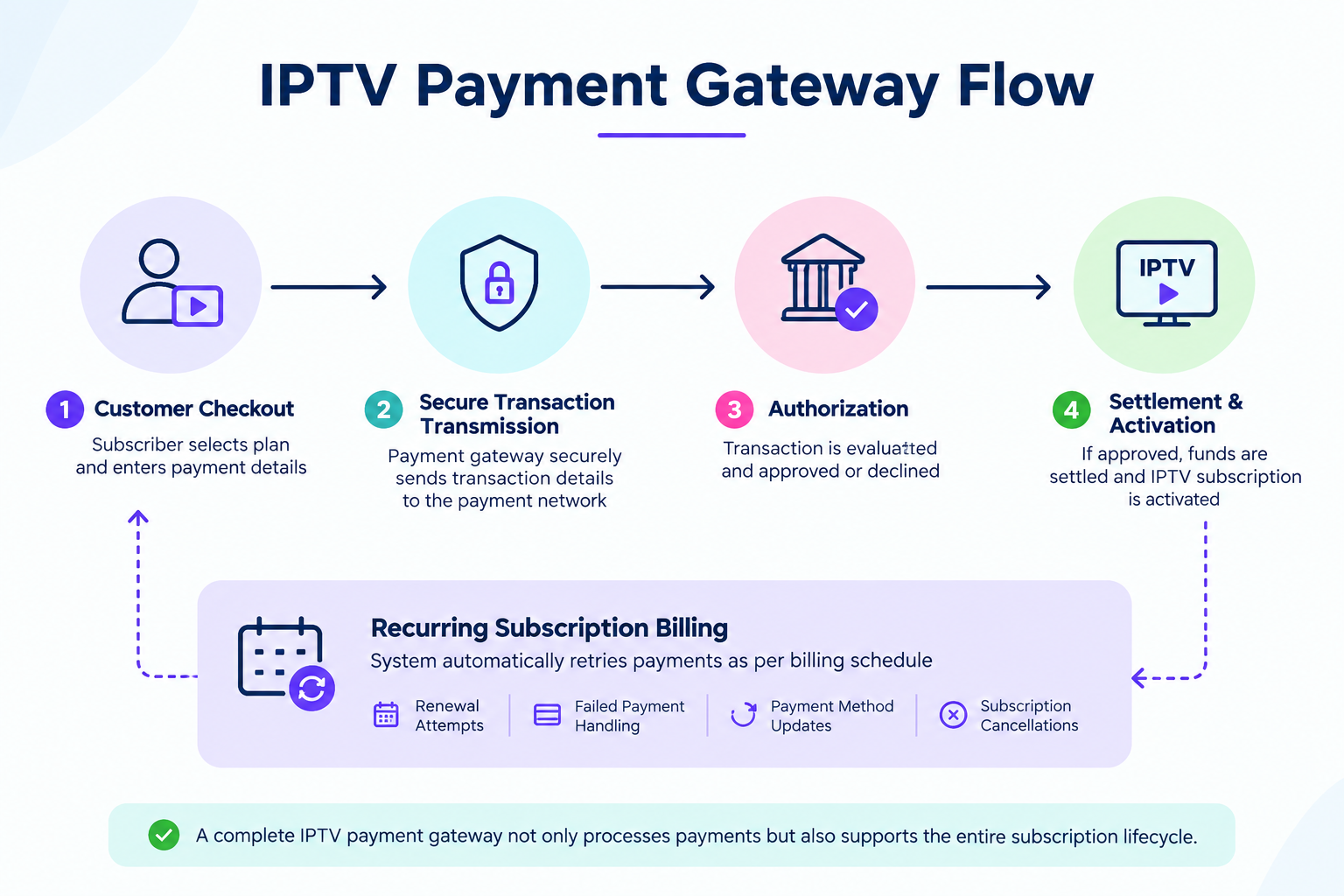
The transaction is then evaluated and either approved or declined. If approved, the customer receives confirmation and the business can activate the subscription according to its service rules. The payment process can be simplified into several connected stages:
- Customer checkout: The subscriber selects a plan and provides payment information.
- Secure transaction transmission: The gateway sends the transaction information through the payment infrastructure.
- Authorization: The transaction is evaluated and an approval or decline is returned.
- Settlement: Once processed, funds are settled to the merchant according to the applicable payment arrangement.
The important part is that the gateway sits within a larger payment ecosystem. A gateway cannot compensate for an unsuitable merchant account, unsupported payment method, issuer decline, or other processing restriction.
Why Do IPTV Businesses Need More Than Basic Payment Acceptance?
A basic payment gateway may be capable of processing a one-time transaction, but IPTV businesses often need considerably more. The reason is the subscription model.
Suppose an IPTV provider has 3,000 subscribers. Processing the first 3,000 payments is only the beginning. The business may need to process another 3,000 renewal transactions the following month, followed by another billing cycle after that. Some customers will renew successfully. Others may have expired cards, insufficient funds, changed payment details, or transactions that are declined for other reasons.
A payment gateway used by an IPTV business therefore needs to work effectively within the broader subscription payment process. The gateway should fit into the business’s billing system so that payment events can be connected to subscription status, customer records, and access management.
Important IPTV Payment Gateway Features
The right features depend on the IPTV business’s size and customer base, but several capabilities are particularly important for subscription-based services.
Recurring Payment Support
Recurring billing is one of the most important considerations for an IPTV payment gateway. A business offering monthly or annual subscriptions needs a system that can handle future payment attempts according to the customer’s billing schedule.
For example, if a customer subscribes on January 10, the system may need to initiate another payment on February 10 and continue the billing cycle until the customer cancels. The business should understand how the gateway handles renewal attempts, failed payments, payment-method updates, and subscription cancellations.
Multiple Payment Methods
Customers do not always want to pay in the same way. Depending on the markets being served and the provider’s capabilities, an IPTV business may consider cards, ACH payments, digital payment methods and wallets, bank-based payment options, and other supported payment methods.
ACH can be particularly relevant for customers who prefer bank-based payments, while digital wallets can provide a faster checkout experience for customers who already use them. The important question is not how many payment methods a gateway advertises. It is whether the available payment methods are appropriate for the IPTV business’s customers and whether they work with its billing model.
Transaction Reporting
Transaction reporting becomes increasingly important as payment volume grows. A business should be able to identify successful payments, failed transactions, refunds, and other payment events without manually checking individual customer accounts.
For example, an IPTV provider with 500 subscribers might be able to investigate failed payments manually. A provider with 20,000 subscribers cannot realistically use the same approach. Detailed transaction information becomes an operational requirement as the business grows.
Payment Security and Customer Data
Because payment gateways handle sensitive transaction information, security is a fundamental consideration.
An IPTV business should understand how payment information is transmitted and protected, what security standards apply to the payment environment, and which party is responsible for different parts of payment security.
Tokenization can also be important for recurring billing. Instead of repeatedly handling the customer’s underlying card information, a payment system can use a token or stored payment credential representation to facilitate future transactions, depending on the payment setup.
For an IPTV business, this can simplify recurring payment workflows while reducing the need for the merchant’s own systems to handle sensitive payment information directly. Security should therefore be evaluated as part of the complete payment architecture rather than treated as an optional gateway feature.
How an IPTV Payment Gateway Handles Failed Payments?
Payment failures are inevitable in subscription businesses. The objective is to understand why payments fail and provide an appropriate recovery process. For example, an IPTV customer’s monthly renewal may fail because their card expired.
A useful payment setup should allow the business to identify the failed transaction and communicate with the customer so that the payment method can be updated. Other failures may occur because the issuing bank declines a transaction, payment information is incorrect, or a transaction triggers a risk control. Different causes require different responses.
This is why transaction status and decline information can be more valuable than simply knowing that a payment “failed.”
IPTV Payment Gateway and Chargeback Management
A payment gateway cannot prevent every chargeback, but the payment infrastructure can support better transaction management. Subscription businesses should maintain clear billing information, accurate customer records, subscription dates, cancellation information, and transaction history.
For example, if a customer disputes a renewal, the business should be able to determine when the subscription started, what plan the customer selected, when the renewal occurred, and whether a cancellation request was received. The gateway and connected payment systems should provide sufficient transaction information to support these operational processes.
How to Choose an IPTV Payment Gateway?
Selecting an IPTV payment gateway should begin with the business model rather than a list of features. A small IPTV provider with a few hundred subscribers may have very different requirements from a platform processing tens of thousands of recurring transactions.
Before choosing a gateway, a business should evaluate:
- Whether recurring subscription payments are supported.
- Which payment methods and customer markets are available.
- How failed transactions and renewals are handled.
- What transaction and settlement reporting is provided.
- How refunds and disputes are managed.
- What integrations are available with the existing website or subscription system.
- Whether the infrastructure can accommodate increasing transaction volume.
Cost should also be evaluated carefully. A gateway with a low advertised transaction fee may not necessarily be the most economical option if it lacks the payment methods, recurring billing capabilities, reporting, or integration features the business actually needs.
Setting Up an IPTV Payment Gateway
Payment gateway setup usually involves connecting the payment infrastructure to the business’s website, checkout, billing system, or subscription platform. The exact implementation depends on the gateway and the technology being used.
Before integration, the merchant generally needs to complete the required business and payment-account approval process. This may include business verification, identity checks, and compliance reviews such as Know Your Customer (KYC) and Anti-Money Laundering (AML) requirements.
KYC and AML procedures help payment providers verify who operates the business, understand the nature of the services being offered, and evaluate the expected transaction activity before enabling payment processing. Depending on the provider, business model, and markets being served, this process may involve reviewing business registration details, ownership information, identification documents, banking information, and other operational details.
Once the required verification and compliance steps are completed, the gateway can be configured according to the supported payment methods, currencies, billing model, and technical requirements.
The business should also test subscription renewals, failed payments, refunds, cancellations, customer notifications, and the way payment status affects subscription access.
A payment system that works during the initial checkout but fails to communicate correctly with the subscription system can create operational problems later.
Choosing the Right Payment Infrastructure for an IPTV Business
An IPTV payment gateway is one component of a much larger payment system. The merchant account determines how the business is established within the payment ecosystem. The processor facilitates transaction processing. The gateway connects the customer’s checkout with that infrastructure. The subscription platform manages billing and customer access.
All of these components need to work together.
For an IPTV business, the right gateway is therefore not necessarily the one with the longest feature list. It is the one that fits the business’s subscription model, customer locations, payment methods, transaction volume, security requirements, and growth plans.
Once the gateway is in place, the next major consideration is recurring billing itself. Understanding how to accept recurring payments for IPTV subscriptions is essential because the long-term success of an IPTV payment system depends on successfully managing not only the first customer payment, but every renewal that follows.

Categories
- ACH Payments (10)
- adult payment processing (11)
- AI (9)
- Altcoins (10)
- Banking (10)
- Bitcoin (133)
- Bitcoin ETF (11)
- Bitcoin Price (30)
- Blockchain (50)
- Brokering World Hunger Away (16)
- Business (17)
- card payment processing (10)
- CBD (11)
- CBDC (11)
- Chargeback (8)
- coaching business (11)
- COVID-19 (3)
- Crypto ATMs (1)
- Crypto Banking (17)
- Crypto Bill (1)
- Crypto business owner platform (31)
- Crypto Investment (3)
- Crypto Markets (5)
- Crypto Payment (35)
- Crypto Payment Processor (4)
- Crypto Prices (1)
- Crypto Trading (92)
- Cryptocurrency (402)
- Cryptocurrency Exchange (108)
- Data Visualization (2)
- dating platforms (11)
- debt collection payment processing (10)
- Decentralized Finance (7)
- DeFi Payment (9)
- DEX (3)
- Digital Currency (23)
- dropshipping payment processing (12)
- Ethereum (2)
- FAQ (7)
- file sharing payment processing (11)
- Finance (25)
- Financial Equality (4)
- Financial Freedom (8)
- Forex (35)
- hemp (1)
- ICO (2)
- Investment (11)
- IPTV (11)
- Merchant Account (10)
- Mining (3)
- News (66)
- NFTs (2)
- online gambling (11)
- P2P (1)
- Paybito (147)
- PayBitoPro (693)
- PayBitoPro Coin Listing (6)
- PayBitoPro Exchange (2)
- Payment Gateway (48)
- peptide (10)
- Post COVID Digital Transformation (1)
- Press Release (130)
- Privacy & Security (3)
- Real Estate (1)
- Stablecoin (5)
- Technology (15)
- Travel (11)
- Uncategorized (10)
- US Presidential Election (2)
- Utility Coin (1)
- Web3 business (4)
- Web3 Wallets (2)
- White Label Crypto Exchange (8)
Recent Posts
- Payment Gateway vs. Payment Orchestration: What’s the Difference?
- What Is Smart Payment Routing? Strategies to Optimize Payment Performance
- How to Improve Payment Approval Rates for High-Risk Businesses?
- Why Are Online Payments Failing? Common Causes and How to Fix Them
- How to Use Multiple Payment Processors to Reduce Business Disruptions?